

How to Choose Reliable Warehouse Cleaning Services
To find reliable warehouse cleaning services, ask each provider for a plan built around your building and shifts. It should name the areas cleaned, how often each task happens, what equipment crews will use, and how they will handle spills without blocking work. Before signing, check insurance, safety training, cleaning logs, and who is responsible when a task is missed.
Start with the busiest areas: loading docks, forklift lanes, and picking aisles. A dependable plan keeps these paths clear and addresses wet or gritty floors promptly. It also makes room for less frequent work, such as cleaning racks and high surfaces.
I’m Ashley Cordova, vice president of Zia Building Maintenance, a family-owned New Mexico janitorial company serving clients since 1989. I oversee daily operations and bring that focus on consistency and accountability to evaluating warehouse cleaning services.
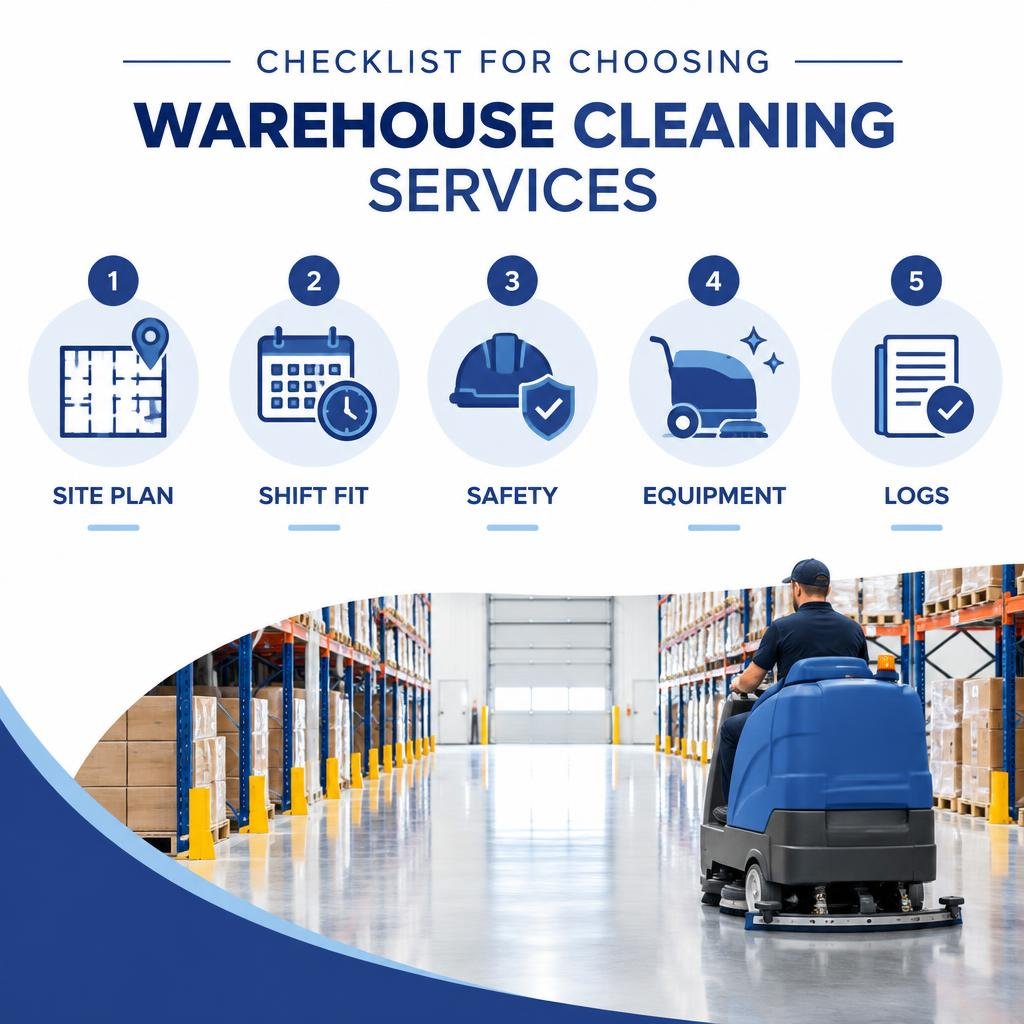
Core Zones and Equipment for Professional Warehouse Cleaning
Industrial warehouse management in 2026 demands far more than basic janitorial upkeep. High-throughput facilities experience constant tire wear, pallet wood splintering, hydraulic fluid drips, and airborne particulate accumulation. Without a structured floor program, grit acts like liquid sandpaper beneath forklift tires, eroding protective slab sealers and dulling safety lines.
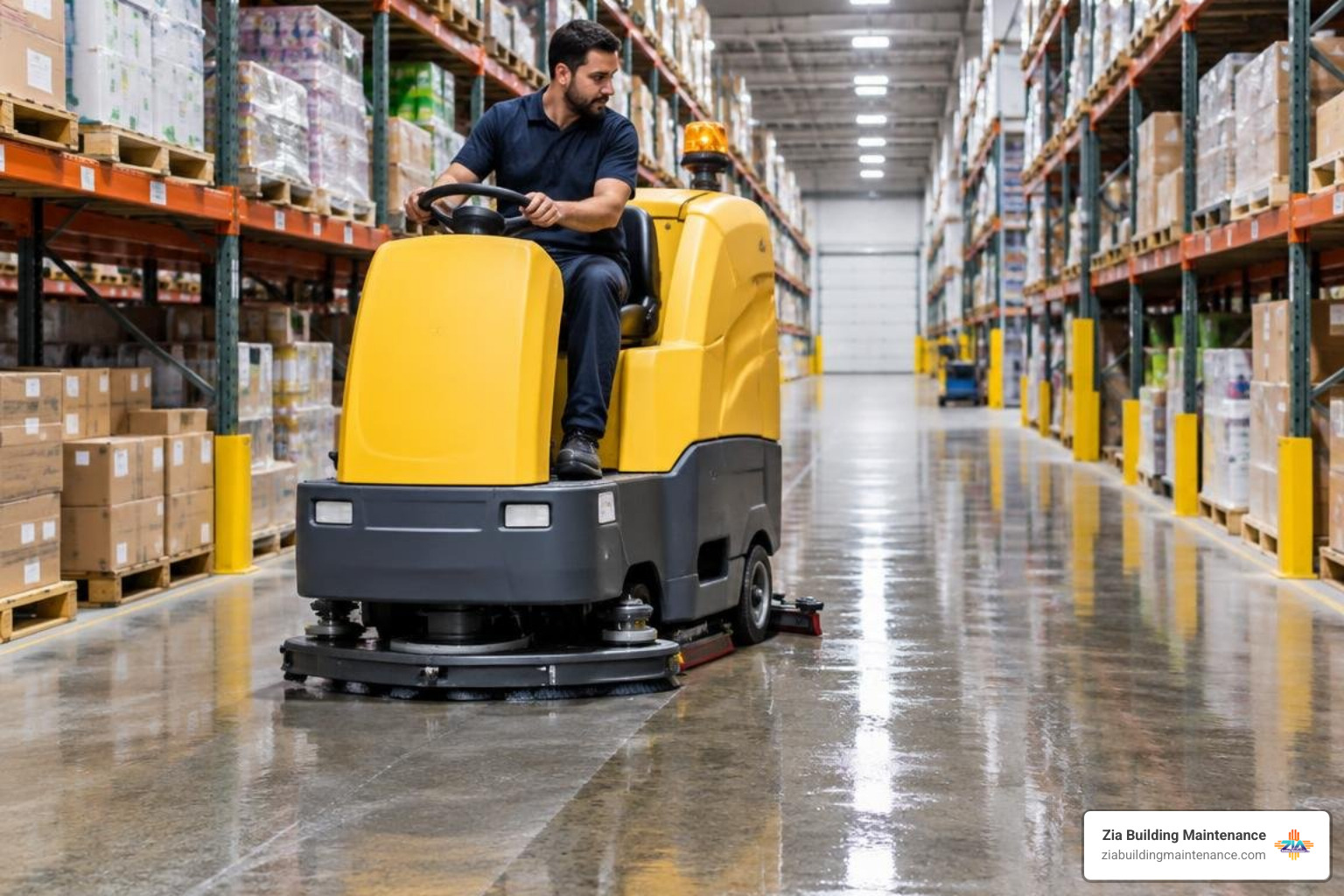
Maintaining these massive facilities requires specialized commercial equipment matched specifically to aisle dimensions and soil loads. Using dedicated warehouse floor cleaning strategies prevents cross-contamination across operational zones and preserves structural concrete.
| Equipment Type | Coverage Rate (Sq Ft / Hr) | Maneuverability & Aisle Width | Ideal Application Fit |
|---|---|---|---|
| Walk-Behind Scrubber | 10,000 – 18,000 | High; fits narrow aisles (<8 ft) | Staging pockets, mezzanines, tight rack runs |
| Ride-On Scrubber (48″) | 25,000 – 35,000 (Live picking) | Moderate; requires aisles ≥10–12 ft | Main haul paths, cross-dock aprons, bulk staging |
| Sweeper-Scrubber Combo | 30,000 – 45,000 | Moderate; best in open avenues | High-debris receiving zones, pallet breakdown areas |
| Industrial HEPA Vacuum | N/A (Spot / Zone-based) | High; portable canister / backpack | Overhead racking, conduit, pallet rack footings |
Selecting the right machine is only half the equation. Active distribution facilities must pair mechanical action with advanced chemistry. Low-foam autoscrubber detergents with a dilution profile of 1:128 to 1:200 allow rapid recovery without blinding suction squeegees. Furthermore, fast-dry formulations engineered for ambient slab temperatures ensure cleaned travel paths dry in 3 to 5 minutes, preventing dangerous moisture transfer into active picking aisles. Reviewing our quick start guide for commercial warehouse floor cleaning offers practical initial steps for designing your machine passes.
High-Risk Zones: Loading Docks, Active Slabs, and Racking
Loading docks represent the primary contamination gateway of any industrial facility. Road grit, rain, tire residue, and exhaust soot continuously enter through open roll-up doors. Dock leveler pits accumulate discarded stretch wrap, plastic banding, and broken pallet fragments, creating severe mechanical and pest hazards if left unattended.
Cross-dock staging areas experience intense forklift braking and turning, leaving heavy black tire scuffs and slick rubber layers. Degreasing these zones using specialized concrete detergents restores the slab’s static coefficient of friction. In areas where heavy oils or fluids compromise traction, addressing dirty floors immediately prevents slip-and-fall injuries and keeps travel corridors safe.
Machinery Selection: Ride-On Scrubbers, Sweepers, and HEPA Vacuums
Deploying a 48-inch disk-brush ride-on scrubber delivers exceptional theoretical coverage—upwards of 40,000 to 50,000 square feet per hour under clear conditions. However, in live logistics environments with active picker traffic, realistic net throughput stabilizes between 25,000 and 35,000 square feet per hour.

Facility operators should prioritize cylindrical scrubbers or sweeper-scrubber combination units when handling dry wood chips and strapping fragments, eliminating the need for separate manual broom passes. Selecting the proper machinery and maintenance routine requires understanding effective floor cleaning methods so that squeegees leave zero water streaks behind.
Watch Warehouse Cleaning and Industrial Floor Maintenance for a visual overview of maintaining concrete slabs, loading docks, and high-rack storage.
Ready to upgrade your industrial facility maintenance? Contact our team today for a free site assessment and tailored cleaning proposal.
Operational Scheduling Around Shifts, Seasonality, and Automation
High-volume fulfillment facilities operate on relentless 24/7 schedules. Stopping operations for comprehensive housekeeping is rarely an option. Instead, successful operations rely on structured, zone-based cleaning matrices scheduled around shift changeovers, low-velocity pick windows, and planned equipment maintenance windows.
To establish predictable intervals that keep facilities safe without slowing fulfillment, operations teams reference frameworks like 24/7 Warehouse Cleaning Schedules | Opora alongside comprehensive internal warehouse dust control protocols.
Integrating Warehouse Cleaning into 24/7 Operations
Cleaning in an active logistics hub requires strict traffic control. When maintenance teams service long storage corridors, they utilize staggered half-aisle maintenance. By cleaning one side of an aisle while leaving a wide, bone-dry lane open for equipment, material handling operations continue safely.
All sanitation crews must wear high-visibility Class 2 or Class 3 PPE and complete site-specific Powered Industrial Truck (PIT) safety inductions. Furthermore, relying on a single wet-floor cone is inadequate in large distribution centers; crews must position high-visibility warning gates and dual-ended signage at every cross-aisle intersection until the slab is completely dry. Many facilities choose to schedule overnight janitorial services to execute deep mechanical scrubs when pallet movement reaches its baseline low.
Dust Control for Automated Guided Vehicles and Robotics
As automated guided vehicles (AGVs) and autonomous mobile robots (AMRs) become standard in modern warehousing, dust control shifts from an aesthetic goal to a strict operational necessity. Fine packaging dust settles over LiDAR lenses, optical navigation reflectors, and ground-facing floor sensors.
Dust on robot sensors? Even the bots need a spa day! When optical pathways cloud over, automated vehicles trigger false obstacle stops, slowing automated fulfillment lines. Regularly implementing industrial dust control along AGV guideways removes micro-particulate before it clouds equipment sensors, cuts off conveyor photo-eyes, or jams sorting rollers. Consistent mechanical pre-sweeping ensures autonomous machines run without interruption.
Regulatory Compliance, OSHA Housekeeping, and Safety Audits
Warehouse housekeeping is an active regulatory compliance mandate under federal and state law. According to the U.S. Bureau of Labor Statistics, warehousing and storage facilities experience an injury rate of roughly 4.8 nonfatal injuries per 100 full-time workers—nearly double the 2.4 private-sector average. Slips, trips, and falls remain the single largest contributor to lost-time accidents in industrial spaces.
A structured cleaning program delivers measurable safety dividends. In fact, a national retailer achieved a 25% reduction in employee slip-and-fall incidents after implementing an audit-backed cleaning schedule. Understanding the role of cleaning in workplace safety helps facility leads design programs that protect teams and eliminate citations, supported by proactive guidance on preventing slips, falls, and trips in the workplace.
OSHA 29 CFR 1910.22 and Walking-Working Surface Standards
OSHA standard 29 CFR 1910.22 mandates that all walking-working surfaces, passageways, and service rooms be maintained in a clean, orderly, and sanitary condition. Floors must remain dry and hazard-free, with prompt drainage and documented spill responses for wet processes. Additionally, 29 CFR 1910.176(c) requires storage areas to remain free from accumulations that could create tripping, fire, explosion, or pest harborage risks.
Inspectors readily document housekeeping infractions because physical evidence sits in plain sight. Unmarked oil slicks, discarded stretch wrap in main lanes, and blocked emergency exit doors trigger citations under OSHA’s General Duty Clause. Conducting a routine commercial property cleaning audit ensures digital cleaning logs, Safety Data Sheet (SDS) binders, and emergency egress corridors remain fully compliant and audit-ready.
How Pre-Inventory Warehouse Cleaning Protects Accuracy
Annual and quarterly inventory cycles require precise barcode scanning and high-speed cycle counting. Fine corrugate particulate settling on shelf faces and racking beams obscures 1D and 2D barcodes, causing handheld RF scanners to misread or fail entirely.
A thorough pre-inventory deep clean clears accumulated grime from upper rack levels, cleans scanning surfaces, and ensures stock numbers match tracking systems. Furthermore, integrating routine cleaning supports compliance during third-party facility assessments, as outlined in our overview of cleaning during building inspections.
Managing Specialized Warehouse Areas: Cold Storage and High Bays
Specialized zones require custom sanitation methods, specialized chemistry, and targeted safety equipment to protect inventory and infrastructure.
Low-Temperature and Cold Storage Protocols
Cleaning refrigerated and sub-zero freezer storage environments presents unique thermal challenges. Standard water-based detergents freeze instantly on contact with sub-zero slabs, creating treacherous ice sheets.
Specialized low-temperature chemical solutions with freezing points down to -20°F are required to lift grease and sanitation soil without freezing. Condensation management around rapid-roll freezer doors is essential to prevent overhead frost formations that can fall onto travel paths. Documenting these specialized cycles using QR-coded digital checklists verifies that temperature-sensitive cold chain environments meet FDA FSMA 21 CFR Part 117 cGMP sanitation standards, reinforcing what is included in deep commercial cleaning.
Overhead Dusting and Combustible Particulate Control
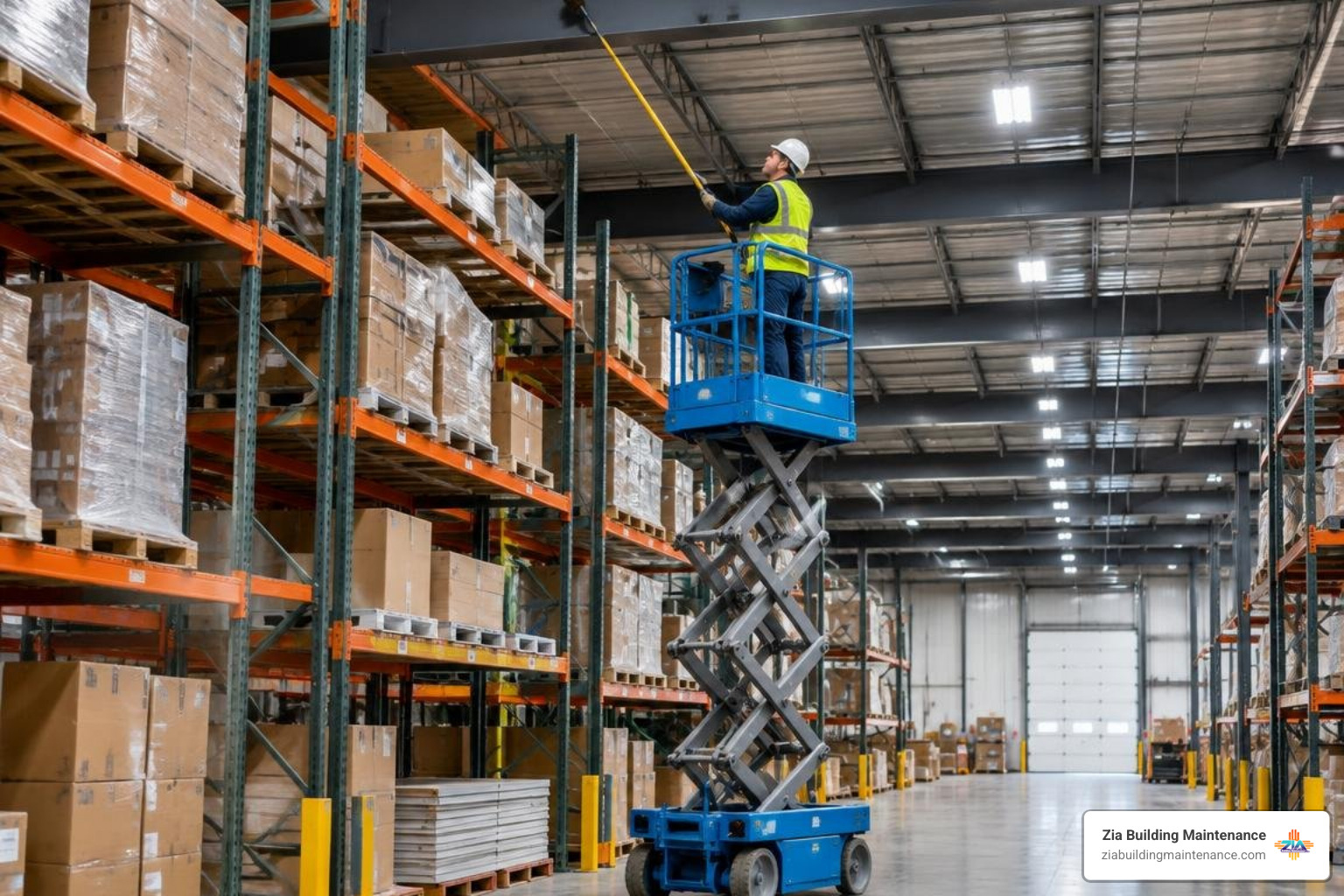
Overhead structural members—including bar joists, HVAC ductwork, light fixtures, and high-rack beam steps—accumulate massive volumes of fine airborne particulate. In distribution facilities handling corrugate, paper packaging, wood pallets, or dry goods, this settled matter represents combustible dust governed by NFPA 660 standards.
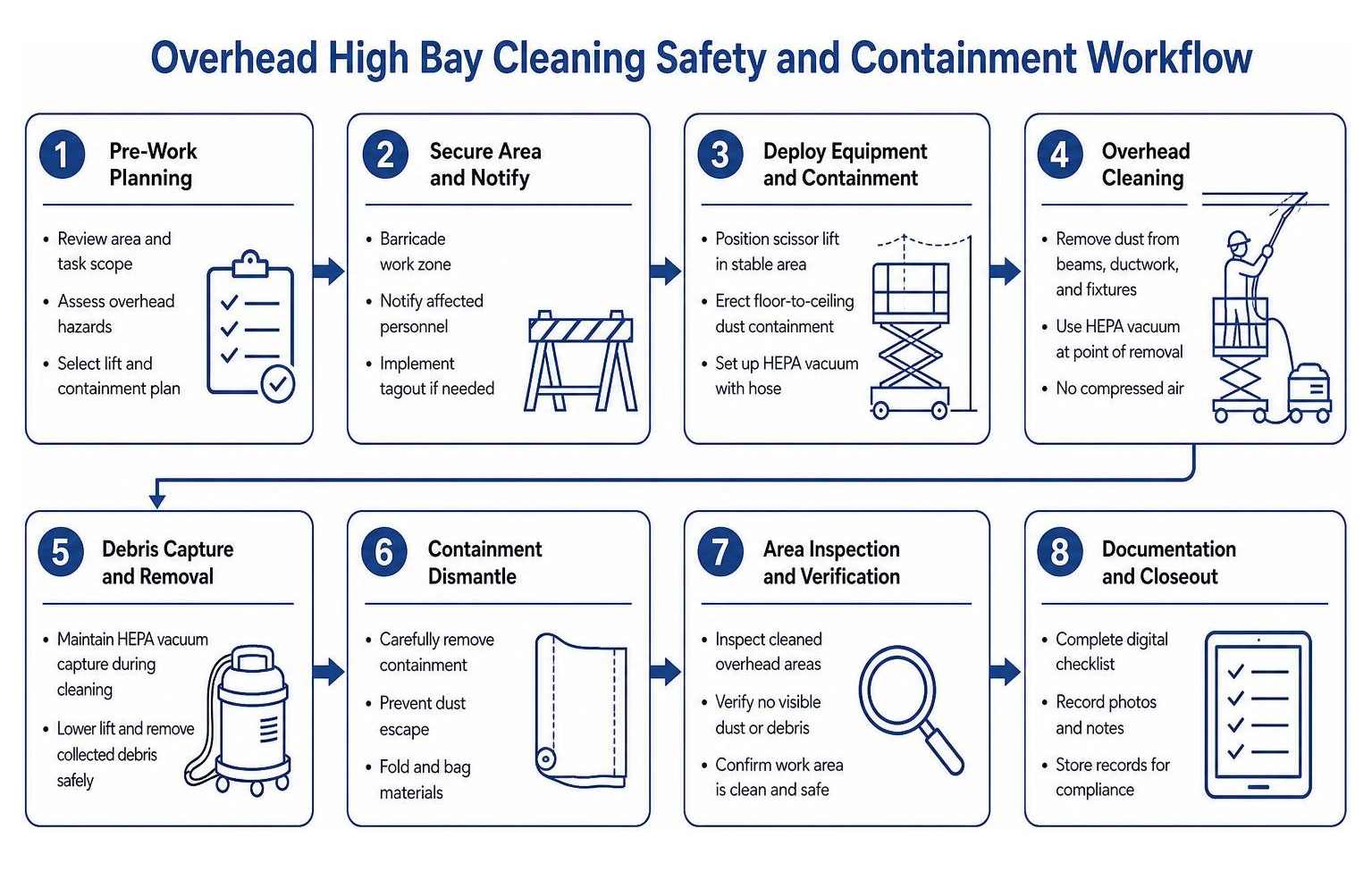
Using compressed air to blow down high beams is extremely dangerous because it suspends combustible dust into explosive airborne clouds and settles debris across lower inventory. Instead, certified cleaning crews use scissor lifts and explosion-proof industrial HEPA vacuums. Facility managers who prioritize dusting high ceilings and overhead structures protect their facilities from fire hazards, optimize fixture light levels, and follow established anti-dust guidelines to maintain clean overhead air space.
Discover how our tailored industrial cleaning packages protect your facility assets. Learn more about our services today.
Vetting and Managing Commercial Cleaning Vendors
Deciding between staffing an internal cleaning crew or hiring an outsourced industrial cleaning contractor impacts capital allocation, equipment maintenance liability, and compliance management.
| Evaluation Metric | In-House Cleaning Program | Contracted Commercial Cleaning Partner |
|---|---|---|
| Capital Expenditure | High ($15k–$60k+ per scrubber/sweeper) | Zero equipment purchase or maintenance costs |
| Labor & Turnover | Direct recruiting, wages, benefits, sick leave | Managed contractor staffing, backup coverage |
| PIT Safety & Training | In-house safety training & OSHA compliance | Pre-certified, insured, and safety-inducted crews |
| Chemical & SDS Tracking | Direct purchasing, dilution management, SDS | Fully managed OSHA HAZCOM & SDS records |
| Audit-Ready Documentation | Manual internal tracking logs | Automated, time-stamped digital compliance reporting |
Managing industrial cleaning successfully requires clear metrics and verified operating scopes. Operations managers can use our cleaning vendor evaluation checklist and understand why cleaning vendor vetting matters to ensure vendor capabilities align with operational demands.
Key Criteria: Insurance, Equipment, and Compliance Tracking
When vetting industrial cleaning partners, verify commercial liability coverage (minimum $2M to $5M umbrella), active workers’ compensation policies, and equipment maintenance schedules. In one facility study, tracking vendor diagnostics and pre-service reporting helped operations cut annual facility maintenance expenses by 12%. Knowing what to look for in a janitorial company ensures your contractor maintains equipment reliability and shift accountability.
Avoiding Common Housekeeping Pitfalls and Costly Downtime
One of the costliest mistakes in warehouse housekeeping is using improper, high-foaming detergents in autoscrubbers. Excess foam bypasses vacuum shut-off floats, burning out expensive suction motors and leaving dirty wash water on the slab.
Another operational error is neglecting pre-shift forklift and scrubber inspections. In one industrial facility, forklift downtime dropped by 20% after implementing structured pre-shift equipment checks. Avoiding common red flags when choosing a facility maintenance partner helps operations teams partner with contractors who respect industrial safety protocols.
Frequently Asked Questions About Warehouse Cleaning
How often should warehouse concrete floors be machine scrubbed?
Main travel lanes, dock approaches, and battery charging areas should be swept and machine-scrubbed daily to prevent tire marks, dust spread, and slip hazards. Lower-traffic storage aisles and secondary corridors typically require autoscrubbing 1 to 2 times per week. Facilities with heavy soil loads or food-grade storage scale wet scrubbing to 3 to 5 passes per week, as detailed in our guide on cleaning frequency.
What are the most common OSHA warehouse housekeeping violations?
The most frequent OSHA violations under 29 CFR 1910.22 and 1910.176(c) include:
- Blocked fire exit doors, electrical panels, or eyewash stations due to staging overflow.
- Unmarked wet floor zones or untreated oil slicks along forklift lanes.
- Excessive accumulations of combustible packaging dust on overhead building structures.
- Pallet debris, banding, and ground clutter obstructing marked pedestrian paths.
Why is dry sweeping discouraged in high-dust logistics facilities?
Dry broom sweeping pushes fine settled dust back into the facility air, where it remains suspended for hours. This airborne dust settles onto inventory, clouds barcode scanners, clogs sensitive automation optical sensors, and creates respiratory hazards for employees. Logistics facilities should always utilize vacuum-assisted mechanical sweepers equipped with HEPA filtration or wet autoscrubbers to trap and remove particulate.
Conclusion
A well-maintained warehouse is fundamental to operational productivity, regulatory compliance, and worker safety. Preventing slips, trips, and falls while protecting the structural concrete slab requires an organized, zone-based cleaning strategy supported by modern scrubbing machinery, safe chemistry, and verified documentation.
For warehouse operators across Albuquerque, Rio Rancho, Corrales, and Los Ranchos, partnering with an experienced, family-owned janitorial specialist ensures your logistics space remains spotless, audit-ready, and efficient around the clock. Discover how you can keep industrial slabs spotless and book your tailored warehouse floor cleaning assessment with Zia Building Maintenance today.