

TL;DR:
- Office cleaning schedules should match office size, usage, and industry regulations to maintain hygiene and save costs. A zone-based hybrid approach adjusts cleaning frequency for high-traffic and low-traffic areas, reducing expenses by up to 30%. Regular review and digital tracking improve hygiene standards and prevent resource waste.
Office cleaning frequency refers to how often different areas within a workspace require professional cleaning to maintain hygiene, health, and productivity. The right schedule depends on office size, foot traffic, employee headcount, and industry regulations. A one-size-fits-all approach fails most workplaces. Smaller offices with 1–10 staff need cleaning once or twice a week, while large offices with 50 or more employees require daily professional cleaning. Zia Building Maintenance has served Albuquerque businesses since 1989, and the single most consistent finding across that experience is this: offices that match cleaning frequency to actual usage spend less and stay healthier.
What factors determine how often office areas should be cleaned?
Office size and employee headcount are the two most direct drivers of cleaning frequency. Industry standard tiers show that small offices with 1–10 staff need cleaning once or twice a week, mid-size offices with 10–50 staff need cleaning two to three times a week, and large offices with 50 or more staff need daily service. Each tier reflects the rate at which surfaces accumulate bacteria, dust, and debris under normal use.
Foot traffic amplifies that baseline. A client-facing reception area in a 20-person office sees more contact per square foot than a private executive suite in a 100-person building. High-traffic zones, including lobbies, restrooms, break rooms, and shared workstations, need more frequent attention regardless of total headcount. Regulated industries raise the bar further. Medical offices, dental practices, and food-related businesses face daily sanitation requirements for high-touch surfaces as a regulatory baseline, not a preference.
Industry type also shapes which tasks are non-negotiable. A medical office must meet OSHA and HIPAA standards for surface disinfection. A standard corporate office does not face those mandates but still carries legal duty-of-care obligations for employee health. Understanding your industry’s floor sets the minimum; actual usage determines how far above that minimum your schedule should sit.
Zone-based cleaning is the practical answer to these variables. Rather than applying the same frequency to every room, facility managers divide the office into zones by usage intensity: high-touch, moderate-traffic, and low-traffic. Each zone gets a frequency that matches its actual demand. This approach prevents both over-servicing quiet areas and under-servicing busy ones.
Scheduling windows matter too. Professional cleaners typically require after-hours access, commonly between 6 PM and midnight, to work without disrupting staff. Day porters can provide midday touch-ups in very high-traffic offices, though that adds cost. Building that cost into the schedule upfront prevents reactive spending later.
- Small offices (1–10 staff): 1–2 times per week covers routine hygiene needs.
- Mid-size offices (10–50 staff): 2–3 times per week for workstations and shared areas.
- Large offices (50+ staff): Daily cleaning for all shared zones.
- Client-facing lobbies and reception areas: Daily regardless of total headcount.
- Regulated industries (medical, dental, food service): Daily disinfection of high-touch surfaces as a compliance requirement.
Pro Tip: Track actual room usage with sign-in logs or occupancy sensors for one month before setting your cleaning schedule. Real data prevents you from paying for daily service in rooms that see three visitors a week.
How does a hybrid office cleaning schedule optimize hygiene and cost?
A hybrid cleaning schedule applies different frequencies to different zones based on actual usage. High-touch areas like restrooms, kitchens, and reception desks get daily cleaning. Workstations and circulation areas get service two to three times per week. Private offices and low-traffic conference rooms get weekly cleaning. This structure matches resources to real demand rather than applying a flat rate across the entire floor plan.
The financial case for hybrid scheduling is clear. Zone-based hybrid cleaning reduces costs by 20–30% compared to uniform daily service, without compromising hygiene standards. That savings comes from reallocating labor hours away from areas that do not need daily attention. For a mid-size office, that difference can represent a meaningful annual budget reduction.
| Factor | Uniform daily cleaning | Hybrid frequency cleaning |
|---|---|---|
| Cost | Higher, flat rate applied everywhere | 20–30% lower through zone-based allocation |
| Hygiene in high-touch areas | Consistent | Consistent (daily for high-touch zones) |
| Hygiene in low-traffic areas | Over-serviced | Appropriate frequency, no waste |
| Asset longevity | Good | Equal or better due to targeted care |
| Schedule flexibility | Low | High, adjustable by zone |
Uniform daily cleaning carries two risks that office managers often overlook. Over-servicing low-traffic areas wastes budget and increases chemical wear on surfaces and carpets. Under-servicing high-touch zones, which happens when budget pressure forces a flat reduction, creates genuine hygiene gaps. Reactive cleaning undermines facility hygiene and increases long-term maintenance costs. A hybrid model avoids both failure modes by design.
Daily sanitization of high-touch shared workstations reduces germ transmission, improves staff morale, and extends the lifespan of furniture and carpet. These are not soft benefits. Reduced sick days translate directly to productivity. Longer asset life reduces capital replacement costs. The cleaning schedule is a financial instrument, not just a hygiene checklist.
Pro Tip: Map your office into three zones before your next contract renewal: daily, twice-weekly, and weekly. Share that map with your cleaning provider and ask for zone-specific pricing. Most providers will adjust, and you will see immediate cost clarity.
What are the common office cleaning tasks and their recommended intervals?
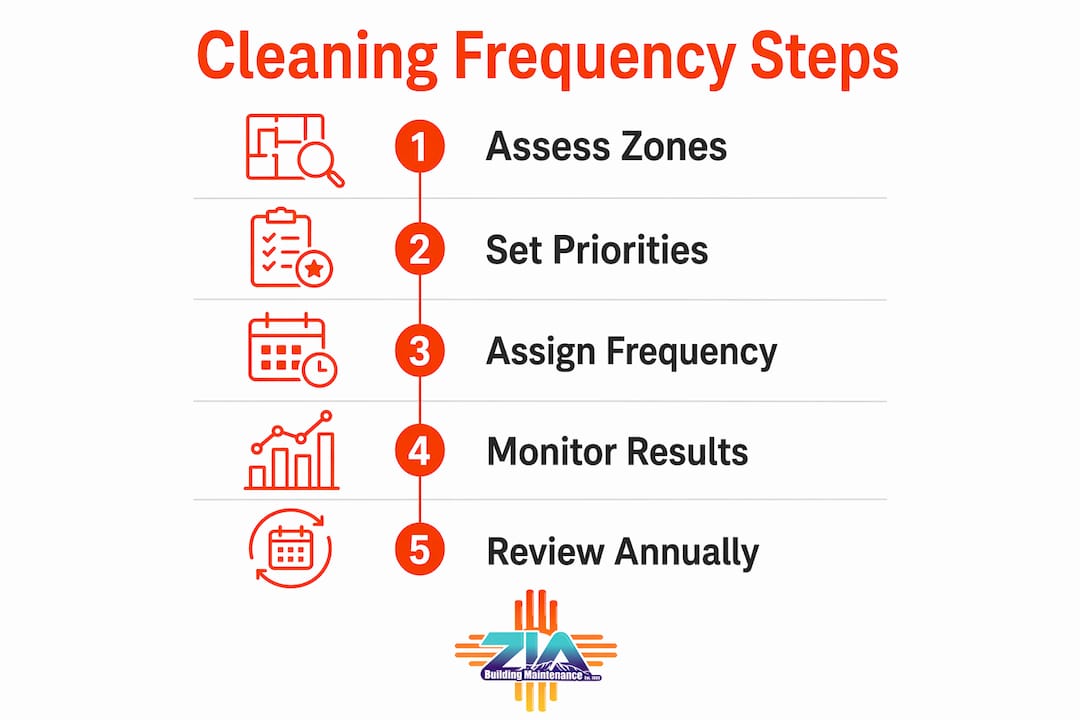
A well-structured office cleaning checklist organizes tasks by frequency: daily, weekly, and monthly or quarterly. Each tier serves a different hygiene function. Daily tasks prevent the rapid buildup of bacteria and waste. Weekly tasks address dust, allergens, and surface grime that accumulate over several days. Monthly and quarterly tasks protect building systems and deep-clean materials that daily service cannot reach.
Daily tasks
- Empty all waste bins and replace liners.
- Disinfect high-touch surfaces: door handles, light switches, elevator buttons, shared keyboards, and countertops.
- Clean and restock restrooms: soap, paper towels, toilet paper, and surface disinfection.
- Wipe down kitchen and break room surfaces, including appliance exteriors.
- Spot-clean glass entry doors and reception desks.
Weekly tasks
- Vacuum all carpeted areas and rugs.
- Dust workstation surfaces, shelving, and window sills.
- Mop hard floors with an appropriate cleaning solution.
- Clean interior glass partitions and mirrors.
- Wipe down conference room chairs and table surfaces.
Monthly and quarterly tasks
HVAC filters should be checked every 30–90 days and replaced on a schedule appropriate to the building’s air quality demands. Deep carpet extraction should occur quarterly or as needed based on traffic. Floor refinishing and stripping for hard floors typically falls on an annual or semi-annual cycle. These tasks protect indoor air quality and extend the life of flooring and HVAC systems.
| Area | Daily | Weekly | Monthly or quarterly |
|---|---|---|---|
| Restrooms | Full clean and restock | Deep scrub grout and fixtures | Inspect ventilation and drains |
| Reception and lobby | Disinfect surfaces, vacuum | Full floor clean | Deep carpet extraction |
| Open office workstations | Disinfect high-touch points | Vacuum and dust | Monitor air vents |
| Break room and kitchen | Wipe surfaces, empty bins | Clean appliance interiors | Deep clean refrigerator |
| Conference rooms | Spot clean after use | Full wipe-down and vacuum | Floor refinishing as needed |
| HVAC system | N/A | N/A | Filter check every 30–90 days |
The break room and restrooms carry the highest bacterial load in any office. Skipping daily service in these areas, even once, allows contamination to spread to other zones through hand contact. Treating these areas as non-negotiable daily tasks is the single most effective hygiene decision an office manager can make.
How should office managers adjust cleaning frequency over time?
Cleaning frequency should be reviewed at least annually to reflect changes in building usage, hybrid work patterns, and headcount. A schedule built for 60 daily employees becomes wasteful if the office now runs at 30 people on a hybrid model. Fixed schedules cause budget waste or hygiene gaps when not updated to match reality.
Hybrid work has changed occupancy patterns significantly. Many offices now see peak attendance on Tuesday, Wednesday, and Thursday, with lighter use on Monday and Friday. Adjusting cleaning intensity to match those peaks, rather than applying flat daily service all week, is a direct cost reduction with no hygiene trade-off. Your cleaning provider should be able to accommodate day-specific scheduling.
Logging cleaning completions by zone enables supervisors to identify recurring hygiene failures and adjust labor allocation based on actual demand. Digital task logs, whether through a facility management app or a simple shared checklist, create accountability and a paper trail. That documentation also protects the business if a health or safety complaint arises.
- Annual schedule review: Reassess headcount, occupancy patterns, and zone usage every 12 months.
- Hybrid work adjustment: Align cleaning intensity with peak attendance days rather than a flat weekly rate.
- Day porter service: Add midday touch-ups for very high-traffic offices where daily after-hours service is not enough.
- Digital logging: Track task completion by zone to catch recurring gaps before they become hygiene problems.
- Seasonal adjustments: Increase frequency during flu season or after high-attendance events.
Pro Tip: Ask your cleaning provider for a monthly completion report by zone. If the same area shows repeated incomplete tasks, that is a scheduling problem, not a one-off miss. Address it in writing and adjust the contract accordingly.
Key takeaways
A hybrid cleaning schedule, calibrated by zone and reviewed annually, delivers the best balance of hygiene, cost control, and asset protection for most office environments.
| Point | Details |
|---|---|
| Frequency by headcount | Small offices need 1–2 cleanings per week; large offices with 50+ staff need daily service. |
| Hybrid scheduling saves money | Zone-based hybrid schedules reduce cleaning costs by 20–30% without lowering hygiene standards. |
| Daily tasks are non-negotiable | Restrooms, kitchens, and high-touch surfaces must be cleaned daily to prevent germ transmission. |
| Annual schedule review | Cleaning frequency should be reassessed every year to reflect headcount and occupancy changes. |
| Digital logging improves accountability | Tracking task completion by zone identifies recurring gaps and supports dynamic labor allocation. |
What I have learned from years of watching offices get their schedules wrong
The most common mistake I see is treating the cleaning schedule as a set-and-forget contract item. An office manager signs a daily cleaning agreement, headcount drops by a third two years later, and the same schedule runs unchanged. The business overpays, the cleaning crew services empty rooms, and nobody notices until the budget review. That is not a cleaning problem. It is a management problem.
The second mistake is cutting frequency across the board when budgets tighten. Reducing daily restroom cleaning to save money is the kind of decision that looks reasonable on a spreadsheet and creates a real health problem within two weeks. The right cut is always in low-traffic zones, never in high-touch shared spaces. Zone-based thinking protects you from making that error.
I also see offices skip digital task logging because it feels like extra administrative work. In practice, a simple zone-by-zone completion log takes minutes to maintain and gives you real leverage in vendor conversations. When you can show a provider exactly which zones were missed and on which dates, the conversation changes from subjective to factual. That accountability benefits everyone.
Cleaning is a health and safety investment. The offices that treat it as a line item to minimize are the same ones that deal with higher absenteeism, faster furniture wear, and periodic hygiene complaints. The offices that treat it as an operational asset, reviewed regularly and matched to actual usage, consistently get better outcomes at lower long-term cost. That pattern holds whether the office has 10 people or 500.
— Ashley
Zia Building Maintenance: office cleaning built around your schedule
Zia Building Maintenance has provided commercial cleaning in Albuquerque since 1989, earning the title of the #1 office cleaning service in South Valley for 2025. Every client gets a schedule built around their actual office zones, headcount, and industry requirements, not a generic package.
Whether you manage a small professional office or a large multi-floor facility, Zia Building Maintenance builds a cleaning plan that matches your usage patterns and budget. From daily high-touch disinfection to quarterly deep cleaning, every task is logged and verified. Explore professional office cleaning solutions in Albuquerque, or review the manager’s guide to cleaning frequency to see how a tailored schedule compares to what you have now. Contact Zia Building Maintenance to request an estimate.
FAQ
How often should a standard office be professionally cleaned?
Most offices with 10–50 employees need professional cleaning two to three times per week. Offices with 50 or more employees, or those with client-facing areas, require daily service.
What is a hybrid office cleaning schedule?
A hybrid schedule applies daily cleaning to high-touch zones like restrooms and kitchens, two to three times weekly to workstations, and weekly to private offices and low-traffic rooms. This structure reduces costs by 20–30% compared to uniform daily cleaning.
Which office areas need daily cleaning?
Restrooms, break rooms, reception desks, and any shared high-touch surfaces require daily cleaning. These areas carry the highest bacterial load and spread contamination fastest through hand contact.
How often should HVAC filters be checked in an office?
HVAC filters should be checked every 30–90 days and replaced on a schedule based on the building’s air quality demands. Neglecting this task degrades indoor air quality and increases HVAC maintenance costs.
When should an office manager review the cleaning schedule?
Cleaning frequency should be reviewed at least once a year. Any significant change in headcount, hybrid work patterns, or office layout is also a trigger for reassessment to avoid overspending or hygiene gaps.