

What Is a Grout Residue Cleaner — and Which One Do You Need?
A grout residue cleaner is a product designed to remove the filmy haze, hardened deposits, or sticky film that grout leaves behind on tile surfaces after installation.
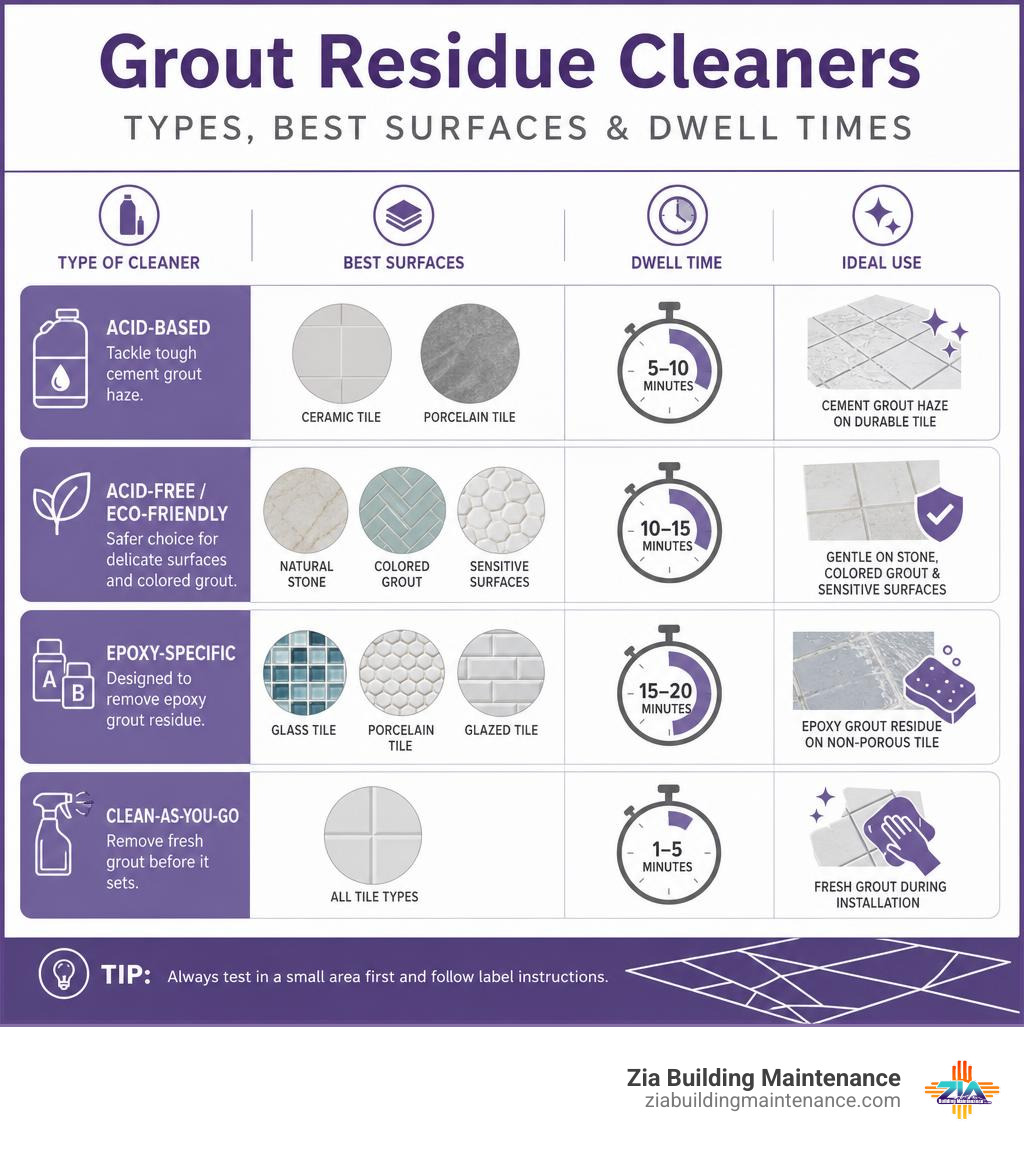
Here are the main types, at a glance:
| Cleaner Type | Best For | Example Products |
|---|---|---|
| Acid-based | Cement grout haze on ceramic/porcelain | Zep Grout Cleaner & Brightener |
| Acid-free / eco-friendly | Colored grout, natural stone, sensitive surfaces | Aqua Mix Grout Haze Clean-Up |
| Epoxy-specific | Epoxy grout residue on porcelain, glass, glazed tile | FILA CR10 |
| Clean-as-you-go | Fresh grout during active installation | FILA Instant Remover |
If you’ve ever finished a tile installation — or managed a facility that just had new tile laid — you know the frustration. The tiles looked perfect going in. Then the grout dried, and suddenly everything looks dull, streaky, and coated in a white film. That’s grout haze. It forms when fine particles from cementitious or epoxy grout dry on the tile surface before they’re fully cleaned away. Left untreated, it can make even brand-new tile look dirty and worn.
The good news: the right grout residue cleaner cuts through that haze quickly — often in as little as 10 minutes — without damaging your tile or grout.
I’m Ashley Cordova, Vice President of Zia Building Maintenance, a family-owned janitorial company serving New Mexico since 1989, and dealing with grout residue cleaner selection is something our team handles regularly across commercial facilities throughout Albuquerque. In this guide, I’ll break down exactly which products work, on which surfaces, and how to use them safely.
Understanding Grout Haze and Why It Forms

To choose the right grout residue cleaner, we first need to understand what we are fighting. Grout haze is not just “dirt.” It is a microscopic layer of binder materials left behind after the grouting process.
When tiles are installed, grout is spread across the entire surface to fill the joints. The installer then wipes the tiles down with a damp sponge. However, as the water evaporates during the curing process, it leaves behind a fine, powdery residue.
If you are dealing with traditional cementitious grout, this haze consists of Portland cement and mineral pigments. When latex additives are mixed in to give the grout flexibility and water resistance, they form a stubborn latex film that binds the cement particles directly to the face of the tile. If you wait too long to clean it, those cement particles fully hydrate and lock onto the surface, requiring chemical intervention to dissolve.
If you are dealing with epoxy grout, the haze is made of tough epoxy resins. This is a completely different beast that does not dissolve with standard acids and requires specialized solvents to break down the plastic-like bond.
Leaving this residue untreated is a recipe for long-term headache. Over time, the rough texture of the haze acts like Velcro, trapping everyday dirt, grease, and foot-traffic grime. If you want to dive deeper into restoring older, heavily soiled tiled floors to their original glory, check out our More info about professional tile restoration.
Choosing the Right Grout Residue Cleaner for Your Tile Type
Before you grab a bottle of cleaner and start scrubbing, you must identify your tile material. Using the wrong chemical can permanently ruin your expensive flooring.
- Ceramic and Porcelain: These fired-clay tiles are incredibly dense and highly resistant to acids. They can safely handle almost any standard acidic or alkaline grout residue cleaner.
- Natural Stone (Marble, Limestone, Travertine, Slate): Natural stones contain calcium carbonate, which reacts violently with acids. Using an acidic cleaner on these surfaces will cause “etching”—a chemical burn that permanently dulls the polished finish. For these materials, you must use a specialized, non-acidic, or alkaline-based haze remover.
- Glass Mosaic: Glass is generally chemical-resistant but can scratch easily. It requires non-abrasive liquid formulations.
If you are looking for gentle, everyday maintenance alternatives rather than heavy-duty post-construction cleanup, you can read our guide on DIY natural tile cleaning alternatives.
When to Use an Acid-Based Grout Residue Cleaner
For traditional cement-based grouts on acid-resistant tiles like ceramic or porcelain, acid-based cleaners are the industry standard. They work by chemically dissolving the alkaline cement minerals, breaking their bond with the tile surface.
A highly popular commercial choice is Zep Grout Cleaner & Brightener – 32 oz – Zep Inc. . This professional-strength acidic formula penetrates deep into the pores to lift stubborn cement deposits with minimal scrubbing. It is incredibly effective, though users should note its strength: on retail platforms, it has over 1,405 customer reviews with 61% giving it a perfect 5-star rating, alongside some warnings from users who applied it to sensitive natural stone by mistake.
Another fantastic option, especially for heavy post-installation cleanup across larger commercial spaces in Rio Rancho or Corrales, is Grout & Cement Residue Remover | Tile & Stone Cleaner | 1 Litre & 5 Li — GleanUK. This product is designed to clean cement residue, saline efflorescences, and even rust stains. It is highly concentrated; for end-of-installation cleaning, it is typically diluted 1:5 with water, offering a coverage rate of up to 40 square meters per liter on porcelain tiles.
Eco-Friendly and Acid-Free Grout Residue Cleaner Options
If you are working with unpolished natural stone, colored grouts that might bleach under harsh acids, or simply want to keep your indoor air quality pristine, you should opt for an acid-free or eco-friendly alternative.
Modern chemical engineering has given us “acid-mimic” technologies. These biodegradable formulas behave like acids to dissolve cement minerals but contain no actual mineral acids, making them significantly safer for users, the environment, and delicate surfaces.
A prime example of a safe, non-acidic option is Aqua Mix® Grout Haze CleanUp. This water-based, non-acidic formula is specifically designed to safely remove cementitious grout haze and latex additive films during the initial cleanup phase. It can be used diluted (3 to 5 oz per gallon of water) for fresh cleanups, or full-strength for lingering residue up to 10 days post-installation. It is safe for unpolished natural stones and boasts incredible coverage—up to 4,800 square feet per gallon when diluted!
To see this product in action, you can view the official guide on Removing Grout Haze using Grout Haze Clean Up – Aqua Mix.
Specialized Epoxy Grout Haze Removers
Epoxy grout is prized for its stain resistance and durability in commercial kitchens and high-traffic Albuquerque entryways. However, because it cures into a tough plastic-like resin, standard acidic or neutral cleaners will not touch it.
To remove epoxy haze, you need a high-viscosity, solvent-based cleaner that can cling to vertical wall tiles and chemically soften the cured plastic resins without damaging the grout joints.
We highly recommend Cleaner for epoxy residues CR10 | FILA Solutions. This specialized liquid detergent features a gel-like consistency, making it perfect for vertical walls. It is designed to eliminate epoxy grout haze in 10 minutes or less on non-absorbent materials like glazed ceramic, porcelain, and glass mosaics. Because of its targeted strength, its coverage is more concentrated, averaging around 10 square meters per liter (approx. 107 sq. ft.) depending on how thick the residue is.
Top Commercial Grout Residue Cleaners Compared
Choosing the right grout residue cleaner often comes down to timing, surface compatibility, and coverage. Below is a quick-reference comparison table of the top commercial products:
| Product Name | Primary Chemical Base | Best Surface Compatibility | Dilution Ratio | Dwell Time | Approximate Coverage |
|---|---|---|---|---|---|
| Zep Grout Cleaner & Brightener | Acidic | Ceramic, Porcelain, Acid-resistant tile | Ready-to-use | 2–3 minutes | Varies by spot application |
| Glean Grout & Cement Residue Remover | Concentrated Acidic | Terracotta, Porcelain, Ceramic, Acid-resistant stone | 1:5 (heavy) to 1:10 (light) | 5 minutes | Up to 40 m² (430 sq. ft.) per liter |
| Aqua Mix Grout Haze Clean-Up | Non-acidic / Alkaline | Unpolished Stone, Ceramic, Porcelain, Quarry tile | 3–5 oz per gallon | 5–10 minutes | Up to 4,800 sq. ft. per gallon |
| FILA CR10 | High-viscosity Solvent | Glazed Ceramic, Porcelain, Glass Mosaic | Undiluted | 30 minutes | Up to 10 m² (107 sq. ft.) per liter |
| FILA Instant Remover | Mild Acidic (Clean-as-you-go) | Porcelain, Ceramic, Glass Mosaic, Quarry tile | Ready-to-use spray | 1–2 minutes | Up to 161 sq. ft. per 24 oz spray |
For active tiling projects where you want to clean as you lay, Clean-as-you-go cement grout remover INSTANT REMOVER | FILA Solutions is a lifesaver. It uses rapid-dry technology to eliminate fresh cement grout residue during installation before it can fully cure, requiring no foaming or rinsing.
If you are dealing with a fully cured, stubborn cement haze that has sat for weeks, you will want a heavy-duty option like Aqua Mix® Cement Grout Haze Remover (also available as Aqua Mix 1 Qt. Cement Grout Haze Remover – The Home Depot), which uses a safe acidic formula to break down tough, aged cement films.
Step-by-Step Guide to Safely Applying Grout Haze Removers

Using a grout residue cleaner requires a careful, systematic approach to ensure you don’t damage your grout lines or tiles. Here is the process our professional crews use in Albuquerque:
- Preparation and Safety First: Always wear chemical-resistant nitrile gloves, eye protection, and long sleeves. Ensure the work area is well-ventilated.
- Pre-Wet the Floor (Crucial Step!): Before applying any acidic cleaner, wet the entire floor with clean water. This saturates the open grout joints, preventing them from absorbing too much concentrated acid, which could weaken or discolor them.
- Perform a Test Patch: Always test your diluted cleaner on a small, hidden corner to ensure it doesn’t discolor the grout or etch the tile.
- Apply and Dwell: Apply your chosen cleaner (diluted according to manufacturer instructions) to a manageable 2′ x 2′ or 3′ x 3′ section. Let it dwell. For mild cleaners like Aqua Mix, let it sit for 5 to 10 minutes. For fast-acting acids like Zep, keep it to 2 to 3 minutes. Never let the chemical dry on the surface!
- Agitate: Scrub the tile face gently using a white, non-abrasive nylon scrub pad or a grout brush. Avoid steel wool or highly abrasive green pads, which can scratch glazed tiles.
- Extract and Rinse: Wipe up the dirty slurry with a clean sponge or wet vacuum. Rinse the area thoroughly with clean, cold water to neutralize any remaining chemical residue.
For more tips on handling industrial-grade cleaning chemicals and keeping your commercial floors safe, read our guide on How to clean commercial floors safely. If you are managing VCT or other resilient surfaces alongside your tile, you may also find our Essential guide to stripping and waxing floors helpful.
Frequently Asked Questions About Grout Residue Removal
How long should I wait after grouting to clean the residue?
For cementitious grout, you should wait until the grout in the joints is firm to the touch (usually 10 to 30 minutes after application) before performing your first damp-sponge wipe. For chemical grout residue cleaners, it is best to wait at least 24 to 72 hours to allow the grout joints to fully cure. If you wait longer than 10 days, the residue becomes significantly harder to remove and will require stronger chemical concentrations and longer dwell times.
Can I use vinegar as a DIY grout residue cleaner?
While vinegar contains acetic acid, we generally advise against using it as a primary grout residue cleaner. Vinegar is highly acidic (typically a pH of 2 to 3) and its acid level is completely unregulated for masonry. Repeated use of vinegar can slowly eat away at the cement binders in your grout joints, causing them to crumble and erode over time. It can also discolor colored grouts. For safer, professional-grade floor care tips, check out our Zia Building Maintenance tile floor care tips.
Will grout haze cleaners damage polished marble or natural stone?
Yes, if they are acidic. Polished marble, travertine, and limestone are composed of calcium carbonate, which dissolves upon contact with acids. Acidic cleaners will immediately etch these stones, leaving dull, white spots that require professional diamond-polishing to fix. Always use a neutral or alkaline, non-acidic cleaner on natural stone.
Conclusion
Removing grout residue doesn’t have to be a nightmare. By identifying your tile type, choosing the correct acidic, non-acidic, or epoxy-specific grout residue cleaner, and following proper application steps, you can restore your tiles to their sparkling, post-installation beauty.
However, we know that post-construction tile cleanup can be incredibly labor-intensive, especially for large commercial buildings, medical clinics, or offices in Albuquerque, Rio Rancho, Corrales, and Los Ranchos. If you’d rather leave the heavy scrubbing, chemical mixing, and safety protocols to the professionals, Zia Building Maintenance is here to help.
As a trusted, family-owned business serving New Mexico since 1989, we provide dependable, high-quality janitorial and specialized floor care services with unmatched attention to detail. Schedule professional tile and grout cleaning services with us today, and let us make your floors look brand new!
wp:html
/wp:html
wp:html
/wp:html