

TL;DR:
- A cleaning budget for business estimates all expenses, including labor, supplies, and overhead, to manage costs effectively.
- Facilities managers must account for fully loaded labor, overhead, and supply usage to prevent underestimating expenses and protect profits.
A cleaning budget for business is a financial control tool that estimates all cleaning-related expenses, including labor, supplies, and overhead, so you can manage spending and maintain compliance consistently. Without a structured budget, facilities managers routinely underestimate costs by failing to account for fully loaded labor and overhead allocation. The industry standard for a sustainable cleaning operation targets a net margin of 15–25% after all costs. Getting those numbers right from the start protects your bottom line and keeps your facility spotless year-round.
How to build a cleaning budget for business: core cost components
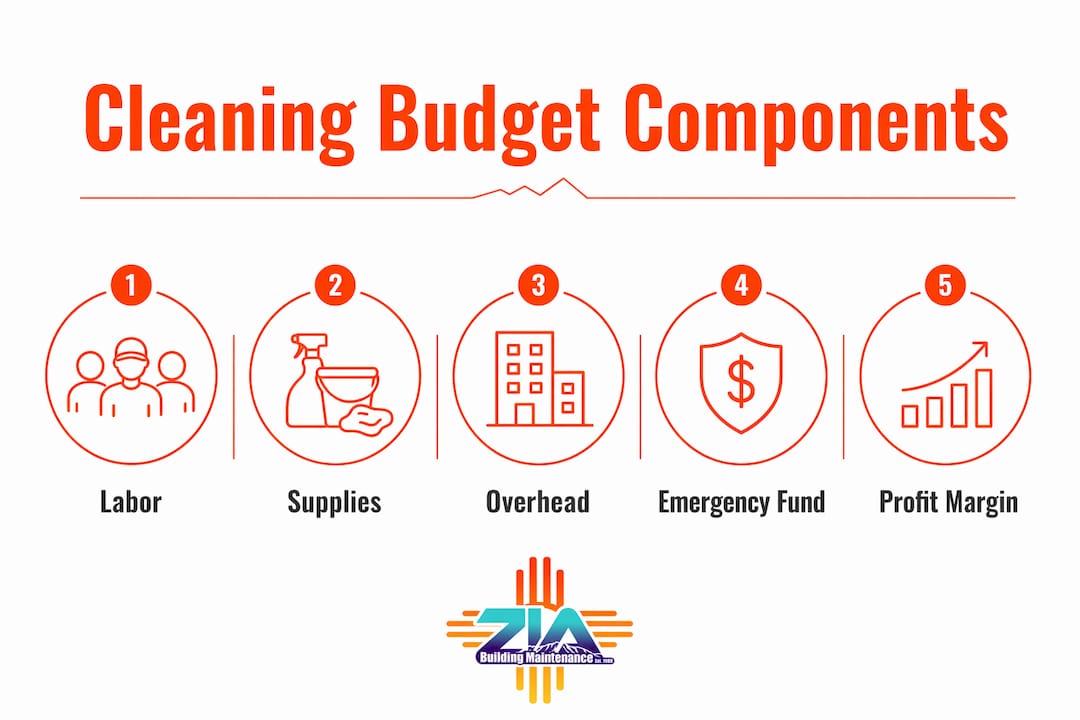
A complete cleaning budget breaks into three categories: labor, supplies, and overhead. Each one carries a distinct weight in your total cost structure, and missing any of them produces a budget that fails within the first quarter.

Labor is the largest line item. Fully loaded labor cost adds 15–25% on top of base wages to cover payroll taxes (7.65%), workers’ compensation (3–8%), and paid time off. That means a cleaner earning $18 per hour actually costs you $21–$22.50 per hour fully loaded. If the business owner works on-site, their time counts as labor too. Ignoring owner labor is one of the most common ways small operations undercount their true costs.
Supplies cover chemicals, paper goods, consumables, and equipment depreciation. Industry benchmarks place supply costs at 8–12% of revenue. Track actual usage monthly rather than estimating from invoices alone. Usage data reveals waste patterns that invoices never show.
Overhead includes insurance, software subscriptions, administrative time, and vehicle costs. Typical overhead runs 15–20% of revenue. Allocating overhead accurately by labor hours, rather than by account or flat rate, produces the most defensible numbers.
Pro Tip: Track actual supply usage for 60 days before finalizing your budget. Real consumption data is more accurate than vendor estimates and prevents costly overruns.
| Cost Category | Typical % of Revenue | What to Include |
|---|---|---|
| Labor | 30–40% | Base wages, payroll taxes, workers’ comp, PTO |
| Supplies | 8–12% | Chemicals, paper goods, consumables, equipment depreciation |
| Overhead | 15–20% | Insurance, software, admin time, vehicles |
| Net Margin Target | 15–25% | Owner compensation, profit, business reinvestment |
How do you estimate cleaning costs by square footage?
Per-square-foot pricing is the most common starting point for estimating commercial cleaning expenses. Standard commercial cleaning rates range from $0.05 to $0.20 per square foot per visit, with facility type driving the biggest variation. A general office falls in the $0.05–$0.10 range, while a medical office runs $0.12–$0.20 per square foot because of stricter sanitation requirements.
Per-square-foot rates are a useful benchmark, but they are a lagging indicator. They do not account for layout complexity, foot traffic, or fixed setup time. The ISSA 2026 production rates offer a more defensible method: convert square footage to labor hours using task-specific production rates, then apply your fully loaded labor cost. This approach ties your estimate directly to time and cost rather than a market average.
Common facility types and their per-square-foot cost ranges:
- General offices: $0.05–$0.10 per sq ft per visit
- Medical offices: $0.12–$0.20 per sq ft per visit
- Warehouses: $0.03–$0.07 per sq ft per visit
- Schools and educational facilities: $0.08–$0.14 per sq ft per visit
- Retail spaces: $0.06–$0.12 per sq ft per visit
Pro Tip: Combine the ISSA production rate calculation with your overhead allocation to validate your per-visit rate. If the two methods produce numbers more than 10% apart, recheck your labor hours estimate.
For a broader look at commercial cleaning contract prices, including how facility type affects the final number, Zia Building Maintenance publishes a detailed pricing guide on their website.
What is the step-by-step process to create a cleaning budget?
Building a cleaning budget plan requires collecting accurate data before you write a single number. Start with your cleanable square footage, then gather labor rates, supply costs, and overhead figures. Skipping the data-collection phase produces a budget built on assumptions, and assumptions erode margins fast.
Here is the process from data collection to finalized budget:
- Measure cleanable square footage. Exclude walls, fixed equipment, and storage areas. Use actual floor plans when available.
- Calculate fully loaded labor cost. Take base hourly wages and add 15–25% for taxes, insurance, and PTO.
- Estimate labor hours per visit. Use ISSA 2026 production rates to convert square footage to hours by task type.
- Add supply costs. Apply the 8–12% of revenue benchmark, then adjust based on 60 days of actual usage data.
- Allocate overhead by labor hours. Divide account labor hours by total labor hours, then multiply by total fixed overhead.
- Add profit margin. Most janitorial businesses target 15–25% net margin. Businesses running below 10% are typically underbidding or carrying unchecked costs.
- Build an emergency cushion. A sound budgeting formula includes 1–3 months of operating expenses as a reserve. This cushion covers unexpected equipment failures, staff turnover, or contract gaps.
The table below shows how fixed and variable costs differ in allocation method and budget behavior:
| Cost Type | Examples | Allocation Method | Budget Behavior |
|---|---|---|---|
| Fixed overhead | Insurance, software, admin | Labor hours percentage | Stable month to month |
| Variable direct costs | Supplies, hourly labor | Per job or per visit | Fluctuates with volume |
Allocating overhead by labor hours is more accurate than revenue-based or flat-rate methods. The formula is straightforward: account labor hours divided by total labor hours, multiplied by total fixed overhead. This gives each account its fair share of the cost burden.
Understanding the cleaning ROI for your business helps justify the budget to stakeholders and reinforces why cutting cleaning costs without data often costs more in the long run.
What are the most common cleaning budget mistakes?
The most damaging budgeting mistake is treating per-square-foot pricing as a final answer rather than a starting point. For contracts under 20,000 sq ft, fixed setup time including parking, equipment unloading, and building access represents a significant portion of total labor. Ignoring that fixed time compresses margins on small contracts to near zero.
Other frequent errors include:
- Omitting fully loaded labor. Using base wages instead of fully loaded rates understates labor cost by 15–25%.
- Excluding owner labor. If you work on-site, your hours have a cost. Leaving them out inflates apparent profit.
- Flat-rate overhead allocation. Spreading overhead equally across accounts regardless of labor hours distorts job-level profitability.
- Ignoring supply price changes. Chemical and paper goods prices shift quarterly. A budget set in january can be off by 10% by june without adjustment.
- No emergency fund. Emergency cushions are frequently overlooked but are critical to surviving unforeseen expenses during startup or contract fluctuations.
Pro Tip: Run a monthly variance analysis comparing actual expenses against your budget line by line. Any line item more than 5% over budget deserves a root-cause review before the next billing cycle.
For practical guidance on reducing office cleaning costs without sacrificing quality, Zia Building Maintenance outlines specific tactics that apply directly to budget management.
How do you keep your cleaning budget accurate over time?
A cleaning budget is not a one-time document. It requires monthly review to stay useful. Separating fixed overhead from variable costs in your tracking system makes variance analysis faster and more meaningful. When you can see that labor ran 3% over budget while supplies came in under, you know exactly where to investigate.
Job costing spreadsheets or dedicated field management software both work for tracking. The key requirement is that your system captures actual hours and supply usage per job, not just totals. Totals hide the accounts that are losing money.
Labor market changes, supply price increases, and shifts in facility needs all require budget adjustments. Review your fully loaded labor rate at least twice a year. If your cleaning provider changes scope, get a revised cost breakdown in writing before the new scope begins. Proactive communication with your provider prevents budget surprises and keeps the relationship transparent.
Pro Tip: Set a calendar reminder every quarter to compare your current supply and labor costs against the rates used in your original budget. Even a $0.50 per hour wage increase compounds significantly across a full year of service.
Reviewing your commercial cleaning contract checklist alongside your budget ensures that scope and cost stay aligned as your facility’s needs evolve.
Key Takeaways
An accurate cleaning budget requires fully loaded labor costs, labor-hour-based overhead allocation, and a 1–3 month emergency cushion to protect profitability and maintain compliance.
| Point | Details |
|---|---|
| Use fully loaded labor rates | Add 15–25% to base wages to cover taxes, workers’ comp, and PTO. |
| Allocate overhead by labor hours | Divide account hours by total hours, then multiply by fixed overhead for accuracy. |
| Validate per-square-foot rates | Cross-check market rates against ISSA production rate calculations to catch pricing gaps. |
| Build an emergency cushion | Reserve 1–3 months of operating expenses to cover unexpected costs or contract gaps. |
| Review the budget monthly | Compare actuals against budget line by line and investigate any variance over 5%. |
Why most cleaning budgets fail before the first quarter ends
Facilities managers and business owners often treat a cleaning budget as a pricing exercise rather than a financial control tool. That framing is the root cause of most budget failures. A budget built only to win a contract or justify a vendor invoice has no mechanism for catching cost drift. It just sits in a spreadsheet until the numbers stop matching reality.
The most reliable budgets I have seen combine two methods: per-square-foot benchmarks for initial estimates and ISSA production rates for validation. Neither method alone is sufficient. Per-square-foot rates reflect market averages, not your specific labor efficiency or overhead structure. Production rates reflect time, which is the one variable you can actually control.
The emergency cushion is the element most business owners skip because it feels like money sitting idle. It is not idle. It is the reason a broken floor machine or a sudden staff vacancy does not turn into a missed service and a lost contract. Businesses that skip the cushion are one equipment failure away from a cash flow problem.
Transparent budgeting also changes the vendor relationship. When you understand your provider’s cost structure, you can have an informed conversation about scope changes, frequency adjustments, and pricing reviews. That conversation builds trust and produces better outcomes than a price negotiation based on gut feeling.
The bottom line: treat your cleaning budget as a living document, review it monthly, and update it whenever labor rates, supply costs, or facility needs change. That discipline separates facilities that control their cleaning costs from those that are controlled by them.
— Ashley
Professional cleaning support from Zia Building Maintenance
Zia Building Maintenance has served businesses in Albuquerque with consistent, quality-focused commercial cleaning since 1989. Their team understands that every facility has different needs, and their pricing is transparent so your budget planning stays on solid ground.
Whether you manage a general office, a medical facility, or a school, Zia Building Maintenance tailors service plans to match your square footage, frequency requirements, and compliance standards. Their professional office cleaning services in Albuquerque are designed to fit real business budgets without cutting corners on quality. Contact Zia Building Maintenance to request an estimate and get a clear, itemized cost breakdown that supports your cleaning budget plan from day one.
FAQ
What does a cleaning budget for a business include?
A cleaning budget includes fully loaded labor costs, supply expenses, overhead allocation, a profit margin of 15–25%, and an emergency reserve of 1–3 months of operating expenses.
How much does commercial cleaning cost per square foot?
Standard commercial cleaning rates range from $0.05 to $0.20 per square foot per visit, depending on facility type. Medical offices sit at the higher end; warehouses sit at the lower end.
How do I calculate fully loaded labor cost?
Take the base hourly wage and add 15–25% to cover payroll taxes (7.65%), workers’ compensation (3–8%), and paid time off. That total is your true labor cost per hour.
Why is per-square-foot pricing unreliable for small contracts?
For facilities under 20,000 sq ft, fixed setup time such as parking and equipment unloading represents a large share of total labor. Per-square-foot rates do not capture that fixed time, so they consistently underestimate costs on smaller contracts.
How often should a cleaning budget be reviewed?
Review your cleaning budget monthly by comparing actual expenses against budgeted figures line by line. Update labor rates and supply costs at least twice a year to reflect market changes.