
TL;DR:
- Effective janitorial inspections involve outcome-based scoring to identify hygiene failures overlooked by task logs. Restrooms require daily evaluations due to high complaint rates, and photo documentation enhances accuracy and accountability. Digital tools and consistent scoring standards improve compliance and foster tenant trust in facility management.
Inspecting janitorial work quality is the process of systematically evaluating cleaning outcomes using standardized scoring methods and documentation to confirm a facility meets health, safety, and compliance standards. A cleaning schedule only confirms that tasks were attempted. A structured quality audit confirms that those tasks produced the right result. Facility managers who rely on task logs alone miss the hygiene failures that generate tenant complaints and trigger regulatory scrutiny. Industry frameworks like APPA cleanliness scoring and OSHA sanitation standard 1910.141 give inspections a measurable, defensible foundation.
How do you inspect janitorial work quality by zone?
Effective janitorial quality assessment divides a facility into defined inspection zones. Each zone carries its own risk level, complaint history, and inspection frequency. The standard zones in commercial facilities are restrooms, offices, break rooms, lobbies and common areas, and janitorial operations areas.
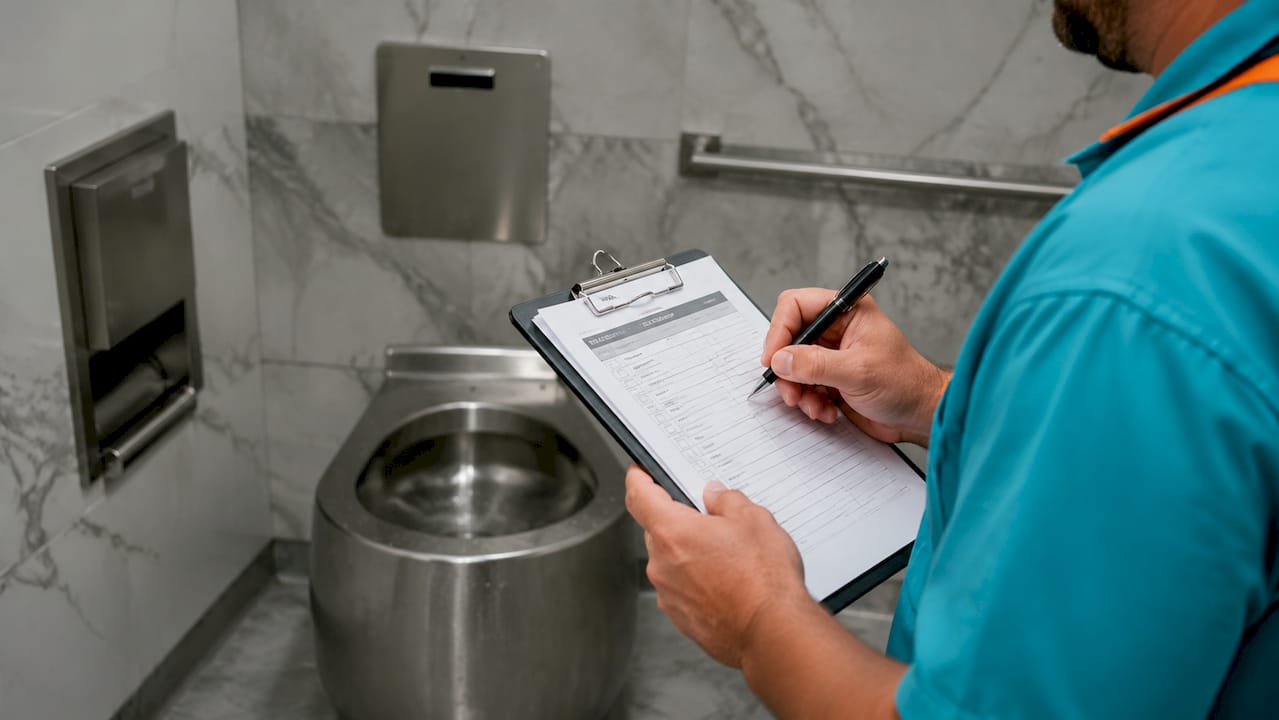
Restrooms carry the highest complaint density of any zone in a commercial building. A single substandard restroom condition generates more occupant dissatisfaction than a month of excellent performance elsewhere. That asymmetry means restrooms require daily or twice-daily scoring, not weekly spot checks.
Offices and break rooms accumulate surface contamination and odors more slowly, but they still require structured scoring at least weekly. Lobbies and high-traffic corridors need inspection after every shift because foot traffic degrades cleanliness faster than in low-use areas. Janitorial operations areas, including storage rooms and equipment staging, affect every other zone. Dirty mop heads, improperly diluted chemicals, and poorly maintained equipment produce substandard results across the entire facility.
The scoring scale used in most commercial contracts is a 4-point system:
- 1 Unacceptable: Condition poses a health or safety risk or is visibly filthy
- 2 Below Standard: Condition is noticeably deficient but not an immediate hazard
- 3 Meets Standard: Condition satisfies the contracted specification
- 4 Exceeds Standard: Condition is noticeably cleaner than the specification requires
| Zone | Recommended Inspection Frequency | Key Criteria |
|---|---|---|
| Restrooms | Daily or twice daily | Fixtures, floors, supplies, odor |
| Lobbies and corridors | After each shift | Floors, glass, trash, appearance |
| Offices | Weekly | Surfaces, floors, trash, dusting |
| Break rooms | Weekly | Appliances, counters, floors, trash |
| Janitorial operations | Monthly | Equipment condition, chemical storage |
How to prepare for an effective janitorial inspection
A cleaning schedule and a quality audit serve different purposes. A schedule confirms task completion; an audit confirms that the outcome meets the contracted standard. Preparing for an audit means gathering the right tools and aligning your criteria with the specifications written into your janitorial service contract.
Before you walk the floor, assemble these tools:
- A zone-specific inspection checklist tied to your contract scope of work
- A scoring template using the 4-point scale
- A camera or smartphone for photo documentation
- A digital inspection app or field form to record findings in real time
- Copies of your cleaning specifications and any applicable regulatory standards
Staff conducting inspections need to understand what each score means and how to apply it consistently. An inspector who scores a restroom a 3 for a visibly soiled floor undermines the entire program. Training inspectors on the scoring criteria before the first audit prevents score drift over time.
Cleaning standards are typically embedded in the janitorial contract or scope of work document. Reviewing those specifications before each inspection cycle keeps your scoring anchored to the agreed benchmark, not personal preference.
Pro Tip: Conduct inspections after cleaning is complete but before occupants arrive. This window gives you the most accurate score of the contractor’s actual output, without foot traffic degrading the result.
Step-by-step method for scoring a janitorial inspection
Both scheduled and unannounced inspections are necessary for a reliable quality control program. Scheduled inspections build routine accountability. Unannounced inspections reveal whether standards hold when the contractor is not expecting scrutiny.
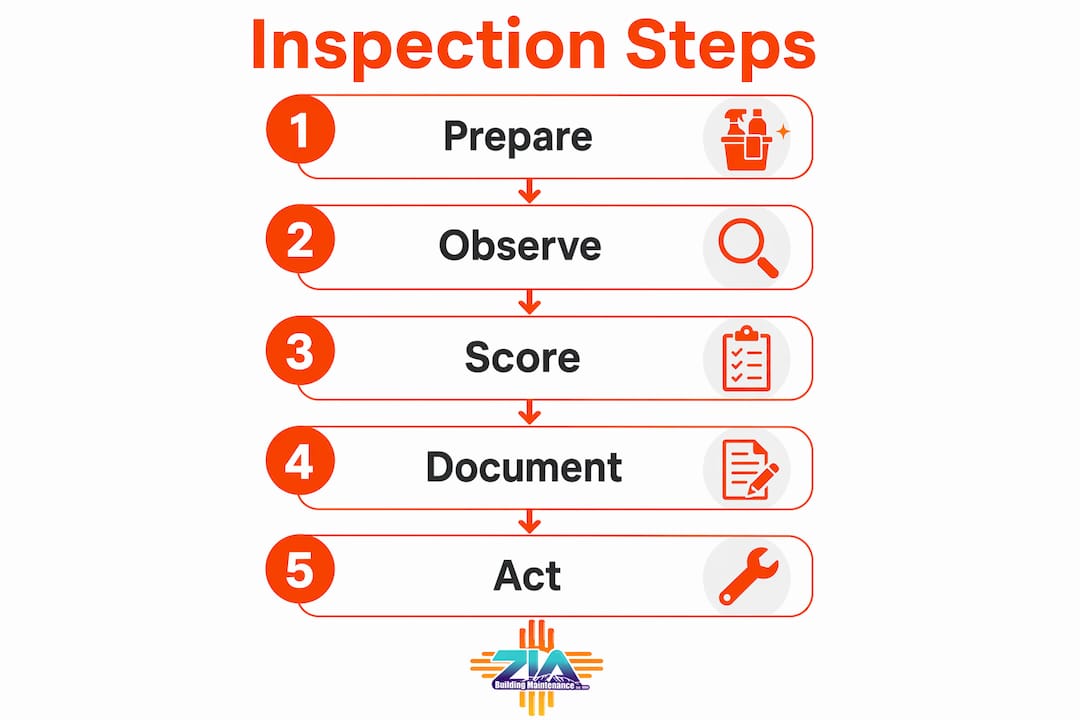
Follow these steps for each inspection cycle:
- Review the scope of work. Confirm which tasks are contracted for the zone you are inspecting before you score anything.
- Enter the zone and assess operational inputs first. Check equipment condition, chemical dilution ratios, and whether technicians are using the correct tools for each surface type.
- Score each checklist item. Use the 4-point scale. Score what you observe, not what you assume was done.
- Photograph every deficiency. A photo of a soiled grout line or a missed trash liner is objective evidence. Written descriptions alone are disputed more often.
- Calculate the zone average. Add all item scores and divide by the number of items. This single number drives your corrective action decision.
- Record findings in your digital system. Timestamped entries create an audit trail that supports contractor reviews and compliance documentation.
- Communicate findings to the contractor immediately. Do not wait until the end of the week. Same-day notification gives the contractor the opportunity to re-service before occupants notice.
Digital inspection tools improve APPA cleanliness scores by up to 25% compared to paper-based methods. The reason is consistency. Digital forms enforce the scoring scale, prevent skipped items, and generate automatic reports without manual data entry.
Pro Tip: Assess operational inputs like equipment condition and dilution ratios alongside visible cleanliness. A zone that scores a 3 today but uses a worn mop head will score a 1 next week.
Reviewing your cleaning audit process periodically also helps you identify whether your checklist items still match the current scope of work.
What are the score thresholds that trigger corrective action?
Score thresholds convert inspection data into decisions. A zone average below 2.5 on the 4-point scale triggers mandatory contractor review within 24–48 hours under most commercial contracts. Healthcare and federal facilities typically require a 95% compliance minimum, while standard commercial environments use a 90% benchmark.
Deficiencies fall into two categories. Minor deficiencies are items that score a 2 but do not pose an immediate health risk. These require re-service within 24 hours and a follow-up inspection to confirm correction. Major deficiencies are items that score a 1, indicating an unacceptable condition that may violate OSHA sanitation requirements. These require immediate re-service, same-day documentation, and a root cause review.
The corrective action process follows a clear sequence:
- Notify the contractor in writing with the zone score, specific deficient items, and photo evidence attached
- Set a re-service deadline based on deficiency severity: same day for major, next service cycle for minor
- Re-inspect after re-service to confirm the deficiency is resolved before closing the corrective action record
- Log recurring deficiencies separately to identify patterns that indicate a systemic training or staffing problem
Recurring deficiencies in the same zone over three consecutive inspection cycles signal a contractor performance problem, not a one-time lapse. That pattern warrants a formal performance review and possible contract adjustment.
Automated digital tracking of inspection deficiencies generates timestamped corrective orders that improve compliance and reduce the administrative burden of manual follow-up. Facilities that track deficiencies digitally resolve corrective actions faster and maintain cleaner audit trails for regulatory reviews.
Common mistakes when evaluating cleaning service standards
The most damaging mistake facility managers make is treating a completed task log as proof of quality. Confusing schedule completion with quality audits allows hygiene failures to persist unnoticed for weeks. A contractor can check every box on a task list and still leave a restroom in a below-standard condition.
Other common errors include:
- Under-inspecting restrooms. Because restrooms generate the most complaints, reducing their inspection frequency to save time produces the opposite of the intended result.
- Skipping photo documentation. Without photos, deficiency disputes become word-against-word conversations. Photos resolve disputes in minutes.
- Failing to follow up on corrective actions. Issuing a corrective notice without re-inspecting tells the contractor that follow-through is optional.
- Using inconsistent scoring. Different inspectors applying the scale differently produce data that cannot be compared across time periods or zones.
Photo documentation supports transparent communication and audit readiness. Facilities that use photo evidence in their inspection records report fewer contractor disputes and faster resolution times.
Pro Tip: Standardize your inspection routine by using the same checklist sequence in every zone, every time. Consistency in the inspection process produces data you can actually use to track trends.
Reviewing how you evaluate janitorial service performance against your contract specifications at least quarterly keeps your program aligned with current facility needs.
Key Takeaways
Structured, outcome-focused inspections using a 4-point scoring scale and photo documentation are the most reliable method to maintain janitorial quality and drive corrective action in commercial facilities.
| Point | Details |
|---|---|
| Audits outperform schedules | Only structured audits confirm cleaning outcomes; task logs only confirm task attempts. |
| Zone scoring drives decisions | A zone average below 2.5 on a 4-point scale triggers mandatory contractor review within 24–48 hours. |
| Restrooms require priority attention | Restrooms generate more occupant complaints than any other zone and need daily scoring. |
| Photo evidence is non-negotiable | Photos resolve contractor disputes faster and support compliance documentation during audits. |
| Digital tools improve accuracy | Digital inspection tools improve APPA cleanliness scores by up to 25% over paper-based methods. |
What I have learned from running janitorial inspection programs
Facility managers often inherit inspection programs built around task completion logs and assume those logs represent quality data. They do not. The first time I shifted a client’s program from schedule-based tracking to outcome-based scoring, we found three recurring restroom deficiencies that had gone undetected for months. The task log showed 100% completion every week.
The second thing I have learned is that photo documentation changes contractor behavior faster than any written policy. When contractors know that every deficiency will be photographed, timestamped, and attached to a corrective notice, the rate of recurring deficiencies drops noticeably. Accountability is most effective when it is visible.
Digital tools matter, but they are only as good as the training behind them. An inspector who does not understand the difference between a score of 2 and a score of 3 will produce unreliable data regardless of the platform. Invest in calibration sessions where multiple inspectors score the same zone independently, then compare results. Disagreements reveal where your scoring criteria need clarification.
The most underrated benefit of a structured inspection program is what it does for tenant trust. When occupants see that deficiencies are documented and corrected quickly, their confidence in facility management rises. That trust is harder to build than any cleaning standard, and easier to lose than most managers realize.
— Ashley
Zia Building Maintenance supports your quality inspection program
Facility managers who want consistent, documented janitorial quality do not have to build an inspection program from scratch. Zia Building Maintenance has delivered tailored commercial cleaning solutions in Albuquerque since 1989, with a structured approach that supports the kind of outcome-focused accountability this article describes.
Zia Building Maintenance serves offices, medical facilities, and schools with cleaning programs designed around your specific compliance requirements. Their team brings detailed reporting, corrective tracking, and the consistency that makes inspection scores meaningful over time. Learn how professional janitorial services reduce costs and protect your facility’s health standards. You can also review their office cleaning services to see how a structured program applies to your space. Contact Zia Building Maintenance to request an estimate and put a reliable quality program in place.
FAQ
What is the difference between a cleaning schedule and a quality audit?
A cleaning schedule confirms that tasks were performed. A quality audit confirms that those tasks produced a result that meets the contracted standard, using scored criteria and documentation.
What score triggers a contractor review in a janitorial inspection?
A zone average below 2.5 on a 4-point scoring scale triggers mandatory contractor review within 24–48 hours under most commercial contracts.
How often should restrooms be inspected in a commercial facility?
Restrooms require daily or twice-daily inspections because they generate more occupant complaints than any other zone and conditions degrade quickly with foot traffic.
Why is photo documentation required during janitorial inspections?
Photos provide objective, timestamped evidence of deficiencies that resolves contractor disputes faster and supports compliance documentation during regulatory audits.
What compliance standard applies to restroom sanitation in commercial facilities?
OSHA sanitation standard 1910.141 mandates clean, sanitary restroom facilities, clean floors, and prompt waste removal, with documentation required for compliance.