

TL;DR:
- Spot cleaning in commercial spaces involves immediate removal of isolated stains to maintain appearance and protect assets. It is a precise, on-demand process that complements routine janitorial work but cannot replace periodic deep cleaning. Proper technique and documentation are essential to prevent damage and ensure consistent, effective maintenance.
Spot cleaning in commercial spaces is defined as the targeted, immediate removal of isolated stains, spills, or marks from a specific surface area without treating the entire floor, wall, or upholstered section. This practice sits at the core of daily commercial space cleaning and is distinct from routine janitorial sweeping or scheduled deep cleaning. Property managers who apply consistent spot cleaning protocols protect their assets, maintain professional appearances, and reduce long-term restoration costs. Planned maintenance with daily spot cleaning can extend carpet life from 5–7 years to 10–15 years. That single fact makes spot cleaning one of the highest-return habits in facility management.
What is spot cleaning in commercial spaces?
Spot cleaning is a precise, on-demand cleaning method that addresses a single stained or soiled area rather than an entire surface. The industry also refers to this as “interim stain treatment” or “localized stain removal” in professional facility management standards. Both terms describe the same practice: act fast, treat only what needs treatment, and protect the surrounding material.
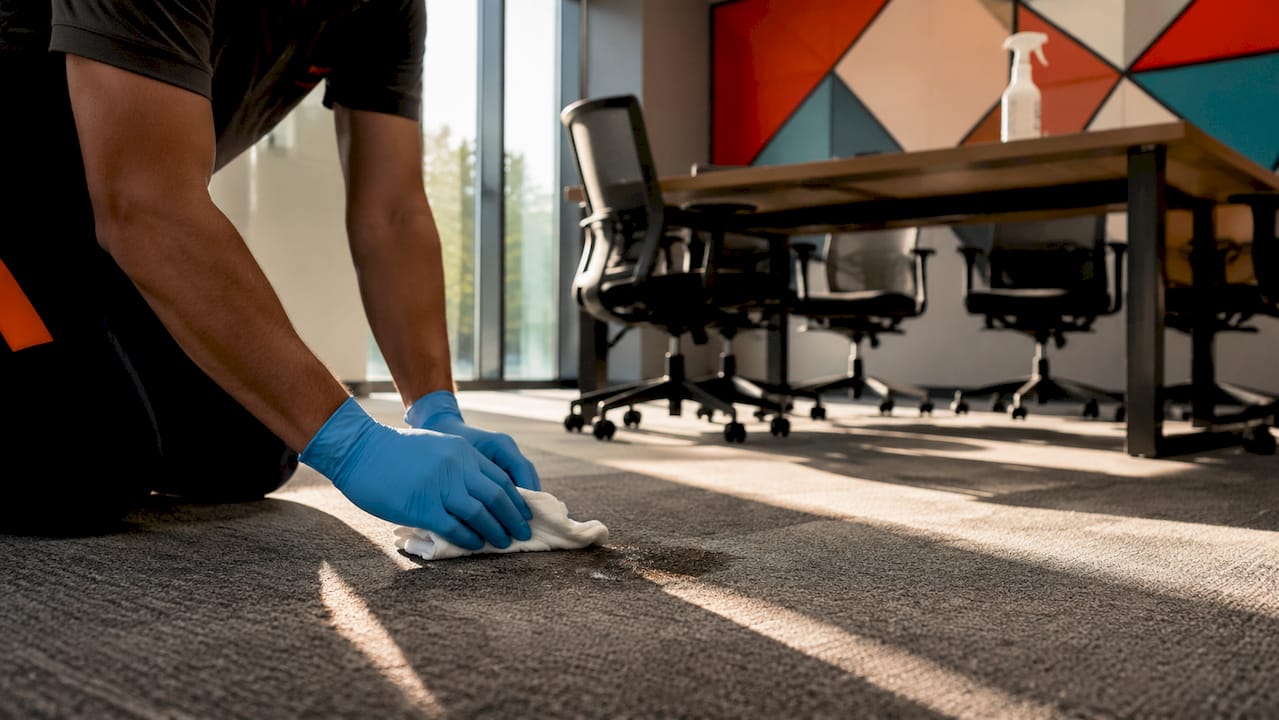
The most common targets in commercial settings include coffee spills on carpet, fingerprints on glass partitions, scuff marks on tile entryways, and ink smudges on upholstered seating. Each of these requires a different approach, but all share the same core principle: contain the damage before it sets. A stain treated within the first few minutes is far easier to remove than one that has dried and bonded with fibers.
Spot cleaning is not a substitute for what is commercial cleaning in its broader sense. It does not replace vacuuming, mopping, disinfecting, or periodic deep cleaning. Instead, it fills the gap between scheduled cleaning cycles, keeping spaces presentable and hygienic at all times.
What are the professional spot cleaning techniques for commercial spaces?
Professional spot cleaning follows a specific sequence. Skipping steps or rushing the process causes more damage than the original stain. The following order applies to most commercial surfaces, including carpet, upholstery, and hard floors.
- Secure the area. Place a wet floor sign or barrier to prevent foot traffic from spreading the stain or creating a slip hazard.
- Remove solid matter first. Use a spoon, dull blade, or absorbent cloth to lift any solid or semi-solid material before applying any liquid. Never rub solids into the surface.
- Apply the mildest suitable cleaner to a cloth, not the surface. Spray or pour the cleaning agent onto a clean white cloth, then apply the cloth to the stain. This controls the amount of moisture introduced.
- Blot from the edges inward. Work from the outer edge of the stain toward the center to prevent spreading. Never scrub in circular motions.
- Rinse with clean water on a separate cloth. Remove cleaning agent residue, which can attract dirt if left behind.
- Dry promptly. Use a clean dry cloth, a small extraction tool, or a fan to speed drying and prevent the wicking effect.
The blot, don’t scrub rule is non-negotiable on carpet. Scrubbing untwists carpet fibers and causes permanent damage, turning a temporary spot into a lasting blemish.
Pro Tip: Always test any cleaning agent on an inconspicuous area first. Strong solvents or high-pH cleaners applied without testing can permanently damage delicate treatments and actually set the stain deeper into the fiber.
The mildest-first chemical approach means starting with plain water, then moving to a neutral pH detergent, then to a specialized spotter only if the milder options fail. This protects carpet treatments, fabric coatings, and floor finishes that are common in commercial settings.
Specialized spot cleaning equipment reduces water use by up to 80–90% compared to full-area cleaning methods. That reduction matters in high-traffic offices where wet floors create safety risks and downtime.
- Use white cloths only. Colored cloths can transfer dye to the surface being cleaned.
- Never over wet. Excess moisture causes the wicking effect, where dissolved deep dirt reappears as the area dries.
- Keep a spot cleaning kit stocked at each janitorial station: neutral detergent, enzyme spotter, clean white cloths, and a small extraction tool.
- Document every treatment with the time, location, agent used, and outcome.
How does spot cleaning fit within commercial cleaning maintenance strategies?
Spot cleaning is a daily, high-frequency task built into standard janitorial duties. It runs continuously throughout the business day, not just during scheduled cleaning windows. Deep cleaning, by contrast, is periodic and performed by specialists using heavy extraction equipment, typically on a quarterly or semi-annual schedule.
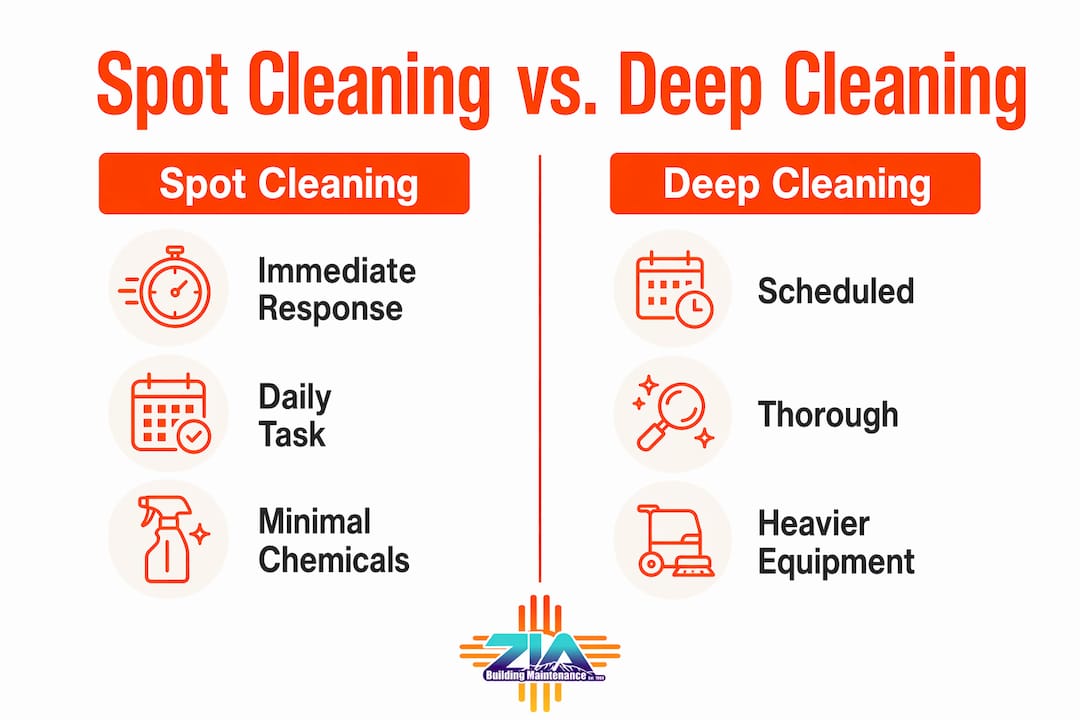
The two practices are complementary, not competing. Spot cleaning acts as a first line of defense that keeps surfaces manageable between deep cleaning cycles. When janitorial teams address stains immediately, deep cleaning sessions become more efficient and less costly because technicians are not fighting months of accumulated, set-in soil.
| Cleaning type | Frequency | Purpose | Equipment |
|---|---|---|---|
| Spot cleaning | Daily or as needed | Remove isolated stains immediately | Cloths, mild cleaners, small extractors |
| Routine janitorial | Daily | General tidiness, vacuuming, mopping | Standard janitorial supplies |
| Deep cleaning | Quarterly or semi-annual | Full restoration, sanitization, extraction | Heavy extraction, industrial equipment |
Different commercial property types require different spot cleaning schedules. A medical office needs immediate response to any visible soil for infection control reasons. A retail lobby with heavy foot traffic may need spot checks every two hours during peak hours. A corporate office with moderate traffic can integrate spot cleaning into morning and afternoon janitorial rounds. Knowing your property’s traffic patterns is the starting point for building an effective protocol.
Neglecting spot cleaning forces deep cleaning cycles to work harder and cost more. A stain that sits for two weeks requires significantly more chemical treatment and dwell time than one addressed within an hour. The cost-effectiveness of deep cleaning depends directly on how well daily spot cleaning has maintained the surface in between sessions.
What are the benefits and limitations of spot cleaning commercial spaces?
The benefits of spot cleaning extend well beyond clean appearances. The practice delivers measurable returns across asset lifespan, operating costs, and workplace hygiene.
- Extended asset life. Carpets maintained with daily spot cleaning last up to twice as long as those relying on periodic cleaning alone. That difference represents significant capital savings on replacement costs.
- Reduced water and chemical use. Treating a 12-inch stain uses a fraction of the resources required to clean an entire room. This efficiency matters for facilities with sustainability targets.
- Minimal business disruption. A spot treatment takes minutes and affects only a small area. Full-area cleaning often requires closing sections of a facility for hours.
- Positive brand perception. A visible stain in a lobby or conference room signals neglect to clients and visitors. Consistent spot cleaning keeps brand perception aligned with a professional image.
- Hygiene compliance. In medical and food service environments, unaddressed spills create contamination risks. Immediate spot treatment supports regulatory hygiene standards.
Spot cleaning has real limitations. It cannot address widespread soiling, embedded allergens, or deeply set stains that have bonded with fibers over time. A carpet that has not received deep cleaning in over a year will still look dull and carry contaminants even if every new stain is addressed immediately. The wicking effect is another limitation: if a stain was previously overwetted or improperly treated, dissolved soil from deeper layers will resurface after drying, making the spot appear to return.
When spot cleaning fails to remove a stain after two attempts, escalate to a professional deep cleaning service. Repeated chemical applications on the same area without proper extraction can damage fibers and leave residue that attracts more dirt.
How to spot clean different areas and materials in commercial offices
Each surface type in a commercial facility requires a specific approach. Applying the wrong method to the wrong material causes damage that spot cleaning was meant to prevent.
Carpet and rugs
Carpet is the most common spot cleaning target in offices and lobbies. Use an enzyme-based spotter for organic stains like coffee, food, or urine. Apply to a cloth, blot inward, and extract moisture with a small portable extractor or dry cloth. For carpet stain removal in high-traffic areas, keep a portable spot extractor at each janitorial station for faster response.
Upholstered furniture
Office chairs, waiting room seating, and fabric panels require a water-based cleaner with low moisture application. Check the manufacturer’s cleaning code first: “W” means water-based cleaners are safe, “S” means solvent-based only, and “X” means vacuum only. Applying water to an “S” or “X” coded fabric causes permanent water marks.
Tile and hard floors
Hard floors respond well to a neutral pH cleaner applied with a microfiber cloth. Avoid acidic cleaners on natural stone like marble or travertine, as they etch the surface. For scuff marks on vinyl or linoleum, a pencil eraser or dry microfiber pad removes most marks without any chemical.
Glass and partitions
Glass partitions and windows in commercial offices show fingerprints and smudges clearly. An isopropyl alcohol solution on a lint-free cloth removes most marks without streaking. Avoid paper towels, which leave lint and can scratch coated glass surfaces.
Pro Tip: Create a surface-specific spot cleaning reference card for your janitorial team. List each surface type in your facility, the approved cleaner, and the correct method. Laminate it and attach it to each cleaning cart. This removes guesswork and prevents costly material damage.
Spot cleaning documentation through digital checklists creates an audit trail that matters in high-occupancy commercial properties. Logging the time, location, agent used, and outcome helps facility managers track recurring problem areas, manage damage accountability, and distinguish normal wear from negligence during lease disputes or insurance claims.
Key takeaways
Spot cleaning is the most cost-effective daily habit a facility manager can build into a commercial maintenance program, and its value compounds when paired with scheduled deep cleaning.
| Point | Details |
|---|---|
| Act immediately | Treat stains within minutes to prevent permanent bonding with fibers or surfaces. |
| Blot, never scrub | Scrubbing damages carpet fibers permanently; always blot from edges inward. |
| Use mildest cleaner first | Start with water or neutral detergent before escalating to specialized spotters. |
| Pair with deep cleaning | Spot cleaning extends asset life but cannot replace periodic deep extraction. |
| Document every treatment | Log time, location, and agent used to track recurring issues and maintain accountability. |
Why spot cleaning deserves more respect in facility management
Most facility managers I work with treat spot cleaning as a minor task, something any staff member handles with whatever cleaner is nearby. That attitude is the single biggest source of preventable carpet and upholstery damage I see in commercial properties.
The real problem is that spot cleaning looks simple. It is not. The mildest-first chemical rule, the blotting technique, and the moisture control requirement are all skills that need deliberate training. I have seen well-meaning staff members scrub a coffee stain with a high-alkaline all-purpose cleaner and create a permanent bleached ring in a carpet that cost thousands of dollars to replace. That outcome was entirely preventable.
What I find works best is treating spot cleaning as a documented protocol, not a casual task. When janitorial teams log every treatment, facility managers can identify which areas generate the most stains, which surfaces are most vulnerable, and whether the current cleaning schedule is adequate. That data changes how you allocate cleaning resources and how you negotiate service contracts.
The other misconception worth addressing is the idea that spot cleaning competes with deep cleaning. They serve completely different functions. Spot cleaning keeps surfaces presentable between cycles. Deep cleaning restores what daily maintenance cannot reach. A facility that does both correctly will spend less on restoration, less on asset replacement, and more time focused on the business itself.
My advice to any property manager: invest in training your janitorial team on proper spot cleaning technique before spending money on more frequent deep cleaning cycles. The return is faster, more visible, and far more sustainable.
— Ashley
Zia Building Maintenance keeps your facility spotless every day
Consistent spot cleaning requires trained staff, the right products, and a protocol built around your specific facility. Zia Building Maintenance has delivered exactly that for commercial properties across Albuquerque since 1989.
Zia Building Maintenance’s janitorial teams are trained in professional spot cleaning techniques, surface-specific chemical selection, and documentation protocols that protect your assets and your reputation. From corporate offices to medical facilities and schools, every service plan includes daily spot cleaning as a core component of the overall maintenance program. Zia Building Maintenance earned the title of the #1 office cleaning service in South Valley for 2025 by treating every detail as a priority. Request an estimate for professional office cleaning in Albuquerque and see what a structured cleaning program delivers. Message us today if you are looking for reliable and award winning janitorial services in Albuquerque, Los Ranchos de Albuquerque, Corrales or Rio Rancho.
FAQ
What is spot cleaning in a commercial space?
Spot cleaning in a commercial space is the targeted, immediate removal of an isolated stain or mark from a specific surface area without treating the entire surface. It is a daily maintenance task distinct from routine janitorial cleaning and periodic deep cleaning.
How often should spot cleaning be done in a commercial office?
Spot cleaning should be performed as needed throughout the business day, with janitorial staff checking high-traffic areas like lobbies, entryways, and break rooms during each cleaning round. High-traffic facilities may require spot checks every two hours during peak hours.
What is the difference between spot cleaning and deep cleaning?
Spot cleaning addresses isolated stains immediately and uses minimal water and chemicals on a small area. Deep cleaning is a periodic, full-surface process using heavy extraction equipment to remove embedded soil, allergens, and buildup that daily maintenance cannot reach.
Can spot cleaning damage carpet or upholstery?
Yes, improper spot cleaning causes permanent damage. Harsh chemicals can cause delamination. Scrubbing untwists carpet fibers, over wetting causes the wicking effect, and using the wrong chemical can bleach or set a stain. Always blot, use the mildest cleaner first, and test in an inconspicuous area.
Why should facility managers document spot cleaning treatments?
Documentation creates an audit trail that tracks recurring problem areas, supports damage accountability, and helps distinguish normal wear from negligence during lease disputes or insurance claims. Digital checklists logging time, location, and agent used are the standard practice for high-occupancy commercial properties.