

Why Commercial Warehouse Floor Cleaning Matters More Than You Think
Commercial warehouse floor cleaning is one of the most overlooked — yet most impactful — parts of running a safe, efficient facility.
Here’s a quick summary of what you need to know:
| Topic | Quick Answer |
|---|---|
| Main methods | Sweeping, scrubbing, pressure washing, concrete polishing |
| Key equipment | Walk-behind scrubbers, ride-on scrubbers, combination sweeper-scrubbers |
| Cleaning frequency | Daily sweeping, weekly scrubbing, periodic deep cleans |
| Floor types | Sealed concrete, epoxy, tile, polyurethane — each needs a different approach |
| Top benefits | Slip prevention, equipment protection, better employee morale |
| Who should do it | A professional service with industrial-grade equipment and flexible scheduling |
Warehouse floors take a beating. Forklifts, foot traffic, spills, dust, and debris build up fast — and when they do, you’re not just looking at a dirty floor. You’re looking at real safety risks, equipment damage, and a workspace that quietly drags down productivity and morale.
The good news? A consistent, well-planned cleaning program fixes all of that.
I’m Ashley Cordova, Vice President of Zia Building Maintenance, a family-owned company serving New Mexico since 1989 — and commercial warehouse floor cleaning is one of the core services our teams handle every day across industrial and commercial facilities. Throughout this guide, I’ll walk you through everything you need to know to get your warehouse floors clean, safe, and staying that way.
The Importance of Commercial Warehouse Floor Cleaning
When you run a busy facility in Albuquerque, Rio Rancho, or Bernalillo, the condition of your floor directly dictates the speed and safety of your operations. Let’s look at why professional floor maintenance is a heavy-duty necessity rather than a cosmetic luxury.
Mitigating Safety Hazards and Preventing Slip-and-Fall Accidents
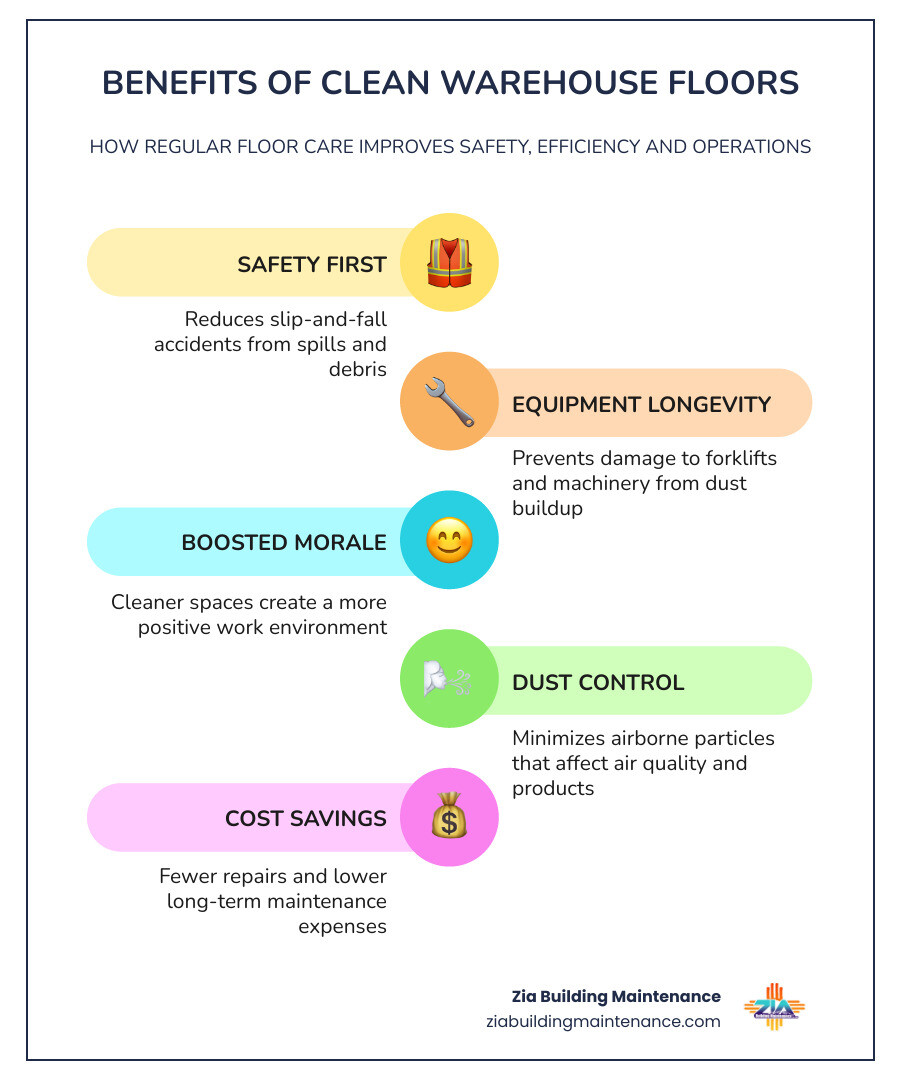
The number-one priority in any warehouse is safety. Dust, fine powder, oil drips, and packaging debris turn concrete floors into skating rinks. Slip-and-fall accidents are among the most common workers’ compensation claims in industrial settings.
By utilizing regular industrial scrubbing, we remove the microscopic layer of dust and grease that reduces traction. This keeps your team on their feet and keeps your facility compliant with safety regulations.
Extending Equipment Longevity and Protecting Inventory
Forklifts, pallet jacks, and automated guided vehicles (AGVs) rely on smooth, clean surfaces. When floors are covered in grit, those tiny abrasive particles grind down forklift tires, compromise steering mechanisms, and clog electric motor intakes.
Furthermore, as forklifts drive over dusty floors, they kick up particulate clouds that settle on your inventory. Keeping your floors clean protects both your high-value handling equipment and the stock sitting on your racks.
Boosting Employee Morale and Pride in the Workplace
It is a proven industry fact: scheduled floor sweeping and scrubbing is an integral part of preventative maintenance and maintaining positive employee morale. People perform better in clean, well-lit, professional environments. A clean floor signals to your workforce that management cares about their safety and respects their work environment.
For a deeper dive into why keeping industrial spaces clean is so critical in New Mexico, read our detailed article on Why professional warehouse cleaning in Albuquerque is a necessity.
Essential Equipment and Methods for Industrial Floors
Cleaning thousands of square feet of industrial flooring requires specialized power equipment. Standard mops and brooms simply push dirt around and leave behind a film of dirty water.
Here is a quick breakdown of how walk-behind and ride-on auto-scrubbers compare for commercial warehouse floor cleaning:
| Feature | Walk-Behind Scrubbers | Ride-On Scrubbers |
|---|---|---|
| Best For | Tight aisles, congested areas, < 50,000 sq ft | Wide-open spaces, large distribution centers |
| Cleaning Path | Typically 20 to 32 inches | Typically 33 to 60+ inches |
| Productivity | 15,000 to 40,000 sq ft / hour | 50,000 to 118,000+ sq ft / hour |
| Maneuverability | High; fits in narrow storage lanes | Medium; requires wider turning radiuses |
At Zia Building Maintenance, we match the right machine to your facility’s unique footprint. You can learn more about our tailored approach on our Zia’s Warehouse Floor Sweeping & Scrubbing Services page.
Walk-Behind vs. Ride-On Scrubbers for Commercial Warehouse Floor Cleaning
Selecting the correct machine is all about balancing tank capacity, cleaning path width, and maneuverability.
- Walk-Behind Scrubbers: These are perfect for medium-sized facilities or warehouses with tight rack configurations. For example, the Tennant T390 Walk Behind Floor Scrubber — Pro Cleaning Equipment features a 700mm (approx. 28-inch) dual-disk cleaning path covering up to 2,503 m² (approx. 27,000 sq ft) per hour. This represents a 38% to 75% productivity increase over smaller 500mm machines, making quick work of congested layouts. Another exceptional option is the M810 | Mach Sweepers , which delivers a cleaning capacity of up to 3,650 m² (39,290 sq ft) per hour using rugged aluminum brush heads and a parabolic squeegee for dry, safe floors instantly. For heavy-duty applications requiring massive down-pressure, the T600e Walk-Behind Floor Scrubber-Dryer-Dryers | Tennant Company can deliver up to 136 kg of disk down-pressure to strip away compacted grime.
- Ride-On Scrubbers: When we handle massive logistics hubs, ride-on units are the undisputed champions. The TigerDuo57 Ride-On Sweeper Scrubber – Sweep & Scrub in One Pass, 118,000 sq ft/h | FloorCleaningMachine sweeps up solid debris and scrubs the floor simultaneously. This single-pass operation cuts labor and cleaning times in half. For heavy manufacturing and transport hubs, machines like the B 260 R I Bp – Kärcher utilize a heavy steel frame and resilient Linatex squeegee blades to withstand harsh industrial environments, while the X800 industrial floor scrubber machine | Suto Company provides a highly productive 73,195 sq ft/h rate with built-in garbage baskets to collect loose debris during scrubbing.
Specialized Techniques for Different Floor Types
Industrial floors are not all created equal, and treating them with a one-size-fits-all approach can damage your investment.
- Sealed and Unsealed Concrete: Concrete is highly porous. Unsealed concrete acts like a sponge for oils and moisture, requiring deep-penetrating alkaline degreasers and heavy scrubbing. Sealed concrete is easier to clean but requires non-abrasive pads to avoid stripping the protective sealant.
- Epoxy Coatings: Epoxy is durable and chemical-resistant, but it can scratch if abrasive brushes are used. We utilize soft nylon brushes or microfiber pads with neutral pH cleaners to maintain the high-gloss, slip-resistant finish.
- Polyurethane Coatings: Often found in food-grade or pharmaceutical warehouses, polyurethane requires careful sanitization and temperature-controlled cleaning solutions to prevent lifting.
- Commercial Tile: In office-adjacent warehouse spaces, tile requires distinct care. We utilize specialized brushes to clean grout lines without eroding them.
To understand why custom cleaning protocols are necessary for your building, check out our guide on Why one-size-fits-all floor cleaning fails.
Designing an Effective Warehouse Cleaning Schedule

A clean warehouse doesn’t happen by accident; it requires a structured schedule. Here is how we recommend structuring your warehouse maintenance to balance operational uptime with facility safety:
- Daily Maintenance (High-Traffic Zones):
- Sweep main travel lanes and forklift paths to remove wood splinters, dust, and discarded packaging.
- Perform immediate spot-cleaning of oil leaks, water spills, or chemical drops to prevent slip hazards.
- Weekly Sweeping & Scrubbing:
- Run auto-scrubbers over all primary aisles and staging zones.
- Perform edge-cleaning along walls, rack bases, and columns where dust bunnies accumulate.
- Monthly Deep Cleaning:
- Scrub low-traffic storage zones under racks.
- Use high-pressure washing on loading docks and exterior concrete pads.
- Quarterly or Semi-Annual Restorations:
- Perform concrete polishing, joint clean-outs, or resealing programs to keep your floor’s structural integrity intact.
Selecting the Right Professional Service
Managing an in-house cleaning program means buying expensive scrubbers, maintaining batteries, training operators, and stocking chemicals. For many businesses in the Albuquerque metro area, partnering with a professional service provider is much more cost-effective and reliable.
wp:html
/wp:html
wp:html
/wp:html
How to Choose a Partner for Commercial Warehouse Floor Cleaning
When evaluating potential service partners in Albuquerque, Rio Rancho, or Bernalillo, look for these critical attributes:
- Industrial-Grade Fleet: Ensure the partner owns and maintains high-capacity, heavy-duty riders and walk-behinds rather than relying on residential-grade equipment.
- Flexible Operational Scheduling: Your cleaning partner should work around your shift schedules. Whether you need service at 2:00 AM on a Sunday or during a planned holiday shutdown, your provider must accommodate your operational windows.
- OSHA and Safety Compliance: Industrial environments are high-risk. Cleaners must wear appropriate PPE, understand forklift right-of-way rules, and use proper wet-floor signage.
- Local Experience: Partnering with a company that understands New Mexico’s unique dust, sand, and climate challenges ensures your floors get the exact care they need.
For more tips on choosing a reliable partner, read our guide on What to look for in a commercial cleaning service.
Frequently Asked Questions About Warehouse Floor Care
How often should warehouse floors be swept and scrubbed?
The frequency depends on your foot and forklift traffic, the types of goods stored, and outdoor environmental factors (like Albuquerque’s windy spring season). High-traffic shipping and receiving docks should be swept daily and scrubbed at least once or twice a week. Low-traffic storage areas can often go on a bi-weekly or monthly schedule.
What are the typical costs of professional warehouse floor cleaning?
Professional cleaning is typically priced by the square foot, the level of soil accumulation, and the frequency of service. A one-time post-construction or post-demolition cleanup will cost more per square foot than an ongoing, scheduled weekly maintenance contract. Contacting us for an on-site assessment is the best way to get an accurate, customized quote.
Can eco-friendly cleaning products handle heavy industrial grease?
Absolutely. Modern green cleaning technologies utilize advanced enzyme-based degreasers and biotechnology to break down heavy hydrocarbons without toxic fumes. Furthermore, advanced equipment features like Tennant’s ec-H2O NanoClean technology electrically convert water into an effective cleaning solution, reducing chemical usage and environmental impact.
Conclusion
A clean warehouse floor is the foundation of a safe, productive, and highly efficient industrial operation. From preventing costly slip-and-fall accidents to extending the lifespan of your forklift fleet, investing in regular commercial warehouse floor cleaning is smart business.
At Zia Building Maintenance, we combine over three decades of local expertise with industrial-grade cleaning technology to deliver consistent, dependable floor care throughout Albuquerque, Rio Rancho, and Bernalillo.
Ready to transform your warehouse floors? Get professional commercial cleaning services from Zia Building Maintenance today and experience a higher standard of clean.