

TL;DR:
- Cleaning ROI measures the financial benefits from reducing costs through professional cleaning, asset protection, and productivity improvements. Using ISSA benchmarks ensures accurate labor-hour estimates tailored to facility specifics, which enhances bid reliability and ROI clarity. Proper preventive maintenance and compliance documentation further maximize asset lifespan and mitigate regulatory risks, transforming cleaning into a measurable facility management strategy.
Cleaning ROI for businesses explained is the measurable financial return generated when professional cleaning investments reduce labor costs, protect physical assets, and prevent productivity losses across a facility. The industry standard for calculating this return relies on ISSA 447 production rates, which convert square footage into defensible labor hours. Beyond the visible cost of a cleaning contract, the real return shows up in deferred capital expenditures, lower employee absenteeism, and avoided compliance penalties. This guide walks you through each driver so you can build a cleaning budget that holds up to financial scrutiny.
How labor-hour benchmarks drive cleaning ROI calculations
ISSA production rates convert building area into expected cleaning labor hours using standardized time-motion benchmarks. The core formula is straightforward: divide the area in square feet by the production rate in square feet per hour, then multiply by the number of visits per month. That calculation gives you monthly labor hours, which you then price against your local wage rate to arrive at a defensible contract cost.

The ISSA 447 standard covers task-level benchmarks for vacuuming, mopping, restroom servicing, and trash removal. ISSA 612 extends those benchmarks to specialty tasks like floor stripping and carpet extraction. Together, they give facility managers and cleaning contractors a shared language for cost modeling.
Site-specific variance is where most ROI calculations break down. Applying ISSA 447 rates without adjusting for furniture density, obstacle count, or floor type can underprice labor hours by 40–90%. That gap translates directly into profit loss for contractors and unreliable cost data for the businesses hiring them.
Pro Tip: Never accept a cleaning bid based solely on square footage without asking the contractor to show their labor-hour calculation. A bid built on ISSA benchmarks with documented variance adjustments is far more reliable than one based on a flat per-square-foot rate.
Pricing model comparison: per-sqft vs. labor-hour bids
| Pricing method | Best use case | ROI clarity | Risk |
|---|---|---|---|
| Per-sqft (flat rate) | Simple, open-plan offices | Low | Underestimates furnished or complex spaces |
| Labor-hour (ISSA-based) | Medical, schools, dense offices | High | Requires detailed site walk |
| Hybrid (sqft anchor + labor adjustment) | Multi-use commercial buildings | Medium-high | Needs contractor expertise to apply correctly |
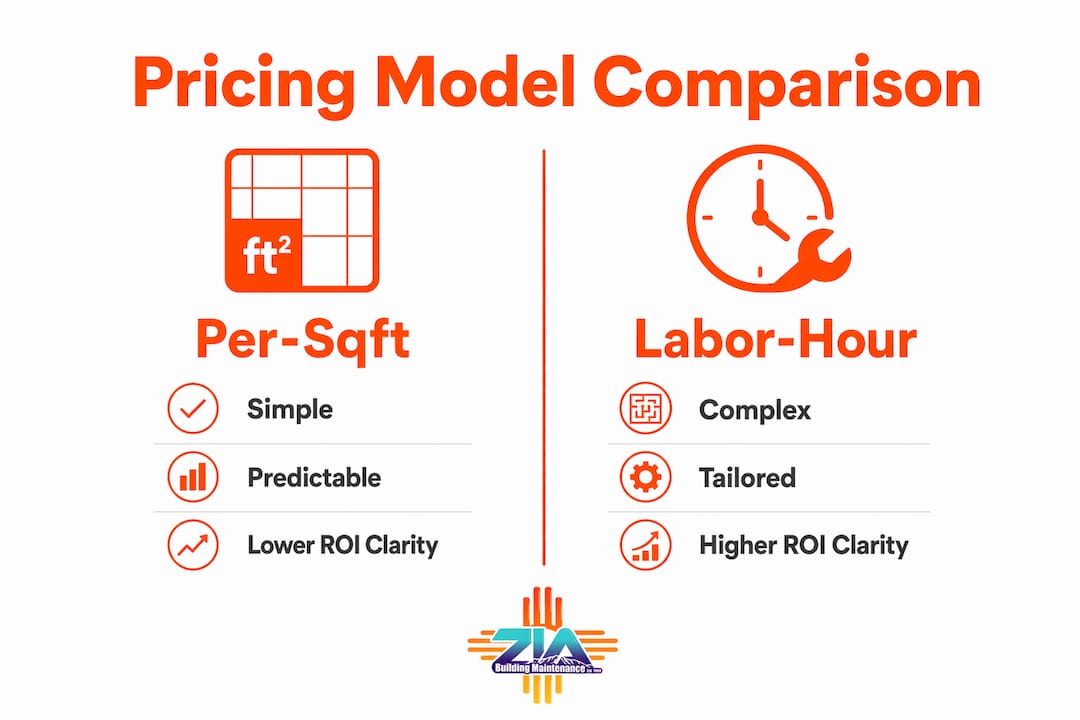
Accurate cleaning cost models rely on adjusting production rates for facility specifics, not just applying industry averages without context. A 10,000-square-foot furnished office and a 10,000-square-foot open warehouse require very different labor hours, even though the square footage is identical.
Does preventive cleaning actually protect capital assets?
Commercial carpet maintenance plans costing roughly $2,000 per year can extend carpet asset life from 5 years to 8–10 years. Over a five-year period, that maintenance investment totals $10,000. Replacing the same carpet runs approximately $50,000. The math makes a clear case for preventive care as a capital expenditure strategy, not just a cleanliness preference.
The mechanism behind this return is straightforward. Reactive cleaning, meaning treating only visible stains after they appear, allows soil and grit to work into carpet fibers and accelerate wear. Proactive maintenance that follows a sequence of regular vacuuming, spot treatment, and periodic deep cleaning prevents that accelerated appearance loss entirely.
For facility managers working with annual capital budgets, this matters beyond the asset itself. Deferring a $50,000 carpet replacement by three to five years smooths a significant budget spike. That flexibility lets you reallocate capital to higher-priority projects without compromising the facility’s appearance or safety.
Hard flooring carries the same logic. Regular floor care services that include stripping, sealing, and burnishing on a traffic-adjusted schedule prevent surface degradation that leads to costly resurfacing or replacement. The key is aligning cleaning frequency and method with actual foot traffic patterns, not applying a one-size-fits-all schedule.
- Vacuuming frequency should match daily foot traffic volume, not a fixed weekly schedule.
- Periodic deep cleaning intervals should be set by traffic data, not calendar months alone.
- Spot treatment protocols should be documented so reactive cleaning does not substitute for scheduled maintenance.
- Preventive maintenance planning for flooring assets belongs in the same financial conversation as HVAC or roof maintenance.
How does infection control affect cleaning ROI?
Infection control is one of the most misunderstood cost variables in cleaning budget planning. CDC-aligned guidance recommends enhanced routine cleaning with EPA-registered disinfectants for isolated cases in a workplace, while reserving professional decontamination for larger outbreaks or facilities with vulnerable populations. Choosing the wrong level in either direction creates direct financial risk.
Over-investing in professional decontamination for routine situations inflates your cleaning budget without a proportional return. Under-investing by skipping enhanced routine cleaning after a confirmed illness event creates liability exposure and potential OSHA compliance issues. The guidance also recommends waiting 24 hours before cleaning an affected workspace where possible, which reduces the risk of surface-to-person transmission during the cleaning process itself.
Compliance documentation is where many businesses leave money on the table. ROI for disinfectant compliance requires verifying product claims and contact times, then documenting that verification to protect contract eligibility and guard against regulatory penalties. A cleaning provider that cannot produce EPA List N product verification and contact time records is a liability, not an asset, to your facility.
Pro Tip: Ask your cleaning contractor to provide written documentation of the disinfectants used, their EPA registration numbers, and the required contact times for each pathogen claim. This documentation protects you during OSHA inspections and contract renewals.
For healthcare and school environments, the stakes are higher still. Zia Building Maintenance addresses this directly through OSHA and HIPAA compliant cleaning protocols that include product verification and service documentation as standard practice.
Comparing pricing models and their effect on ROI clarity
Commercial cleaning pricing typically ranges from $0.05 to $0.15 per square foot per month for weekly office cleaning. Medical facilities and gyms sit at the higher end of that range due to infection control requirements and higher labor intensity. Those anchor figures are useful for initial budgeting, but they do not tell you whether a specific bid reflects the actual labor required for your facility.
Per-square-foot pricing works well for simple, open-plan spaces where production rates are predictable and variance factors are minimal. A single-floor office with minimal furniture and standard restroom counts fits this model cleanly. The ROI calculation is transparent because the cost driver, area, is easy to verify.
Labor-hour pricing based on ISSA benchmarks is superior for complex facilities. Medical offices, schools, and multi-use commercial buildings have variable task mixes, obstacle densities, and compliance requirements that a flat rate cannot capture. When you understand the cleaning cost analysis behind a bid, you can evaluate whether the labor allocation matches your facility’s actual needs.
The practical implication for decision-makers is this: a lower per-square-foot rate does not automatically mean better ROI. A bid that underestimates labor hours will either result in service shortcuts or contract renegotiation within months. Both outcomes cost more than paying the right price from the start. Understanding office cleaning versus janitorial service distinctions also affects how you structure contracts and measure return.
Key Takeaways
Professional cleaning ROI is best measured through labor-hour benchmarks, preventive asset maintenance, and documented compliance practices, not by contract price alone.
| Point | Details |
|---|---|
| Use ISSA benchmarks for bids | Require contractors to show ISSA 447-based labor-hour calculations, not just a flat per-sqft rate. |
| Preventive maintenance protects CapEx | A $2,000/year carpet plan can defer a $50,000 replacement by 3–5 years. |
| Match cleaning level to infection risk | Enhanced routine cleaning covers most workplace cases; professional decontamination is for outbreaks or sensitive facilities. |
| Document compliance for every service | EPA product verification and contact time records protect against OSHA penalties and contract disqualification. |
| Pricing model affects ROI transparency | Labor-hour bids give clearer ROI visibility than flat per-sqft rates in complex or high-traffic facilities. |
What I’ve learned about building a defensible cleaning ROI model
Working with ISSA standards and real facility data over many years has taught me one consistent lesson: the biggest ROI failures come from treating cleaning as a commodity purchase rather than a facility management decision. Businesses that shop purely on price almost always end up with underbid contracts, service gaps, and accelerated asset wear that costs far more than the savings they captured upfront.
The variance factor problem is real and underappreciated. A furnished, obstacle-dense office can require twice the labor hours of an open-plan space with the same square footage. When a contractor ignores that variance, the bid looks competitive but the service delivery suffers. I have seen facilities where the cleaning contract looked like a bargain on paper but the carpet needed replacement two years ahead of schedule because the maintenance cadence was never properly funded.
The most effective approach I have seen is when facility managers treat cleaning as part of their asset management program, not a separate line item. That means aligning cleaning frequency with traffic data, building preventive maintenance schedules into the capital budget, and requiring compliance documentation as a contract deliverable. When you do that, the ROI becomes measurable and defensible, not just assumed.
Collaboration between facility managers and cleaning contractors is the piece most decision-makers skip. A contractor who understands your facility’s traffic patterns, compliance requirements, and asset replacement schedule can deliver far better ROI than one who simply shows up on a fixed schedule. The conversation before the contract is where the return gets built.
— Ashley
See how Zia Building Maintenance delivers measurable cleaning ROI
Zia Building Maintenance has served Albuquerque businesses since 1989, applying ISSA-aligned benchmarks and documented cleaning protocols to offices, medical facilities, and schools across the region. Every service plan is built around your facility’s specific traffic patterns, compliance requirements, and asset protection goals, not a generic schedule.
Whether you need consistent office cleaning services that protect your floors and furnishings, or compliance-grade janitorial programs for healthcare environments, Zia Building Maintenance brings the documentation and consistency that turn cleaning from a cost center into a measurable return. Rated the number one office cleaning service in South Valley for 2025, Zia Building Maintenance is ready to build a cleaning plan that works for your budget and your facility. Request an estimate today.
FAQ
What is cleaning ROI for businesses?
Cleaning ROI is the measurable financial return generated by professional cleaning investments through reduced asset replacement costs, lower absenteeism, and avoided compliance penalties. Cleaning ROI is driven primarily by labor-hour efficiency and preventive maintenance outcomes.
How do ISSA 447 production rates affect cleaning costs?
ISSA 447 rates convert square footage into labor hours for specific cleaning tasks, giving contractors and facility managers a shared basis for accurate bid pricing. Ignoring site-specific variance factors when applying these rates can underprice labor by 40–90%, which leads to service shortfalls.
How often should a commercial facility be professionally cleaned?
Cleaning frequency should align with foot traffic volume and facility type, not a fixed calendar schedule. You can review office cleaning frequency guidelines to match service intervals to your building’s actual usage patterns.
Does professional cleaning reduce employee absenteeism?
Professional cleaning reduces the spread of pathogens in shared workspaces, which directly lowers illness-related absenteeism. A cleaner office environment also reduces productivity friction caused by cluttered or unsanitary conditions.
What documentation should a cleaning contractor provide for compliance?
A compliant cleaning contractor should provide EPA registration numbers for all disinfectants used, documented contact times for each pathogen claim, and service logs verifiable during OSHA inspections. Missing documentation creates contract disqualification risk and potential regulatory liability.