
TL;DR:
- Professional janitorial services for property management ensure building cleanliness, safety, and tenant satisfaction through scheduled, supervised crews. Combining nightly cleaning with daytime porters offers comprehensive coverage, especially for high-traffic buildings. Effective vendor selection, onboarding, and ongoing management are essential for maintaining quality and long-term tenant retention.
Professional janitorial services for property management are defined as contracted cleaning programs that maintain building cleanliness, safety, and tenant satisfaction through scheduled, supervised crews. When you hire janitorial service for property management, you are not simply buying mops and labor. You are buying consistency, liability protection, and a direct line of defense against tenant turnover. Providers like Signature Janitorial Services and Fraser Commercial have built their models around the specific demands of multi-tenant buildings, offering structured programs that go far beyond a weekly sweep. This guide walks you through service models, vendor selection, onboarding, and long-term management so you get results that hold.
What service models do janitorial companies use for property management?
Professional janitorial services for property managers fall into two primary models: nightly janitorial and day porter. Understanding the difference determines whether your building stays clean or just looks clean at certain hours.
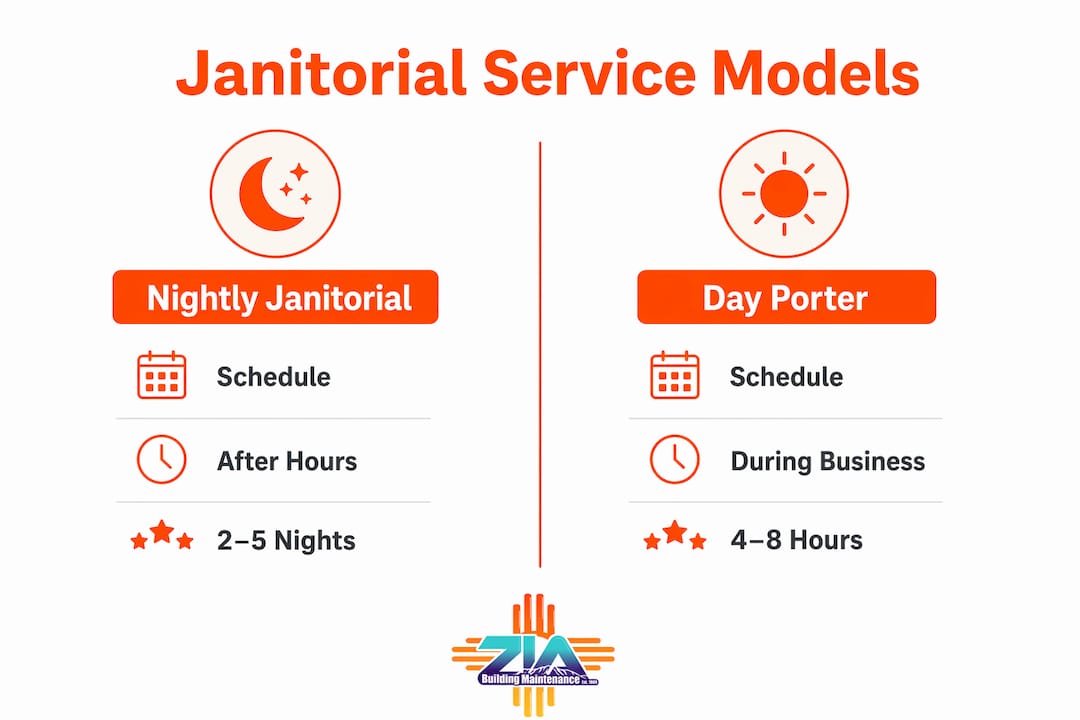
Nightly janitorial covers after-hours cleaning, typically scheduled 2–5 nights per week. Crews work without interrupting tenants or foot traffic, handling restroom sanitation, trash removal, floor care, and surface disinfection. This model suits office buildings, medical facilities, and schools where daytime operations cannot be disrupted.
Day porter service places a dedicated crew member on-site during business hours, typically 4–8 hours daily. The porter handles real-time spills, restroom restocking, lobby upkeep, and common area maintenance as issues arise. High-traffic properties like retail centers and mixed-use buildings benefit most from this model.
| Feature | Nightly janitorial | Day porter |
|---|---|---|
| Schedule | 2–5 nights per week | 4–8 hours daily during business hours |
| Primary tasks | Deep cleaning, floors, restrooms | Spills, restocking, lobby upkeep |
| Best for | Offices, medical, schools | Retail, mixed-use, high-traffic lobbies |
| Tenant disruption | None | Minimal |
| Response to incidents | Next scheduled visit | Immediate |
Many property managers discover that neither model alone covers every need. A combined program, nightly cleaning plus a part-time day porter, delivers the most complete coverage for larger or higher-traffic properties. You can explore the differences in detail before committing to a single model.
Pro Tip: If your building has a mix of office tenants and ground-floor retail, start with nightly janitorial and add a part-time day porter for the lobby and restrooms. The cost difference is modest, and the visible cleanliness improvement is immediate.
How do you evaluate and select the best janitorial service?
The hiring process for commercial cleaning services starts with a mandatory, no-obligation site walkthrough. Custom proposals are built around your building’s size, foot traffic, and specific scope requirements. No credible vendor quotes a flat rate without seeing the property first. If a company sends a price without visiting, that is a red flag.
During the walkthrough, pay attention to how the vendor representative asks questions. A strong vendor asks about tenant schedules, floor types, restroom counts, and any specialized areas like server rooms or medical suites. A weak vendor measures square footage and leaves.
Here is what to verify before signing any contract:
- Supervision structure. Ask who manages the crew on-site and how often supervisors inspect completed work. Consistent cleaning quality depends on supervision and stable crews, not just products or equipment.
- In-house vs. franchise model. Fully in-house teams offer better training, faster issue resolution, and clearer accountability than franchise operations, which may subcontract tasks without your knowledge.
- Background checks and training. Verify that all crew members pass background screening and receive documented training on your building’s specific requirements.
- OSHA compliance and insurance. Confirm the vendor carries general liability and workers’ compensation insurance. Outsourcing janitorial services shifts hiring and compliance risk away from you, but only if the vendor is properly insured.
- References from comparable properties. Ask for references from property managers running buildings similar in size and type to yours.
Pro Tip: The lowest bid almost always signals skipped tasks and absent supervision. A vendor charging 20% less than competitors is typically cutting corners on crew hours or management oversight. Focus on value and accountability, not the bottom line of the quote.
Understanding what separates great from mediocre service before you sign a contract saves you months of frustration and re-bidding.
How to onboard a new janitorial service and set clear standards
Smooth onboarding is the difference between a vendor who performs well for six months and one who performs well for six years. The process requires documentation, communication, and a clear quality framework from day one.
-
Schedule the initial walkthrough and priority meeting. Walk the building with the crew supervisor, not just the sales representative. Identify high-priority areas, problem zones, and any tenant-specific requirements. Document everything in writing.
-
Build an itemized scope of work. Without a documented scope tied to measurable inspections, cleaning standards degrade after the first few months. Every task should be listed, assigned a frequency, and linked to an inspection criterion. “Clean restrooms” is not a scope item. “Disinfect all fixtures, restock dispensers, mop floors, and empty trash nightly Monday through Friday” is.
-
Set up your inspection routine. Decide how often you or your facility manager will conduct formal inspections. Weekly spot checks in the first 90 days are standard practice. Document findings with photos and share them with the vendor’s supervisor promptly.
-
Leverage digital tracking tools. Modern janitorial providers use digital platforms for real-time performance tracking and inspection documentation. These systems prevent service drift by creating a timestamped record of completed tasks. Demand access to this data as part of your contract.
-
Establish a rapid response protocol. Define how tenant complaints are reported, who receives them, and what the expected response time is. A 24-hour response window for non-emergency issues and a 4-hour window for urgent problems is a reasonable standard.
-
Train on-site for building-specific needs. Even experienced crews need a building-specific orientation. Walk them through your HVAC room, utility closets, tenant suite access procedures, and any areas requiring special handling.
The onboarding process sets the tone for the entire vendor relationship. Invest time here and you will spend far less time managing problems later.
How do you maintain janitorial quality for long-term tenant retention?
Poor janitorial quality is the number one reason for tenant turnover in multi-tenant properties. That single fact should shape how seriously you treat ongoing vendor management. Cleanliness is not a background function. It is a direct driver of property value and lease renewals.
Routine supervisory inspections are the backbone of long-term quality. Schedule formal audits monthly and document results using a standardized checklist. Share the results with your vendor’s account manager and require a written response to any deficiencies within 48 hours.
Communication channels matter as much as inspections. Create a direct line between your property management team and the cleaning crew supervisor. Tenant complaints should reach the vendor the same day they reach you. Delays in communication allow small issues to become lease-breaking grievances.
Integrated cleaning programs outperform fragmented vendor arrangements. Combining routine janitorial upkeep with scheduled commercial cleaning projects like carpet extraction and floor refinishing under one vendor reduces coordination overhead and improves results. Managing two separate vendors for routine and deep cleaning creates gaps in accountability.
Pro Tip: Review your scope of work every six months. Tenant turnover, seasonal traffic changes, and building renovations all affect cleaning requirements. A scope written at contract signing may be outdated within a year. Adjust frequency and task lists proactively rather than waiting for complaints.
Tracking the benefits of consistent janitorial programs over time gives you concrete data to justify vendor investment to ownership and stakeholders.
Key takeaways
Hiring the right janitorial service for property management requires matching service models to building needs, vetting vendors on supervision and accountability, and maintaining quality through documented inspections and clear communication.
| Point | Details |
|---|---|
| Match the service model | Use nightly janitorial for offices and day porter for high-traffic lobbies, or combine both for full coverage. |
| Require a site walkthrough | No credible vendor quotes without visiting your property; custom proposals reflect real scope and traffic. |
| Prioritize supervision over price | In-house crews with active supervisors outperform low-bid franchise models on consistency and issue response. |
| Document the scope of work | Itemized, inspection-linked scopes prevent service drift and give you enforceable quality standards. |
| Review and adjust regularly | Update your scope every six months to reflect traffic changes, tenant needs, and seasonal demands. |
What I have learned after years of watching property managers get this wrong
I have reviewed a lot of janitorial contracts over the years, and the pattern is almost always the same. A property manager selects a vendor based on price, skips the scope documentation, and then spends the next year chasing the vendor for missed tasks. The frustration is real, but the root cause is almost always a process failure, not a vendor failure.
The most common mistake I see is treating janitorial service as a commodity purchase. It is not. You are hiring a management relationship. The cleaning is the output. The supervision, communication, and accountability systems are what actually determine whether that output stays consistent.
I am also skeptical of the assumption that technology alone solves quality problems. Digital tracking platforms from providers like Service by Medallion are genuinely useful. But a timestamped log of completed tasks only matters if someone reviews it and acts on the data. Technology without human oversight is just documentation of decline.
The property managers who get the best results are the ones who treat their janitorial vendor as a building partner. They share tenant feedback, adjust scopes proactively, and hold quarterly performance reviews. That level of engagement is not excessive. It is the minimum required to protect your property’s reputation and your tenants’ experience.
One more thing worth saying directly: OSHA compliance and risk management for property managers are not abstract concerns. A slip-and-fall in a poorly maintained lobby or a restroom that fails a health inspection creates liability that far exceeds the cost of a well-managed cleaning program. The investment in quality pays for itself.
— Ashley
How Zia Building Maintenance supports property managers in Albuquerque
Zia Building Maintenance has served property managers and business owners in Albuquerque since 1989, earning the title of the #1 office cleaning service in South Valley for 2025. Every program starts with a no-obligation walkthrough and a customized scope built around your building’s size, traffic, and tenant requirements.
Zia Building Maintenance uses experienced in-house crews, not subcontractors, so you get consistent personnel, clear accountability, and faster issue resolution. Transparent pricing and digital quality tracking are standard, not add-ons. Whether you manage a single office building or a portfolio of mixed-use properties, Zia Building Maintenance builds a program that fits. Discover how a professional janitorial program can save your property time and money and request your estimate today.
FAQ
What is the difference between janitorial and commercial cleaning services?
Janitorial service covers routine upkeep like nightly cleaning, trash removal, and restroom sanitation. Commercial cleaning refers to specialized deep cleaning projects such as carpet extraction and floor refinishing, and both should be integrated under one vendor for best results.
How often should a property manager schedule janitorial service?
Most office and multi-tenant properties require nightly janitorial service 3–5 nights per week, with day porter coverage during business hours for high-traffic common areas. Frequency should be adjusted based on foot traffic and tenant feedback.
Why does janitorial quality affect tenant retention?
Poor janitorial quality is the leading cause of tenant turnover in multi-tenant properties. Clean, well-maintained common areas signal professionalism and reduce daily complaints, directly supporting lease renewals and property value.
What should a janitorial service contract include?
A strong contract includes an itemized scope of work, task frequencies, inspection criteria, supervisor contact information, and a defined response protocol for complaints. Without clear documentation, cleaning standards typically decline within the first few months.
Is outsourcing janitorial services better than hiring in-house staff?
Outsourcing shifts hiring, training, and compliance liability to the vendor, reducing your exposure to workplace injury claims and regulatory fines. For most property managers, a qualified outsourced provider delivers better results at lower total cost than managing an in-house custodial team.