

Essential Scope of Commercial Warehouse Cleaning Services
Maintaining a massive logistics hub or manufacturing plant requires a structured approach. Unlike basic retail footprints, an industrial facility encompasses multiple zones with drastically different sanitation needs. Understanding what is commercial property maintenance cleaning at an industrial scale starts with mapping these zones:
- Primary Concrete Slabs & Aisles: High-traffic forklift lanes, staging zones, and pallet racking aisles that collect rubber tire marks, hydraulic fluid drips, and fine grit.
- Loading Docks & Staging Bays: High-friction zones exposed to exterior weather, diesel exhaust, road debris, and heavy transfer traffic.
- High-Bay Storage & Overhead Infrastructure: Elevated structural beams, trusses, sprinkler pipes, and HVAC ductwork where airborne dust settles over months of operation.
- Ancillary Operational Spaces: Dock master stations, shipping desks, break rooms, locker rooms, and multi-stall restrooms that experience extreme traffic spikes during shift changes.
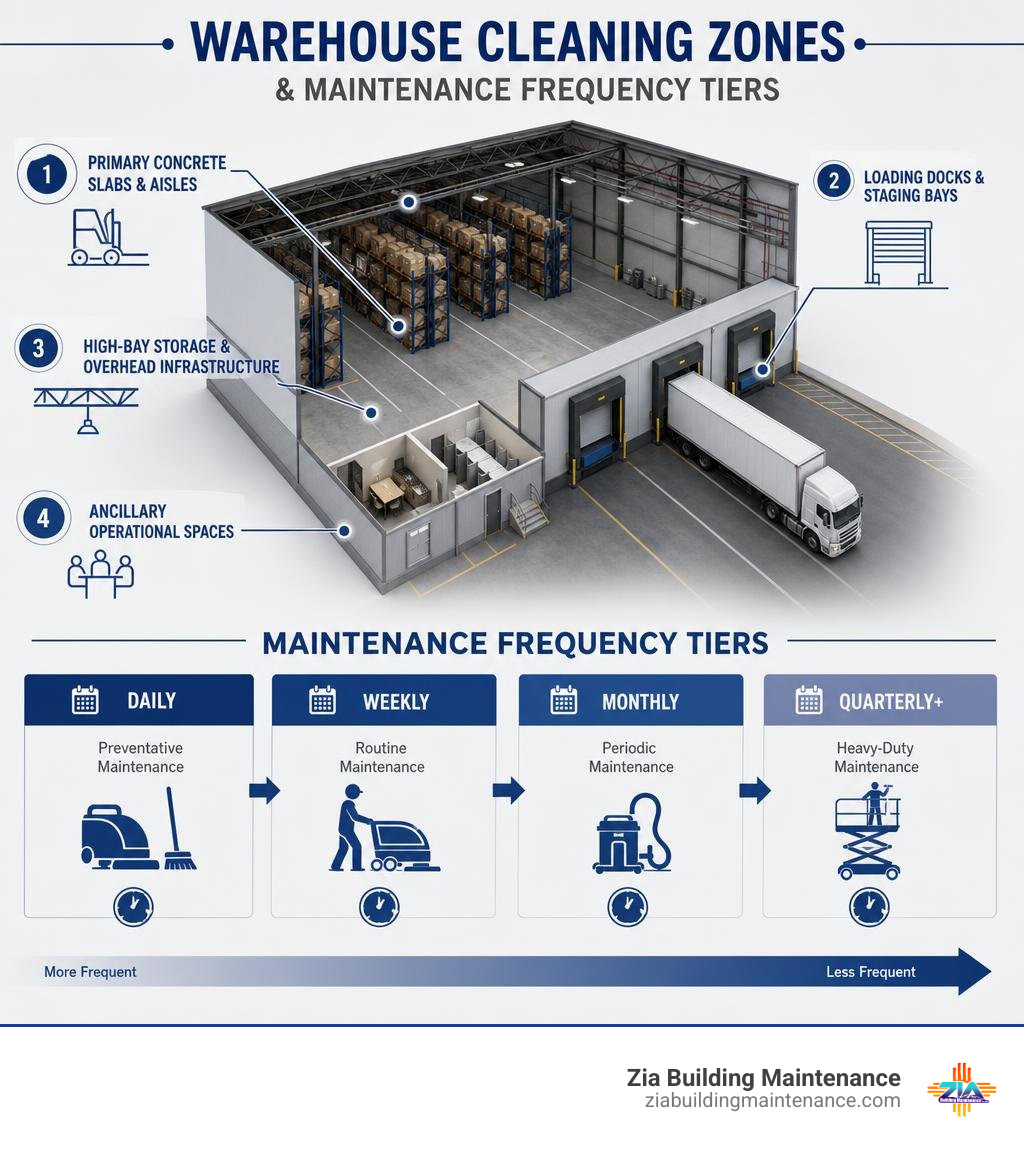
A comprehensive commercial warehouse cleaning program separates low-frequency heavy interventions (like overhead rafter vacuuming or slab resealing) from daily preventative maintenance (such as walkway sweeping and dock sanitation). By breaking down a facility into targeted operational zones, facilities maintain safe, inspection-ready standards without halting active pick-and-pack lines.
Industrial Facility Upkeep vs. General Janitorial Services
There is a vast difference between standard office cleaning and industrial warehouse sanitation. While light office janitorial focuses on emptying desk trash bins and vacuuming carpet runners, industrial cleaning tackles harsh contaminants and enforces stringent safety standards. Having a clear property cleaning scope of work explained helps logistics managers avoid hiring a vendor equipped only with standard mops for a 100,000-square-foot concrete floor.
| Feature / Requirement | General Janitorial Services | Industrial Warehouse Sanitation |
|---|---|---|
| Primary Environment | Commercial offices, retail shops, lobbies | Distribution centers, cross-docks, manufacturing plants |
| Floor Substrates | VCT, laminate, low-pile carpet, ceramic tile | Polished concrete, bare slab, heavy-duty epoxy coatings |
| Typical Contaminants | Dust, paper debris, light spills, footprints | Heavy oil, hydraulic grease, forklift tire marks, wood splinters |
| Equipment Deployed | Upright vacuums, mop buckets, microfiber dusters | Ride-on auto-scrubbers, power sweepers, scissor lifts, HEPA vacuums |
| Safety Compliance | Basic chemical handling, wet floor signs | OSHA General Industry standards, SDS compatibility, PPE matrices |
| Scheduling Constraints | Standard evening cleans after office hours | 24/7 continuous operations, shift changes, shoulder-shift windows |
Critical Facility Zones Beyond the Main Slab
Industrial operations frequently report that general cleaning vendors focus solely on the broad concrete aisles while neglecting the surrounding high-touch areas. Comprehensive commercial cleaning services bridge this gap by addressing:
- Office Mezzanines & Elevated Workstations: Dust and diesel soot migrate upward. Mezzanines require specialized dust control, HVAC vent sanitization, and detailed glass cleaning to keep management spaces functional and clean.
- High-Volume Shift-Change Restrooms: Facilities with 100+ floor workers need rapid-turnaround restroom protocols. This includes floor degreasing to prevent slick tile surfaces, heavy-duty fixture disinfection, and high-capacity consumable restocking.
- Break Rooms & Locker Facilities: High-traffic lunchrooms accumulate food residues that attract pests if not deep-cleaned on structured schedules.
- Dock Offices & Shipping Desks: These compact spaces handle high foot traffic and require regular surface disinfection, keyboard cleaning, and floor care to keep dispatchers productive.
Why High-Traffic Distribution Centers Rely on Commercial Warehouse Cleaning Services
A dirty warehouse floor is a safety and operational hazard. Concrete dust and discarded pallet chips create slippery conditions that compromise forklift traction. Understanding why professional warehouse cleaning in albuquerque is a heavy duty necessity comes down to three measurable operational impacts:
- Slip and Fall Mitigation: Residual oils, shrink wrap fragments, and loose dust create significant slip risks for both foot traffic and material handling equipment.
- Asset Longevity: Fine abrasive dust acts like sandpaper under forklift wheels, wearing down slab coatings and clogging sensitive mechanical components on automated conveyor belts.
- Worker Respiratory Health: Enclosed distribution centers with poor air turnover trap airborne particulate matter, reducing indoor air quality and leading to worker fatigue or increased sick days.
Heavy-Duty Equipment, Degreasing, and High-Bay Cleaning Methods
Cleaning an active industrial slab cannot be achieved with traditional household tools. Crews rely on specialized machinery that cleans, degreases, and dries floors in a single pass.

Effective industrial sanitization pairs specialized equipment with safe operational systems when cleaning complex logistics facilities. For floor maintenance, commercial crews deploy:
- Ride-On Industrial Auto-Scrubbers: These machines apply custom-metered degreasing chemistry, scrub the slab using aggressive disc or cylindrical brushes, and immediately vacuum up dirty slurry via high-power squeegee assemblies.
- Heavy-Duty Power Sweepers: Equipped with multi-stage filtration, sweepers capture everything from heavy pallet fragments to fine particulate without generating fugitive dust clouds.
- Industrial-Strength Degreasers: Formulated to break the chemical bond between petroleum-based oils and porous concrete without degrading underlying sealers.
- Insulated Cleaning Tools: Required when operating near electrical busways, high-voltage substations, or automated sorting equipment.
Expert floor care service ensures that the cleaning solution matches the exact porosity and chemistry of the facility’s slab.
wp:html
/wp:html
wp:html
/wp:html
High Dusting and Overhead Air Quality Control
Overhead dust collection is one of the most overlooked hazards in distribution centers. Vibrations from overhead cranes, HVAC blowers, and truck docks cause accumulated dust on joists and light fixtures to fall onto inventory and equipment below.

Implementing routine warehouse dust control utilizing scissor lifts, telescoping carbon-fiber poles, and sealed HEPA filtration vacuums captures fine dust, allergens, and combustible debris directly at the source. This keeps lighting fixtures operating at peak lumens, prevents fire risks in overhead roof voids, and protects open inventory from particulate contamination.
Concrete Slab Restoration and Protective Sealing
Beyond everyday maintenance, concrete slabs undergo significant wear. For operations teams setting up initial maintenance routines, our commercial warehouse floor cleaning a quick start guide outlines how deep chemical extraction removes embedded petrochemicals from porous concrete. Once deep-cleaned, applying high-solid sealers or polishing bare concrete densifies the surface, preventing concrete dusting and making future daily maintenance significantly more efficient.
Operational Logistics, Safety Standards, and Cost Considerations
Executing industrial cleaning inside an active facility demands absolute adherence to safety protocols. Industrial teams must integrate into existing facility safety matrices before touching a single tool.

Professional providers follow strict workplace safety frameworks, emphasizing site-specific onboarding, comprehensive SDS reviews, and proper PPE deployment.
Every industrial cleaning workflow requires:
- OSHA General Industry Standards (29 CFR 1910): Strict adherence to walking-working surfaces rules, spill response, and hazard communications.
- Safety Data Sheet (SDS) Alignment: Reviewing the facility’s chemical registry on day one to ensure cleaning chemicals do not react with stored or manufactured inventory.
- PPE Protocols: Technicians must be outfitted in steel-toe boots, ANSI-approved eye protection, high-visibility class 2 vests, and hard hats when operating around active machinery.
- Zero-Downtime Scheduling: Structuring maintenance during shoulder-shifts, weekend pauses, or overnight changeovers to ensure zero disruption to logistics throughput.
Our local commercial cleaning albuquerque teams regularly coordinate with safety officers across Albuquerque, Rio Rancho, Corrales, and Los Ranchos to ensure all on-site work strictly aligns with local facility risk assessments.
Pricing Models and Estimating Costs for Commercial Warehouse Cleaning Services
Industrial cleaning pricing reflects facility layout, operational speed, square footage, and chemical requirements. For managers planning maintenance budgets, our breakdown on commercial cleaning cost per square foot helps illustrate common pricing tiers across the market:
- Small Warehouses (<10,000 sq. ft., heavy office mix): $1,200 – $2,800 per month.
- Mid-Size Distribution Facilities (10,000 – 50,000 sq. ft.): $3,500 – $8,500 per month.
- Large Logistics & Cross-Dock Hubs (50,000 – 150,000+ sq. ft.): $8,500 – $22,000+ per month.
Variables that influence cost include the ratio of open warehouse floor to mezzanine office space, the frequency of required ride-on auto-scrubbing, and whether high-bay lift work is required on a monthly, quarterly, or annual cadence.
Sustainable Green Cleaning and Worker Health
Modern industrial facilities increasingly prioritize sustainable, low-impact cleaning chemistries. By swapping harsh solvents for water-based, biodegradable degreasers, facilities lower volatile organic compound (VOC) emissions, protecting worker respiratory health and reducing environmental runoff during waste disposal. Integrating electrostatic disinfection into break rooms and restrooms provides broad-spectrum pathogen control without soaking surfaces in toxic residues.
Frequently Asked Questions About Industrial Warehouse Cleaning
How often should an active warehouse or distribution center be professionally cleaned?
Cleaning frequency is driven by inventory turnover, forklift traffic, and operating hours:
- Daily: Trash clearing, high-traffic aisle sweeping, dock cleanups, and multi-shift restroom/breakroom sanitation.
- Weekly / Bi-Weekly: Comprehensive ride-on floor scrubbing, walkway degreasing, and entry mat extraction.
- Monthly / Quarterly: Deep tire mark removal, mezzanine detailing, high-bay structural dusting, and overhead fixture cleaning.
Can heavy-duty floor scrubbing be performed during active operating shifts?
Yes. Professional industrial cleaners use ride-on scrubbers equipped with high-efficiency squeegee vacuums that leave slabs clean, dry, and immediately walkable within seconds. Crews work in zoned, barricaded sections or operate during scheduled shoulder shifts to prevent cross-traffic between industrial sweepers and active material handling equipment.
What insurance and safety credentials should industrial cleaning contractors possess?
When vetting an industrial cleaning partner, ensure they provide:
- A Certificate of Insurance showing at least $2M in General Liability coverage, complete Workers’ Compensation, and commercial auto insurance.
- OSHA 10/30-trained crew leads and certified operators for scissor lifts and boom lifts.
- W-2 employed, background-checked, and badged personnel equipped with standard industrial PPE.
Conclusion: Selecting the Right Industrial Cleaning Partner
Maintaining clean, safe, and compliant industrial slabs requires specialized machinery, rigorous safety training, and flexible scheduling. From scrubbing high-traffic forklift lanes to eliminating dust in overhead rafters and keeping shift restrooms spotless, partnering with an experienced service provider protects your building assets and keeps your workforce productive.
At Zia Building Maintenance, we have provided dependable, detail-driven commercial cleaning and janitorial solutions across Albuquerque and surrounding areas since 1989. Connect with our team today to develop a customized plan using our professional warehouse floor cleaning solutions tailored specifically to your facility’s layout and operational cadence.