
TL;DR:
- Cleaning vendor vetting involves evaluating service providers to ensure compliance, safety, and reliability. It prevents legal, security, and service issues by thoroughly assessing licenses, insurance, workforce practices, and quality control systems before contract signing.
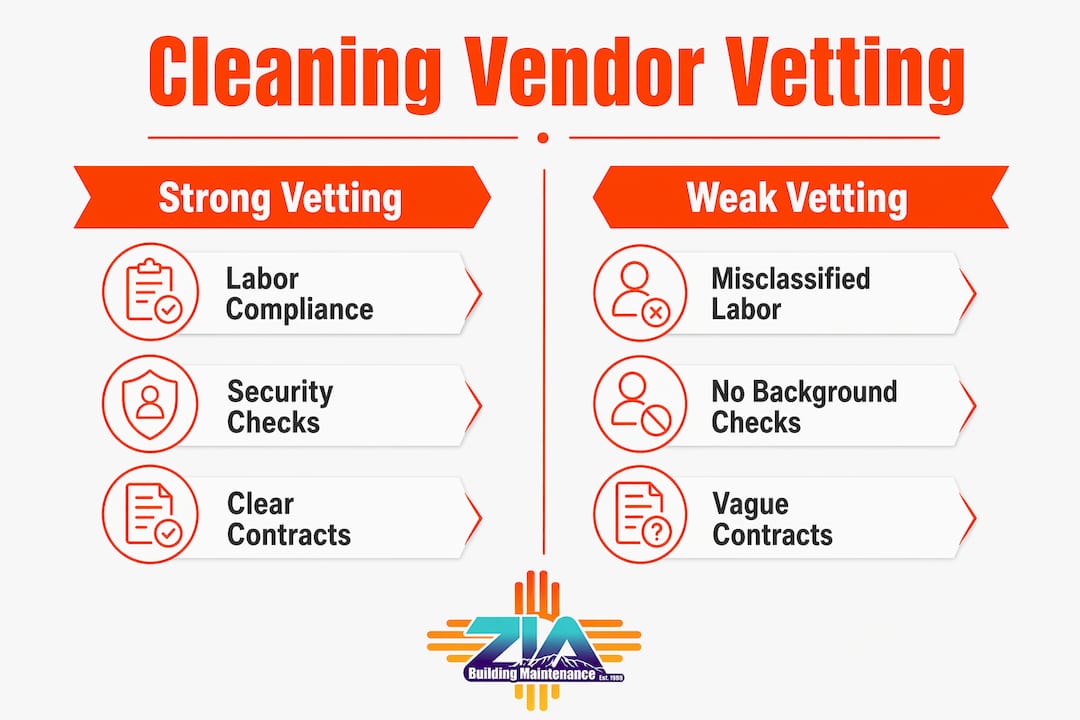
Cleaning vendor vetting is the process of thoroughly evaluating potential cleaning service providers to confirm they meet your organization’s standards for quality, compliance, safety, and reliability. Why cleaning vendor vetting matters for businesses goes well beyond finding the lowest bid. A poorly chosen vendor exposes your facility to OSHA violations, labor law liability, security breaches, and inconsistent service that erodes your professional environment. The right vetting process protects your assets, your people, and your reputation before a single mop hits the floor.
Why cleaning vendor vetting matters for businesses: core criteria to evaluate
Selecting a cleaning vendor without a structured assessment process is the single fastest way to inherit someone else’s compliance problems. A defensible vendor assessment process evaluates every bid against the same criteria so vendors compete on identical terms, not on whichever line items they chose to highlight.
The core criteria every facility manager should verify include:
- Business registration and licensing. Confirm the vendor holds a valid state business registration. An unregistered vendor creates immediate legal exposure for your organization.
- Liability insurance and janitorial bonding. Require certificates of insurance with your facility named as an additional insured. Bonding protects you against theft by cleaning staff.
- Workers’ compensation coverage. Verify valid insurance that matches the vendor’s actual workforce size. A policy covering only a fraction of their real workforce signals payroll underreporting and leaves you exposed when an injury occurs on your property.
- Labor law compliance certifications. Ask vendors to confirm compliance with federal and state wage laws, including proper employee classification. This step reduces your reputational and legal risk significantly.
- Scope of work specificity. Require task-level detail, not just frequency. A contract that says “clean restrooms nightly” is unenforceable. One that specifies disinfecting fixtures, restocking supplies, and mopping with a hospital-grade solution is not.
- Quality control processes. Ask how the vendor documents service delivery. Strong partners use inspection systems with scoring, timestamped photos, and trend reports to flag deficiencies before they become complaints.
- Issue resolution protocols. Confirm the vendor has a defined process for re-cleans, escalations, and client communication when service falls short.
Pro Tip: Request a sample quality control report from any vendor you are seriously considering. A vendor who cannot produce one does not have a real quality control program.
The importance of vendor vetting becomes clear the moment you compare a vendor who checks every box against one who only checks price. The difference shows up in your facility within weeks.

How does labor classification affect cleaning service reliability?
Labor is the single largest cost in any cleaning contract, typically accounting for 60–70% of total contract cost. That fact has a direct consequence for facility managers: a bid that comes in significantly below market almost always reflects below-market wages, which creates a chain of problems.
Here is how labor classification issues play out in practice:
- Below-market wages drive turnover. 78% of cleaning companies report difficulty retaining workers, and industry turnover averages 42%. When staff rotate constantly, your facility never gets a crew that knows your building, your standards, or your security protocols.
- High turnover increases your retraining costs. Every new worker requires orientation, access provisioning, and supervision. Those costs are real even when the vendor absorbs them on paper.
- Misclassified contractors create joint employer liability. Joint employer liability laws mean that a vendor who misclassifies employees as independent contractors can pull your organization into wage and hour disputes. You did not hire those workers, but you may share legal exposure.
- Underreported payroll produces inadequate workers’ comp coverage. When a vendor’s workers’ compensation policy covers fewer workers than they actually deploy in your facility, any on-site injury becomes a financial and legal problem for you.
- Service inconsistency follows workforce instability. A crew that changes every few weeks cannot deliver consistent results. Inconsistency in cleaning directly affects indoor air quality, infection control, and the professional appearance of your space.
Pro Tip: Ask every finalist vendor for their current workers’ compensation certificate and cross-reference the covered payroll amount against the number of staff they plan to assign to your account. A mismatch is a red flag worth investigating before you sign.
Cleaning vendor reliability is not a personality trait. It is a direct output of how a vendor manages, pays, and retains its workforce. Vetting labor practices is not optional; it is the foundation of cleaning service selection done correctly.
What security risks come with unvetted cleaning vendors?
Cleaning crews operate in your facility after hours, often with keys, access codes, and unsupervised access to executive offices, server rooms, and sensitive records. Security vetting is the most commonly overlooked element of the vendor assessment process, and it is the one with the most immediate consequences when it fails.
A thorough security review covers:
- Background check procedures. Confirm the vendor conducts criminal background checks on all staff assigned to your facility. Some states, including Massachusetts, use CORI checks as a standard. Ask whether checks are run at hire only or on a recurring basis.
- Access issuance and tracking. Verify that the vendor has a formal system for issuing, tracking, and revoking keys, fobs, and access codes. A vendor who hands out keys informally and has no revocation process is a liability.
- Badging and on-site identification. Staff should wear visible identification at all times. This protects your employees and creates accountability for who is in the building.
- Subcontractor oversight. Ask whether the vendor uses subcontractors and, if so, whether those subcontractors go through the same background check and badging process. Subcontractor gaps are a common source of security lapses.
- Supervision protocols. Confirm that a supervisor inspects work and is reachable during cleaning hours. Unsupervised crews with no accountability structure create risk regardless of how good the contract looks on paper.
Security lapses from poor vetting are not hypothetical. A vendor without a formal key tracking system can leave a facility exposed long after a staff member has left the company. The cleaning company qualifications that matter most in sensitive environments are the ones that address access, not just cleanliness.
How do contracts and inspections ensure cleaning service accountability?
A cleaning contract without task-level scope definitions is not a contract. It is a handshake with a price tag. Specifying only frequency without task specificity makes bids incomparable and the contract unenforceable. That gap is where scope drift happens, where services quietly disappear after the first month.
The table below shows the difference between a weak contract structure and one that supports real accountability.
| Contract element | Weak structure | Strong structure |
|---|---|---|
| Scope of work | “Clean offices nightly” | Task-by-task list with products, methods, and frequencies |
| Quality control | Verbal assurances | Scored inspections with timestamped photos and trend reports |
| Issue resolution | “Call us if there’s a problem” | Defined re-clean window, escalation path, and service credit terms |
| Performance metrics | None | Re-clean rate, inspection scores, and compliance tracking |
| Walkthrough process | One-time pre-bid tour | Structured checklist walkthrough with sign-off at contract start |
Formal inspection systems with scoring, timestamped photos, and trend reports are the mark of a vendor who takes accountability seriously. They also give you documented evidence if you ever need to enforce a service credit or terminate a contract for cause.
A structured vendor lifecycle approach that spans procurement, contracting, and ongoing performance management produces far better outcomes than a quick bid exercise. Build inspection walkthroughs into your contract from day one. Review janitorial work quality on a scheduled basis, not just when something goes wrong.
The scope of work detail outweighs price in importance. Clear task definitions enable enforceable contracts and reduce disputes. That single principle, applied consistently, separates facility managers who control their cleaning programs from those who are controlled by them.
Key Takeaways
Thorough cleaning vendor vetting protects businesses from labor liability, security risks, and service failure by verifying compliance, workforce stability, and contract accountability before work begins.
| Point | Details |
|---|---|
| Labor cost signals risk | Labor is 60–70% of contract cost; below-market bids signal wage noncompliance and high turnover. |
| Workers’ comp verification | Match the vendor’s coverage to their actual workforce size to avoid on-site injury exposure. |
| Security protocols are non-negotiable | Verify background checks, access tracking, badging, and subcontractor oversight before signing. |
| Task-level scope is enforceable | Contracts with specific tasks, methods, and frequencies are the only ones you can actually enforce. |
| Inspection systems prove accountability | Vendors with scored, documented inspections deliver consistent results and give you recourse when they do not. |
What I have learned from watching vetting go wrong
I have seen facility managers spend weeks negotiating price and less than an hour reviewing scope. That imbalance is where most cleaning contracts fail. The vendor who wins on price almost always wins because they cut somewhere, and that somewhere is usually wages, insurance, or supervision.
The most expensive mistake I see is treating vendor selection as a procurement event rather than a relationship decision. You are not buying a commodity. You are granting access to your building, your staff, and your clients’ environment. A vendor who cannot show you a quality control report, a workers’ comp certificate that matches their headcount, or a written background check policy is not ready for that responsibility.
Scope clarity is the other issue that never gets enough attention. Facility managers who invest time in defining exactly what they need, room by room and task by task, almost always end up with better service and fewer disputes. Those who hand over a vague scope and hope for the best spend the back half of every contract managing disappointment.
The good news is that a structured vetting process is not complicated. It requires discipline, the right questions, and the willingness to walk away from a vendor who cannot answer them. Businesses that commit to that process build cleaning partnerships that last years, not months.
— Ashley
Zia Building Maintenance: a cleaning partner built for accountability
Zia Building Maintenance has served commercial facilities in Albuquerque since 1989, and the vetting standards described in this article are the same ones the company applies to its own operations. Every client account includes documented quality control, verified insurance, background-checked staff, and a scope of work defined at the task level.
Facility managers who want a professional office cleaning partner that meets every criterion in this article can request a detailed estimate from Zia Building Maintenance. The team works with offices, medical facilities, and schools across the South Valley, and every proposal includes a written scope, inspection protocol, and compliance documentation. For managers who want to build a stronger contract framework first, the commercial cleaning contract checklist is a practical starting point. Contact Zia Building Maintenance to discuss a cleaning program built around your facility’s specific requirements.
FAQ
What is cleaning vendor vetting?
Cleaning vendor vetting is the process of evaluating a cleaning service provider’s licenses, insurance, labor practices, security protocols, and quality control systems before awarding a contract. It confirms the vendor can deliver reliable, compliant service.
Why does labor classification matter when vetting cleaning vendors?
Labor typically accounts for 60–70% of a cleaning contract’s cost. Vendors who misclassify workers or pay below-market wages create turnover, service inconsistency, and potential joint employer liability for your business.
What security checks should I require from a cleaning vendor?
Require documented background check procedures, a formal system for issuing and revoking facility access, visible staff badging, and confirmed oversight of any subcontractors the vendor uses.
How specific should a cleaning contract scope of work be?
The scope should list every task by room, method, product, and frequency. Contracts that specify only cleaning frequency are unenforceable and invite scope drift after the first month.
How do I verify a cleaning vendor’s quality control process?
Ask for a sample inspection report. Strong vendors produce scored reports with timestamped photos and trend data. A vendor who cannot provide one does not have a real quality control program in place.