

Why Floor Maintenance Is the Most Overlooked Cost-Saver in Your Building
Floor maintenance is the regular process of cleaning, protecting, and restoring your floors to extend their life, prevent safety hazards, and keep your facility looking professional.
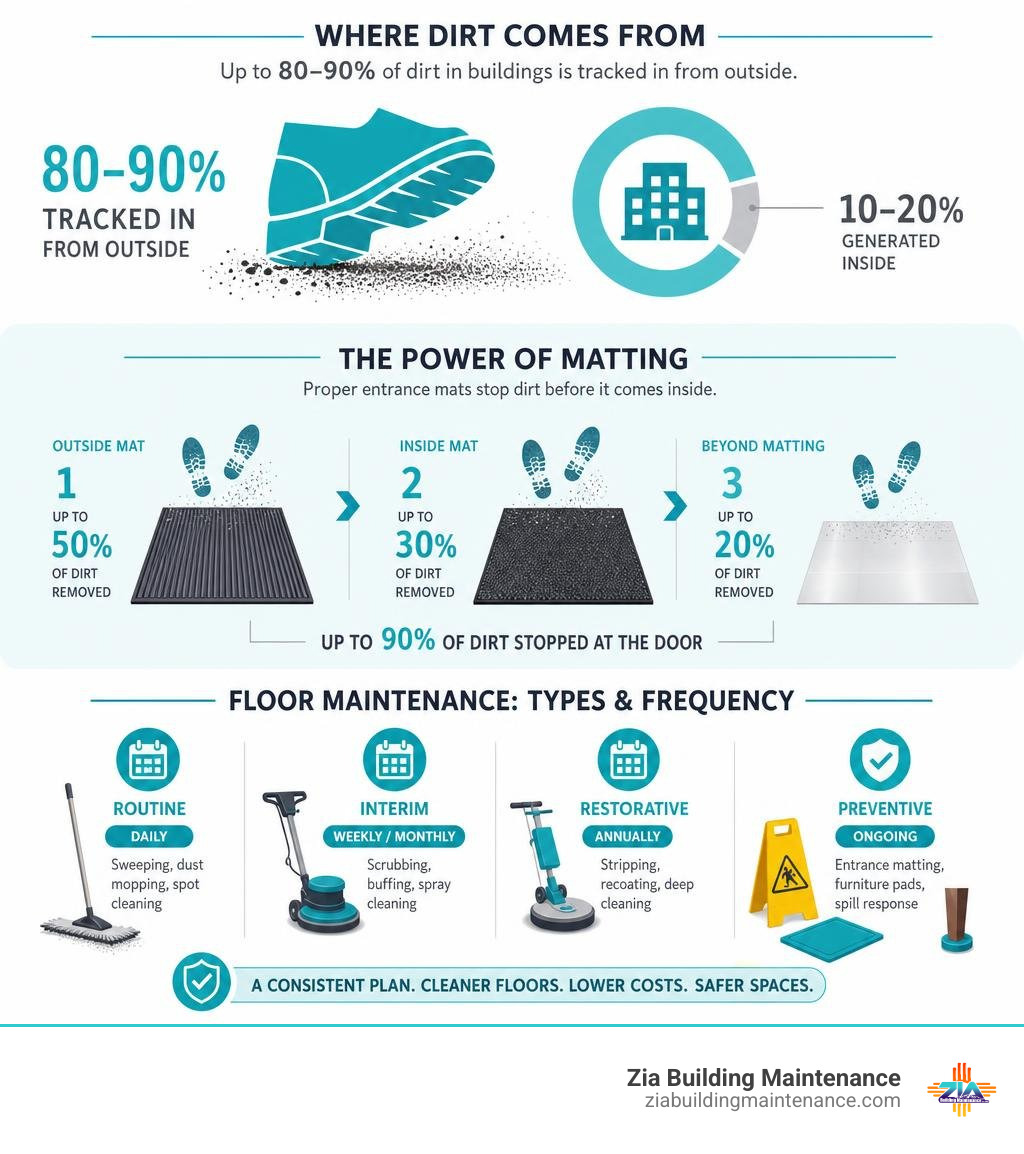
Here’s a quick overview of what proper floor care involves:
| Maintenance Type | Frequency | What It Includes |
|---|---|---|
| Routine | Daily | Sweeping, dust mopping, spot cleaning |
| Interim | Weekly/Monthly | Scrubbing, buffing, spray cleaning |
| Restorative | Annually | Stripping, recoating, deep cleaning |
| Preventive | Ongoing | Entrance matting, furniture pads, spill response |
Your floors take a beating every single day. Up to 80–90% of the dirt, grit, and moisture in commercial buildings is tracked in from outside — and that grit acts like sandpaper underfoot, grinding down your floor finish with every step.
The damage is quiet. You won’t notice it until the finish is gone, the surface is dull, or worse — someone slips and falls. Injuries from slips and trips on level floors are one of the leading causes of accidental injury in commercial spaces.
The good news? Most floor damage is preventable. A consistent, well-planned maintenance program protects your flooring investment, reduces long-term costs, and keeps your facility safe and presentable.
I’m Ashley Cordova, Vice President of Zia Building Maintenance, a family-owned company serving New Mexico since 1989 — and floor maintenance is one of the most common challenges I see Albuquerque facility managers struggle to get right. In this guide, I’ll walk you through everything you need to know to protect your floors and your budget.
Mastering the Four-Step Floor Maintenance Process
To keep your commercial floors looking spectacular and lasting for decades, we rely on a structured, four-step process. Each step is designed for a specific level of wear and requires specialized equipment and floor pads.
The core of this process relies on matching the right pad aggressiveness with the correct machine speed. Floor machines generally fall into three speed categories:
- Low-speed machines (175–350 RPM): Used for heavy-duty stripping, deep scrubbing, and wet polishing.
- High-speed machines (350–1200 RPM): Used for routine spray buffing and light polishing.
- Ultra-high-speed (UHS) machines (1000–3000 RPM): Used strictly for burnishing to achieve a dry, mirror-like gloss.
By consulting a professional General Floor Care Maintenance Guide, we can map out how these steps work together to maximize your floor’s lifespan.
wp:html
/wp:html
wp:html
/wp:html
Step 1: Stripping and Deep Prep
When a floor finish becomes yellowed, chipped, or embedded with deep-seated grit that normal cleaning cannot remove, it is time for a full restoration. Stripping is the process of chemical dissolution of the old finish.
We apply a high-quality stripping solution to loosen the old layers of wax. Then, using a low-speed rotary floor machine (175–350 RPM) paired with a highly aggressive pad, such as an Ultra Blue Stripper pad, we grind away the old finish. This step requires immense care, proper personal protective equipment (PPE), and thorough rinsing to neutralize the floor before applying a new finish. For a detailed breakdown of this phase, check out our guide on stripping and waxing.
Step 2: Scrubbing and Cleaning
For periodic maintenance where the finish is still intact but heavily soiled or scuffed, we perform a deep scrub rather than a full strip. This process removes only the top micro-layers of contaminated finish.
We use automatic scrubbers equipped with a Green Super Scrub pad and a neutral pH floor cleaner. This combination easily lifts heavy scuff marks, grease, and dirt without degrading the underlying floor finish. Regular deep scrubbing is a cornerstone of commercial warehouse floor cleaning and high-traffic retail environments where dirt accumulates rapidly.
Step 3: Buffing and Polishing
Buffing is an interim maintenance step designed to remove light scratches and restore a clean, even luster. This step can be performed using either wet or dry methods.
With a high-speed machine (typically around 175 to 500 RPM) and a soft Red or White buffing pad, we spray a light mist of spray-cleaner or buffing formula onto the floor. The machine polishes out the imperfections, blending minor surface scratches and restoring the floor’s uniform appearance. This is ideal for weekly or bi-weekly maintenance in office corridors and lobbies.
Step 4: High-Speed Burnishing
If you want that jaw-dropping, mirror-like “wet look” gloss, burnishing is the answer. Unlike buffing, burnishing is always performed dry on a completely clean floor.
Using ultra-high-speed (UHS) machines operating at 1000 to 3000 RPM, we pass over the floor with specialized burnishing pads, often containing natural hair fibers. The extreme speed creates friction, which temporarily softens the top layer of floor finish, smoothing out microscopic imperfections to create a highly reflective surface. Burnishing is a dry application that must be done rapidly to prevent heat buildup and finish burning.
Resilient vs. Non-Resilient Flooring Care
Not all floors are created equal. Using the wrong chemical or equipment on a specific material can permanently ruin a costly flooring asset. Flooring is divided into two primary categories: resilient and non-resilient.
| Flooring Category | Common Materials | Key Characteristics | Chemical Compatibility | Preferred Maintenance |
|---|---|---|---|---|
| Resilient | VCT, LVT, Sheet Vinyl, Linoleum, Rubber | Flexible, absorbs impact, quieter underfoot | Tolerates mild alkaline; sensitive to high pH (especially linoleum) | Spray buffing, burnishing, periodic recoating |
| Non-Resilient | Hardwood, Terrazzo, Granite, Concrete, Ceramic Tile | Rigid, highly durable, long lifespan | Highly sensitive to acids; wood is extremely sensitive to water | Dust mopping, neutral pH damp cleaning, specialized polishing |
To protect your investments, always consult the manufacturer’s guidelines, such as the FLOOR CARE & MAINTENANCE manual, to ensure your program aligns with the physical limits of your flooring material.
Resilient Floor Maintenance: VCT, Vinyl, and Rubber
Resilient floors are popular in schools, hospitals, and offices because they are cost-effective and comfortable. However, they require consistent care to prevent a dull, greyed-out appearance.
Vinyl Composition Tile (VCT) is a classic example of a high-maintenance resilient floor. Traditional VCT care requires applying multiple coats of acrylic wax, which must be regularly burnished, scrubbed, and stripped. If you want to keep your VCT looking sharp without damage, you must establish a careful VCT floor care routine.
Modern alternatives like Luxury Vinyl Tile (LVT) and Luxury Vinyl Plank (LVP) are highly durable but require different care. While LVT does not strictly require wax, applying a protective polish can prevent scratches in high-traffic commercial spaces. To learn how to maintain these modern surfaces, read our step-by-step guide on how to clean commercial vinyl floors and how to clean luxury vinyl plank flooring.
For high-end facilities, we often recommend upgrading from traditional wax to high-durability molecular sealers. While traditional wax sits on top of the tile and requires annual stripping, molecular sealers bond chemically with the flooring material, creating a permanent, scratch-resistant barrier that never needs to be stripped. For detailed technical specifications on these surfaces, check out the Commercial Luxury Flooring, Rigid Core, & Sheet Maintenance Instructions.
Non-Resilient Floor Maintenance: Wood, Stone, and Concrete
Non-resilient floors are incredibly durable, but they are unforgiving when subjected to improper cleaning chemicals.
Hardwood floors, for instance, must never be cleaned with wet mops or steam cleaners, as standing water will warp the wood and ruin the polyurethane finish. Instead, we use microfiber dust mops and specialized, wood-safe cleaners applied in a light mist. For professional wood care, it is best to rely on experienced commercial cleaners who understand the specific needs of hardwood.
Natural stone, terrazzo, and polished concrete require strictly neutral pH cleaners. Acidic cleaners (like vinegar or bathroom descalers) will chemically etch marble and terrazzo, leaving dull, white spots that can only be removed through mechanical diamond polishing. If you need specialized restoration or local stone services, our team at Zia Building Maintenance can help restore your stone surfaces to their original luster.
With our professional Albuquerque floor cleaning services, we use advanced rotary scrubbers and specialized stone sealers to protect these surfaces. Implementing a professional routine is the easiest way to make your Albuquerque floors look brand new and keep them that way.
The Power of Prevention: Dirt Barrier Systems and Daily Care
The most cost-effective floor maintenance strategy is keeping dirt out of your building in the first place.

Up to 80% of all dirt, grit, and moisture is carried into a building by the people using it. When these particles get inside, they act like miniature razor blades, scraping away your floor finish under the pressure of foot traffic.
To combat this, we design and install comprehensive dirt barrier systems:
- The 15-Foot Rule: Installing a total of 15 feet of high-quality entry matting (consisting of both outdoor scraper mats and indoor moisture-absorbing mats) will successfully remove about 80% of tracked-in dirt before it ever touches your hard floors.
- Microfiber Dust Mopping: Daily sweeping is essential, but traditional brooms often just kick dust into the air. We utilize microfiber dust mops, which generate a natural static charge that attracts and traps fine dust, pollen, and abrasive silica particles.
- Daily Spot Mopping: Spills should be addressed immediately. When liquid spills dry, they attract more dirt, which quickly turns into a sticky, abrasive paste underfoot.
By stopping dirt at the door and removing daily grit, you can easily double the lifespan of your floor finish, saving thousands of dollars in premature strip-and-wax cycles. If you want to set up an effective barrier system for your facility, contact Zia Building Maintenance today for a professional assessment.
Scheduling Your Maintenance: Routine, Interim, and Restorative Cycles
A successful floor care program must be tailored to your building’s unique traffic patterns, local weather, and specific activities. There is no “one-size-fits-all” schedule.
To build an efficient schedule, we divide tasks into three distinct cycles:
- Routine Maintenance (Daily): Microfiber dust mopping, spot mopping, and vacuuming. This prevents daily grit accumulation.
- Interim Maintenance (Weekly/Monthly): Machine scrubbing with neutral cleaners and high-speed buffing or burnishing. This removes light scuffing and restores gloss.
- Restorative Maintenance (Semi-Annually/Annually): Deep extraction for carpets, diamond polishing for stone, and full stripping and waxing for VCT.
When designing a facility schedule, we perform a thorough location assessment. For example, a ground-floor lobby in a busy Albuquerque office building will require daily routine care and monthly burnishing, while an upper-floor corridor might only need burnishing once a quarter. We also adjust our programs for seasonal weather changes—such as increased mud and grit tracking during New Mexico’s late-summer monsoon season. For a deeper look at institutional maintenance scheduling, refer to the federal guidelines in the Maintenance Series Handbook MS-10.
Specialized Flooring and Unique Maintenance Protocols
Some facilities feature highly specialized flooring materials designed for safety, sports, or electronics. These surfaces require strict adherence to unique maintenance protocols.

ESD (Electrostatic Dissipative) Floors
Common in cleanrooms, laboratories, and electronics manufacturing plants, ESD floors drain static electricity away from sensitive components. Regular floor waxes will insulate the floor, completely destroying its static-dissipative properties. We use highly specialized, conductive floor finishes and ESD-safe cleaners to maintain these critical surfaces.
Wood Sports Floors
Gymnasium floors must maintain a specific level of traction to prevent athlete injuries. We maintain these floors in strict environmental conditions, keeping the HVAC system set between 55–80°F and maintaining a relative humidity range of 35–50%. If humidity rises too high, wood sports floors will cup and warp, voiding manufacturer warranties. They must be swept daily with treated dust mops and screened and recoated annually.
Wet Room Safety Floors
Safety flooring in commercial kitchens, locker rooms, and wet areas features a textured surface slip-resistant finish. Traditional mops will simply shred on these rough surfaces, leaving lint behind. We clean safety floors using automatic scrubbers with cylindrical brushes that can reach deep into the textured surface.
Furthermore, when using chlorine-based disinfectants on these floors, we always perform a clean water rinse afterward. If left to dry, chlorine salts will crystallize on the surface, acting like tiny ball bearings that make the safety floor incredibly slippery—the exact opposite of its intended purpose!
Need help maintaining specialized flooring? Our trained technicians at Zia Building Maintenance follow strict protocols to keep your unique surfaces safe and compliant.
Common Floor Care Questions
How often should commercial floors be professionally deep cleaned?
It depends entirely on your floor type and daily foot traffic. High-traffic retail areas and school lobbies should be auto-scrubbed daily and burnished weekly. Office corridors generally require interim scrubbing monthly, while low-traffic areas can go 6 to 12 months between professional deep cleanings.
What is the difference between stripping and waxing versus molecular sealers?
Traditional stripping and waxing involves applying an acrylic finish that sits on top of the tile. It is highly reflective but soft, requiring frequent burnishing and annual chemical stripping. Molecular sealers bond chemically with the flooring material to create an ultra-hard, permanent protective shield. They do not require stripping and dramatically reduce ongoing labor costs.
Why do some cleaning agents make floors slippery?
Slippery conditions are usually caused by chemical residue. If disinfectants or high-pH detergents are not properly diluted, or if the floor is not thoroughly rinsed with clean water, a thin chemical film remains. Once dry, this residue can act like a lubricant under shoe soles—especially when exposed to a little moisture.
Conclusion: Partner with New Mexico’s Floor Care Experts
Developing and managing a professional floor care program requires the right equipment, specialized training, and a deep understanding of chemical compatibility. At Zia Building Maintenance, we have been keeping New Mexico’s commercial spaces immaculate since 1989.
As a family-owned and operated business, we pride ourselves on our dependable, detail-oriented service. Whether you manage a school in Rio Rancho, an office in Corrales, a healthcare clinic in Los Ranchos, or a massive industrial warehouse in Albuquerque, we can design a customized maintenance program tailored to your facility’s exact needs.
Ready to protect your flooring investment and elevate your building’s professional appearance? Let us take the hassle out of floor care.
- Explore our specialized services: Zia Building Maintenance Janitorial Services
- See what we can do for your business: Commercial Cleaning Services
- Learn about the sectors we serve: Industries We Clean
Contact us today at Zia Building Maintenance to schedule your free, comprehensive floor care assessment!