

How to Not Ruin Your New VCT Floor Care Routine
Why VCT Tile Care Determines Whether Your Floor Lasts 10 Years or 30
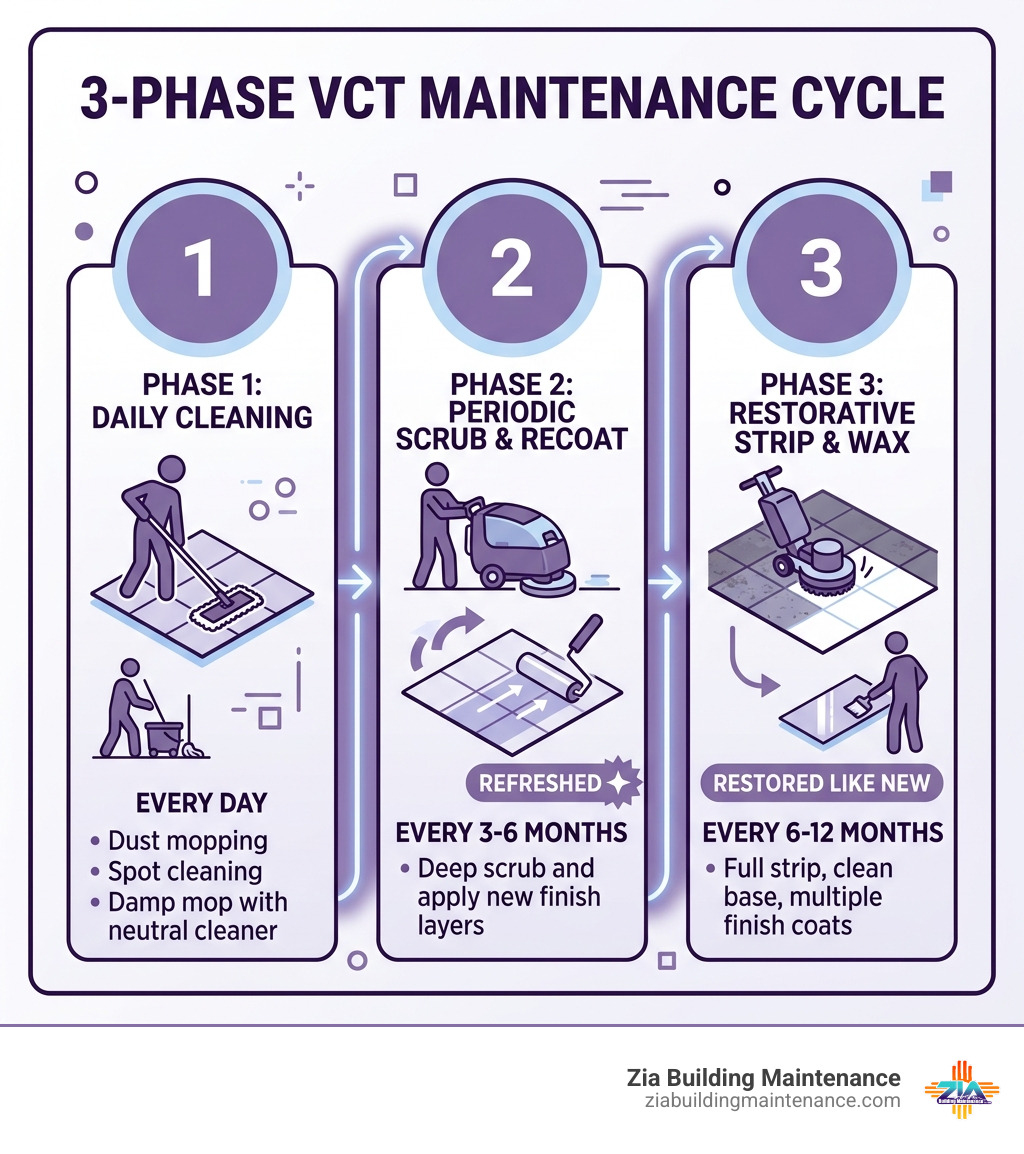
VCT tile care done right is the difference between a floor that looks great for decades and one that turns dull, scratched, and costly to replace within a few years. Here’s what proper VCT maintenance looks like at a glance:
Core VCT Care Routine:
| Phase | Frequency | What It Involves |
|---|---|---|
| Daily | Every day | Dust mopping, spot cleaning, damp mop with neutral cleaner |
| Periodic | Every 3-6 months | Scrub and recoat to refresh finish layers |
| Restorative | Every 6-12 months | Full strip and wax to reset the floor |
VCT is one of the most common commercial floors in Albuquerque — found in schools, medical offices, retail spaces, and office buildings. It’s durable and affordable. But it has one catch: it has no permanent protective layer. Without consistent care, the finish wears down, grit grinds into the surface, and the tile degrades fast.
The good news? A structured routine prevents almost all of it.
I’m Ashley Cordova, Vice President of Zia Building Maintenance, a family-owned company serving New Mexico since 1989 — and VCT tile care has been one of our most requested services for commercial clients across the state. In the sections below, I’ll walk you through exactly what works, what doesn’t, and how to protect your floor investment for the long haul.
Understanding VCT and Why It Needs a Specialized Routine
If you’ve ever looked at a Vinyl Composition Tile (VCT) and thought it looked like a solid piece of plastic, you’re only half right. VCT is actually a mixture of natural limestone, fillers, color pigments, and a vinyl resin binder. This combination makes it incredibly durable and cost-effective, which is why it’s a staple in high-traffic spots like Downtown Albuquerque hospitals and Rio Rancho schools.
However, because of that limestone content, VCT is naturally porous. If you were to look at a raw VCT tile under a microscope, it would look a bit like a sponge. This is why VCT tile care is so specialized: you aren’t actually walking on the tile itself; you are walking on the layers of floor finish (often called “wax”) applied over it.
Without that finish, dirt, salt, and moisture would seep into the pores of the tile, causing permanent staining and “yellowing.” Furthermore, VCT is sensitive to moisture. If water sits on the floor for too long, it can seep into the seams and break down the adhesive bond, leading to tiles popping up or “oozing” adhesive. This is a primary reason Why Having Dirty Floors Harms Your Business—it’s not just about aesthetics; it’s about preventing a total floor failure.
For a deeper dive into the basics, check out this How To Clean VCT Flooring – Step-by-Step Guide For A Spotless Shine.
The Three Pillars of Effective VCT Tile Care
To keep your floors from becoming a cautionary tale, we follow a tiered approach. Think of it like maintaining a car: you wash it weekly (Daily Care), you wax it every few months (Periodic Care), and every once in a long while, you might need a professional detail or a new paint job (Restorative Care).
| Maintenance Level | Goal | Key Tools |
|---|---|---|
| Daily/Weekly | Remove abrasive grit | Dust mop, Microfiber mop, Neutral pH cleaner |
| Periodic | Restore shine & protection | Auto-scrubber, Red pad, 2-3 coats of finish |
| Restorative | Remove built-up grime & old wax | Stripping solution, Black pad, 3-5 coats of finish |
By following this structure, you ensure that your Commercial VCT Cleaning Service is proactive rather than reactive.
Daily and Weekly Maintenance for VCT Tile Care
The absolute biggest enemy of your VCT floor isn’t spills—it’s sand and grit. In the high-desert environment of Bernalillo and Albuquerque, we have plenty of both. Grit acts like sandpaper under the shoes of your customers and employees, grinding away the finish until the bare tile is exposed.
The Daily Routine:
- Dust Mopping: This should happen at least once a day, and more often in high-traffic entryways. We recommend using a microfiber dust mop, which is far more effective at trapping fine particles than traditional cotton mops.
- Damp Mopping: Use a “less is more” approach with water. A damp mop with a pH-neutral detergent is essential. Why pH-neutral? Because acidic cleaners (like vinegar) or high-alkaline cleaners (like bleach) can eat through your floor finish, leaving it dull and vulnerable.
- Spot Cleaning: Spills happen. When they do, tend to them immediately. For sticky residues or scuffs, follow these VCT Spot Cleaning Guidelines | Wolfe Flooring Inc. to ensure you don’t damage the underlying wax.
Periodic Scrub and Recoat: The Mid-Level Refresh
Even with perfect daily cleaning, the top layer of finish will eventually get “walked off” or become embedded with fine soil that mopping can’t reach. This usually happens every 3 to 6 months.
Instead of a full strip and wax—which is labor-intensive and uses harsh chemicals—we perform a “Scrub and Recoat.”
- We use a floor machine with a blue or red pad and a concentrated neutral cleaner to “deep scrub” the top 1-2 layers of finish.
- This removes the surface dirt and light scratches.
- After rinsing and drying, we apply 2 to 3 fresh coats of high-quality floor finish.
This process is the “secret sauce” of long-lasting floors. It keeps the floor looking brand new without the cost of a full restoration. Our Commercial Tile Cleaning Service team often recommends this for retail spaces that need to maintain a high-gloss “wet look” year-round.
Restorative Maintenance: The Step-by-Step Strip and Wax Process
Eventually, after several years or if maintenance has been neglected, the floor finish will become too thick, yellowed, or damaged for a simple recoat. This is when we perform restorative maintenance.
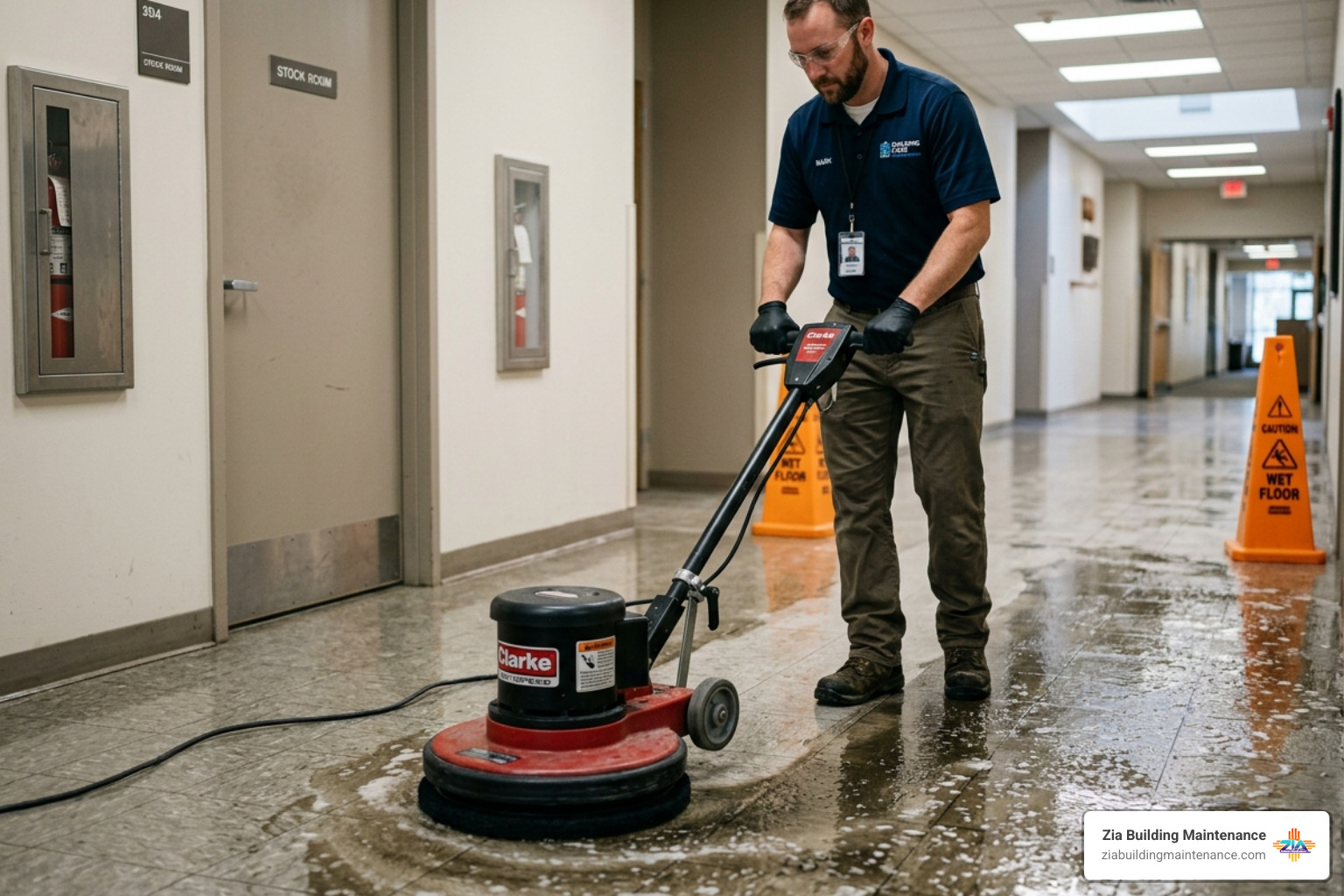
The goal here is to remove every single bit of old wax and sealer, taking the floor down to the bare tile before building it back up. Here is our professional process:
- Preparation: We clear the area of all furniture and “attic stock” (extra tiles).
- Applying Stripper: We apply a high-quality stripping solution and let it “dwell” for 10 to 15 minutes. This is critical—the chemicals need time to emulsify the old wax. We never let the solution dry on the floor.
- Agitation: Using a low-speed rotary machine (usually under 350 RPM) with a black stripping pad, we scrub the floor to break up the finish.
- Extraction and Rinsing: We use a wet vacuum to pick up the slurry. Then, we rinse the floor at least twice with clean water. Any leftover stripper residue will prevent the new wax from bonding.
- Finishing: Once the floor is bone-dry, we apply 3 to 5 coats of high-solids floor finish. We allow at least 30 to 60 minutes of drying time between coats, depending on the humidity in Albuquerque that day.
For a more detailed look at this transformation, read our Revive Your Floors: The Essential Guide to Stripping and Waxing.
Professional VCT Tile Care for High-Traffic Areas
In areas like Downtown Albuquerque office lobbies or busy Rio Rancho clinics, standard mopping isn’t enough to keep that “wow factor” shine. This is where burnishing and spray buffing come in.
Burnishing vs. Spray Buffing:
- Burnishing: We use ultra-high-speed machines (1500 to 2000 RPM) with specialty pads. This process uses friction and heat to “pop” the shine and harden the finish, making it more resistant to scuffs.
- Spray Buffing: This involves spraying a small amount of “buffing solution” onto the floor and using a standard-speed machine to remove black marks and restore gloss.
Regular burnishing (every 2-3 months) densifies the finish, meaning dirt is less likely to get ground in. This is a staple of our Albuquerque Floor Cleaning Services That Will Make Your Tiles Sparkle Like New.
Preventive Measures and Common Mistakes to Avoid
The easiest way to care for your floor is to stop the dirt from getting there in the first place.
The 15-Foot Rule: Research shows that most soil is tracked in within the first six feet of an entrance. To protect your VCT, you need an effective entryway matting system. We recommend 15 feet of matting outside and another 15 feet inside. This allows guests to take about 8 to 10 steps on the mats, which removes up to 90% of tracked-in dirt before it ever touches your VCT.
Common Mistakes We See in New Mexico:
- Using the Wrong Chemicals: Using “mop and glow” products or oil-based soaps (like Murphy’s) creates a sticky residue that actually attracts more dirt.
- Over-Wetting: Flooding the floor with water can cause the tiles to lift.
- Skipping the Dust Mop: If you damp mop a floor that hasn’t been dust-mopped, you’re just moving “mud” around and scratching the finish.
- Improper Furniture Protection: Not using felt glides on chairs can gouge VCT in a single afternoon.
Check out our guide on What’s the Best Way to Clean My Floor? for more tips on avoiding these pitfalls.
Caring for New VCT Floors After Installation
If you’ve just had new VCT installed in your Bernalillo office, STOP! Do not break out the mop just yet.
New VCT requires a “curing” period. The adhesive used to stick the tiles to the subfloor needs time to set completely.
- Wait 72 Hours: Do not perform any cleaning for the first 3 days post-installation.
- Wait 4 Days for Wet Cleaning: Do not wet wash, machine scrub, or strip the floor for at least 4 days. If you introduce excess moisture too early, it can interfere with the adhesive bond, leading to loose tiles.
- The Initial Maintenance: After the 4-day wait, the floor should be swept and then scrubbed with a blue pad to remove the “factory finish” (which is just a temporary coating to protect the tile during shipping). Only then should you apply your initial 3-5 coats of high-quality finish.
For more manufacturer-specific advice, see How to Maintain Vinyl Composition Tile (VCT) | Wolfe Flooring Inc..
Frequently Asked Questions about VCT Maintenance
How often should VCT floors be stripped and waxed?
For most commercial spaces in Albuquerque, a full strip and wax is recommended every 6 to 12 months. However, this depends entirely on foot traffic. A quiet hallway might only need it every 18 months, while a busy school cafeteria might need it twice a year. If the floor looks “yellowed” or if the finish is peeling, it’s time for our Floor Care Service.
Can I use bleach or ammonia on VCT floors?
We strongly advise against it. Bleach and ammonia are too harsh for the acrylic polymers in floor wax. They will cause the finish to become brittle, lose its shine, and eventually flake off. Stick to pH-neutral cleaners specifically designed for VCT. This is a classic example of Why One-Size-Fits-All Floor Cleaning Fails for Commercial Buildings.
How do I remove scuff marks without damaging the wax?
For light scuffs, a “tennis ball on a stick” works wonders—the felt gently lifts the rubber without scratching. For tougher marks, use a soft cloth with a tiny bit of neutral cleaner or a specialized scuff remover. Avoid using green scouring pads, as they will leave a permanent dull spot in your wax. For more on handling stubborn grime, see Cleaning Dirty Floors.
Conclusion
At Zia Building Maintenance, we know that your floors are a major investment. Since 1989, our family has been helping Albuquerque businesses keep their VCT looking sharp and professional. Whether you are in Rio Rancho, Bernalillo, or the heart of Downtown, proper VCT tile care is the key to a safe, clean, and welcoming environment.
Don’t wait until your floors are scratched and dull. With a consistent 3-phase maintenance routine, you can Make Your Albuquerque Floors Look Brand New Again.
Ready to see the difference professional care makes? Contact us for professional Commercial VCT Cleaning Services today for a free estimate!