

What Is Post-Construction Cleaning — and Why It Matters for Your Building Handover
Post-construction cleaning is a specialized, multi-phase process that removes construction debris, fine silica dust, adhesive residues, and paint overspray from a newly built or renovated space — preparing it for safe occupancy, final walkthrough, or Certificate of Occupancy inspection.
Here’s a quick overview of what it involves:
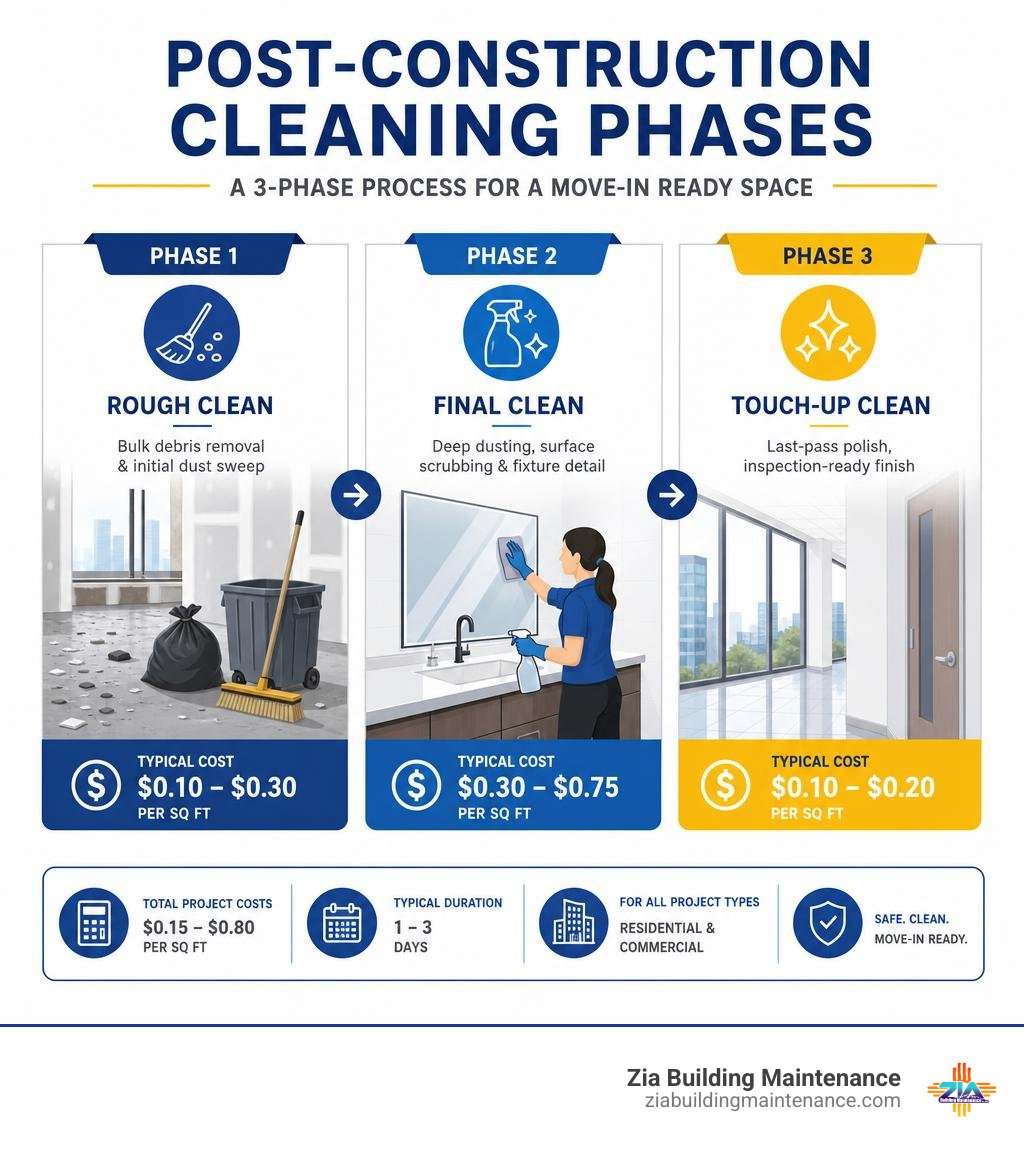
| Phase | What Happens | Typical Cost (per sq ft) |
|---|---|---|
| Rough Clean | Bulk debris removal, initial dust sweep | $0.10 – $0.30 |
| Final Clean | Deep dusting, surface scrubbing, fixture detail | $0.30 – $0.75 |
| Touch-Up Clean | Last-pass polish, inspection-ready finish | $0.10 – $0.20 |
Total project costs typically range from $0.15 to $0.80 per square foot, depending on facility size, debris volume, and finish quality. Most residential and commercial projects are completed within 1 to 3 days.
Post-construction cleaning is not the same as regular deep cleaning. Standard janitorial crews and household vacuums simply aren’t built for fine silica dust, grout haze, or paint splatter on brand-new surfaces. Getting it wrong can damage finishes — and delay your handover.
If you manage commercial properties in Albuquerque or anywhere in New Mexico, getting this step right is critical. I’m Ashley Cordova, Vice President of Zia Building Maintenance — a family-owned company serving New Mexico since 1989 — and I’ve overseen post-construction cleaning across offices, medical facilities, warehouses, and federal projects throughout the region. In this guide, I’ll break down the five best service types, what they cost, and exactly what to look for before you sign a contract.
Understanding Post Construction Cleaning: Costs, Phases, and Standards
To understand why post construction cleaning requires a systematic strategy, you first have to understand what happens to a job site after the drywall crews, electricians, and painters pack up their trucks. Construction creates heavy waste, but its most persistent byproduct is microscopic particulate matter. Fine concrete and silica dust float through the building, settling into HVAC ductwork, light fixtures, cabinet tracks, and window sills long after heavy work finishes.
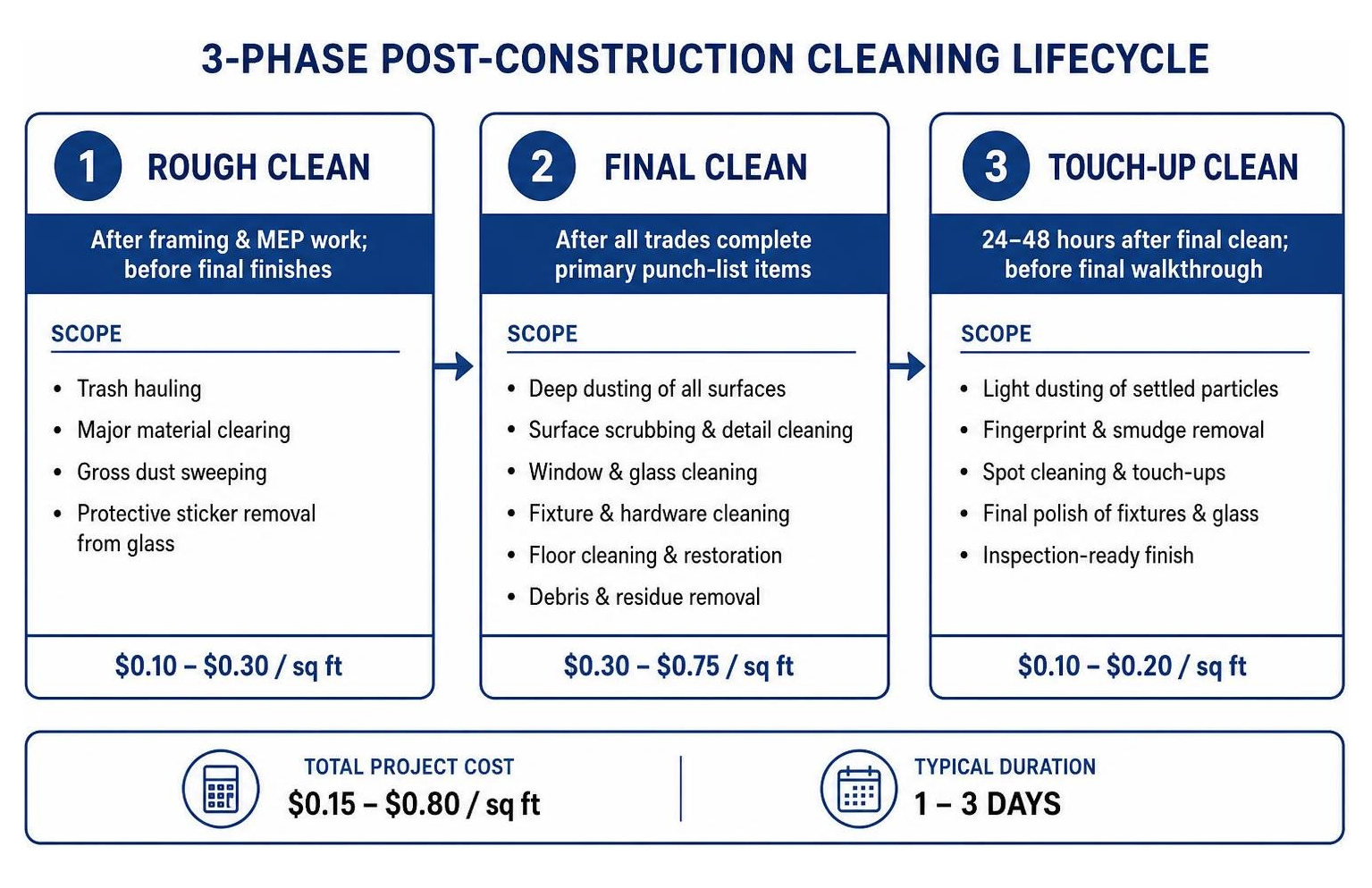
That is why professional cleanup is delivered across three sequential project phases rather than a single pass. Structuring the work into distinct stages keeps site conditions safe and prevents trade workers from dirtying newly scrubbed surfaces:
- Rough Clean: Conducted right after mechanical, electrical, and plumbing (MEP) rough-ins and drywall framing are complete. Crews remove large debris, wood scraps, packaging, and trash, sweeping loose dirt so finishing trades can operate safely.
- Final Clean: Executed after all sub-contractors complete their primary punch-list items. This is the intensive, top-to-bottom detail pass where walls are wiped, glass is scraped streak-free, fixtures are disinfected, and floor restoration occurs.
- Touch-Up Clean: Performed roughly 24 to 48 hours after the deep final clean — just before the final client walkthrough or Certificate of Occupancy inspection. Because airborne particles take up to seven days to fully settle, this final pass catches settling dust and wipes away stray fingerprints left by inspectors or touch-up trades.
Keeping your building project compliant with OSHA safety standards during site handover requires strict execution across all three phases. If you skip phases or rush the process, settling dust can contaminate indoor air quality or scratch fresh, high-end surface finishes. For more details on heavy surface restoration, check out our Deep Commercial Cleaning Guide.
| Cleaning Phase | Timing & Scope | Typical Square-Foot Cost | Standard Inclusions |
|---|---|---|---|
| Phase 1: Rough Clean | After framing & MEP work; before final finishes | $0.10 – $0.30 / sq ft | Trash hauling, major material clearing, gross dust sweeping, protective sticker removal from glass |
| Phase 2: Final Clean | After trade completion; before furniture move-in | $0.30 – $0.75 / sq ft | HEPA dust extraction, fixture polishing, window/glass scraping, grout haze removal, floor scrubbing |
| Phase 3: Touch-Up Clean | 1-2 days before handover or inspector walk | $0.10 – $0.20 / sq ft | High-surface re-wipe, floor buffing, streak touch-ups, air vent diffuser cleaning, light fixture polish |
How Much Does Post Construction Cleaning Cost?
When budgeting for a project in Albuquerque, Rio Rancho, Corrales, or Los Ranchos, cost calculations usually hinge on facility size, debris volume, surface complexity, and target turnaround times.
Nationally and locally, overall post construction cleaning rates range between $0.15 and $0.80 per square foot. For most commercial build-outs, a comprehensive final clean averages $0.30 to $0.75 per square foot.
To put these figures into practical terms:
- Small Commercial Suite (5,000 sq ft): A full final clean typically costs between $1,500 and $3,000. When bundling all three phases (rough, final, and touch-up), overall project budgets generally sit between $2,000 and $5,000.
- Medium Commercial Space (20,000 sq ft): A multi-pass post-construction scope averages between $8,000 and $21,000.
- Large Facility (50,000+ sq ft): Large-scale commercial facilities or industrial sites range from $20,000 to $50,000+, depending on ceiling heights and specialized floor care requirements.
While some smaller items on a contractor’s punch list might be priced at hourly rates between $25 and $75 per cleaner per hour, full-scope site cleanups should always be executed under fixed, flat project fees. Flat pricing protects property owners and facility managers from unexpected budget overruns when stubborn drywall dust or tile adhesive requires additional passes. If you are preparing an existing commercial footprint for tenant transition, compare these scopes with our Move-Out Cleaning Commercial Property Guide.
Essential Equipment for Post Construction Cleaning
You cannot clear heavy renovation residues using standard household broom closets or domestic shop vacuums. Commercial site cleanup requires specialized, industrial-grade equipment built to trap microscopic silica dust without blowing it back into the ambient air.
Key machinery and tools required for effective site remediation include:
- HEPA-Filter Vacuums: High-Efficiency Particulate Air (HEPA) equipment captures 99.97% of particles down to 0.3 microns. Standard vacuums leak microscopic drywall dust back into the air, but commercial HEPA vacuums lock it in permanently.
- Automatic Floor Scrubbers & Buffers: Industrial scrubbers paired with pH-neutral recovery chemistry lift grout haze, drywall mud, and construction grit from hardwood, luxury vinyl plank (LVP), epoxy, and sealed concrete without scratching surface seals.
- Commercial Carpet Extractors: Deep-cleaning extractors pull crushed drywall powder and carpet adhesive fumes directly from textile fibers.
- Air Dust Suppression & Scrubber Units: Airborne dust management equipment isolates work zones, drawing floating particulates out of active air space.
- Non-Abrasive Scrapers & Anti-Static Solutions: Precision plastic scrapers remove window stickers and paint overspray without scratching glass, while anti-static cleaners treat vertical baseboards and crown molding so dust doesn’t immediately re-settle.
For additional perspectives on professional cleaning technology and specifications, review external guidance on Post-construction cleaning services for spotless results.
wp:html
/wp:html
wp:html
/wp:html
Key Factors for Evaluating Commercial Cleanup Providers
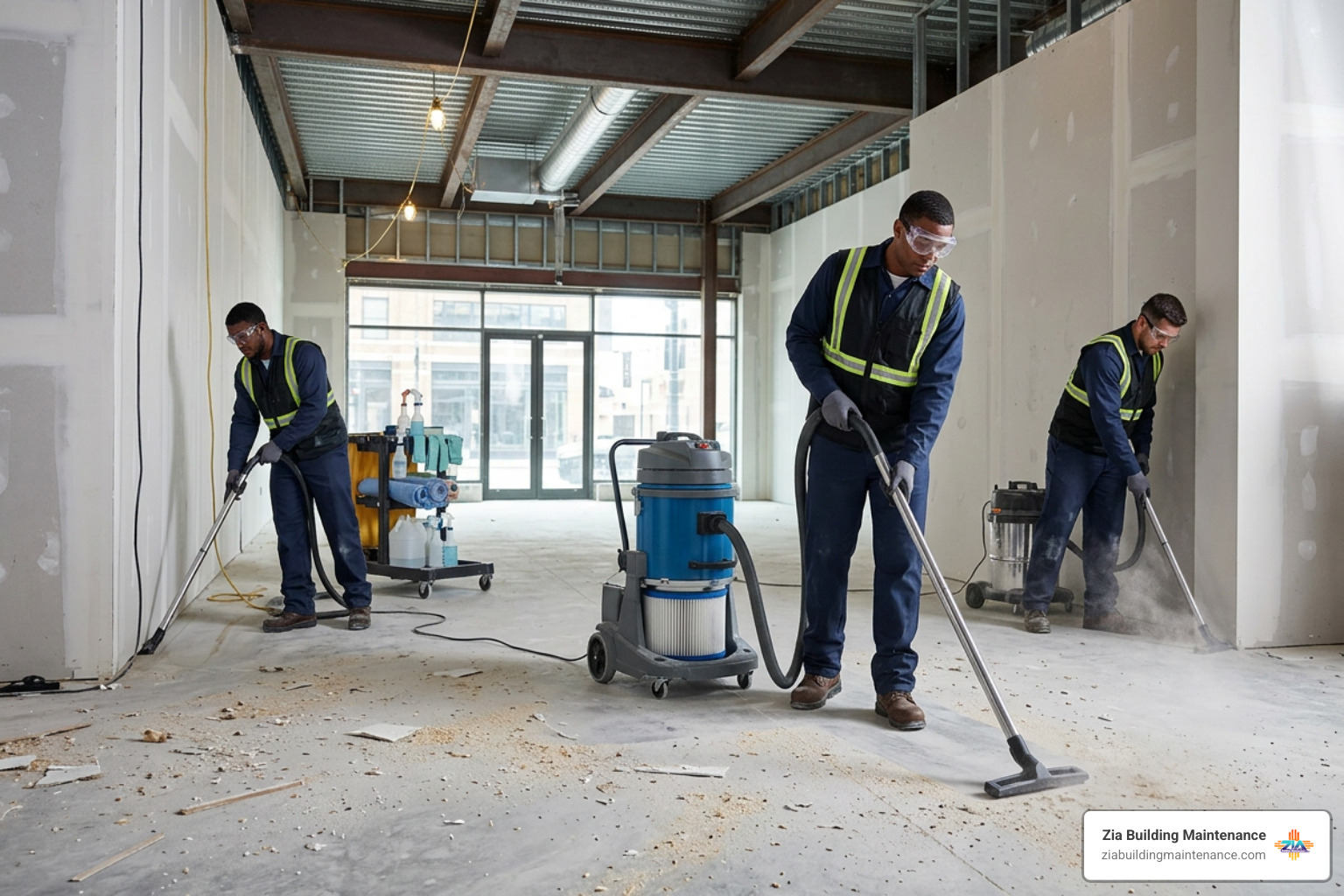
Not all cleaning companies possess the operational capacity to manage complex construction handovers. A standard janitorial service that maintains clean offices during weekly visits will often struggle when faced with post-renovation dust loads, tight project deadlines, and active site safety hazards.
When evaluating potential service partners for your property, focus on these critical operational benchmarks:
1. W-2 Self-Performing Labor vs. Subcontracted Operations
Who actually walks onto your job site? Independent operational studies from Harvard Business School and McKinsey research show that commercial facilities organizations using self-performing W-2 employees deliver 15% to 25% higher performance outcomes compared to firms relying on third-party subcontractors or franchise pass-throughs. W-2 employees receive standardized safety training, undergo background checks, and are accountable to internal quality control supervisors.
2. General Liability, Worker’s Comp & Bonding
Active construction zones carry inherent physical risks. Ensure your cleaning partner carries comprehensive commercial general liability insurance (typically $2M+ aggregate), complete worker’s compensation coverage for every crew member on site, and fidelity bonding. Request a Certificate of Insurance (COI) naming your organization or general contractor as an additional insured before work begins.
3. Trade Alignment & Timeline Flexibility
Construction schedules change constantly. Inspections get delayed, trade workers work late, and handover dates shift. A reliable cleanup team must offer flexible scheduling that aligns with shifting construction milestones. Before signing contract paperwork, review our comprehensive Commercial Cleaning Contract Checklist and follow our steps on Onboarding Janitorial Services to establish clear communication channels.
The 5 Best Post-Construction Cleaning Services Compared
To help facility managers, general contractors, and building owners choose the right partner, we have analyzed the five main categories of post construction cleaning providers available in today’s commercial marketplace.
1. Self-Performing W-2 Commercial Cleaning Specialists
- Best For: Commercial handovers, tenant improvements, corporate suites, medical facilities, and federal projects requiring guaranteed reliability and safety compliance.
- Operational Model: Direct W-2 employees managed by dedicated on-site project supervisors.
- Pros: Superior quality control, 15–25% higher performance efficiency, full insurance compliance, and direct alignment with site superintendents.
- Cons: Rates may be slightly higher than budget independent cleaners, but they eliminate re-work costs.
- Overview: These specialized firms focus on commercial spaces and construction turnovers. They invest heavily in HEPA extraction equipment, floor scrubbers, and OSHA compliance training. At Zia Building Maintenance, we operate under this exact model across Albuquerque and surrounding areas, delivering dependable quality backed by family ownership since 1989.
2. Regional Janitorial Contractors
- Best For: Standard commercial office refresh projects and ongoing maintenance transitions.
- Operational Model: Locally owned janitorial teams that combine daily maintenance cleaning with occasional post-renovation projects.
- Pros: Established regional presence, responsive communication, and easy transition from construction cleanup into recurring janitorial contracts.
- Cons: May lack heavy industrial equipment for massive structural debris clearance.
- Overview: Regional contractors offer reliable services for small-to-medium remodels. To understand how site cleanup transitions into tenant maintenance, read our Building Site Cleaning Guide.
3. National Disaster Recovery & Cleanup Franchises
- Best For: Emergency post-incident site clearing, water damage remediation, and exterior pressure washing.
- Operational Model: Franchise owner-operator network under a national brand name.
- Pros: Extensive equipment fleets and rapid mobilization for emergency site clearing.
- Cons: Service quality, pricing, and labor practices vary widely between individual local franchise owners.
- Overview: While national franchise networks excel at emergency restoration, their localized crew experience for delicate, high-spec interior architectural detailing can be inconsistent.
4. Specialized Floor Restoration Teams
- Best For: Facilities with extensive specialty flooring, such as polished concrete, terrazzo, natural stone, or broadloom carpeting.
- Operational Model: Niche subcontractors specializing exclusively in floor stripping, waxing, stone honing, and carpet extraction.
- Pros: High expertise in floor chemistry and heavy equipment operation.
- Cons: Narrow scope of work; they rarely handle high dusting, window scraping, or fixture disinfection.
- Overview: Specialized floor care teams are best brought in as dedicated sub-contractors alongside your primary post-construction cleaner when dealing with sensitive floor surfaces.
5. Full-Service Facility Maintenance Operations
- Best For: Large multi-tenant commercial centers, industrial parks, and enterprise property management groups.
- Operational Model: Comprehensive property management organizations handling maintenance, mechanical HVAC support, groundskeeping, and post-build cleanup.
- Pros: Single point of contact for all facility operations and long-term building maintenance.
- Cons: Higher overhead cost structure across smaller commercial projects.
- Overview: These firms provide broad operational scale for large commercial centers. For insights on managing commercial builds in nearby regional markets, see external research on Post Construction Cleaning Colorado Springs as well as our 2026 Post-Construction Office Cleaning Guide.
Room-by-Room Site Handover Checklist
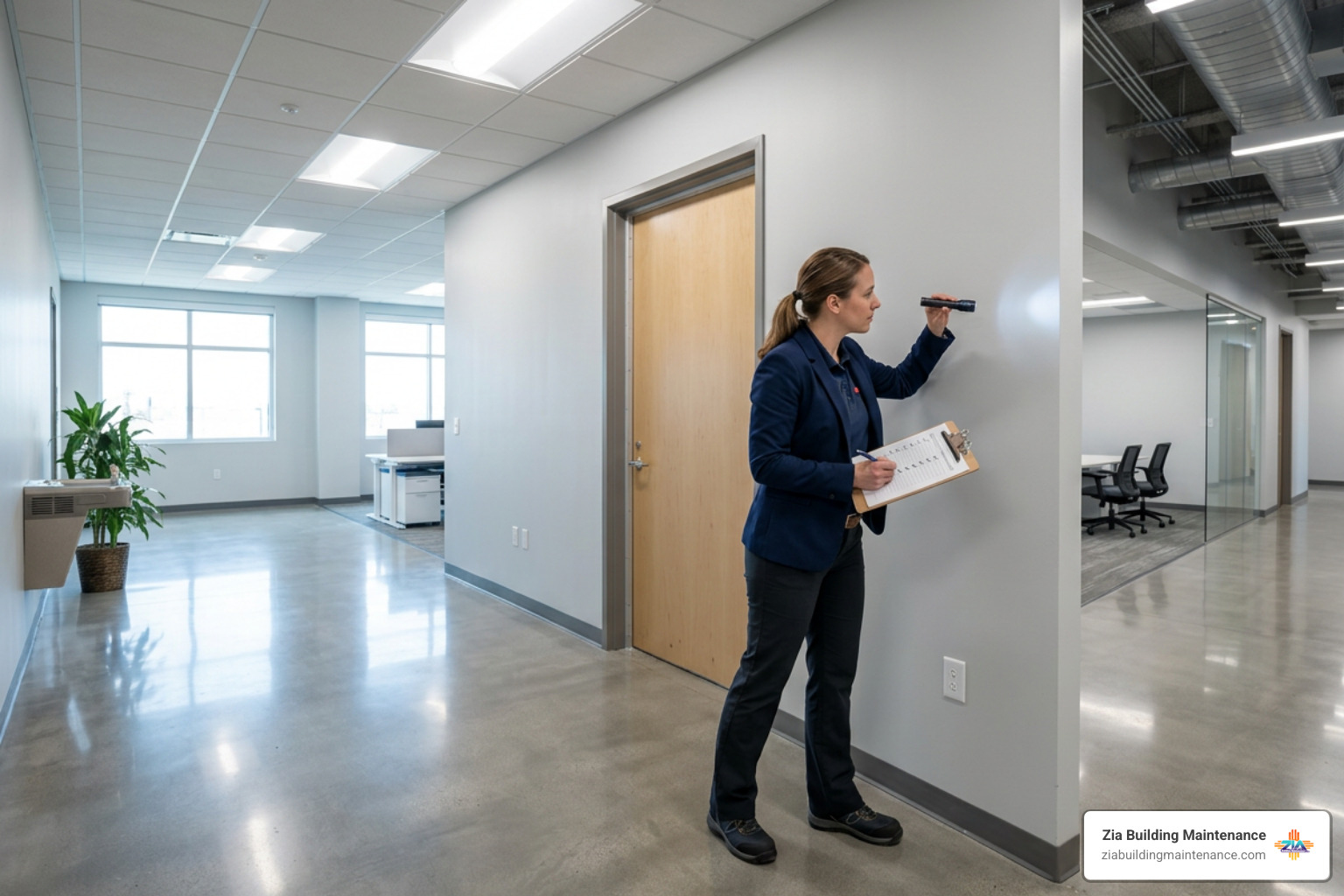
A successful final walkthrough requires systematically reviewing every interior and exterior surface. Use our room-by-room quality assurance checklist to ensure your site is completely ready for occupancy:
Entrance, Hallways & Reception
- [ ] Sweep, vacuum, and pressure wash exterior entry walkways and thresholds.
- [ ] Wipe down vertical walls, baseboards, door frames, and high-reach crown molding with anti-static microfiber tools.
- [ ] Remove paint overspray, silicone residue, and factory labels from entrance glass doors and interior partition walls.
- [ ] Damp-wipe interior light fixtures, emergency exit signage, and security sensor housings.
Open Offices, Conference Rooms & Workstations
- [ ] HEPA-vacuum all textile carpeting twice, allowing a 30-minute settling window between passes.
- [ ] Clean inside and outside of all built-in cabinetry, shelving units, and desk drawers, vacuuming accumulated wood shavings from hardware tracks.
- [ ] Clean and disinfect all glass partition panels using non-streak, ammonia-free window cleaners.
- [ ] Vacuum HVAC air supply diffusers, return grilles, and exhaust vents to clear fine silica dust. For specialized retail spaces, reference our Retail Renovation Cleaning Guide.
Kitchens, Breakrooms & Restrooms
- [ ] Scrub wall tile and grout lines using specialized recovery chemistry to eliminate grout haze and tile adhesive.
- [ ] Sanitize sink basins, chrome hardware, counter surfaces, and backsplashes.
- [ ] Deep-clean stainless steel appliances, removing interior/exterior protective film, factory oils, and fingerprints.
- [ ] Polish mirrors, clean porcelain fixtures, and scrub hard floor surfaces with pH-neutral solutions.
To verify quality standards across all building zones before final sign-off, utilize our structured Commercial Cleaning Audit Checklist.
Frequently Asked Questions About Post-Construction Cleanup
Who is responsible for cleanup: the builder or property owner?
Responsibility depends entirely on the terms written into the construction contract. Typically, the general contractor or builder is responsible for rough site clearing — removing structural waste, scrap materials, drywall offcuts, and hazardous demolition trash. However, detailed final cleaning (dust extraction, fixture polishing, window scraping, and sanitization) is usually contracted separately. If the builder’s contract does not explicitly mandate a “white-glove, move-in ready final clean,” the property owner or facility manager must hire a specialized post-construction cleaning service before opening.
How long does post-construction cleaning usually take?
Most commercial post-construction cleaning projects take between 1 and 3 days to complete, depending on square footage, ceiling heights, and initial debris levels. A small 5,000-square-foot office suite can usually be final-cleaned in a single day by an experienced crew. Larger 20,000+ square-foot facilities require multi-day schedules split across rough, deep final, and touch-up phases. Crucially, project managers should allow at least 24 hours of settling time between the rough sweep and the deep final clean so floating dust can drop to horizontal surfaces.
Can standard house or office cleaners manage post-renovation dust?
No. Standard residential or office cleaners rely on traditional household vacuums and routine dusting tools. Drywall dust and masonry powder contain ultra-fine silica particulates that slip right through standard vacuum filters, scattering microscopic dust back into your HVAC system and space. Furthermore, standard cleaners lack specialized equipment like floor scrubbers, HEPA extractors, and non-abrasive chemical strippers required to remove grout haze, caulking, and paint splatters without damaging brand-new surface finishes.
Conclusion
Completing a construction or renovation project is a major milestone. But until that fine drywall dust is completely extracted, window labels are scraped clean, and floors are polished to a shine, your building isn’t truly finished. Partnering with a proven, self-performing post-construction cleaning specialist ensures your space makes an immediate, positive impression during client walkthroughs and passes inspector reviews on the very first try.
At Zia Building Maintenance, we have delivered trusted, high-quality commercial cleaning and post construction cleaning across Albuquerque, Rio Rancho, Corrales, and Los Ranchos since 1989. As a family-owned business, our W-2 uniformed crews take personal pride in every building handover, backing our work with attention to detail and direct owner oversight.
Ready to transition your construction site from raw build to move-in ready? Read our detailed guide on Why You Need Professional Post-Construction Cleanup or contact our Albuquerque team today to request a free, flat-rate project quote!