

TL;DR:
- A systems-driven cleaning program relies on documented SOPs, scheduled inspections, and transparent pricing to ensure consistent facility maintenance. Zia Building Maintenance has provided such services in Albuquerque since 1989, emphasizing comprehensive service coverage and local expertise. Proper evaluation includes reviewing SOPs, inspection routines, labor cost reconciliation, and contract details to select a reliable provider.
A systems-driven corporate cleaning program, backed by documented SOPs, scheduled inspections, and transparent pricing, is the most reliable way to maintain a professional facility. Zia Building Maintenance has delivered exactly that to Albuquerque-area businesses since 1989, and this guide gives you the tools to evaluate any provider on the same terms.
Here is what you will find:
- Core services a complete program should include (routine janitorial, restroom sanitation, breakroom cleaning, floor care, specialty disinfection, supply restocking)
- A worked pricing example for a 6,000 sq ft office
- A contracting and onboarding checklist
- How to request a quote and what to have ready (square footage, facility type, and preferred frequency)
Table of Contents
- What does a corporate cleaning system actually mean for facility managers?
- What services should every corporate cleaning program include?
- How Zia Building Maintenance implements a systems-driven program
- How are corporate cleaning programs priced, and what does a 6,000 sq ft office cost?
- What should a corporate cleaning contract include, and how long does onboarding take?
- How do you evaluate and choose the right corporate cleaning provider?
- Why square-foot bids must be reconciled with labor-hour reality
- Key Takeaways
- What onboarding really looks like in Albuquerque
- Zia Building Maintenance is ready to quote your facility
- Useful sources and further reading
- FAQ
What does a corporate cleaning system actually mean for facility managers?
A corporate cleaning system is a coordinated program of standard operating procedures, a staffing plan, scheduled inspections, reporting tools, equipment, and supplies, all tailored to your facility type. It is not a single-service quote. The distinction matters because a one-off bid tells you a price; a system tells you how that price gets delivered consistently, week after week.
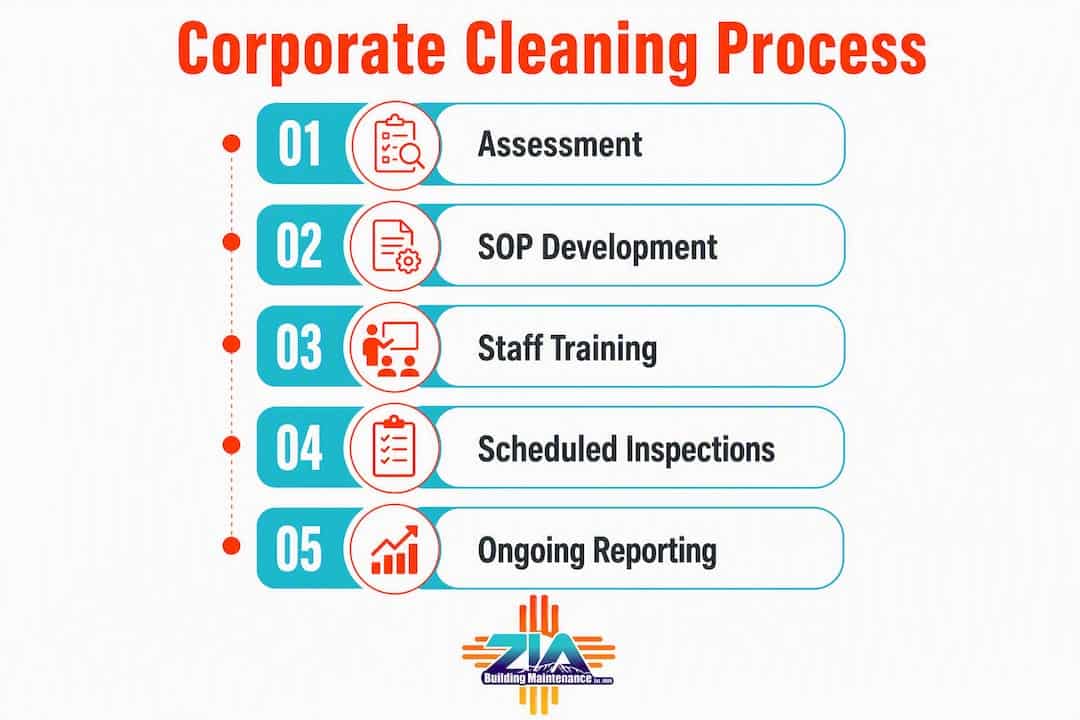
A typical program includes written SOPs for every task area, an inspection cadence (weekly or biweekly), janitorial management software that consolidates scheduling and client communication, a defined staffing model, and measurable KPIs like inspection pass rates and response times. The U.S. commercial janitorial industry is highly fragmented, with roughly one million businesses competing for contracts, which means the gap between a provider with real systems infrastructure and one without it is wide. Outsourcing professional janitorial services to a systems-driven provider removes the people-dependency that causes quality to slip when a single cleaner calls out sick.
What services should every corporate cleaning program include?
A complete office cleaning solution covers more ground than most facility managers initially scope. Before you compare bids, confirm each provider covers all of the following.
Routine janitorial services:
- Daily trash removal, dusting, and vacuuming
- Restroom sanitation with supply restocking (paper goods, soap, liners)
- Breakroom and kitchen cleaning, including appliance wipe-downs and sink sanitation
- Interior window and glass cleaning
- Consistent office cleaning of high-touch surfaces (door handles, light switches, elevator buttons)
Floor care:
- Daily maintenance sweeping and mopping
- Machine scrubbing and burnishing on hard floors
- Periodic strip-and-refinish schedules for VCT and resilient flooring
- Carpet extraction on a defined cycle
Specialty services:
- Electrostatic and high-touch disinfection (post-pandemic specs are now embedded in most baseline scopes)
- Green cleaning using LEED-compatible products
- Post-construction cleanup
- Healthcare-grade cleaning for medical offices and clinics
Automation is expanding in floor care specifically. Tennant Company reported the sale of its 10,000th autonomous mobile robot in 2025, and Brain Corp reports more than 37,000 robots running its operating system across brands. That said, autonomous scrubbers supplement manual labor on large open floors; they do not replace restroom attendants or detail dusting.
How Zia Building Maintenance implements a systems-driven program
Zia Building Maintenance follows a structured process from the first site visit to ongoing quality reporting. The sequence looks like this: site survey and scope development, written SOP delivery, staffing and schedule planning, onboarding with a shadowing period, then regular inspections with corrective-action protocols and client reporting.
Operating since 1989 and recognized as the #1 office cleaning service in South Valley for 2025, Zia brings local knowledge that national providers rarely match. That includes familiarity with Albuquerque building access schedules, parking constraints, and the seasonal demands that affect staffing. Insurance certificates, background-check policies, and training logs are available during the contracting phase, not after you sign.
Pro Tip: During your site survey, ask the provider to show you a one-page SOP excerpt for restroom sanitation and their inspection report template. A provider with real systems can produce both on the spot. One that cannot is running on individual habit, not documented process.
Zia uses commercial cleaning methods and janitorial software to replace paper timesheets with digital time tracking, scheduling, and inspection records. That shift gives facility managers real-time visibility into what was cleaned, when, and by whom, reducing people-dependency and creating an accountability trail that holds up during audits or lease renewals.

How are corporate cleaning programs priced, and what does a 6,000 sq ft office cost?
Commercial cleaning bids typically follow one of three models: per square foot, per hour, or a hybrid that uses a square-foot baseline with labor-hour reconciliation. The per-square-foot range for standard offices runs $0.07–$0.15 per square foot; medical and food-service environments run $0.12–$0.25 per square foot. Hourly commercial rates typically fall between $30 and $75 per hour.
Worked example: For a 6,000 sq ft office, monthly cost depends on the selected per square foot or hourly rate and cleaning frequency, calculated using the ranges above.
The square-foot figures above assume standard office density and a five-day-per-week schedule. Deep cleans, move-in/move-out work, and post-construction cleanup should always be priced separately at a premium rate; treating them the same as recurring service is one of the most common pricing mistakes providers make.
The bigger risk for facility managers is a low square-foot bid that does not survive a burdened-labor check. Well-run commercial contracts typically carry gross margins of 40–50% and net margins of 10–20%. A bid priced below what the labor math supports usually means reduced visit frequency, understaffing, or deferred floor maintenance.
Ask every provider these questions before accepting a bid:
- How do you calculate your burdened labor rate (wages, payroll tax, workers’ comp, benefits)?
- What travel time assumptions are built into the quote?
- What is the monthly supply allowance, and what does it cover?
- What are your payment terms, and do you offer net 30?
What should a corporate cleaning contract include, and how long does onboarding take?
A solid contract protects both parties and sets clear expectations from day one. At minimum, it should include a detailed scope attachment, service-level agreements with inspection cadence, termination and cure clauses, insurance and bonding requirements, and a cap on unilateral price increases.
Onboarding timeline
A realistic onboarding runs 30–90 days. Key milestones:
- Week 1–2: Site survey, SOP delivery, schedule confirmation
- Week 2–4: Pilot period begins; shadowing and staff orientation
- Day 30: First independent inspection and client acceptance review
- Day 60–90: Two additional inspections; corrective actions documented and closed
A pilot period of 30–90 days with at least two independent inspections reduces onboarding risk far more effectively than a shorter trial. Request these documents before signing: SOPs, insurance certificates, background-check policy, training logs, and two client references in a comparable facility type.
Watch for these contract red flags: vague scope language with no task-level detail, automatic renewals without advance notice, unilateral price increases without a stated cap, and cure periods longer than five business days without a corresponding service credit.
How do you evaluate and choose the right corporate cleaning provider?
Use this checklist during vendor selection and on-site interviews to improve your cleaning service SEO and win more contracts.
Decision checklist:
- Verified, written SOPs for each service area
- Documented inspection cadence and sample inspection report
- Burdened labor math available on request
- Equipment and supply standards specified in the contract
- General liability and workers’ comp certificates current
- Local references in a comparable facility type
- Background-check policy for all staff
Interview questions to ask operations managers:
- How do you measure cleaner productivity per shift?
- What is your corrective-action response time when an inspection fails?
- How often do you retrain staff, and what does that training cover?
Weight your evaluation roughly as follows: operations infrastructure (SOPs, inspections, reporting) at 30%, pricing transparency at 25%, references at 20%, local capacity at 15%, and green or sustainability options at 10%. Janitorial consistency is the single factor that separates providers who perform well at contract start from those who hold that standard at month 18.
Red flags that should end a conversation: no written SOPs, refusal to share inspection reports, cash payroll, and staffing plans that list headcount without task assignments.

Why square-foot bids must be reconciled with labor-hour reality
The 2026 Opora operational analysis identifies a persistent mismatch between square-foot pricing and actual labor-hour costs. The fix is a three-step reconciliation.
Industry context: The U.S. commercial janitorial sector generates roughly $74–75 billion in annual revenue and remains one of the most labor-intensive service categories in the economy.
Step 1: Estimate production rate. A standard office typically runs 2,500–3,500 sq ft per cleaner-hour for routine tasks. For a 6,000 sq ft office, that implies roughly 1.7–2.4 cleaner-hours per visit.
Step 2: Calculate burdened wage. Take the cleaner’s base wage and add payroll taxes, workers’ comp, benefits, and any travel allowance. If the local wage is $16/hr and burdened costs add 35%, the true cost per cleaner-hour is approximately $21.60.
Step 3: Compare to quoted revenue. Multiply cleaner-hours by burdened wage and compare to the provider’s quoted price per visit. If the math does not leave room for a reasonable margin, the provider is either cutting hours or cutting corners.
This reconciliation is the single most useful check you can run on any commercial cleaning quote before you sign.
Key Takeaways
A systems-driven corporate cleaning program, built on documented SOPs, scheduled inspections, and transparent burdened-labor pricing, is the most reliable way to maintain a professional facility and hold providers accountable over the life of a contract.
| Point | Details |
|---|---|
| Systems over people-dependency | Providers with written SOPs and inspection cadences deliver consistent results regardless of staff turnover. |
| Reconcile sq ft bids | Convert cents-per-square-foot quotes to cleaner-hours and check against burdened wages before signing. |
| Pilot period matters | A 30–90 day pilot with at least two independent inspections reduces onboarding risk significantly. |
| Contract red flags | Vague scope, automatic renewals, and unilateral price increases without caps are the top warning signs. |
| Zia Building Maintenance | Serving Albuquerque since 1989, rated #1 office cleaning in South Valley 2025, with SOPs, insurance, and references available at quote stage. |
What onboarding really looks like in Albuquerque
Albuquerque facilities come with their own set of practical constraints that generic onboarding guides do not account for. Building access windows vary widely across downtown, the South Valley, and the Northeast Heights. Parking for cleaning crews at multi-tenant properties can be genuinely complicated, especially during the Balloon Fiesta season when surrounding streets and lots fill up weeks in advance. Dust infiltration from the high desert environment means filter and surface maintenance schedules need to be adjusted compared to what a national provider’s standard SOP assumes.
The onboarding process at Zia Building Maintenance accounts for all of that from the site survey forward. Local references and case examples from comparable Albuquerque facilities are available on request and well worth asking for. A provider who has cleaned a similar building in the same neighborhood for several years will handle those constraints without a learning curve.
Zia Building Maintenance is ready to quote your facility
Zia Building Maintenance has been cleaning commercial facilities across Albuquerque since 1989, and the quote process is straightforward. Request a cleaning estimate for your facility and a site survey will be scheduled at your convenience.
To get the most accurate quote, have the following ready: total square footage, a floor plan or photos of key areas, your preferred cleaning frequency, any specialty areas (labs, medical exam rooms, commercial kitchens), and your preferred service hours. Zia provides SOP samples, current insurance certificates, client references, and a sample inspection report with every quote, so you can evaluate the program before you commit. For healthcare facilities, the janitorial training requirements and compliance documentation are included as part of the standard quote package. Contact Zia Building Maintenance today to schedule your site survey and receive a burdened-labor reconciliation alongside your square-foot bid.
Useful sources and further reading
The research and industry data in this article draw from the following sources. Each is worth reviewing if you are building a procurement process or evaluating multiple bids.
- State of Commercial Cleaning Operations 2026 | Opora — operational benchmarks, labor reconciliation methodology, and software adoption data
- Cleaning Service Pricing Guide | Stackrows — per-square-foot and hourly rate ranges for standard and specialty environments
- Building Cleaning & Janitorial Services 2026 Credit Analysis | CoreCredit — industry revenue, margin benchmarks, and market structure
- Zia Building Maintenance: corporate cleaning solutions deep dive — Zia’s systems-driven approach and local service details
- Commercial cleaning contract checklist — a practical document checklist for facility managers at the contracting stage
FAQ
What is corporate cleaning, and how does it differ from regular janitorial service?
Corporate cleaning refers to a coordinated program of scheduled janitorial tasks, documented SOPs, inspections, and reporting designed for commercial facilities. It differs from a basic janitorial quote in that it defines how quality is maintained consistently, not just what tasks are performed.
How much does it cost to clean a 6,000 sq ft office?
At standard commercial rates of $0.07–$0.15 per square foot, a 6,000 sq ft office’s monthly cost varies by service frequency and level. Specialty environments or deep-clean services are priced at a premium above those ranges.
What should I ask a cleaning provider before signing a contract?
Ask for a written SOP excerpt, a sample inspection report, proof of insurance, and a burdened-labor breakdown of their quote. A provider who cannot produce all four on request is not running a systems-driven program.
How do I know if a square-foot bid is realistic?
Convert the bid to cleaner-hours using a production rate of 2,500–3,500 sq ft per cleaner-hour, then multiply by the local burdened wage. If the math does not leave room for a 10–20% net margin, the provider will likely cut hours or frequency to stay profitable.
Does Zia Building Maintenance serve facilities outside standard offices?
Zia Building Maintenance serves offices, medical facilities, schools, retail spaces, industrial sites, property management portfolios, and government and religious buildings across Albuquerque, with tailored cleaning plans for each facility type.