

TL;DR:
- Effective onboarding begins before the first day by completing paperwork, establishing access, and setting clear communication channels. A structured 30-day training plan with evaluations, chemical safety protocols, and documented SLAs ensures consistent, high-quality facility cleanliness. Regular performance reviews at 30 and 60 days solidify standards and foster continuous improvement.
Onboarding a new janitorial service is the structured process of integrating cleaning personnel, vendor operations, and facility-specific standards into a repeatable system that delivers consistent, measurable cleanliness. Facility managers who treat this as a formal integration process, rather than a simple handoff, see faster ramp-up times, fewer service gaps, and stronger vendor accountability from the start. The process spans pre-start preparation, a structured training timeline, chemical safety certification, and clearly defined service level agreements. This guide gives you the exact framework to onboard new janitorial service operations with confidence, whether you manage an office building, a medical facility, or a school.
What preparation steps are required before the janitorial service starts?
Effective janitorial onboarding requires at least a few days of pre-start preparation to have paperwork, schedules, and training materials ready before the first shift begins. Skipping this phase is the most common reason new cleaning contracts underperform in the first 30 days. The goal is to remove every obstacle so the crew can focus entirely on learning your facility’s standards from day one.
Pre-start preparation covers several distinct categories. Each one directly affects how quickly the new crew reaches full operational competency:
- Compliance documentation: Collect signed contracts, insurance certificates, W-9 forms, and any facility-specific vendor agreements before the start date.
- Building access: Issue key cards, access badges, and alarm codes. Confirm after-hours entry protocols with your security team.
- Uniforms and equipment: Provide branded uniforms, cleaning kits, and any facility-required personal protective equipment (PPE) at designated storage points.
- Communication channels: Set up a shared communication platform, whether that is a group text thread, a Slack channel, or a facility management system integration, so supervisors and crew leads can report issues in real time.
- Internal team notification: Brief your own staff on the new vendor’s schedule, access rights, and point-of-contact protocols to prevent confusion.
Pro Tip: Stage chemical safety materials and PPE at the exact points of use within your facility before the crew’s first shift. New hires retain safety information far better when they encounter it in the actual work environment rather than in a conference room.
Operational onboarding starts the moment the candidate accepts the contract, not on the first physical workday. Sending a welcome message with schedule details, access instructions, and a clear outline of week-one expectations reduces confusion and accelerates the ramp-up period significantly. This early communication sets a professional tone and signals to the vendor that your organization takes quality seriously.
How to structure the onboarding timeline and training for janitorial staff?
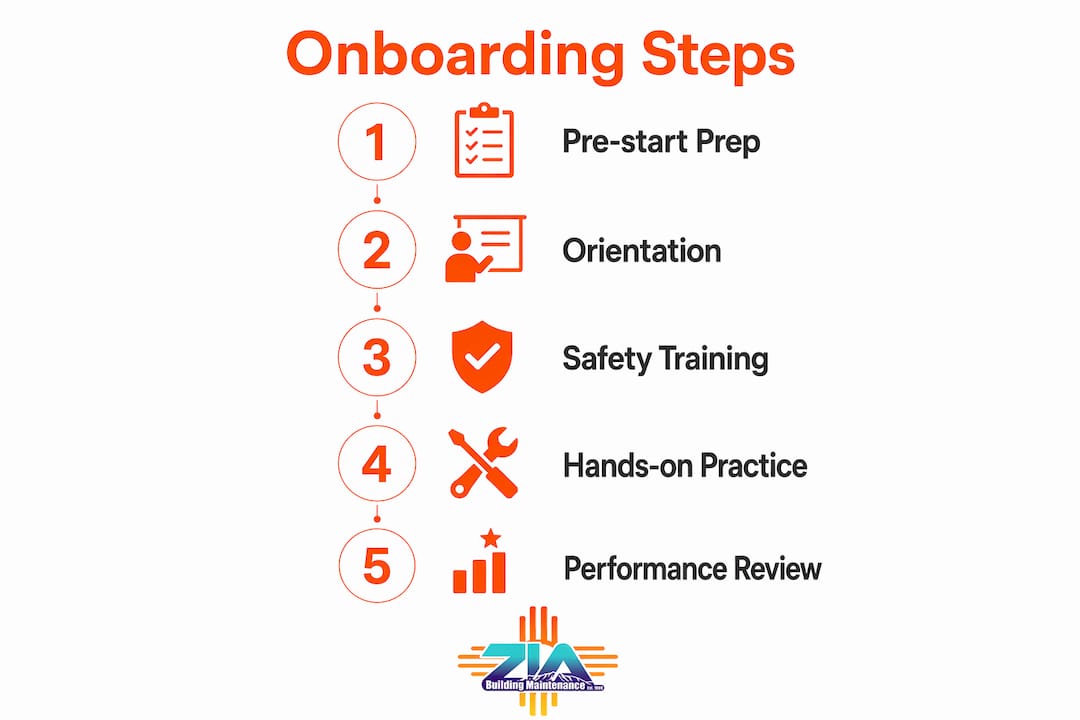
A structured 30-day onboarding plan that includes product training, supervised fieldwork, and progressive independence produces measurably better outcomes than informal on-the-job learning. This is the industry standard for new cleaning service integration, and it applies whether you are managing a single-location office or a multi-site facility portfolio.
Here is a practical week-by-week framework:
- Week 1 (Days 1 to 5): Orientation and foundational training. Cover facility orientation, paperwork completion, chemical safety certification, and a thorough introduction to your standard operating procedures (SOPs). Days 3 through 5 focus on product training, quality standards review, and shadowing experienced crew members on actual cleaning routes.
- Week 2 (Days 6 to 10): Supervised fieldwork. New hires perform cleaning tasks under direct supervision, with emphasis on client-specific procedures, problem-solving for unexpected situations, and adherence to your facility’s quality checklist.
- Week 3 (Days 11 to 15): Assisted independence. New hires lead cleaning assignments with a supervisor available but not directing every task. Formal evaluations occur at the end of this week to identify any gaps before full independence.
- Week 4 (Days 16 to 30): Full competency and quality verification. The crew operates independently. Spot-checks, client interaction skills, and a formal 30-day performance review confirm readiness.
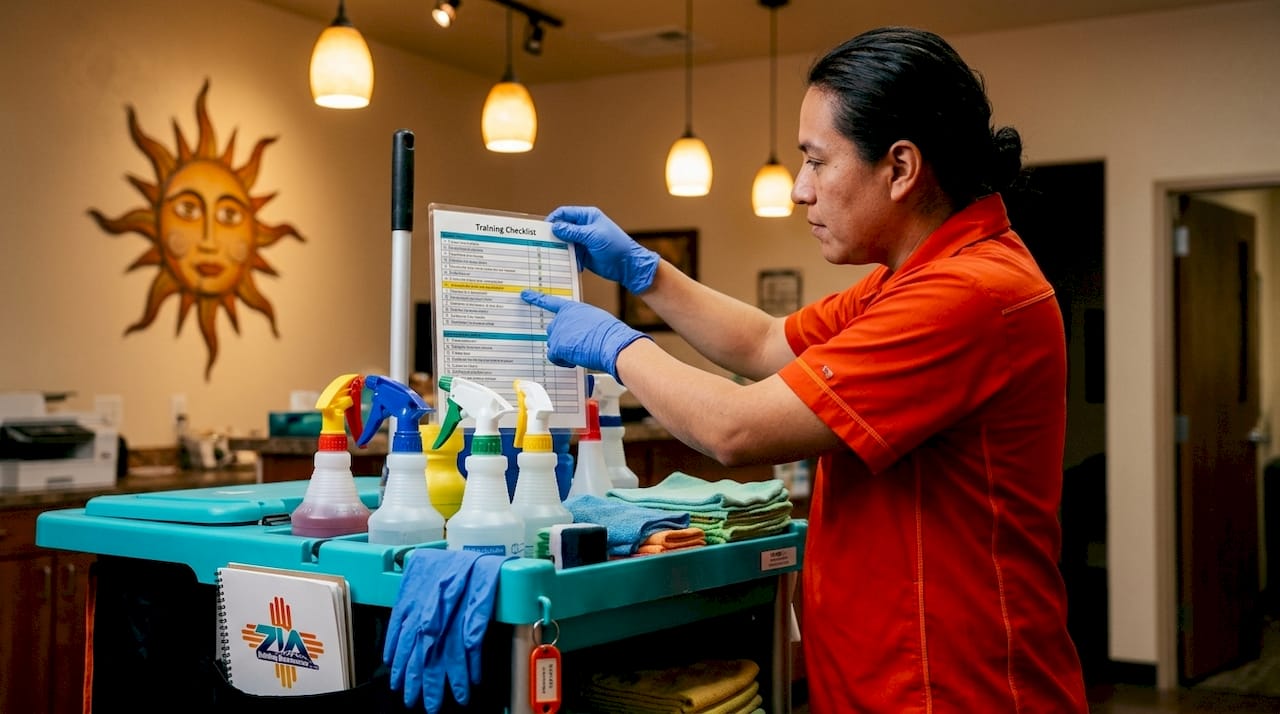
Checklists, SOPs, and evaluation forms standardize training and reduce variability, which directly increases new hire productivity and lowers turnover in janitorial service roles. Staff cannot meet expectations they have never seen in writing. Every quality standard, restocking protocol, and reporting procedure should exist as a documented reference the crew can consult independently.
| Training phase | Primary focus | Evaluation method |
|---|---|---|
| Week 1 | Orientation, SOPs, chemical safety | Paperwork completion, safety quiz |
| Week 2 | Supervised cleaning, client procedures | Supervisor observation checklist |
| Week 3 | Assisted independence, problem-solving | Mid-point performance evaluation |
| Week 4 | Full independence, quality spot-checks | 30-day formal review |
Review your commercial cleaning contract checklist alongside this timeline to confirm that every contractual obligation maps to a specific training milestone. Gaps between contract terms and training content are a leading cause of service disputes in the first 60 days.
What are best practices for training on safety and chemical handling during onboarding?
Chemical safety training is the highest-risk component of any janitorial staff orientation, and it requires a dedicated, structured approach rather than a single orientation lecture. Embedding chemical safety training within onboarding as a practical, staged process builds lasting habits and reduces workplace incidents far more effectively than one-time sessions.
The foundation of this training rests on three non-negotiable elements:
- Safety Data Sheet (SDS) accessibility: Every SDS for chemicals used in your facility must be physically accessible at the workstation where that chemical is used, not stored in a back office binder.
- Label literacy: New hires must demonstrate the ability to read product labels, identify hazard symbols, and interpret dilution instructions before using any chemical independently.
- PPE staging and use: Role-specific PPE, including gloves, eye protection, and respiratory equipment where required, should be staged at points of use so crew members have no barrier to compliance.
A targeted 7-day chemical safety plan that covers SDS review, PPE use, and spill response through hands-on quizzes produces significantly better retention than classroom-only instruction. This means retention is built through repetition in the actual work environment, not through a single slide deck.
The most effective chemical safety training happens where the chemicals are actually used. Walk new hires through each product at the point of use, demonstrate the correct dilution, and have them practice the spill response protocol on the spot. Generic lectures do not build the muscle memory that prevents accidents.
Pro Tip: Schedule a brief chemical safety check-in at the end of each of the first seven shifts. Ask one specific question about a product the crew used that day. This reinforces learning without adding formal training time and catches misunderstandings before they become incidents.
For facilities with restrooms requiring specialized cleaning products, a restroom inspection checklist can serve as a practical reference during chemical safety walkthroughs, helping new hires connect product knowledge to specific task requirements.
How to set and communicate measurable service expectations?
Vague expectations are the primary cause of janitorial service underperformance, and the solution is a set of specific, measurable service level agreements (SLAs) documented before the first shift. Staff cannot meet standards they have never seen. Every cleaning task, restocking threshold, and reporting requirement should be defined in writing with a clear, observable outcome.
Effective SLAs for janitorial services address four operational areas:
- Task frequency and scope: Define which areas are cleaned daily, weekly, and monthly. Specify floor care, restroom sanitation, trash removal, and surface disinfection schedules with measurable outcomes such as “restrooms inspected and restocked by 7:00 a.m. daily.”
- Restocking and supply protocols: Set minimum inventory thresholds for paper products, soap, and liners. Assign responsibility for reorder notifications clearly between the vendor and your facilities team.
- After-hours access and reporting: Document who holds access credentials, what the check-in and check-out procedure is, and how after-hours incidents are reported and escalated.
- Communication and escalation paths: Name the specific contacts on both sides for routine questions, quality concerns, and urgent issues. Ambiguity in escalation paths delays resolution and erodes trust.
Janitorial vendor onboarding typically completes in 5 to 8 business days, with the most common bottlenecks occurring in badge provisioning and site walkthroughs. This means your SLAs and access protocols need to be finalized before the vendor’s start date, not during it.
Clearer, buyer-focused proposals that answer five core questions, covering cost clarity, communication paths, staffing reliability, startup plans, and references, improve contract success and reduce onboarding confusion. Apply the same principle to your internal SLA documents. Answer the questions your crew will actually ask rather than producing a document that covers every possible scenario in exhaustive detail.
Pro Tip: Schedule formal service reviews at 30 days and 60 days post-start. The 30-day review identifies training gaps and protocol adjustments. The 60-day review confirms whether the service has reached the performance baseline defined in your SLAs. Document both reviews in writing and share them with the vendor.
For a deeper look at evaluating ongoing performance beyond the initial onboarding period, structured performance monitoring tools help facility managers maintain accountability long after the first 60 days.
Key takeaways
Successful janitorial service onboarding requires pre-start preparation, a structured 30-day training timeline, hands-on chemical safety certification, and documented SLAs reviewed at 30 and 60 days to deliver consistent facility cleanliness.
| Point | Details |
|---|---|
| Start before day one | Complete paperwork, access provisioning, and communication setup at least a few days before the first shift. |
| Use a 30-day training blueprint | Progress from orientation through supervised work to full independence with formal evaluations at weeks two and four. |
| Embed chemical safety in the workflow | Stage SDS sheets and PPE at points of use and conduct daily check-ins during the first seven shifts. |
| Define measurable SLAs | Document task frequency, restocking thresholds, and escalation paths before the vendor starts. |
| Review at 30 and 60 days | Formal written reviews at both milestones confirm performance and allow protocol adjustments before issues compound. |
What I’ve learned from watching onboarding go wrong
The most consistent mistake I see facility managers make is treating onboarding as something that begins on the first physical workday. By that point, you have already lost a week of preparation time that could have prevented the majority of early-stage problems. Onboarding begins the moment the contract is signed, and the managers who understand that are the ones whose new janitorial services hit their quality benchmarks within 30 days instead of 90.
The second pattern I notice is the tendency to over-document training materials without making them usable in the field. A 40-page SOP manual does not help a crew member who needs to know the correct dilution ratio for a floor cleaner at 10 p.m. Practical, task-specific reference cards posted at workstations outperform binders every time. Documented SOPs and checklists work only when they are accessible and formatted for the person doing the actual work.
The third issue is the absence of a feedback loop after the first two weeks. Managers complete the orientation, hand off the schedule, and assume the system is running. The crews that perform best at 90 days are the ones whose managers stayed engaged through structured check-ins, asked specific questions about daily tasks, and treated early performance gaps as coaching opportunities rather than contract violations. Build the feedback loop into your calendar before the vendor starts, not after a problem surfaces.
— Ashley
How Zia Building Maintenance makes janitorial onboarding straightforward
Zia Building Maintenance has served Albuquerque facilities since 1989, and the team brings that depth of experience directly to the onboarding process for every new client.
When you work with Zia Building Maintenance, you receive trained personnel who arrive with established SOPs, chemical safety certifications, and a clear understanding of quality standards before their first shift in your facility. The team’s professional office cleaning services are structured to integrate with your operational schedule, your reporting requirements, and your facility’s specific cleanliness standards. Rated the number one office cleaning service in South Valley for 2025, Zia Building Maintenance removes the guesswork from new cleaning service integration. Contact the team today to discuss a customized plan for your facility.
FAQ
How long does it take to onboard a new janitorial service?
Janitorial vendor onboarding typically completes in 5 to 8 business days, though full operational competency following a structured training program is generally achieved by day 30.
What documents are needed before a janitorial service starts?
Pre-start documentation includes signed contracts, insurance certificates, vendor compliance forms, and any facility-specific access agreements. These should be finalized at least a few days before the first scheduled shift.
Why is chemical safety training critical during janitorial onboarding?
Chemical safety training protects staff from injury and keeps your facility compliant with OSHA regulations. A hands-on 7-day training plan covering SDS review, PPE use, and spill response produces better retention than a single orientation session.
What should a janitorial service SLA include?
A strong SLA defines task frequency, restocking thresholds, after-hours access protocols, and named escalation contacts on both sides. Vague SLAs are the leading cause of service disputes in the first 60 days of a new contract.
When should you conduct the first performance review for a new janitorial service?
The first formal review should occur at 30 days to identify training gaps, with a second review at 60 days to confirm the service has reached the performance baseline defined in the original SLA.