

What’s the fastest way to get your renovated store customer-ready?
The fastest path to a clean, customer-ready retail store after renovation is a three-phase post-construction clean that always works high-to-low, uses HEPA filtration throughout, and closes each zone with a signed inspection under operating light. Skip any one of those three elements and you risk rework, a failed inspection, or a reopening delay.
Here’s the required sequence at a glance:
- Phase 1 — Rough clean: Remove bulk debris, packaging, and construction waste the same day trades finish.
- Phase 2 — Final clean: Detail every surface, fixture, glass panel, and floor finish to inspection standard.
- Phase 3 — Touch-up pass: Schedule 24–72 hours before opening to catch dust and scuffs left by returning trades.
Pro Tip: Under OSHA 29 CFR 1926, post-renovation cleaning on an active construction site is governed by construction standards, not general industry 1910 rules. Confirm any crew you hire carries OSHA 10 or OSHA 30 construction cards before they set foot on site.
Your immediate next step: schedule a zone-by-zone final-clean inspection under normal operating light and require a signed sign-off for each zone before turnover. Zia Building Maintenance provides exactly this workflow, with documented sign-offs and HEPA-grade equipment, for retail turnovers across the Albuquerque area.
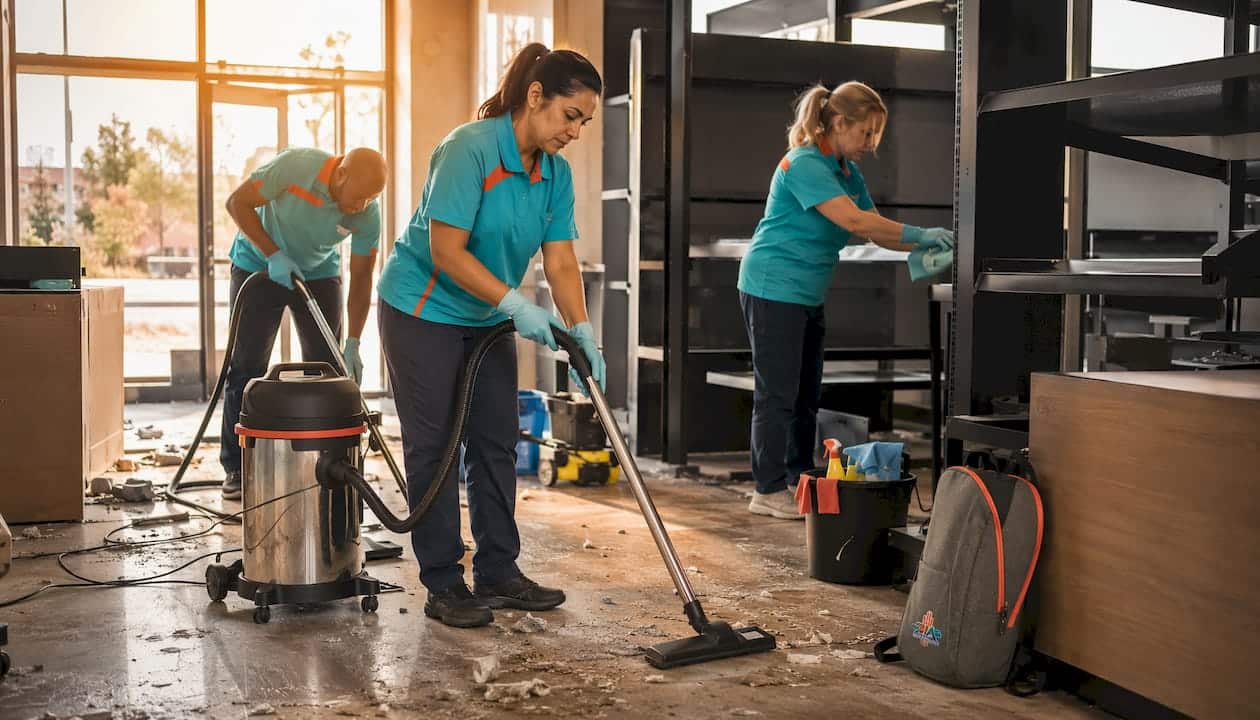
Table of Contents
- Your printable post-renovation cleanup checklist for retail
- Step-by-step zone cleaning workflow: high-to-low, clean-to-dirty
- How do zone sign-offs work as a contract deliverable?
- What does post-renovation retail cleaning cost and how long does it take?
- When should you hire a professional post-construction cleaner?
- What should your cleaning contract actually include?
- Air quality, hazardous materials, and safe waste disposal
- Final retail-specific tasks before customers walk in
- Key Takeaways
- The mistake most retail managers make at handover
- Zia Building Maintenance handles your post-renovation retail cleanup
- Useful sources
- FAQ
Your printable post-renovation cleanup checklist for retail
A reliable checklist does double duty: it guides your crew and becomes the acceptance standard your contract enforces. Tie every task to a phase, assign a signatory, and attach photos.
Pro Tip: Treat this checklist as your scope of work. A checklist tied to milestones with named signatories and photo logs is the most effective tool for avoiding turnover disputes.
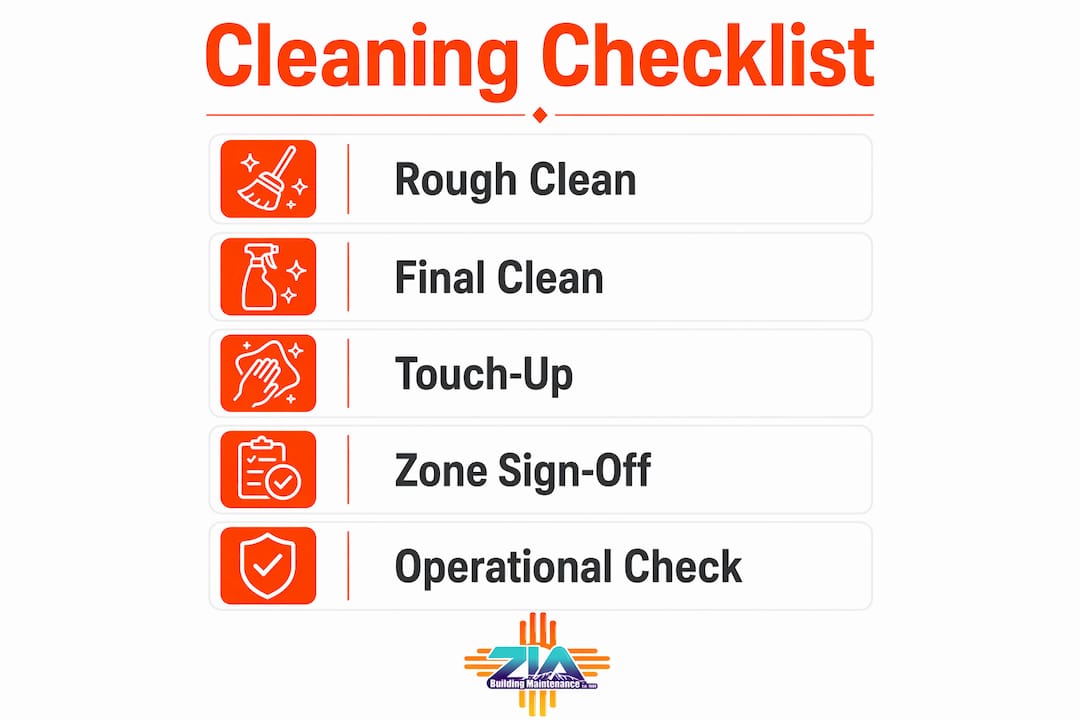
| Phase | Core Tasks | Sign-Off Required |
|---|---|---|
| Rough clean | Bulk debris removal, packaging disposal, sweep all surfaces | Cleaning lead |
| Final clean | High dusting, HVAC vents, glass, grout haze, floor finish, restrooms | Cleaning lead + PM |
| Touch-up | Spot dust, glass re-wipe, floor scuffs, entrance threshold | Owner rep |
Each sign-off entry should record: zone name, tasks completed, any exceptions noted, photo evidence, inspector name, date and time, and the lighting condition (operating light, not work lights).
Step-by-step zone cleaning workflow: high-to-low, clean-to-dirty
Cleaning high-to-low is the single most important quality-control rule in post-renovation retail cleanup. Dust dislodged from ceilings and fixtures falls onto surfaces below. Clean the floor first and you clean it twice.
Exact task order
- Ceilings, beams, and high ledges — dry microfiber or extension duster
- Light fixtures, diffusers, and HVAC registers — wipe and vacuum
- Vertical surfaces: walls, columns, and casework exteriors
- Glass panels, storefront windows, and mirrors — nonabrasive glass cleaner
- Cabinet and display interiors, drawer compartments
- HEPA-vacuum all edges, corners, and grout lines
- Floor edges and transition strips
- Mop, scrub, or apply floor finish last — matched to floor type (VCT, LVT, polished concrete, or stone)
New flooring requires manufacturer-compatible methods. Abrasive cleaners and wrong-pH products can void floor warranties, so identify the floor type before selecting pads or finish products.
Equipment and PPE per phase
- HEPA vacuums (mandatory — standard vacuums recirculate fine silica and drywall dust)
- Microfiber cloths and disposable wipes
- P100 respirators for silica-prone tasks
- Orbital floor machine or buffer for finish application
- Grout haze remover, low-alkaline floor cleaner, nonabrasive glass cleaner
- Hard hat and steel-toed boots per OSHA 29 CFR 1926
Estimated crew-hours by retail zone
| Zone | Estimated Crew-Hours (2,000–4,000 sq ft store) | Crew Size |
|---|---|---|
| Sales floor | 4–8 hrs | 2–3 |
| Checkout area | 1–2 hrs | 1–2 |
| Stockroom | 2–3 hrs | 1–2 |
| Restrooms | 1–2 hrs | 1 |
| Fitting rooms | 1–2 hrs | 1 |
For scale reference: a 50,000 sq ft commercial build typically requires roughly 40 crew-hours for rough clean, 100 for construction clean, and 75 for final clean. A small-to-medium retail fit-out requires several crew-hours spread over the final clean phase.
How do zone sign-offs work as a contract deliverable?
Require signed zone sign-offs inspected under operating lighting as the criterion for turnover. Work-light inspections miss streaks, grout haze, and fine dust that customers will see immediately.
Sign-off template elements
- Zone name and square footage
- Tasks completed (reference checklist line items)
- Exceptions or deficiencies noted
- Corrective action deadline (typically 24 hours)
- Digital photos attached
- Inspector name, signature, date, and time
- Lighting condition confirmed as operating light
Inspection protocol steps
- Walk each zone under full operating light with both the cleaning foreperson and the owner or project manager present.
- Apply a visible acceptance standard: no dust visible on horizontal surfaces, no streaks on glass, no grout haze on tile.
- Note any deficiency with a photo and assign a remediation window.
- Withhold a payment percentage (retainage) until each zone sign-off is complete and accepted.
Pro Tip: Digital sign-offs with timestamped photos attached to each zone entry give you a defensible record if a dispute arises at final payment.
| Sign-Off Element | Purpose |
|---|---|
| Operating-light inspection | Catches defects customers will see |
| Named signatories | Assigns accountability |
| Photo evidence | Dispute-resolution record |
| Retainage tie | Financial incentive for completion |
What does post-renovation retail cleaning cost and how long does it take?
For a small-to-medium retail fit-out, budget several crew-hours for the final clean phase. The rough clean is done shortly after trades finish; the final clean usually spans a few days; and the touch-up pass takes a few hours immediately before opening.
Cost drivers that move the price up:
- High-end finishes (marble, polished concrete, specialty glass)
- Presence of hazardous materials (lead paint in pre-1978 buildings, asbestos, silica)
- After-hours or weekend access requirements
- Floor restoration work (stripping, refinishing, or sealing)
- HVAC duct cleaning, which is a separate scope item
Hazardous materials and duct cleaning materially increase both time and cost. If your building predates 1978, budget for air quality and asbestos testing before the final clean begins.
| Store Size | Final Clean (crew-hours) | Touch-Up |
|---|---|---|
| 2,000–4,000 sq ft | 8–16 hrs | 1–4 hrs |
| — | 16 hrs | 2–6 hrs |
| — | — | Half day+ |
| — | — | Half day+ |
When should you hire a professional post-construction cleaner?
Hire a professional when the project involves respirable silica dust, specialist finishes, a compressed timeline, or a contract that requires documented zone sign-offs. DIY crews rarely have HEPA equipment, construction-site PPE, or the sequencing discipline to pass a formal inspection.
| Factor | DIY | Professional |
|---|---|---|
| HEPA equipment | Rarely available | Standard |
| OSHA 29 CFR 1926 compliance | Unlikely | Required of reputable vendors |
| Zone sign-off documentation | Difficult | Included |
| Specialist floor finishes | High warranty risk | Manufacturer-compatible methods |
| Hazardous material awareness | Low | Trained |
Pro Tip: When vetting vendors, require proof of general liability insurance, OSHA 10 or 30 construction training cards, a HEPA equipment list, references from retail projects, and photo documentation capability. A vendor who cannot produce these should not be on your shortlist.
Professional post-construction cleanup also protects you from warranty voids on new flooring and finishes, which DIY cleaning with the wrong products can trigger.
What should your cleaning contract actually include?
Lead with phase definitions, acceptance criteria tied to zone sign-offs under operating light, remediation windows, and retainage tied to acceptance. A contract without these elements gives you no leverage when a zone fails inspection.
Core contract clauses
- Scope of work: Phase-by-phase task list with zone assignments and square footage.
- Inspection and acceptance: Sign-off under operating light, named inspector, photo log required.
- Corrective action: 24-hour remediation window for deficiencies; re-inspection at no additional cost.
- Payment and retainage: Percentage withheld until each zone sign-off is accepted.
- Insurance and certifications: General liability, OSHA construction training, SDS for all chemicals.
- Warranty on workmanship: Minimum 48-hour warranty covering visible defects found after sign-off.
- Dispute resolution: Named method (mediation, arbitration) and jurisdiction.
Sample acceptance clause: “Cleaning Contractor shall deliver each zone to Owner’s Representative for inspection under normal operating lighting. Owner’s Representative shall accept or reject each zone within 24 hours of notification. Rejected zones shall be remediated within 24 hours at Contractor’s expense. Final payment of [X]% retainage is conditioned upon written acceptance of all zones.”
Pro Tip: Use your commercial cleaning contract checklist as the scope-of-work attachment. It becomes an enforceable deliverable, not just a reference document.
Consult legal counsel before finalizing contract language for binding agreements.
Air quality, hazardous materials, and safe waste disposal
Post-renovation cleaning on an active construction site falls under OSHA 29 CFR 1926, not general industry standards. That distinction matters for PPE requirements, exposure controls, and crew training.
Required safety controls:
- Silica: Wet suppression or HEPA vacuuming; P100 respirators mandatory during dry sweeping or grinding residue removal.
- Lead (pre-1978 buildings): Assume lead paint is present until tested; require licensed abatement if confirmed.
- Asbestos: If suspected, halt cleaning and engage a licensed abatement firm before proceeding.
- Chemical adhesives and solvents: SDS sheets must be on site and visible; ventilate the space during application.
- Electrical safety: Confirm lockout/tagout procedures are in place before cleaning near exposed wiring.
Pro Tip: Replace HVAC filters after the final clean and document the filter change as part of the zone sign-off. Filters loaded with construction dust will redistribute particulates the moment the system runs.
| Hazard | Control Method | Responsible Party |
|---|---|---|
| Silica dust | HEPA vacuum + P100 respirator | Cleaning crew |
| Lead paint | Licensed abatement if confirmed | Abatement contractor |
| Asbestos | Stop work; licensed abatement | Abatement contractor |
| Chemical solvents | SDS on site; ventilate | Cleaning crew + PM |
Separate construction debris streams: general waste, recyclables, and regulated hazardous materials must go to different disposal paths. Never mix asbestos or lead waste with general construction debris.
Final retail-specific tasks before customers walk in
Final prep is not just cleaning. It’s confirming the store is merchandised, operational, and safe before the first customer crosses the threshold.
Schedule the touch-up pass 24–72 hours before opening, then lock completed zones to prevent recontamination from deliveries or returning trades.
Last-mile retail checklist
- Dust all shelving and display fixtures after merchandising teams finish.
- Remove protective films and installation labels from hardware, glass, and fixtures.
- Confirm POS systems and power connections are dust-free and functional.
- Inspect fitting room mirrors and benches under operating light.
- Restock and disinfect restrooms: soap, paper towels, hand sanitizer.
- Clean entrance glass, door thresholds, and exterior signage.
- Walk all customer pathways for trip hazards, scuffs, or debris.
- Take staged photos of each zone as opening-day evidence.
For ongoing maintenance after reopening, a structured retail store cleaning routine keeps the space customer-ready through high foot-traffic periods.
Key Takeaways
Effective cleaning after retail renovation requires a three-phase, high-to-low sequence with HEPA controls, zone sign-offs under operating light, and a touch-up pass 24–72 hours before opening.
| Point | Details |
|---|---|
| Enforce high-to-low sequence | Always clean ceilings and fixtures before floors to prevent rework and recontamination. |
| Three-phase budget | Plan for rough clean, final clean (8–16 crew-hours for a 2,000–4,000 sq ft store), and a touch-up pass. |
| Zone sign-offs under operating light | Require signed, photo-documented sign-offs per zone as the contract acceptance standard. |
| Verify OSHA compliance | Confirm any hired crew holds OSHA 10 or 30 construction cards and carries HEPA equipment. |
| Zia Building Maintenance | Operating since 1989 and named #1 in South Valley for 2025, Zia provides phased retail post-renovation cleaning with documented zone sign-offs and HEPA-grade equipment. |
The mistake most retail managers make at handover
The biggest time sink in post-renovation retail cleanup is not the volume of work. It’s cleaning out of sequence and failing to lock completed zones afterward.
Mopping drywall dust before HEPA-vacuuming turns it into a paste that bonds to grout lines and floor finishes. Using abrasive pads on new LVT or polished concrete scratches surfaces that were just installed. Skipping HVAC filter replacement after the final clean means the system redistributes fine particulates the moment it cycles on. These are not edge cases; they are the most common on-site mistakes that create rework and delay reopening.
What actually saves days at handover: a clear scope tied to zone sign-off, HEPA filtration from the first pass, and a touch-up scheduled 24–72 hours before opening. Managers who lock completed zones and prohibit re-entry by trades or delivery crews consistently avoid the last-minute scramble that pushes opening day back.
Zia Building Maintenance handles your post-renovation retail cleanup
Retail managers who need a spotless, inspection-ready store on a fixed timeline have a reliable option in Zia Building Maintenance. Since 1989, Zia has delivered phased commercial cleaning with the consistency and documentation that retail turnovers demand, earning the title of #1 office cleaning service in South Valley for 2025.
For post-renovation retail projects, Zia provides HEPA-grade equipment, OSHA-aware crews, zone-by-zone sign-off documentation, and floor care matched to your specific finish type. Whether your store is 2,000 or 20,000 square feet, the process starts with a site walkthrough so the scope reflects your actual conditions, not a generic estimate.
Request a walkthrough-based quote through Zia’s office cleaning services page and get a cleaning plan built around your reopening date.
Useful sources
- OSHA 29 CFR 1926 Post-Construction Safety Guide (Opora) — best for safety standards, PPE requirements, and phase crew-hour estimates
- Post-Construction Cleaning Study Guide (EcoClear Solutions) — best for sequencing principles and common operational pitfalls
- Post-Construction Cleaning Checklist: Commercial Buildings (ForemanPro) — best for sign-off templates and milestone-tied checklists
- Touch-Up Pass and Floor Care Guidance (Oasis Cleaning) — best for touch-up timing and floor warranty protection
Save the zone sign-off template from ForemanPro and require SDS sheets and OSHA certifications from every vendor before work begins.
FAQ
What are the three phases of post-renovation retail cleaning?
The three phases are rough clean (bulk debris removal), final clean (detail cleaning of all surfaces, glass, and floors to inspection standard), and touch-up pass (a light re-clean 24–72 hours before opening to address dust from returning trades).
How long does cleaning after retail renovation take?
A 2,000–4,000 sq ft retail store typically requires 8–16 crew-hours for the final clean phase. The rough clean runs the same day trades finish; the touch-up pass takes 1–4 hours immediately before opening.
Why must post-renovation cleaning follow a high-to-low sequence?
Cleaning high surfaces first prevents dislodged dust from recontaminating floors and lower surfaces already cleaned. Reversing the sequence creates rework and can turn drywall dust into a paste if floors are mopped before HEPA-vacuuming is complete.
When should a retail manager hire a professional cleaning crew?
Hire a professional when the project involves respirable silica dust, specialist finishes, a compressed timeline, or a contract requiring documented zone sign-offs. Professional crews bring HEPA equipment, OSHA 29 CFR 1926 compliance, and photo documentation that in-house staff typically cannot match.
What should a zone sign-off include?
Each zone sign-off should record the zone name, tasks completed, any exceptions, digital photos, the inspector’s name and signature, date and time, and confirmation that the inspection was conducted under normal operating light.