

How to Build an Office Cleaning Plan That Sticks
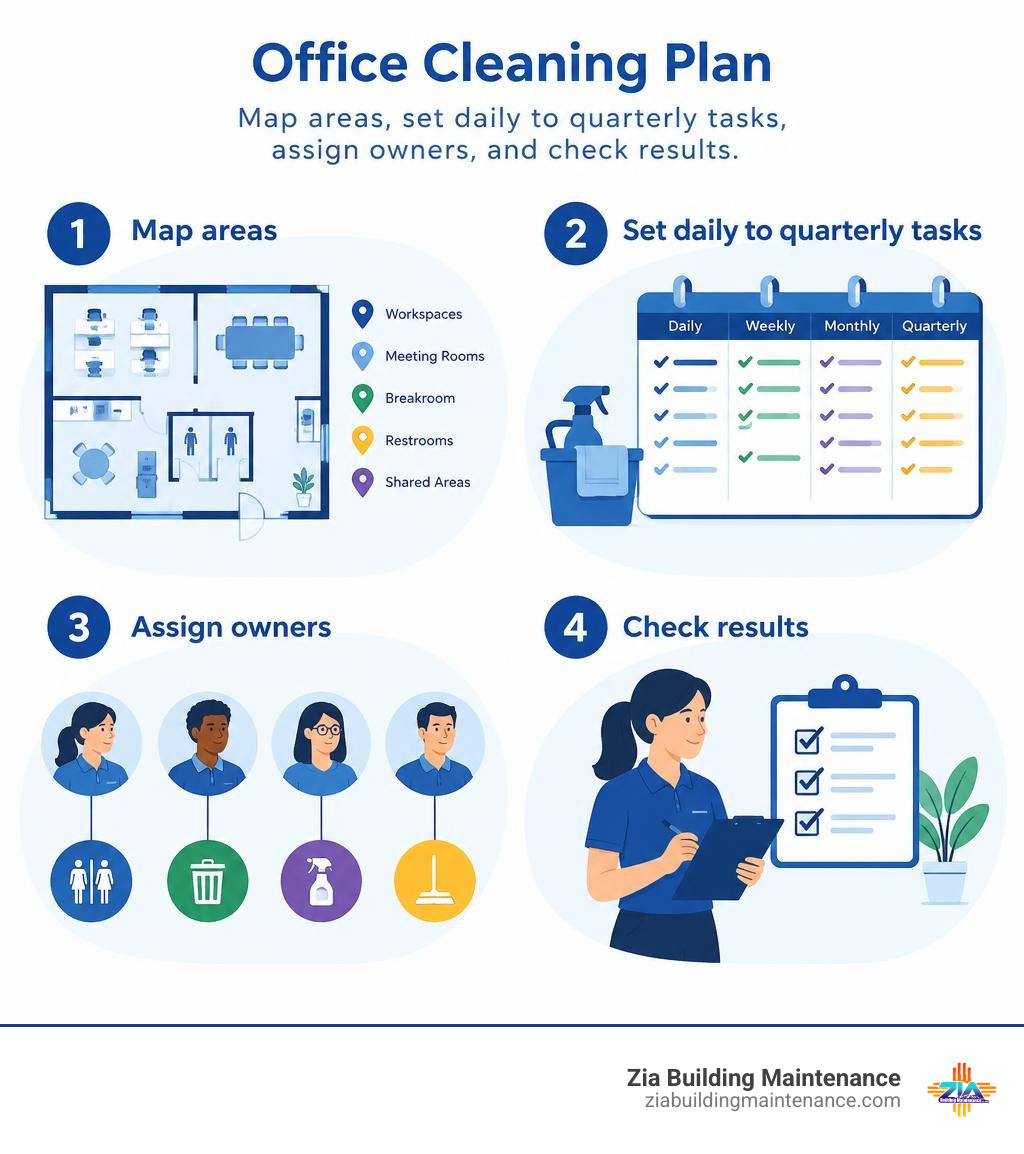
Start your office cleaning plan by listing each area, how often it is used, and who will clean it. Schedule restrooms, breakrooms, trash, and shared touchpoints daily; detailed dusting and overlooked spots weekly; deeper floor and fixture work monthly; and larger jobs, such as carpet cleaning, quarterly. Give every task an owner, a time, and a way to confirm it was done.
That last step matters. A checklist can tell a crew what to clean, but a quick inspection helps catch the details that are easy to miss.
I’m Ashley Cordova, Vice President of Zia Building Maintenance, where I oversee day-to-day operations for our family-owned janitorial company. My work with cleaning teams and clients has taught me that an office cleaning plan works best when duties are clear and the schedule fits the business.
A dirty workspace is not merely an eyesore; it takes a measurable toll on your workforce. Scientific studies show that the average office desk harbors 400 times more bacteria than a typical toilet seat, translating to roughly 10 million microbes residing on standard work surfaces. Keyboards alone carry 70% more bacteria than restroom commodes, while communal office phones host around 25,000 germs per square inch. Because common flu viruses can survive on hard office surfaces for 24 to 48 hours, an unmanaged facility quickly turns into a vector for workplace illness.
Conversely, investing in workplace hygiene yields significant operational gains. Research demonstrates that employees in clean offices are 12% more productive. Furthermore, 94% of workers report feeling noticeably more productive in a well-maintained setting, with 77% stating they produce higher quality work. By structuring a systematic routine, facilities eliminate bio-contaminants, improve indoor air quality, and keep teams performing at their peak.
Core Elements of an Effective Office Cleaning Plan
Every high-performing sanitization program begins with a clear operational framework. You cannot manage what you do not map. We recommend dividing your commercial property into distinct operational zones: high-traffic entryways and reception areas, collaborative workspaces and private offices, breakrooms and kitchens, and washrooms.
Mapping traffic patterns allows facility managers to establish sanitation tiers based on occupant density and cross-contamination risks. Understanding the benefits of consistent office cleaning for managers makes it easier to allocate internal labor and professional janitorial services without overextending resources.
High-Touch Surface Disinfection and Germ Hotspots
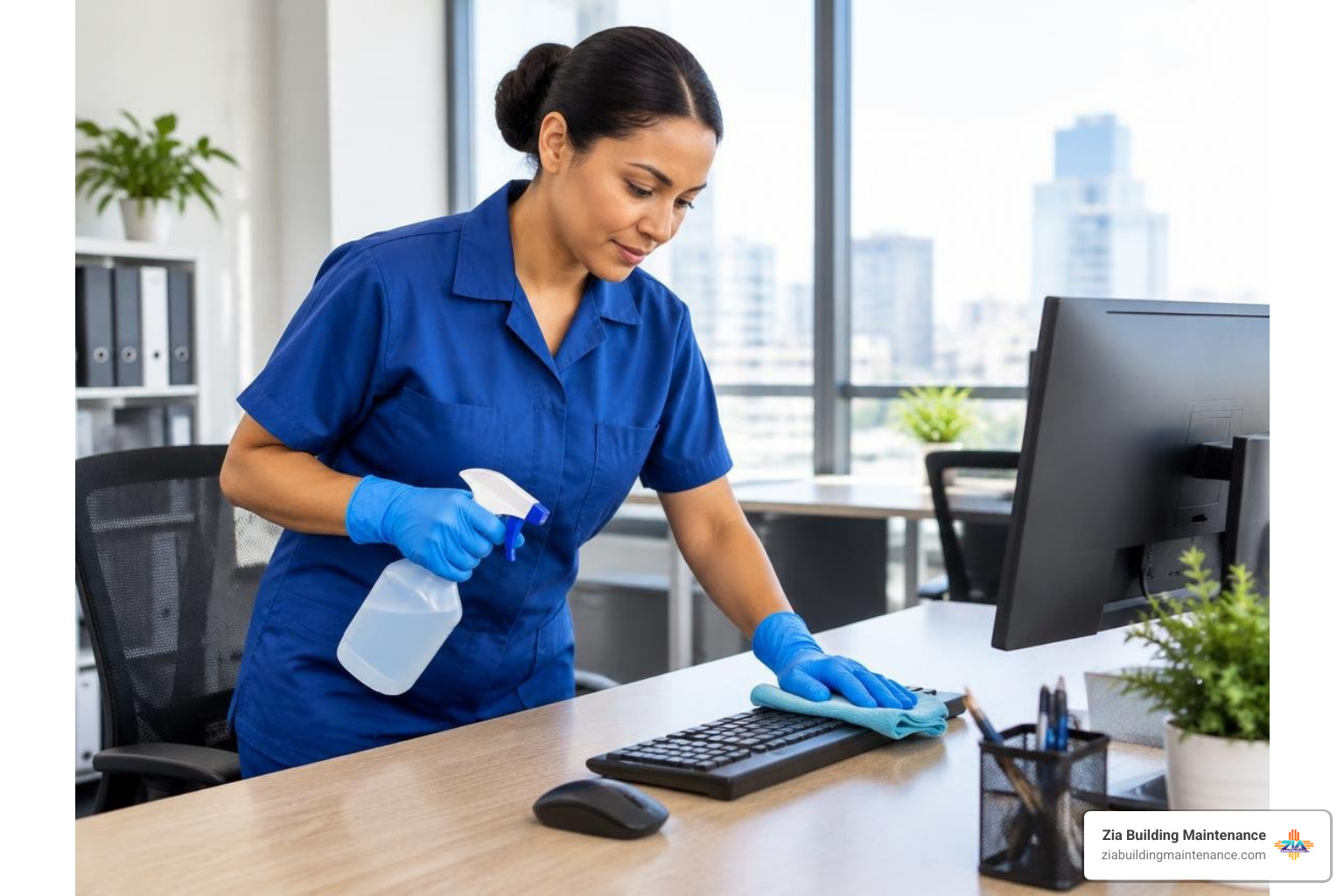
Field swab studies across thousands of commercial facilities indicate that the most contaminated office areas are rarely the bathroom doors—they are the common touchpoints we handle daily. The top five germ hotspots in modern commercial facilities include:
- Breakroom sink faucet handles
- Microwave door buttons and handles
- Computer keyboards and mice
- Refrigerator doors and water cooler levers
- Communal drinking fountain buttons
Disinfecting wipes and EPA-registered antimicrobial solutions can achieve a 99% reduction in bacterial levels across high-touch points over a 48-hour period. However, commercial sanitization requires respecting manufacturer-mandated dwell times—the specific duration a disinfectant must remain visibly wet on a surface to kill target pathogens. Wiping a chemical away immediately after spraying strips it of its germicidal power.
Supplies, Color-Coded Equipment, and Safety Protocols
Cross-contamination occurs when cleaning gear transfers microbes from high-risk zones, such as restrooms, into low-risk areas, like lunchrooms. Establishing a color-coded microfiber system prevents this risk entirely (for example, red cloths for toilets and urinals, yellow for kitchen prep surfaces, and blue for general workstation dusting).
wp:html
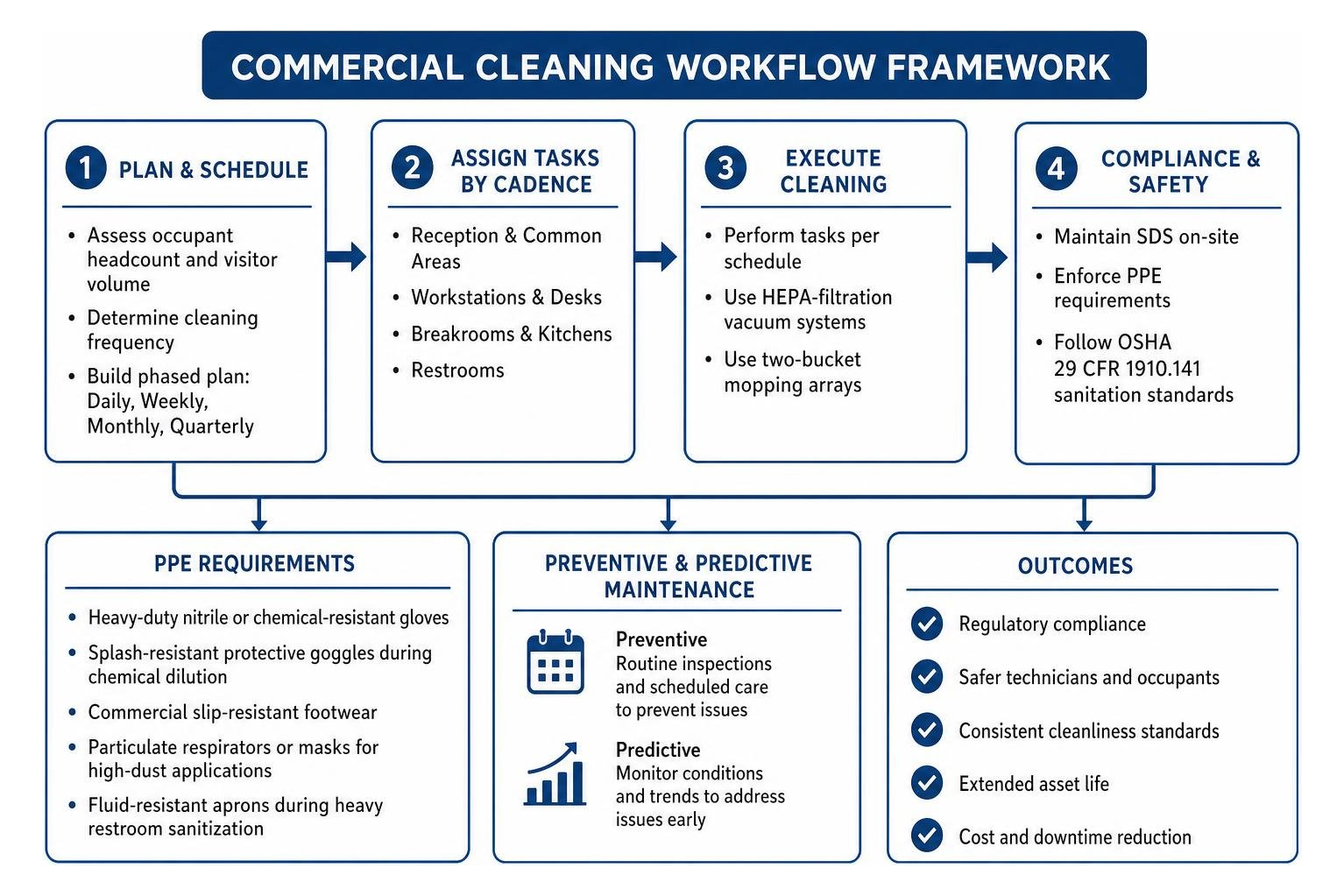
To maintain regulatory compliance under OSHA 29 CFR 1910.141 sanitation standards, facility managers must maintain on-site Safety Data Sheets (SDS) for all cleaning formulations and mandate appropriate personal protective equipment (PPE):
- Heavy-duty nitrile or chemical-resistant gloves
- Splash-resistant protective goggles during chemical dilution
- Commercial slip-resistant footwear
- Particulate respirators or masks for high-dust applications
- Fluid-resistant aprons during heavy restroom sanitization
Combining PPE compliance with HEPA-filtration vacuum systems and two-bucket mopping arrays protects both cleaning technicians and building occupants.
Structuring Your Office Cleaning Schedule Across Cadences
A structured schedule prevents operational chaos and maintains spotless standards across all work shifts. Determining the optimal cleaning frequency for commercial spaces requires balancing occupant headcount, daily visitor volume, and the nature of the work performed.
Designing a Phased Office Cleaning Plan by Frequency
Establishing dedicated frequencies ensures that daily maintenance is not overwhelmed by heavy restorative tasks. Use our structured operational matrix below to delegate duties across daily, weekly, monthly, and quarterly schedules:
| Cadence | Reception & Common Areas | Workstations & Desks | Breakrooms & Kitchens | Restrooms |
|---|---|---|---|---|
| Daily | Empty trash, damp mop hard floors, sanitize entrance glass | Disinfect touchpoints, empty bins, damp wipe surfaces | Sanitize countertops, sinks, handles, and wipe microwave interiors | Clean and disinfect toilets, sinks, mirrors; restock consumables |
| Weekly | Detail entry mats, edge vacuum corners, dust baseboards | Sanitize shared phones, wipe cubicle partition trims | Purge expired fridge items, clean appliance exteriors, descale faucets | Deep scrub stall partitions, acid-wash urinal scale, detail drain traps |
| Monthly | Machine scrub hard flooring, high dust fixtures above 7 feet | Vacuum fabric office chairs, spot clean interior partition walls | Pull out and clean behind appliances, deep clean cabinet fronts | Machine scrub tile grout, polish stainless fixtures, check exhaust vents |
| Quarterly | Deep hot-water carpet extraction, clean high architectural glass | Comprehensive tech-safe sanitization, dust overhead HVAC diffusers | Sanitize full interior of refrigerators, deep clean grease traps | Reseal grout lines, perform deep restorative bio-sanitization |
Adopting proven, structured cleaning frameworks guarantees that standard janitorial sweeps seamlessly support periodic deep cleaning protocols.
Integrating Preventive and Predictive Facility Maintenance Strategies
An effective cleaning plan incorporates proactive facility maintenance instead of relying exclusively on reactive repairs:
- Reactive Maintenance: Immediate spill containment, biohazard remediation, or clearing sudden plumbing backups.
- Preventive Care: Scheduled floor waxing, carpet protectant reapplications, and routine HVAC filter replacements that safeguard assets before wear occurs.
- Predictive Upkeep: Utilizing IoT sensors to monitor indoor air quality, assess carpet wear indices, or identify humidity swings before mold growth takes root.
- Risk-Based Maintenance: Adjusting sanitization intensity based on seasonal sickness trends or sudden changes in building occupancy.
Integrating these methodologies protects valuable building infrastructure and prevents costly floor replacements.
Managing Execution, Accountability, and Operational Disruption
Executing a cleaning plan requires a clear division of responsibilities. Approximately 46.42% of facility managers choose to keep daily maintenance internal, while others leverage specialized external partners. Distinguishing between regular janitorial maintenance versus specialized office cleaning ensures that routine daily chores like trash removal never distract from complex restorative tasks like rotary floor buffing.
To avoid distracting staff during business hours, schedule heavy equipment operations, carpet extraction, and loud vacuuming outside regular office shifts. When daytime presence is necessary, deploy quiet day porters focused solely on restocking, light touchpoint sanitizing, and spill response.
How to Adapt Your Office Cleaning Plan for Regional Climates and Office Size
Square footage directly dictates cleaning logistics. Workplaces under 1,500 square feet with fewer than six employees can often manage light chores internally, but larger properties require dedicated commercial execution.
Regional climates introduce unique challenges. For businesses in arid, high-desert environments with frequent dust storms and low humidity, tracking grit indoors is an ongoing challenge. Commercial facilities require double-barrier walk-off matting systems (at least 12 to 15 feet of matting at all exterior entryways) to trap abrasive soil before it damages interior finishes. Research shows that shoes carry over 420,000 types of bacteria into commercial spaces; high-performance entryway matting significantly limits these contaminants. For regional facility managers, scheduling recurring office cleaning in Albuquerque and Rio Rancho ensures local dust, pollen, and sediment are mitigated before harming indoor air systems.
Tracking Quality Through Cleanliness KPIs and Quality Audits
Accountability turns an ordinary checklist into a measurable management system. Utilize quantitative KPIs and digital tracking templates to audit performance across every shift:
- Checklist Completion Rate: Target a 98% or higher completion score per cleaning cycle.
- Random Inspection Audits: Conduct weekly walkthroughs using a standardized 10-point scoring rubric.
- Incident Resolution Velocity: Resolve high-priority cleanliness tickets within 60 minutes.
- Occupant Satisfaction Index: Track monthly employee feedback scores regarding workspace hygiene.
Pairing physical inspection forms with digital QR-code check-ins at major service stations gives managers transparent, timestamped proof of quality.
Frequently Asked Questions About Office Cleaning Plans
What is the single most important task in an office cleaning schedule?
Daily high-touch disinfection is the single most vital component. Sanitizing shared surfaces—such as microwave handles, faucet controls, conference room remotes, and door hardware—breaks pathogen transmission chains, directly reducing employee absenteeism.
How often should an office undergo a comprehensive deep clean?
Offices should undergo comprehensive deep cleaning quarterly. This cycle should include hot-water carpet extraction, machine scrubbing of tile grout, detailed dusting of high architectural features, and sanitizing overhead HVAC diffusers.
Should commercial office cleaning be scheduled during or after working hours?
Most commercial cleaning is best scheduled after hours or during early morning windows to avoid disrupting business operations and client calls. High-occupancy facilities can pair evening deep cleaning with a quiet daytime porter service for ongoing restroom restocking and breakroom upkeep.
Conclusion
A well-structured cleaning plan safeguards employee well-being, protects long-term property assets, and ensures your facility consistently makes an exceptional impression on clients. As a trusted, family-owned business serving Albuquerque, Rio Rancho, Corrales, and Los Ranchos since 1989, Zia Building Maintenance delivers dependable, detailed commercial janitorial programs tailored to your exact operational requirements.
To audit your current facility standards or build a custom schedule from the ground up, download our comprehensive office cleaning checklist or contact our team today for a tailored commercial proposal.