

TL;DR:
- Deep cleaning targets hidden grime, allergens, and buildup that routine office cleaning often misses, enhancing health and appearance. Regular deep cleaning schedules, tailored to office size and foot traffic, help maintain a sanitary workspace and extend asset lifespan. Combining routine janitorial services with periodic deep cleans ensures a consistently professional and healthy environment.
If you manage an office, you’ve likely scheduled regular cleaning and assumed that was enough. But what is deep cleaning an office, exactly, and how does it differ from what your janitorial crew does every week? The short answer is that routine cleaning maintains surface appearance, while deep cleaning addresses the grime, allergens, and buildup that accumulate invisibly over time. For office managers and business owners, understanding this distinction is the first step toward maintaining a truly sanitary, professional workspace that protects your team and impresses your clients.
Table of Contents
- Key takeaways
- What is deep cleaning an office: definition and full scope
- Benefits of deep cleaning your office environment
- How to deep clean an office: steps and checklist
- Scheduling frequency for office deep cleaning
- My take on combining deep cleaning with routine services
- Keep your office clean year-round with Zia Building Maintenance
- FAQ
Key takeaways
| Point | Details |
|---|---|
| Deep cleaning goes beyond routine tasks | It targets vents, carpet fibers, upholstery, and high-touch surfaces that daily cleaning routinely misses. |
| Health and productivity improve | Removing allergens and pathogens from deep within surfaces reduces sick days and supports employee well-being. |
| Frequency depends on office size | Small offices need deep cleaning every 3 to 6 months; large offices may need it monthly or bimonthly. |
| A checklist prevents missed areas | Structured checklists covering floors, restrooms, kitchens, and vents help verify thoroughness every time. |
| Combining services saves money | Pairing routine janitorial upkeep with periodic deep cleaning extends the life of flooring, furniture, and assets. |
What is deep cleaning an office: definition and full scope
The office deep cleaning definition starts with one clear idea. It is a thorough, detail-oriented cleaning process that addresses the areas and surfaces that routine janitorial services do not reach. Where daily or weekly cleaning covers visible surfaces like countertops, floors, and trash bins, deep cleaning goes further. It removes hidden dirt and grime that builds up in places most people never look.
Deep cleaning targets areas like air vents, under and behind furniture, upholstery, baseboards, and full restroom sanitization that are typically skipped during regular maintenance. Janitorial crews handle everyday tasks like trash removal, surface wiping, and floor mopping, while deep cleaning requires specialized equipment and techniques that go well beyond those basics.
Tasks included in what does office deep cleaning include are:
- Steam cleaning carpets and extracting embedded dirt and allergens
- Stripping and waxing hard floors to restore their original finish
- Cleaning interior surfaces of kitchen appliances and breakroom equipment
- Dusting light fixtures, ceiling fans, and air vents
- Sanitizing restrooms from top to bottom, including grout lines and fixtures
- Cleaning behind and underneath office furniture and filing cabinets
- Wiping down chair upholstery and fabric partitions
The equipment used in deep cleaning is also different. Commercial carpet extractors, floor stripping machines, steam sanitizers, and industrial-grade disinfectants are standard tools. These are not items a typical janitorial crew arrives with on a Tuesday morning. Specialized equipment and techniques are required for jobs like floor stripping, carpet extraction, and vent cleaning.
Pro Tip: Ask any prospective cleaning provider to give you a written list of what their deep cleaning service includes versus their standard janitorial service. If they cannot clearly distinguish between the two, that tells you everything you need to know about the depth of their work.
Benefits of deep cleaning your office environment
The benefits of deep cleaning office spaces extend well beyond a polished appearance. The most significant return is on employee health. Carpets, upholstery, and air vents trap allergens, dust mites, mold spores, and pollutants over time. Removing allergens from carpets, vents, and surfaces contributes directly to better indoor air quality and reduced health risks for everyone in the building.
Here is what office managers consistently see after investing in professional office deep cleaning:
- Fewer respiratory complaints and allergy flare-ups among staff
- Reduced spread of colds and viruses through properly disinfected high-touch surfaces
- Extended lifespan of flooring materials, carpet, and office furniture
- A noticeably cleaner appearance that impresses visiting clients and partners
- Improved employee morale tied to working in a well-maintained space
The importance of office cleanliness at a deeper level also has financial consequences. Replacing carpet that could have lasted five more years with proper maintenance, or repainting walls stained by years of neglected grime, costs significantly more than periodic professional cleaning.
“A clean office isn’t just about looking professional. It communicates to your employees that their health and comfort matter, and it communicates to your clients that your organization pays attention to the details.”
The productivity connection is real as well. Employees who work in cleaner environments report less distraction, fewer sick days, and a stronger sense of pride in their workplace. That translates to measurable output improvements over time.
How to deep clean an office: steps and checklist

Knowing how to deep clean an office means following a systematic process rather than cleaning whatever looks dirty. The difference between thorough and superficial deep cleaning comes down to structure. A solid deep cleaning office checklist removes the guesswork and makes sure no critical area is overlooked.
Here is a practical sequence that works well for most office environments:
- Start high, work low. Dust and clean ceiling vents, light fixtures, and ceiling fan blades before touching floors or furniture. Debris falls down, so you clean it once, not twice.
- Move furniture. Pull desks, filing cabinets, and shelving away from walls to clean behind and underneath them. This is where dust buildup and debris concentrate.
- Clean all upholstered surfaces. Treat office chairs, sofas, and fabric partitions with appropriate cleaning agents. Steam cleaning works best for removing embedded particles.
- Deep clean the kitchen and breakroom. Clean the inside of microwaves, refrigerators, and coffee makers. Wipe down cabinet interiors and sanitize sink hardware thoroughly.
- Sanitize restrooms completely. This goes beyond daily surface wiping. Scrub grout, clean behind fixtures, and disinfect every surface including walls and door hardware.
- Address high-touch points. Door handles, desks, keyboards, phones, elevator buttons, and light switches harbor the highest concentration of germs and need detailed disinfecting.
- Steam clean or extract carpets. This removes the residue and allergens that vacuuming leaves behind every single day.
- Strip, clean, and refinish hard floors. Vinyl, tile, and hardwood all benefit from periodic stripping and reapplication of protective finish.
- Verify with a checklist. A detailed deep cleaning checklist covering floors, upholstery, vents, restrooms, kitchens, and behind furniture helps managers verify that everything was covered.
Timing matters too. Most offices schedule deep cleaning after hours, over a weekend, or during a holiday closure so operations are not disrupted. Coordinating your cleaning crew’s arrival with building management and staff notifications avoids confusion and keeps the process efficient.
Pro Tip: Photograph areas before and after deep cleaning. This gives you a documented baseline, makes it easier to track how quickly certain areas accumulate buildup, and helps you communicate expectations to your cleaning provider.
Scheduling frequency for office deep cleaning
Understanding how often to schedule deep cleaning services for offices requires looking at several variables. Office size, employee count, foot traffic from visitors, and the nature of the work all affect how quickly an office needs attention beyond routine maintenance.
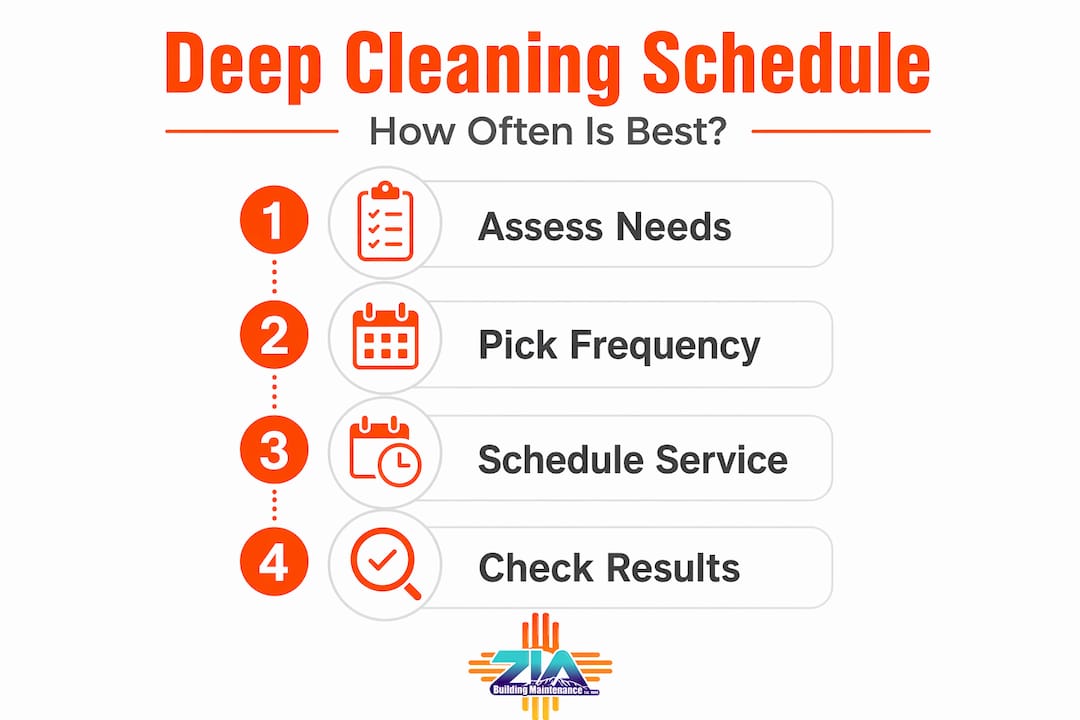
Frequency should be tailored to each facility based on these factors rather than a generic calendar. Here is a practical framework:
| Office size | Employee count | Recommended deep cleaning frequency |
|---|---|---|
| Small office | Under 15 employees | Every 3 to 6 months |
| Medium office | 15 to 50 employees | Every 2 to 3 months |
| Large office | 50 or more employees | Monthly or bimonthly |
| High-traffic client office | Any size with frequent visitors | Monthly, at minimum |
Beyond size and headcount, seasonal patterns play a role. Cold and flu season in the fall and winter is the most critical time to schedule a thorough deep clean. Offices that host regular client events or large meetings should also schedule a deep clean before and after major gatherings.
The distinction between routine and deep cleaning schedules is worth keeping clear. Daily or weekly janitorial services keep the office presentable and functional. Deep cleaning occurs on a separate, less frequent schedule and is not a substitute for either. Both serve different purposes, and both are necessary for a well-maintained office environment. If you manage a larger facility, reviewing large office cleaning frequency guidance can help you set the right intervals.
My take on combining deep cleaning with routine services
I’ve worked with enough office cleaning programs to recognize a pattern that trips up even experienced office managers. They invest in a solid janitorial contract, the office looks clean day to day, and they quietly assume deep cleaning is taken care of. It is not.
Routine janitorial services and deep cleaning are not interchangeable. In my experience, the offices that struggle most with air quality complaints, rising sick day totals, and deteriorating flooring are almost always the ones that skipped scheduled deep cleans for one or two years in a row. The buildup happens slowly, invisibly, and then all at once in the form of a health complaint, a stained carpet that will not come clean, or a client who notices something they should not have.
What I’ve found actually works is treating deep cleaning as a fixed line in your facility management budget, not an optional add-on you schedule when things look bad. The most effective cleaning programs pair daily janitorial upkeep with periodic deep cleans customized to the facility’s size and industry. That combination is what keeps surfaces truly sanitary, extends the life of your assets, and gives you a workspace that holds up over time. One more thing: when selecting a provider, ask specifically whether their deep cleaning scope is documented. Verbal assurances are not the same as a written checklist you can verify.
— Ashley
Keep your office clean year-round with Zia Building Maintenance
Deep cleaning is only part of the picture. The offices that consistently look professional and stay genuinely sanitary are the ones backed by a reliable ongoing cleaning program, not just periodic interventions.
Zia Building Maintenance has delivered tailored janitorial and commercial cleaning solutions in Albuquerque since 1989. Whether you need a one-time intensive deep clean or a scheduled program that combines daily janitorial services with regular deep cleaning intervals, the team builds a plan around your facility size, industry, and budget. As the #1 office cleaning service in South Valley for 2025, Zia Building Maintenance brings the consistency and expertise that office managers rely on. Contact the team today to request a customized estimate and find out what a professionally maintained office really looks like. You can also explore what separates great from mediocre janitorial services before you make your decision.
FAQ
What is the difference between deep cleaning and regular office cleaning?
Regular office cleaning covers daily maintenance tasks like vacuuming, surface wiping, and trash removal. Deep cleaning addresses hidden buildup in vents, carpets, upholstery, and high-touch surfaces that routine cleaning does not reach.
How often should an office be deep cleaned?
Deep cleaning frequency depends on office size and usage. Small offices typically need it every 3 to 6 months, medium offices every 2 to 3 months, and large or high-traffic offices monthly or bimonthly.
What does office deep cleaning include?
Office deep cleaning includes steam cleaning carpets, stripping and waxing floors, sanitizing restrooms completely, cleaning kitchen appliance interiors, dusting vents and fixtures, and disinfecting all high-touch surfaces.
Why is deep cleaning important for office health?
Deep cleaning removes allergens, dust, mold spores, and pathogens that accumulate in carpets, air vents, and upholstery. This directly improves indoor air quality and helps reduce employee sick days and respiratory issues.
Can my regular janitorial crew handle deep cleaning?
Most standard janitorial crews are not equipped for deep cleaning tasks. Specialized equipment and techniques like carpet extractors, floor stripping machines, and industrial sanitizers are required, which go beyond what routine janitorial services provide.