

Why Automotive Showroom Buffing Pros Make the Difference for Your Vehicle’s Finish
Automotive showroom buffing pros are trained specialists who use multi-stage paint correction techniques to remove defects like swirl marks, oxidation, and light scratches — restoring a vehicle’s finish to a flawless, mirror-like shine that standard waxing simply cannot achieve.
Here’s what you need to know at a glance:
| What You Want | What Showroom Buffing Delivers |
|---|---|
| Remove swirl marks & scratches | Multi-stage compounding removes up to 95%+ of surface defects |
| Restore dull, oxidized paint | Cutting and leveling the clear coat reveals deep color and gloss |
| Protect the result long-term | Ceramic coatings or sealants lock in the corrected finish |
| Increase resale value | A flawless paint job makes a vehicle look newer and better-maintained |
| Know the cost | Professional services range from $150 for a one-step polish to $1,000+ for full multi-stage correction |
Your vehicle’s paint is under constant attack — UV rays, environmental contaminants, and everyday wear leave behind a surface that looks dull, hazy, or scratched. A quick wax at the car wash masks the problem. Professional buffing solves it.
The global car detailing market was valued at around $36.7 billion in 2024, and paint correction sits at the heart of that industry — because once car owners see the before-and-after difference, the results speak for themselves.
I’m Ashley Cordova, Vice President of Zia Building Maintenance, and through years of overseeing high-standard facility and vehicle care operations across Albuquerque and Downtown Albuquerque, I’ve seen what separates a truly professional finish from a rushed job — the same attention to detail that defines automotive showroom buffing pros is what we bring to every service we deliver. That foundation shapes everything covered in this guide.
Understanding the Art of Automotive Showroom Buffing Pros
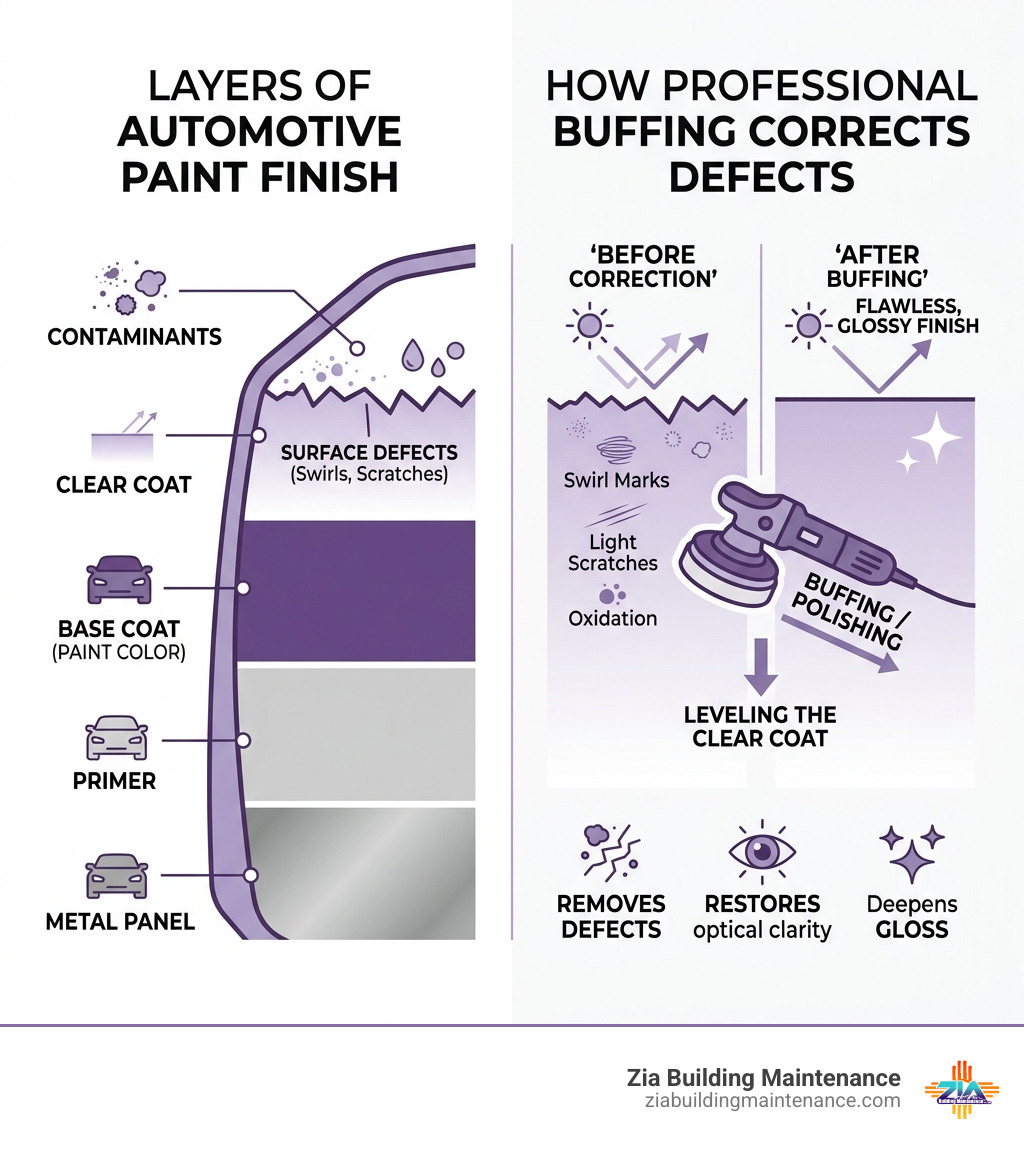
When we talk about achieving a “showroom finish,” we aren’t just talking about a clean car. We are talking about optical clarity. To the untrained eye, a car might look “fine,” but under the bright lights of a dealership or the harsh New Mexico sun in Downtown Albuquerque, the truth comes out. You’ll see those spider-web-like swirl marks and a hazy film that prevents the paint’s true color from popping.

Automotive showroom buffing pros view a vehicle’s clear coat as a landscape. Over time, that landscape becomes filled with “valleys” (scratches) and “dirt” (oxidation). Buffing is the process of microscopically leveling that landscape until it is perfectly flat. When light hits a flat surface, it reflects directly back at you, creating a mirror-image finish. When it hits a scratched surface, the light scatters, which is why the paint looks dull.
Why Showroom Buffing Differs from Standard Waxing
It is a common misconception that waxing and buffing are the same thing. Think of it this way: waxing is like putting a fresh coat of makeup over a blemish. It hides the problem temporarily. Buffing, or paint correction, is like a deep dermatological treatment that removes the blemish entirely.
- Standard Waxing: Applies a sacrificial layer of wax or sealant on top of the paint. It fills in tiny gaps to add shine, but the scratches are still there underneath. It usually lasts 2–4 months.
- Showroom Buffing: Uses abrasive technology to physically remove a microscopic layer of the clear coat. This permanently removes the defects. Once the surface is leveled, the shine is “built-in” to the paint itself, not just sitting on top.
The Role of Automotive Showroom Buffing Pros in Paint Correction
The term “paint correction” is the industry-standard way of describing what high-end buffing actually does. It’s a precision game. Modern clear coats are surprisingly thin—often thinner than a post-it note. Automotive showroom buffing pros must balance the need to remove enough material to eliminate a scratch without “burning through” the clear coat to the base paint.
This expertise is why professional results look so different from DIY attempts. Professionals use paint thickness gauges to measure how much “room” they have to work with, ensuring they restore that “factory fresh” look without compromising the long-term integrity of the vehicle’s protection.
The Multi-Stage Process for a Mirror-Like Finish
Achieving perfection isn’t a one-step job. If you see a “buff and shine” service that takes 30 minutes, it isn’t true showroom buffing. At Zia Building Maintenance, we understand that a Car Dealership Cleaning Service requires a methodical approach to ensure every vehicle on the lot looks its absolute best.
The process generally follows these critical steps:
- Decontamination Wash: We remove all loose dirt and road grime using pH-balanced shampoos.
- Clay Bar Treatment: Even after washing, contaminants like industrial fallout or tree sap remain bonded to the paint. A clay bar “shaves” these off, leaving the surface smooth as glass.
- Masking: We use automotive-safe tape to cover rubber trim, plastic emblems, and chrome. This prevents the buffing compounds from staining or damaging non-paint surfaces.
- The Correction Phases: This is where the heavy lifting happens, often using a “cross-hatch” pattern (overlapping horizontal and vertical passes) to ensure even coverage.
| Feature | Rotary Polisher | Dual-Action (DA) Polisher |
|---|---|---|
| Motion | Direct drive (spins in a circle) | Oscillates and rotates (random motion) |
| Heat Generation | High | Low |
| Correction Speed | Very Fast | Moderate |
| Risk Level | High (can burn paint) | Low (beginner-friendly) |
| Best For | Heavy scratches & oxidation | Finishing & swirl removal |
Essential Tools Used by Automotive Showroom Buffing Pros
The “pros” don’t just have one machine and one pad. They have an arsenal. Different paint types (soft vs. hard) require different combinations of abrasives.
- Pads: Wool pads are the most aggressive and are used for “cutting” through heavy damage. Microfiber pads offer a middle ground, while foam pads come in various densities for final polishing and refining.
- Compounds and Polishes: A “compound” is a gritty liquid used to level the paint. A “polish” is a much finer liquid used to remove the tiny marks left by the compound, bringing out the high gloss.
- Precision Lighting: You can’t fix what you can’t see. Pros use high-lumen LED lamps that mimic sunlight to reveal hidden swirls and holograms.
Protecting the Results with Ceramic Coatings
Once the automotive showroom buffing pros have achieved that perfect finish, the last thing you want is for it to get ruined a week later. This is where ceramic coatings come in.
Unlike traditional wax, ceramic coatings use nanotechnology to bond with the paint at a molecular level. This creates a hard, hydrophobic (water-repelling) layer that is resistant to UV rays and chemical stains. It’s the ultimate “shield” that keeps the showroom glow alive for years rather than months.
Maximizing Vehicle Value and Longevity in Albuquerque
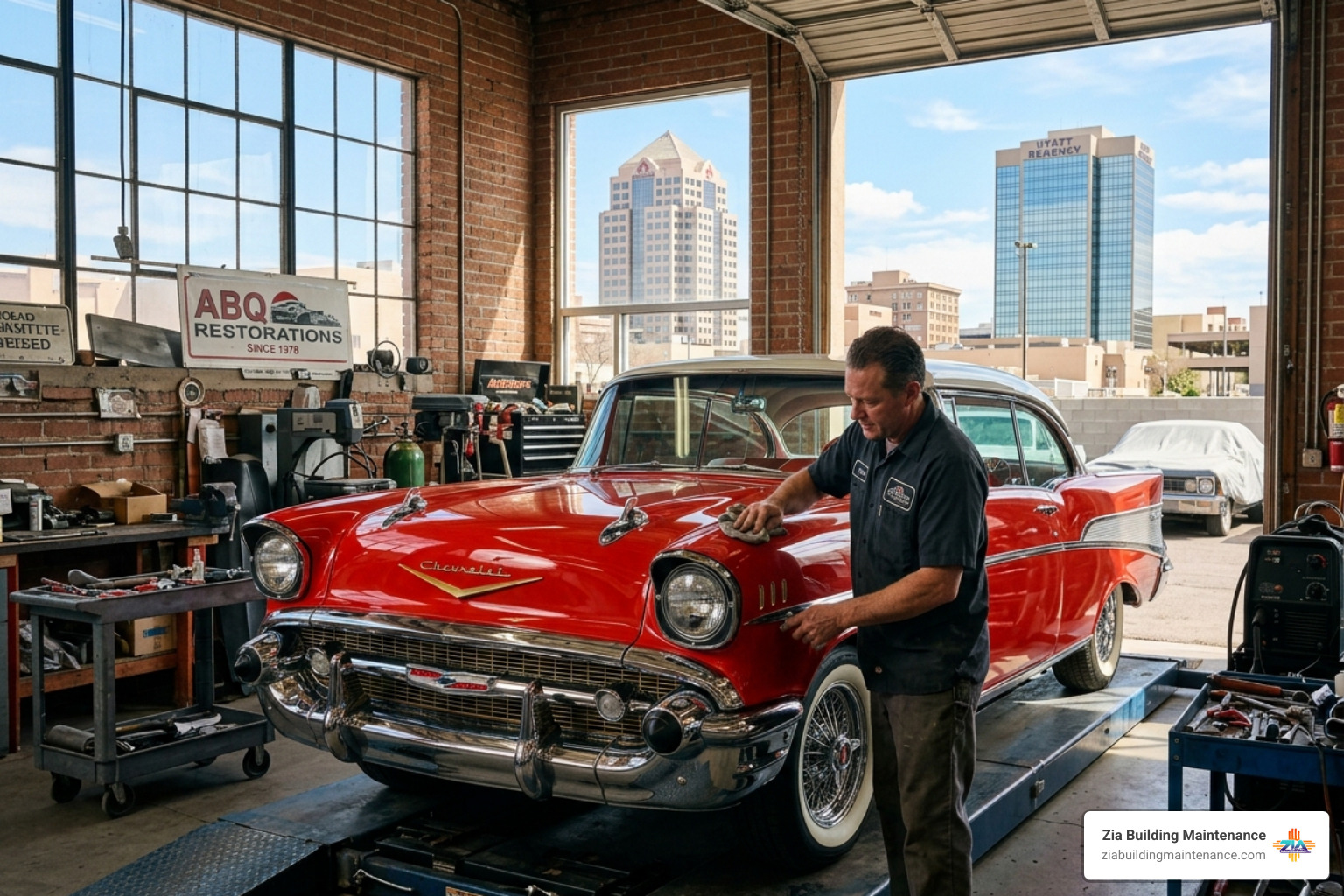
In our neck of the woods, your vehicle faces unique challenges. Whether you are showing off a classic car in Downtown Albuquerque or managing a fleet in Rio Rancho, the environment is not your friend.
Addressing Local Environmental Challenges
Albuquerque’s high-desert climate is particularly brutal on automotive finishes.
- High-UV Sun: At our elevation, the sun’s rays are much stronger, leading to rapid paint oxidation. This turns your vibrant red or deep black paint into a chalky, dull mess.
- Dust and Sand: The wind in Bernalillo and Rio Rancho carries fine grit that acts like sandpaper on your clear coat.
- Asset Preservation: For collectors and dealerships, professional buffing isn’t just about looks; it’s about protecting a financial asset. A vehicle with corrected paint and a ceramic coating can see a significant boost in resale value—often far exceeding the cost of the service itself.
Cost Factors and Professional Investment for Automotive Showroom Buffing Pros
We often get asked, “Why does it cost so much?” The answer lies in the labor. A full multi-stage paint correction can take anywhere from 5 to 15 hours of continuous, focused work.
Factors that influence the price include:
- Vehicle Size: A Chevy Suburban takes much longer than a Mazda Miata.
- Paint Condition: Heavy oxidation or deep scratches require more “passes” with the machine.
- Level of Perfection: A “one-step” polish might remove 60-70% of defects, which is great for a daily driver. A “showroom” correction aims for 95% or better, which requires significantly more time.
Generally, you can expect to pay $150–$300 for basic polishing, while multi-stage correction for high-end or neglected vehicles can range from $500 to over $1,000.
Common Mistakes and When to Choose a Professional
The rise of “DIY” YouTube tutorials has led many brave souls to buy their own polishers. While we love the enthusiasm, we’ve also seen the “horror stories.”
The most common DIY mistakes include:
- Burn-Through: Staying in one spot too long with a rotary polisher, which generates enough heat to melt the clear coat. This requires a trip to the body shop for a full repaint.
- Holograms: Using the wrong pad or technique, leaving behind “ghostly” trails in the paint that look terrible in the sun.
- Inadequate Decontamination: Buffing over a car that hasn’t been clayed. This just picks up dirt and grinds it into the paint, creating more scratches.
Choosing automotive showroom buffing pros gives you peace of mind. Professionals are insured and have the experience to “read” the paint, knowing exactly how much pressure and heat to apply.
Video Resource: Professional Paint Correction Techniques
To see the level of detail required for a true showroom finish, watch this breakdown of professional techniques:
}
Frequently Asked Questions about Automotive Showroom Buffing Pros
How often should a vehicle receive professional buffing?
For a daily driver in Albuquerque, we recommend a professional buffing or “polish” every 12 to 18 months. This removes the light swirls accumulated from washing and restores the UV protection. For garage-kept show cars, you may only need it once every few years.
Can all scratches be removed by showroom buffing?
Unfortunately, no. A good rule of thumb is the “fingernail test.” If you can catch your fingernail in the scratch, it has likely gone through the clear coat and into the base paint. Buffing can make these deep scratches look better by rounding off the edges, but it won’t make them disappear entirely.
What preparation is needed before a buffing service?
Before bringing your car to the automotive showroom buffing pros, please remove all personal items and trash from the interior. While the focus is on the exterior, a clean workspace allows the technicians to move freely around the vehicle. A basic wash is helpful, but the pros will perform their own deep decontamination wash as part of the service.
Conclusion
At Zia Building Maintenance, we believe that every professional space—whether it’s an office building or an auto dealership showroom—should reflect excellence. Our commitment to Auto Dealership Cleaning in Albuquerque, Rio Rancho, and Bernalillo is built on the same principles as the world’s best automotive showroom buffing pros: patience, precision, and the right tools for the job.
Since 1989, our family-owned business has been the trusted name for dependable, high-quality cleaning services. We know that in the automotive world, first impressions are everything. A vehicle that gleams under the showroom lights isn’t just “clean”—it’s a testament to the care and quality your business provides.
If you’re ready to elevate the standard of your automotive presentation, trust the experts who understand the “quest for paint perfection.”