

TL;DR:
- Most offices require daily cleaning to effectively control bacteria buildup and maintain a healthy workspace.
- A clean environment boosts employee focus, morale, and reduces sick days, ultimately improving productivity.
Most business leaders assume a weekly cleaning schedule keeps their office in good shape. The numbers say otherwise. A typical office desk can harbor over 10 million bacteria, which is 400 times more germs than the average toilet seat. Understanding why offices need daily cleaning starts with recognizing that surface contamination builds faster than most people expect, and the consequences reach well beyond visible dirt. This article covers the health risks, productivity effects, and practical steps that help facility managers build cleaning programs that actually protect their teams and their reputation.
Table of Contents
- Key takeaways
- Why offices need daily cleaning to protect employee health
- How clean offices boost productivity and morale
- Cleaning frequency: daily tasks versus weekly deep cleans
- Building a practical daily cleaning routine
- Benefits beyond health and productivity
- My take on daily cleaning as a non-negotiable standard
- Professional cleaning services that keep offices consistently clean
- FAQ
Key takeaways
| Point | Details |
|---|---|
| Bacteria accumulate fast | Office desks carry millions of germs daily, making frequent disinfection a health necessity, not a preference. |
| Productivity depends on cleanliness | Clean, clutter-free workspaces directly improve employee focus, morale, and daily output. |
| Frequency must match foot traffic | High-traffic offices require daily attention to touchpoints, restrooms, and shared equipment to control contamination. |
| Checklists create accountability | Documented daily cleaning records signed by responsible staff reduce complaints and prove duty of care. |
| Professional services add reliability | Customized cleaning plans from experienced providers maintain consistent standards without disrupting business operations. |
Why offices need daily cleaning to protect employee health
The health argument for daily office sanitation is grounded in hard data, not general caution. Office phones carry up to 25,000 germs per square inch, and keyboards, door handles, and elevator buttons are not far behind. These surfaces transfer bacteria and viruses every time an employee touches them, creating a chain of exposure that moves through an entire office within hours.
Shared workspaces amplify the problem. When one sick employee comes in and touches a communal printer, a coffee machine handle, or a conference room chair, those surfaces become transmission points for everyone else who follows. Daily disinfection of these high-touch areas breaks that chain before it spreads.
The cost of ignoring this is measurable. Skipping daily cleaning leads to increased employee sick days, reduced productivity, and poor first impressions on clients. A single illness outbreak in a mid-size office can translate to dozens of lost workdays in a matter of weeks. For a business leader, that is a direct hit to output and payroll.
Here are the areas that require daily disinfection to meaningfully reduce health risks:
- Desks and personal workstations, where bacteria accumulate from hands, food, and shared items throughout the day
- Restrooms, where bacteria multiply fast in warm, moist conditions with frequent use
- Kitchen and break room surfaces, including countertops, appliance handles, and sink faucets
- Shared equipment such as phones, printers, and copier touchscreens
- Reception and entrance areas, which collect external dirt and germs each time the door opens
Pro Tip: Place disinfectant wipe dispensers near shared equipment so employees can do a quick wipe between professional cleaning cycles. This supplements daily office sanitation without replacing it.
How clean offices boost productivity and morale
The connection between cleanliness and performance is not just intuitive. Research supports it. Employees feel more focused and comfortable in clean, clutter-free environments, which translates directly to better job satisfaction and higher output. The psychological effect of a tidy workspace is real. When a person sits down at a clean desk in a well-maintained office, their attention goes to the work in front of them rather than the mess around them.
Clutter and grime create low-level stress that compounds over time. An employee who notices overflowing trash cans, sticky surfaces, or persistent odors is processing those signals even when they are not consciously aware of it. That cognitive load adds up and pulls focus away from the tasks that matter.
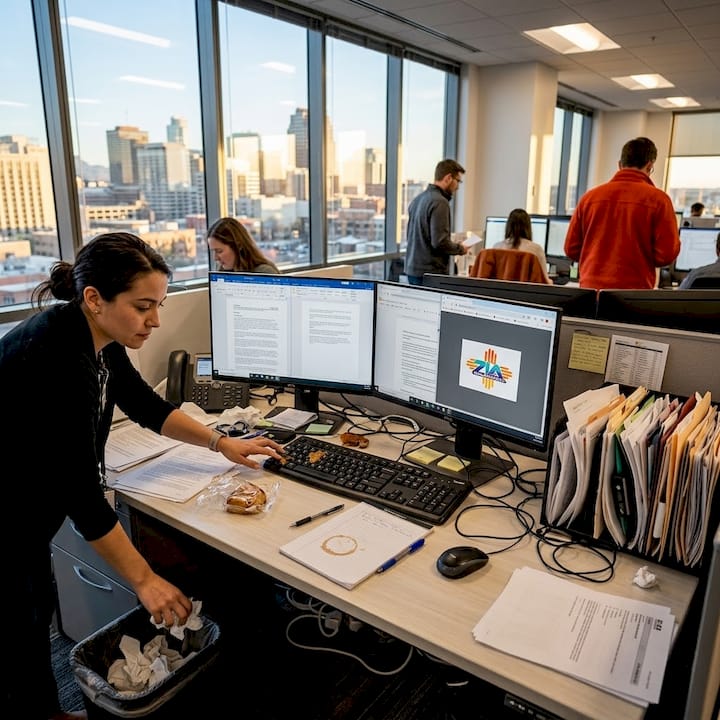
The morale dimension is equally significant. Employees read the state of their workspace as a signal of how much the organization values them. A consistently clean office communicates respect and investment. A neglected one signals the opposite, and that perception affects engagement, retention, and how people represent the company to clients and visitors.
There are also direct health benefits that feed into productivity. Fewer sick days mean more consistent team presence. Better air quality from regular dusting and vacuuming reduces fatigue and headaches. The benefits of a clean workplace extend from individual wellbeing to team-level performance in ways that compound over weeks and months.
Pro Tip: Share cleaning schedules and standards with your team. When employees know a professional crew cleans their office each day, they are more likely to maintain their own spaces between visits, reinforcing the overall standard.
Cleaning frequency: daily tasks versus weekly deep cleans
Not every cleaning task needs to happen every day, but knowing which ones do is where many facility managers make costly mistakes. The right frequency depends on office size, foot traffic, the nature of the work, and how many shared spaces the facility contains.
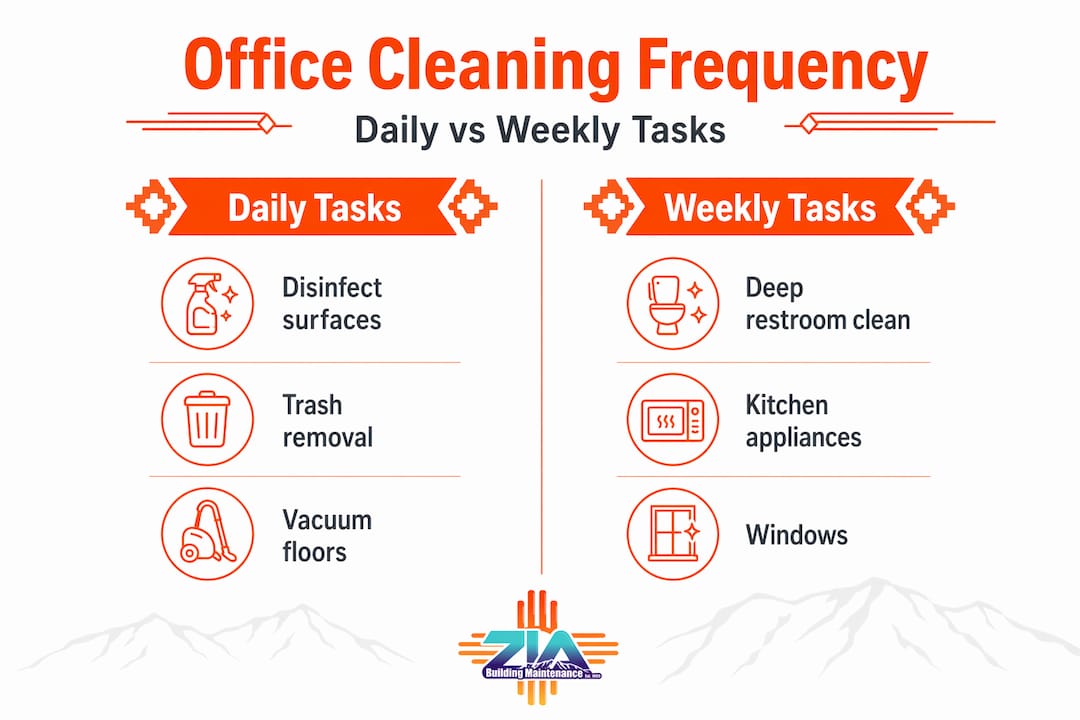
Daily tasks address the surfaces and areas that accumulate contamination fastest. Weekly or bi-weekly tasks cover deeper maintenance that does not require the same urgency but still matters for long-term hygiene and appearance.
| Task | Daily | Weekly | Bi-Weekly or Monthly |
|---|---|---|---|
| Empty trash and recycling bins | ✓ | ||
| Wipe down desks and high-touch surfaces | ✓ | ||
| Disinfect restrooms | ✓ | ||
| Clean kitchen counters and appliance handles | ✓ | ||
| Vacuum high-traffic areas | ✓ | ||
| Deep clean carpets and floors | ✓ | ||
| Sanitize phones and keyboards | ✓ | ||
| Clean windows and glass partitions | ✓ | ||
| Dust vents, blinds, and ceiling fixtures | ✓ |
Reception and entrance areas fall firmly in the daily column. These zones gather external dirt and germs continuously, and they are the first thing visitors see. A dusty lobby or a fingerprint-covered reception desk makes a poor first impression before a single conversation happens.
High-traffic offices with 50 or more employees, multiple shared spaces, or client-facing areas generally need more comprehensive daily attention than a small team in a private suite. Facilities managers should assess their specific environment rather than defaulting to a generic schedule.
Building a practical daily cleaning routine
Knowing what needs to be cleaned daily is only half the work. Implementing a routine that holds up over time requires structure, communication, and accountability. Here is a practical framework for facility managers to follow.
-
Create a written daily cleaning checklist. List every task, the responsible party, and the expected completion time. Documented daily cleaning records signed by responsible staff provide accountability and give you a paper trail if complaints arise.
-
Prioritize restrooms, kitchens, and shared equipment. These three areas carry the highest contamination risk and require attention at the start and end of each workday in busy offices.
-
Schedule cleaning around business operations. Early morning before staff arrive, midday during lunch breaks, and after hours are the most effective windows. Flexible cleaning schedules reduce disruption while maintaining consistent hygiene standards.
-
Communicate standards to employees. Post expectations in common areas. Let staff know which surfaces are cleaned daily and encourage them to report spills or issues between scheduled visits.
-
Review and adjust quarterly. Cleaning needs shift as office occupancy, seasons, and activities change. A quarterly review of your checklist keeps the program aligned with current conditions.
-
Consider professional cleaning services. In-house staff often lack the training, equipment, and products to match the results a dedicated commercial cleaning crew delivers. Professional providers also carry liability coverage and bring consistency that is hard to replicate internally.
Pro Tip: Review your missed disinfection areas periodically. Light switches, cabinet handles, and chair armrests are commonly overlooked touchpoints that accumulate germs between standard cleaning passes.
Benefits beyond health and productivity
The impact of clean environments extends into areas that business leaders sometimes overlook until a problem surfaces. Odor control is one of them. Offices that are not cleaned daily develop persistent smells from trash, food residue, and restroom use. Those odors affect how clients perceive your business and how employees feel about coming to work.
Pest prevention is another. Food debris in kitchens and break rooms attracts ants, rodents, and other pests when not addressed daily. A single pest sighting can trigger complaints, regulatory scrutiny, and reputational damage that far outweighs the cost of consistent cleaning.
There are also compliance and safety considerations. Many industries operate under regulations that specify hygiene standards for workplaces, particularly in healthcare, food service, and education. Maintaining daily cleaning records supports regulatory compliance and demonstrates a documented duty of care.
Finally, a consistently clean office makes a strong impression on visitors and prospective clients. The state of your facility communicates your operational standards before anyone says a word. Clients notice gleaming floors, spotless restrooms, and well-maintained common areas. They notice the opposite just as quickly.
My take on daily cleaning as a non-negotiable standard
I’ve worked alongside facility managers across a wide range of industries, and the pattern I see most often is the same. Organizations that treat cleaning as a cost to minimize end up paying far more in sick leave, staff turnover, and client perception problems than they ever saved on their cleaning budget.
What I’ve found is that the resistance to daily cleaning usually comes from a visibility problem. The consequences of skipping it are not immediate. Bacteria don’t announce themselves. Morale doesn’t collapse overnight. But the cumulative effect is real, and by the time it becomes obvious, the damage is already done.
The managers who get this right document everything. They treat their cleaning program the way they treat any other operational standard: with written procedures, assigned accountability, and regular review. Cleaning records that formalize accountability do more than satisfy compliance requirements. They build trust with employees and clients alike.
My honest advice: stop treating daily cleaning as optional and start treating it as part of your facility’s baseline operating standard. The return on that investment shows up in ways that are hard to attribute directly but impossible to ignore once you see them.
— Ashley
Professional cleaning services that keep offices consistently clean
Maintaining daily cleaning standards is straightforward in theory and genuinely demanding in practice. That is where a trusted professional cleaning partner makes a measurable difference.
Zia Building Maintenance has served offices, medical facilities, and schools in Albuquerque since 1989, earning recognition as the number one office cleaning service in South Valley for 2025. Their approach centers on customized cleaning plans built around your office size, foot traffic, and schedule. Whether you need early morning service before staff arrive or after-hours cleaning that keeps operations uninterrupted, Zia Building Maintenance adapts to your needs. Their documented checklists and consistent crews give facility managers the accountability and reliability that in-house efforts rarely match. Explore their commercial cleaning strategies or review their cleaning contract checklist to see exactly what a professional daily cleaning program looks like in practice.
FAQ
How often should office surfaces be disinfected?
High-touch surfaces including desks, phones, door handles, and shared equipment should be disinfected daily. Office phones can carry up to 25,000 germs per square inch, making daily sanitation a health requirement rather than a preference.
What tasks must be completed every day in an office?
Daily office cleaning should cover restrooms, kitchen and break room surfaces, high-touch points, trash removal, and vacuuming of high-traffic areas. Reception and entrance zones also need daily attention because they collect external dirt and germs with every visitor.
Does daily cleaning actually improve employee productivity?
Yes. Research shows that employees feel more focused and comfortable in clean environments, which improves job satisfaction and output. Fewer sick days from better daily office sanitation also means more consistent team presence and performance.
Why is a documented cleaning checklist worth the effort?
Documented daily cleaning records signed by responsible staff create accountability, help resolve tenant or employee complaints, and demonstrate a formal duty of care. They also make it easier to identify gaps and adjust your program when conditions change.
When should an office hire a professional cleaning service?
When in-house staff cannot consistently meet daily cleaning standards across all required areas, a professional service is the practical answer. Professional providers bring trained crews, commercial-grade products, flexible scheduling, and documented quality assurance that internal teams rarely replicate at the same level.