

Why Your Office Cleaning Schedule Directly Affects Your Bottom Line
A solid office cleaning schedule is the difference between a workplace that runs smoothly and one that quietly drains productivity, drives up sick days, and leaves a bad impression on every client who walks through the door.
Here’s a quick breakdown of what an effective office cleaning schedule looks like:
| Frequency | Key Tasks |
|---|---|
| Daily | Empty trash, disinfect high-touch surfaces, clean restrooms, wipe down break room, vacuum high-traffic floors |
| Weekly | Deep clean restrooms, sanitize fridge, dust vents and baseboards, mop all floors, clean glass partitions |
| Monthly | Dust HVAC vents, clean windows, scrub grout, vacuum upholstery, high dusting |
| Quarterly | Deep clean carpets, strip and polish hard floors, inspect and replace HVAC filters |
| Annually | Deep clean upholstery, degrease kitchen exhaust, full facility deep clean |
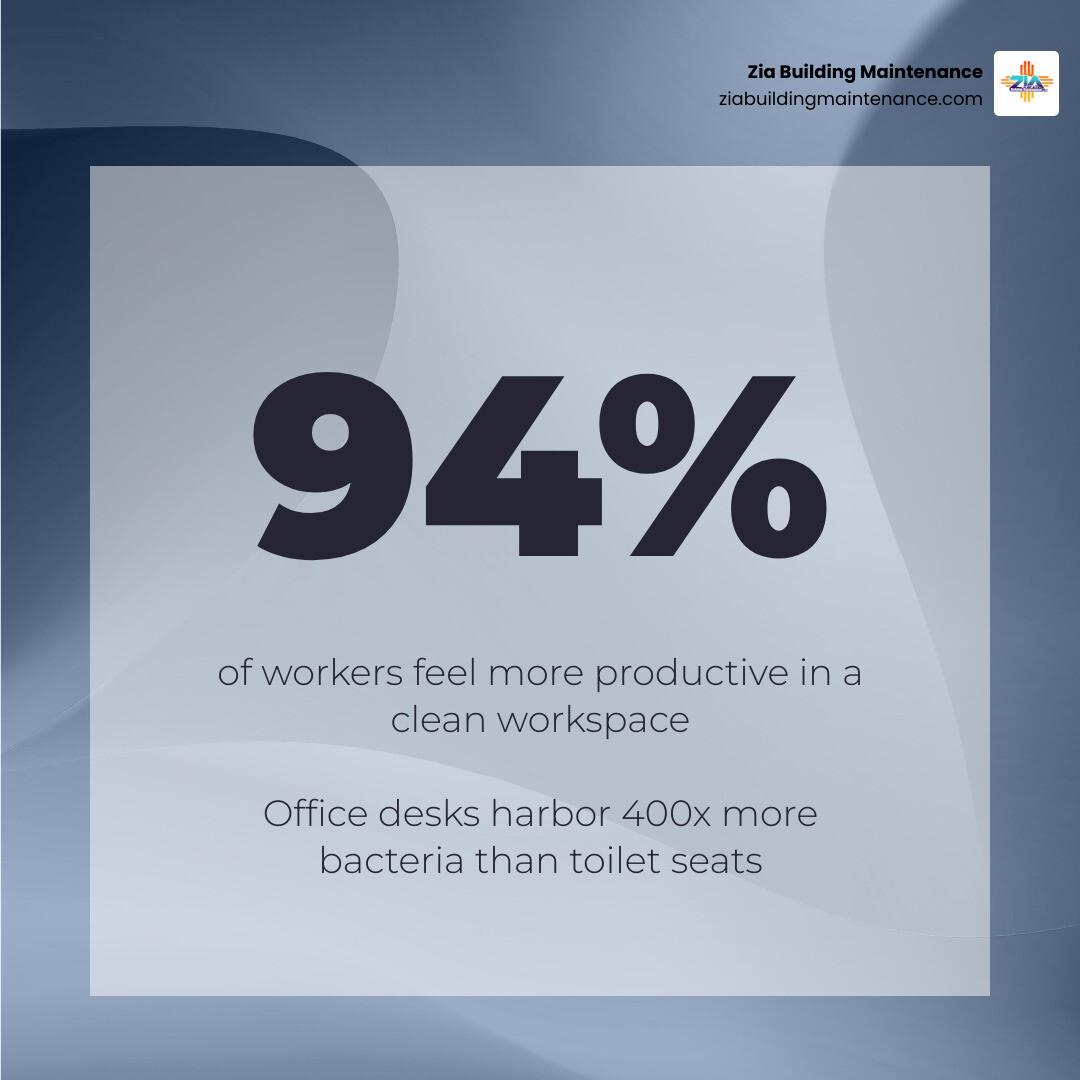
The numbers behind office hygiene are hard to ignore. Research shows that 94% of workers feel more productive in a clean workspace. Studies also show that the average office desk harbors 400 times more bacteria than a toilet seat — a fact that makes a consistent cleaning routine non-negotiable, not optional.
For businesses across the Albuquerque metro — from busy Downtown offices to growing companies in Rio Rancho — the challenge isn’t knowing that cleaning matters. It’s knowing exactly what to clean, how often, and how to make sure it actually gets done.
That’s what this guide covers.
I’m Ashley Cordova, Vice President of Zia Building Maintenance, a family-owned company serving New Mexico since 1989 — and developing reliable office cleaning schedules for facilities of all sizes is at the core of what we do every day. In the sections ahead, I’ll walk you through everything you need to build a schedule that protects your people, your space, and your reputation.
Identifying Germ Hotspots and the Science of Clean
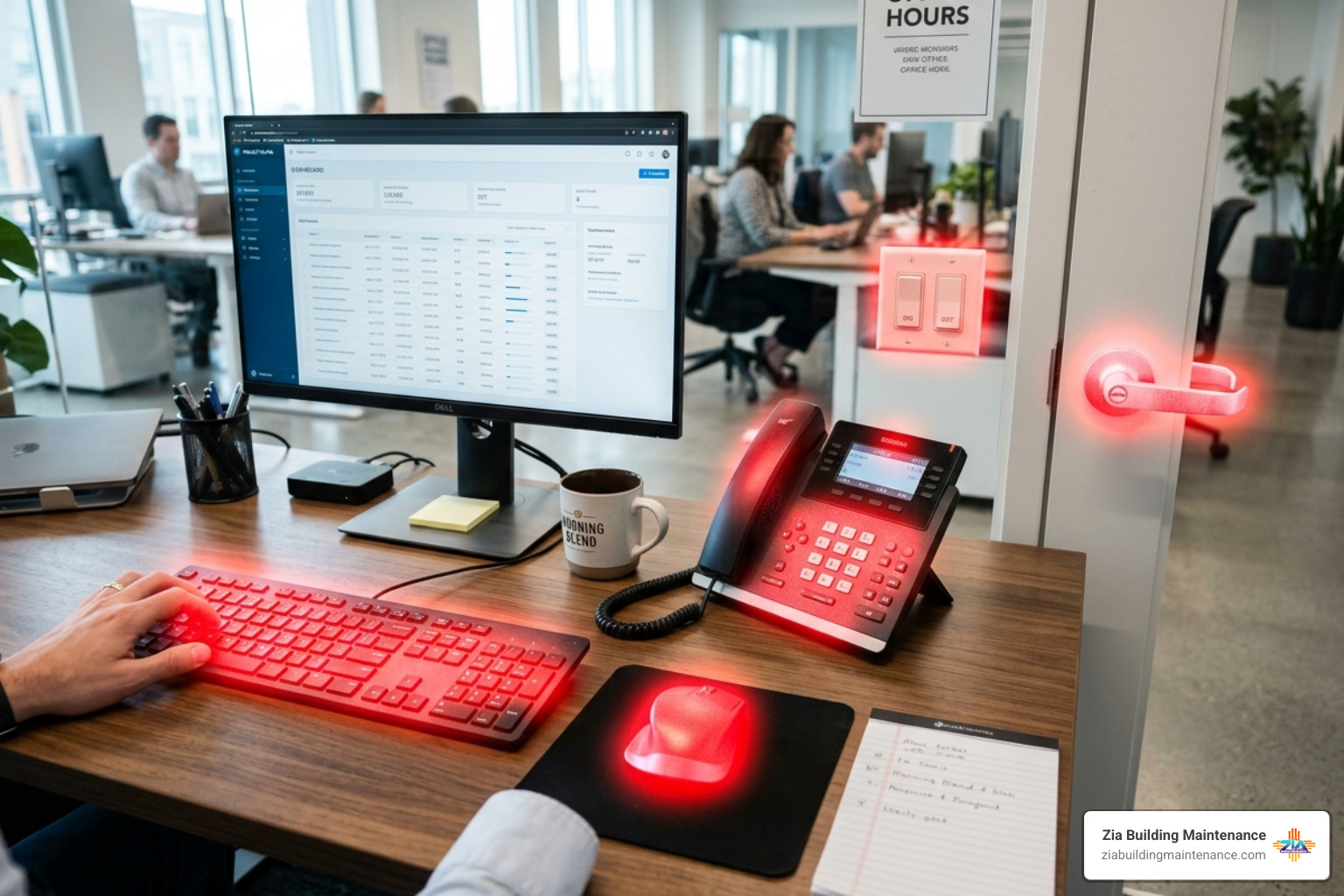
To build an effective office cleaning schedule, we first have to understand what we are up against. In a typical office environment, germs aren’t just present; they are thriving. According to Scientific research on office contamination, the average office desk is home to roughly 10 million bacteria. To put that in perspective, that is 400 times more bacteria than you would find on a toilet seat.
Why is the desk so much worse? Because we touch our desks constantly, often while eating, and they rarely receive the same rigorous disinfection that a restroom fixture does. Furthermore, flu viruses can survive on these hard surfaces for 24 to 48 hours, meaning a single sick employee can spark an office-wide outbreak if the cleaning protocol isn’t up to par.
A landmark study by Kimberly-Clark Professional identified the five most contaminated areas in an office:
- Break room sink faucet handles
- Microwave door handles
- Computer keyboards
- Refrigerator door handles
- Water fountain buttons
Cleaning, Sanitizing, and Disinfecting: What’s the Difference?
We often hear these terms used interchangeably, but in professional janitorial services, they mean very different things:
- Cleaning: This is the physical removal of dirt, dust, and debris. It uses soap and water but doesn’t necessarily kill germs. It is the essential first step.
- Sanitizing: This reduces the number of bacteria to a safe level as judged by public health standards.
- Disinfecting: This involves using chemicals (disinfectants) to kill 99.999% of germs on surfaces. This is critical for high-touch hotspots.
To prevent cross-contamination, we recommend using a color-coded microfiber system—for example, red for restrooms and blue for kitchens. This ensures that the cloth used to wipe a toilet handle never touches a break room table. For a detailed list of what needs attention, you can refer to this office cleaning checklist PDF.
Building a Comprehensive Office Cleaning Schedule
Creating a schedule isn’t just about making a list; it’s about understanding the “traffic flow” of your specific building. A law firm in Downtown Albuquerque has different needs than a high-traffic retail space in Rio Rancho.
| Task Category | Focus Area | Goal |
|---|---|---|
| Daily | Functionality & Hygiene | Prevent germ spread and manage waste |
| Weekly | Detail & Thoroughness | Catch the dust and grime missed in daily rounds |
| Monthly | Protection & Longevity | Maintain building assets like flooring and HVAC |
When determining how often should large offices be cleaned, we look at occupancy levels and the type of work being done. A structured approach ensures that no task falls through the cracks. As we detail in your office cleaning playbook, consistency is the key to asset protection. Regular maintenance prevents the slow decline of carpets and hard floors, which can be incredibly expensive to replace.
Daily Tasks for a Consistent Office Cleaning Schedule
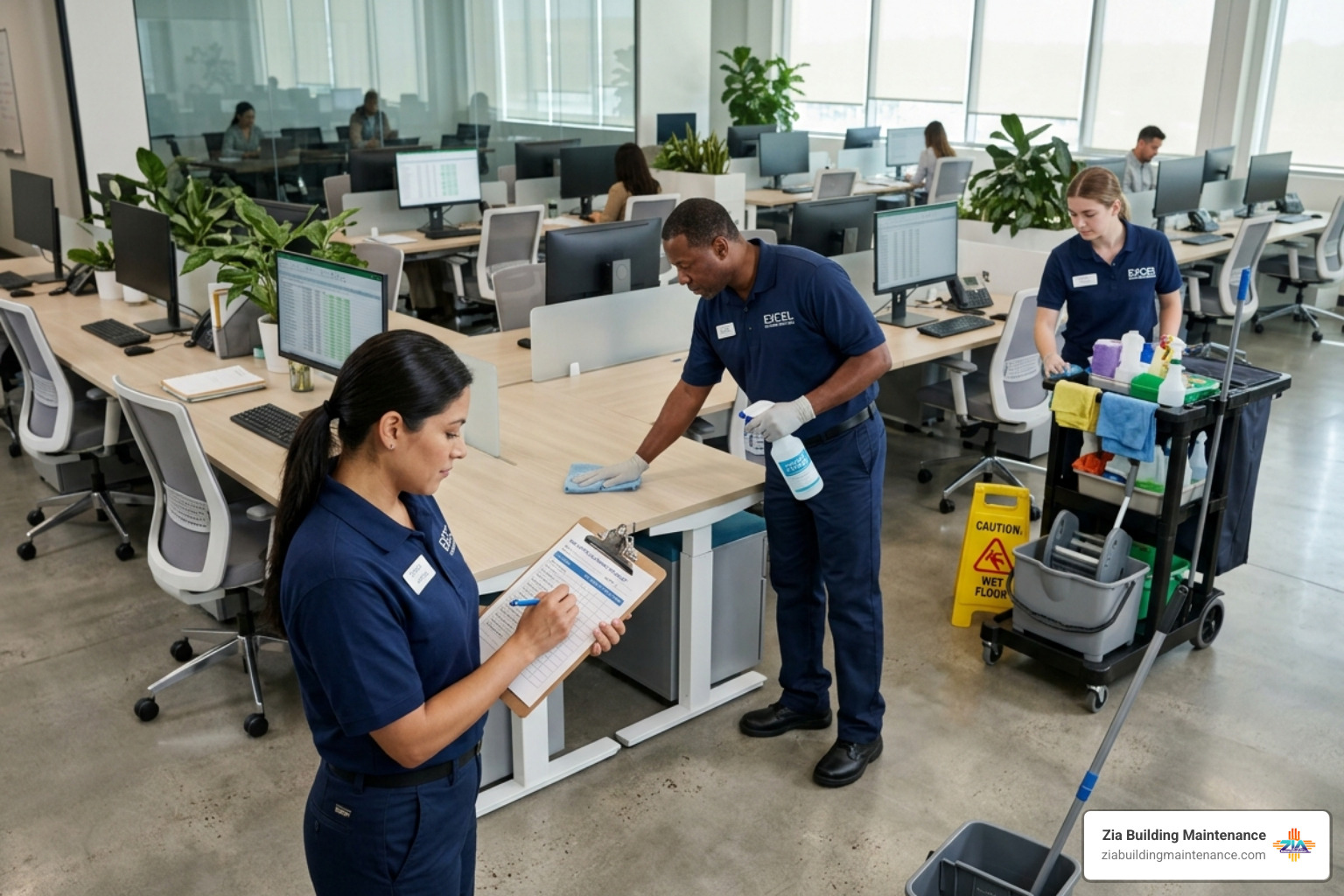
Daily tasks are your frontline defense. They keep the office functional and presentable.
- Trash and Recycling: Emptying bins daily prevents odors and pests.
- Restrooms: These must be cleaned, disinfected, and restocked every single day.
- High-Touch Disinfection: Wiping down door handles, elevator buttons, and light switches.
- Floor Care: Vacuuming high-traffic entryways and spot-mopping spills.
For many Albuquerque businesses, the choice comes down to day porter vs after hours cleaning. A day porter is excellent for high-traffic buildings that need constant restroom restocking and lobby maintenance during business hours, while after-hours cleaning allows for deep vacuuming and floor care without disrupting staff.
Weekly and Monthly Maintenance for Long-Term Hygiene
While daily cleaning handles the “now,” weekly and monthly tasks handle the “hidden.”
- The Friday Fridge Cleanout: Tossing expired food and sanitizing shelves prevents “science experiments” from growing in the break room.
- Glass and Partitions: Smudges on conference room glass can make a professional space look sloppy.
- Dusting: Weekly dusting of baseboards and monthly dusting of high vents and light fixtures.
- HVAC Maintenance: In our dusty New Mexico climate, checking filters monthly is vital for air quality.
If you are looking for a DIY starting point, these 7 steps to a weekly schedule offer a great framework for smaller teams. For larger projects, we often recommend a seasonal approach—take the time to spring clean your office to tackle those once-a-year deep cleaning needs.
Area-Specific Protocols: From the Lobby to the Break Room
Every area of your office requires a specialized touch. You wouldn’t clean a computer screen the same way you clean a bathroom floor.
The Restroom: This is the most scrutinized area of any building. A clean restroom reflects a business that cares about its employees and visitors. Beyond daily cleaning, restrooms need weekly deep scrubs of grout and fixtures to prevent mineral buildup and odors.
The Break Room: This is the #1 source of odor complaints. Because food is prepared here, the risk of cross-contamination is high. Microwave handles, refrigerator doors, and sink faucets need daily disinfection.
Workstations and Cubicles: We encourage employees to do a “two-minute reset” at the end of the day, clearing their desks so our team can effectively wipe down surfaces. Keyboards and phones—those bacteria magnets we mentioned earlier—should be wiped with electronics-safe disinfectant wipes.
To keep standards high, we recommend a “trust but verify” approach. Understanding why you should have routine cleaning inspections is essential for maintaining quality over time. For more in-depth strategies, check out our office cleaning services ultimate guide.
Optimizing Your Office Cleaning Schedule with Smart Technology
It’s April 2026, and the “old way” of cleaning is being replaced by data-driven solutions. Smart technology is revolutionizing how we maintain spaces:
- QR Codes: Placed in restrooms or conference rooms, these allow employees to report a spill or a lack of supplies instantly.
- Restroom Sensors: These track foot traffic and alert the cleaning team when a restroom has been used by a certain number of people, triggering a cleaning exactly when it’s needed rather than on a blind timer.
- Janitorial Software: This helps us track supply levels and ensure that every task on the office cleaning schedule is timestamped and completed.
When you evaluate janitorial service performance, look for a partner that uses these tools to provide transparency and efficiency.
Local Considerations for New Mexico Businesses
Cleaning in the Duke City and Rio Rancho comes with its own set of “Land of Enchantment” challenges. Our environment is beautiful, but it’s tough on buildings.
- The Dust Factor: Between the Rio Rancho winds and the sand from the West Mesa, dust accumulation in Albuquerque is significantly higher than in more humid climates. This requires more frequent high dusting and HVAC filter changes.
- The Sand and Salt: In the winter, salt and ice melt used on sidewalks get tracked into lobbies. If left on hard floors, it acts like sandpaper, stripping away the finish.
- Low Humidity: While we don’t deal with the mold issues of Florida, our dry air leads to static electricity, which actually attracts more dust to electronic equipment like servers and computers.
We advocate for how to start spring cleaning for offices by focusing on these regional nuances. Furthermore, we are committed to sustainable practices, using eco-friendly products that are effective but safe for our unique high-desert ecosystem.
Frequently Asked Questions about Office Cleaning
How often should a large office be professionally cleaned?
There isn’t a one-size-fits-all answer, but generally, a large office with over 50 employees should have daily professional cleaning. As we discuss in our guide on how often should large offices be professionally cleaned, high-traffic zones like lobbies and restrooms need attention every night, while lower-traffic areas might scale to 2-3 times per week.
What are the most contaminated areas in an office?
As backed by the Kimberly-Clark study, the “Big Five” are break room sink faucets, microwave handles, keyboards, water fountain buttons, and refrigerator handles. These areas should be the priority of any daily disinfection routine.
Can a structured cleaning schedule save my business money?
Absolutely. A structured office cleaning schedule saves money in three main ways:
- Asset Longevity: Regular floor and furniture care prevents premature replacement.
- Reduced Sick Leave: Sanitizing high-touch surfaces can reduce the spread of viruses by up to 80%.
- Efficiency: A clear plan means cleaners spend less time “figuring out what to do” and more time doing it. Learn more about keeping it consistent with a monthly plan to see how scheduling impacts the bottom line.
Conclusion
At Zia Building Maintenance, we’ve spent over 35 years perfecting the art of the clean. Since 1989, our family-owned business has been dedicated to providing Albuquerque and Rio Rancho businesses with dependable, high-quality service. We understand that a clean office isn’t just a luxury—it’s a vital part of your business’s health, productivity, and professional image.
Whether you are managing a small startup or a massive corporate facility, we have the experience and the attention to detail to keep your space sparkling. If you’re ready to take the guesswork out of your maintenance, explore our office cleaning services and let us build a custom schedule that works for you.