

TL;DR:
- Janitorial services focus on routine daily maintenance, while commercial cleaning provides deeper, less frequent sanitation targeting pathogens and grime. Choosing the appropriate service depends on facility type, occupancy, and health risks, with layered protocols ensuring hygiene and compliance. Properly understanding and documenting task frequencies and protocols enhances facility safety, occupant health, and operational ROI.
Office cleaning versus janitorial service is defined by scope and frequency: janitorial services handle routine daily upkeep to keep facilities presentable, while commercial cleaning delivers deeper, less frequent sanitation targeting pathogens, grime, and surfaces that daily maintenance cannot reach. Business managers and property owners who treat these two service types as interchangeable risk gaps in hygiene, unexpected costs, and compliance failures. Understanding the difference between cleaning services is the first step toward building a program that protects your facility, your employees, and your bottom line. Zia Building Maintenance has served Albuquerque offices, medical facilities, and schools since 1989, and the distinction between these two service types shapes every contract they write.
What is the difference between office cleaning and janitorial service?
Janitorial service is defined as the ongoing, high-frequency maintenance of a facility. This includes daily trash removal, restroom sanitizing, floor sweeping and mopping, surface spot cleaning, and restocking consumables like paper towels and soap. The goal is consistent presentability. Janitorial staff typically work during or after business hours on a set schedule, keeping spaces functional and tidy between deeper cleaning cycles.
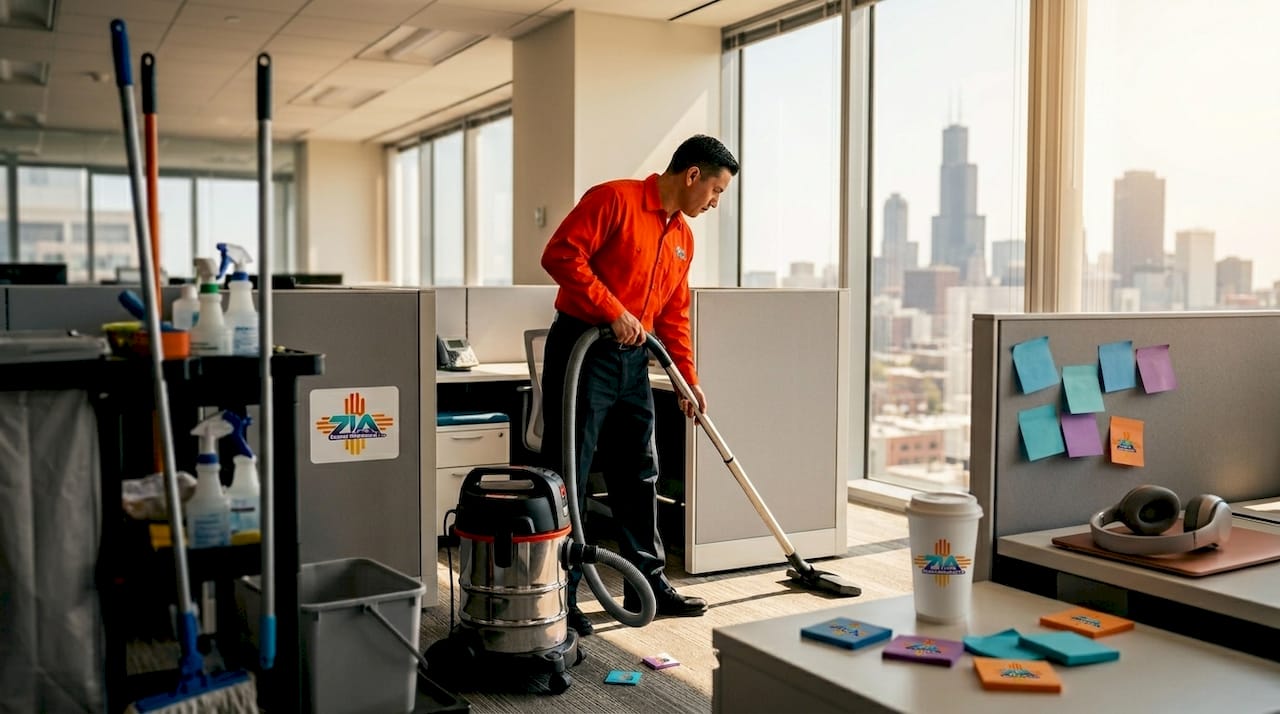
Commercial cleaning, often called office cleaning in the context of workplace facilities, targets what routine janitorial work leaves behind. This means periodic carpet shampooing, window washing, grout scrubbing, and surface disinfection with proper chemical dwell times. Where janitorial service maintains appearance, commercial cleaning restores hygiene at a structural level. The two are not competing services. They are sequential layers of a complete office maintenance solution.
A common misconception is that janitorial service means only nightly mopping. In practice, janitorial contracts often include multi-tiered cleaning schedules with quarterly grout and window cleaning, semi-annual carpet extraction, and annual deep cleaning tasks. Managers who read only the headline price without reviewing the frequency table miss the full scope of what they are purchasing.
What tasks and schedules separate janitorial from commercial cleaning?
The operational difference becomes clearest when you map tasks against frequency. A well-structured facility cleaning program typically organizes work into four tiers.
- Daily: Trash removal, restroom cleaning and restocking, floor sweeping and mopping, kitchen or break room wipe-downs, and spot cleaning of visible soils.
- Weekly: Vacuuming carpeted areas, wiping down desks and workstations, cleaning interior glass, and sanitizing high-touch surfaces like door handles, light switches, and elevator buttons.
- Quarterly: Grout cleaning, interior window washing, and detailed floor scrubbing. A 2026 Bureau of Land Management solicitation confirmed that quarterly deep-clean tasks are standard inclusions in government janitorial contracts, not optional add-ons.
- Semi-annual and annual: Hot-water carpet extraction, exterior window washing, and full surface disinfection cycles.
Janitorial service typically covers tiers one and two. Commercial cleaning services cover tiers three and four, and sometimes tier two in facilities with elevated hygiene requirements such as healthcare clinics or food-service environments.
Pro Tip: Before signing any cleaning contract, request the full frequency table in writing. Verbal assurances about “deep cleaning included” mean nothing without a documented schedule tied to specific tasks.
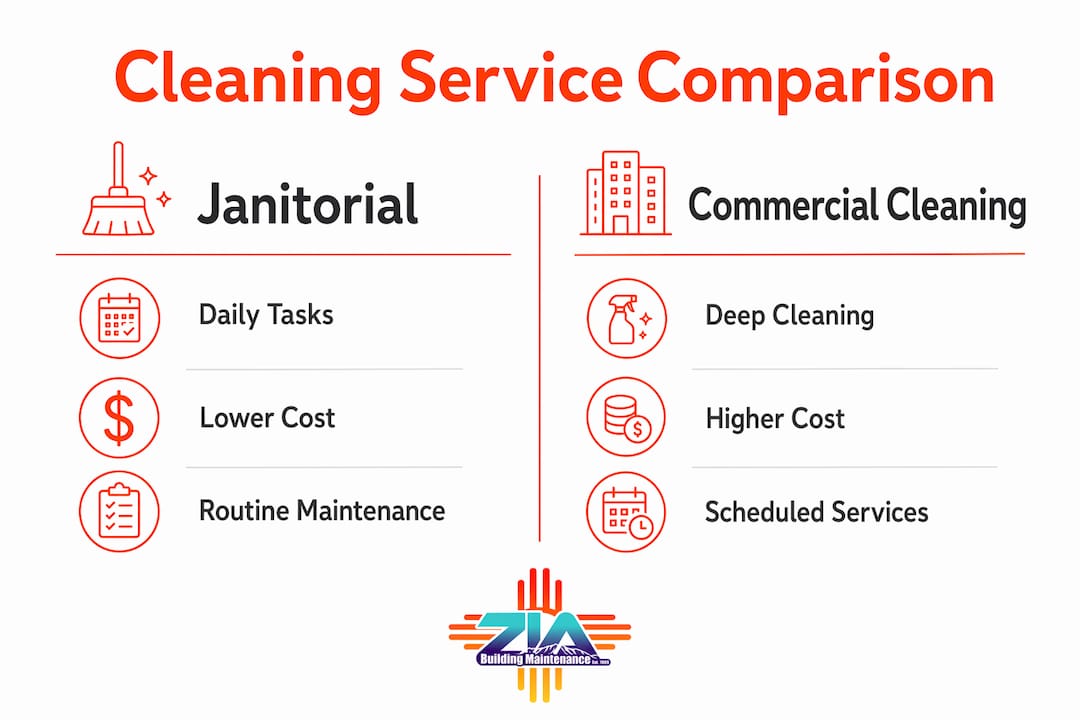
The table below summarizes the core operational split:
| Task | Janitorial service | Commercial cleaning |
|---|---|---|
| Daily trash and restrooms | Yes | No |
| Floor mopping and sweeping | Yes | No |
| High-touch surface disinfection | Spot only | Full protocol |
| Carpet extraction | No | Yes (semi-annual) |
| Grout and window deep clean | No | Yes (quarterly) |
| Disinfectant dwell time compliance | Rarely enforced | Required |
How do health and hygiene priorities differ between the two service types?
This is where the stakes get serious for healthcare facilities, retail environments with high foot traffic, and any office managing a workforce through cold and flu season. Janitorial service keeps a space looking clean. Commercial cleaning keeps a space biologically clean. The difference matters because pathogens do not respond to appearance.
High-touch surface disinfection requires disinfectants to remain visibly wet on surfaces for one to ten minutes, depending on the product label. Most janitorial staff wipe and move on within seconds. That technique removes visible soil but does not kill pathogens. In healthcare settings, high-touch surfaces may need disinfection every shift or even hourly during outbreak conditions.
The correct sequence for effective disinfection is clean first, disinfect second, and hold the surface visibly wet for the labeled contact time. Skipping the cleaning step leaves organic matter that neutralizes the disinfectant before it can act. Skipping the dwell time means the chemical never reaches its rated kill efficacy.
“The problem isn’t product choice. It’s technique and surface dwell time.” — Project Heartbeat, 2026
Facilities that enforce structured contact time compliance reduce infections including MRSA and VRE. This is the core janitorial service benefit gap: routine maintenance cannot substitute for protocol-driven disinfection in environments where occupant health is at risk.
A May 2026 CleanLink poll found that infection prevention and control priorities outweigh cost efficiency by large margins among facility professionals. That finding signals a shift in how cleaning programs are evaluated. Managers who still select services based on price alone are out of step with current industry standards.
Pro Tip: Ask any prospective cleaning vendor to describe their disinfectant dwell time protocol. If they cannot explain it, their infection prevention claims are not credible.
What operational and cost factors should guide your service decision?
Budget is the first variable most managers reach for, but it is rarely the most useful one. Janitorial service carries a lower per-visit cost because the scope is narrower and the labor is less specialized. Commercial cleaning requires trained staff, specialized equipment such as hot-water extraction machines and industrial floor scrubbers, and products with documented efficacy. Those inputs cost more per visit but are needed far less frequently.
The real cost comparison requires looking at total annual spend, not per-visit rates. A janitorial contract that excludes carpet extraction forces you to hire a separate vendor twice a year. A commercial cleaning contract that bundles quarterly deep cleaning may cost more monthly but eliminates surprise invoices and service gaps.
The ISSA’s “Hiring for Health” model demonstrates that investing in trained cleaning staff yields measurable ROI through reduced sick days, lower staff turnover, and higher client satisfaction. That model applies directly to facility managers evaluating whether to upgrade from basic janitorial to a health-focused commercial cleaning program. Higher wages for skilled cleaners pay back through fewer occupant illnesses and stronger regulatory compliance.
| Factor | Janitorial service | Commercial cleaning |
|---|---|---|
| Cost per visit | Lower | Higher |
| Annual total cost | Moderate | Moderate to high |
| Equipment required | Basic | Specialized |
| Staff training level | General | Health-protocol trained |
| Regulatory compliance support | Limited | Strong |
| Sick day reduction potential | Low | High |
Pro Tip: Calculate your cleaning ROI by estimating the cost of one sick-day wave across your team. For most offices, a single flu outbreak costs more in lost productivity than a full year of upgraded commercial cleaning.
How to evaluate and select the right cleaning solution for your facility
The right service mix depends on three variables: facility type, occupancy density, and health risk profile. A retail showroom with high daily foot traffic needs more frequent floor care and restroom attention than a small professional office with ten employees. A medical clinic or dental practice needs protocol-driven disinfection on every visit, not just quarterly.
Start your evaluation with these criteria:
- Facility type: Offices, retail spaces, and healthcare facilities each carry different contamination risks and regulatory expectations. Healthcare environments require infection prevention protocols that go well beyond standard janitorial scope.
- Occupancy and traffic: Higher occupancy means faster soil accumulation on floors, restrooms, and high-touch surfaces. Daily janitorial service is non-negotiable above a certain threshold.
- Health risk factors: Any facility serving vulnerable populations, including medical waiting rooms, schools, or senior care offices, should prioritize commercial cleaning with documented disinfection protocols.
- Contract transparency: Require a written frequency table, a list of included products with EPA registration numbers, and a defined escalation process for complaints. Vague contracts produce inconsistent results.
- Vendor qualifications: Janitorial service awards at the government level evaluate technical approach, past performance, and staffing qualifications alongside price. Apply the same standard when selecting a private vendor.
Businesses that integrate rigorous cleaning with trained staff and modern accountability tools report better outcomes and operational ROI. Digital inspection logs, photographic verification, and scheduled quality audits are no longer optional features. They are the baseline for any serious cleaning program in 2026.
Pro Tip: Request references from facilities in your same industry vertical, not just general office clients. A vendor experienced in medical office cleaning thinks about risk differently than one focused on retail.
Key takeaways
Janitorial service and commercial cleaning are complementary layers of a complete facility hygiene program, and choosing between them without understanding their distinct roles leads to gaps in cleanliness, compliance, and occupant health.
| Point | Details |
|---|---|
| Scope defines the difference | Janitorial covers daily upkeep; commercial cleaning handles deep sanitation and pathogen control. |
| Dwell time is non-negotiable | Disinfectants must remain wet for one to ten minutes to kill pathogens effectively. |
| Contracts require scrutiny | Always request a written frequency table before signing any cleaning service agreement. |
| Cost analysis must be annual | Per-visit pricing obscures the true cost difference between service tiers. |
| Health risk drives service level | Healthcare and high-traffic facilities require protocol-driven commercial cleaning, not routine janitorial alone. |
Why I think most facilities are underbuying on cleaning
After years of working alongside facility managers across offices, clinics, and retail spaces, the pattern I see most often is not overspending on cleaning. It is underbuying on the right type of cleaning. Managers sign janitorial contracts because the price is familiar, then wonder why their carpets look worn after two years or why their team keeps cycling through the same respiratory illness every winter.
The mistake is treating janitorial and commercial cleaning as substitutes rather than complements. A daily janitorial program without scheduled deep cleaning is like changing your car’s oil without ever replacing the filters. The surface maintenance happens, but the underlying buildup accumulates until it becomes a problem you cannot ignore.
What I have found actually works is a tiered program: daily janitorial for presentability and basic hygiene, monthly or quarterly commercial cleaning for deep sanitation, and a documented quality audit cycle that holds the vendor accountable. The benefits of a clean workplace extend well beyond appearance. They show up in employee attendance, client perception, and regulatory readiness.
The other mistake I see consistently is ignoring commonly missed areas in daily disinfection routines. Light switches, cabinet handles, shared equipment controls, and chair armrests accumulate pathogen loads that routine mopping never touches. A vendor who cannot identify these zones in your facility is not running a health-focused program.
Cleaning is not a cost to minimize. It is an investment in the people who work in and visit your facility every day. The facilities that understand this distinction consistently outperform those that treat it as a line item to cut.
— Ashley
Trusted cleaning solutions for Albuquerque businesses
Zia Building Maintenance has delivered tailored janitorial and commercial cleaning services across Albuquerque since 1989, earning the title of the #1 office cleaning service in South Valley for 2025. Whether your facility is a professional office, a retail environment, or a medical clinic, Zia Building Maintenance builds customized cleaning plans that match your occupancy, health risk profile, and budget.
Their team is trained in protocol-driven disinfection, documented quality audits, and the full spectrum of office cleaning services from daily janitorial upkeep to intensive floor care and deep sanitation cycles. If you are ready to move beyond guesswork and build a cleaning program that protects your team and your facility, contact Zia Building Maintenance for a consultation and customized estimate today.
FAQ
What is janitorial service versus commercial cleaning?
Janitorial service covers routine, high-frequency tasks like trash removal, restroom cleaning, and floor mopping to keep a facility presentable daily. Commercial cleaning delivers deeper, less frequent sanitation including carpet extraction, grout cleaning, and protocol-driven disinfection targeting pathogens.
How often should high-touch surfaces be disinfected in an office?
High-touch surfaces in standard offices should be disinfected at minimum daily, with disinfectants held visibly wet for the labeled contact time of one to ten minutes. Healthcare environments may require disinfection every shift or hourly during elevated risk periods.
Does janitorial service include deep cleaning?
Many janitorial contracts do include deep cleaning tasks, but on a quarterly or semi-annual schedule rather than daily. Managers should request a written frequency table to confirm which deep-clean tasks are included and how often they are performed.
How do I choose between janitorial and commercial cleaning for my facility?
Assess your facility type, occupancy density, and health risk profile first. High-traffic or healthcare environments need commercial cleaning protocols layered on top of daily janitorial service. Lower-risk offices may manage with janitorial service supplemented by periodic commercial cleaning cycles.
What is the ROI of upgrading from janitorial to commercial cleaning?
The ISSA’s research shows that health-focused cleaning programs with trained staff reduce sick days, lower staff turnover, and improve client satisfaction. For most facilities, the productivity gains from reduced illness outweigh the incremental cost of upgrading to a commercial cleaning tier.