
TL;DR:
- A office cleaning contract, or janitorial service agreement, clearly defines tasks, frequency, and standards, preventing misunderstandings. It includes detailed scope, pricing models, insurance, and termination clauses to protect clients and ensure accountability. A well-structured contract improves vendor relationships by setting measurable expectations and reducing disputes.
Understanding what an office cleaning contract actually covers is something many business owners get wrong until a dispute forces the issue. A janitorial service agreement, which is the standard industry term for this document, is far more than a price sheet with a signature line. It defines who cleans what, how often, to what measurable standard, and what happens when either party falls short. This guide walks you through every component that belongs in a well-structured contract, how pricing models work, and how to use the agreement as a real management tool rather than a forgotten file in a drawer.
Table of Contents
- Key Takeaways
- What is an office cleaning contract and what it includes
- Why a cleaning contract is a strategic business tool
- Pricing models and how to address them in the contract
- How to create a reliable cleaning contract
- My honest take on what these contracts actually do for you
- Reliable office cleaning services with contracts built for your facility
- FAQ
Key Takeaways
| Point | Details |
|---|---|
| Contracts define scope precisely | A solid office cleaning agreement specifies tasks, locations, frequency, and performance standards in writing. |
| Scope of Work is the anchor | The Scope of Work section prevents ambiguity and is the most critical clause for avoiding disputes. |
| Pricing models need explicit detail | Flat monthly fees and per-square-foot rates both require clear exclusions to prevent scope creep. |
| Insurance and compliance belong in writing | Liability insurance certificates and workers’ compensation documentation must be part of every commercial contract. |
| Transition clauses protect both parties | A documented handover process at contract end prevents confusion and last-minute conflicts. |
What is an office cleaning contract and what it includes
An office cleaning contract, formally known as a janitorial service agreement, is a written agreement specifying who cleans what, how often, to what standard, and the payment terms that govern the relationship. It covers both recurring maintenance schedules and one-time deep cleaning visits, and it pins down the physical location, days and times of service, and which personnel are authorized on-site. Without this document, every assumption about your cleaning service lives in someone’s memory, and memories are unreliable.
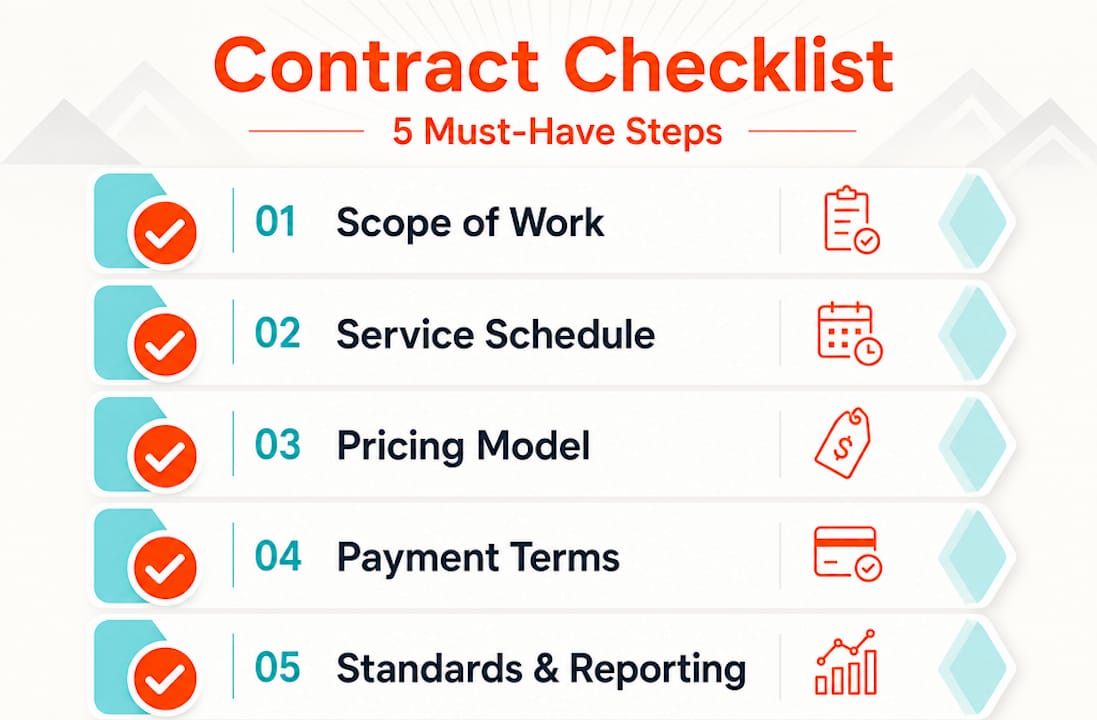
A complete janitorial service agreement includes the following core components:
- Parties involved: Full legal names and contact information for the client and the cleaning provider.
- Scope of Work: A detailed task list by area, such as vacuuming carpeted offices three times per week, sanitizing restrooms daily, and deep cleaning break rooms every Friday.
- Service frequency and schedule: Specific days, times, and any after-hours access windows.
- Performance standards: Measurable outcomes, not vague language like “clean to satisfaction.”
- Pricing structure: Whether the rate is a flat monthly fee, a per-square-foot calculation, or task-based pricing.
- Payment terms: Invoice schedule, accepted payment methods, and late payment fees.
- Exclusions: Tasks the provider will not perform unless separately quoted, such as window washing or carpet extraction.
- Personnel and security provisions: Background check requirements, key or access card protocols, and who to contact for site access issues.
- Termination clause: Notice period required by either party to end the contract without penalty.
Pro Tip: Always attach a facility floor plan or room list as an exhibit to the Scope of Work. This removes any debate about which areas are covered and which are not.
Why a cleaning contract is a strategic business tool
Most facility managers treat the office cleaning agreement as a formality. That is a costly mistake. The contract is actually your primary accountability mechanism, and understanding how to use it changes your relationship with your service provider entirely.
The Scope of Work section is the most critical part of any commercial cleaning contract. It anchors performance expectations and removes the ambiguity that leads to recurring disputes. A vague scope like “clean common areas” invites disagreement every single week. A detailed scope that lists specific surfaces, products, and frequency leaves no room for interpretation.
Beyond day-to-day accountability, here is what a well-written contract protects you from:
- Hidden liability exposure. Insurance disclosure fields and liability provisions are non-negotiable for commercial clients. If a cleaning technician is injured on your property and the provider lacks proper workers’ compensation coverage, your business may face financial consequences.
- Security and access disputes. Cleaning often happens outside business hours. The contract should specify who holds keys or access credentials, what areas are off-limits, and how security incidents are reported.
- Health and safety compliance failures. For offices in regulated industries, the agreement should reference applicable standards. You can learn more about OSHA and HIPAA compliance requirements that cleaning providers operating in your facility must follow.
- Unclear supply responsibility. The contract should state whether the provider supplies cleaning products and equipment or whether the client stocks them. This detail alone prevents dozens of small conflicts.
- Escalation gaps. A professional cleaning contract names a supervisor, defines inspection reporting with documented photos, and sets issue resolution timelines. Without this, complaints go unresolved because no one owns the problem.
“Facility managers prevent costly disputes by ensuring contract terms reflect actual operating realities, including site access and service exclusions.” — Insureon
One underappreciated benefit of office cleaning contracts is what they do for vendor relationships. When expectations are written clearly, your cleaning provider can staff and schedule appropriately. You get better results because the provider is not guessing what you want.
Pricing models and how to address them in the contract
Contracts typically detail pricing, invoicing, and payment terms with enough specificity to prevent billing disputes from arising later. Two models dominate commercial cleaning pricing, and each has trade-offs.
| Pricing Model | How It Works | Key Risk to Address in Contract |
|---|---|---|
| Flat monthly fee | One fixed price for an agreed set of tasks | Scope creep if tasks are added without a formal amendment |
| Per square foot | Rate multiplied by the facility’s square footage | Masks assumptions about which areas are included vs. excluded |
| Task-based pricing | Each service line is priced individually | Requires more detailed tracking but offers transparent billing |
The flat monthly model is easier to budget around, but it creates risk if the Scope of Work is not airtight. If your cleaning provider quietly stops servicing a storage area because it was never explicitly listed, you may not notice for weeks. The per-square-foot model sounds precise, but pricing models can mask assumptions about which spaces count toward the total unless exclusions are spelled out.

Your contract’s payment section should address four specifics: the invoicing frequency (monthly is standard), accepted payment methods, the due date, and the late fee structure. Most commercial agreements charge 1.5% per month on overdue balances, though this varies.
One clause most managers overlook is the operational transition provision. When a contract ends, there is often a gap between the outgoing provider and the incoming one. A transition clause with documented handover practices, including a first-clean assessment and cooperation requirements, prevents disputes and confusion at that moment when your facility is most vulnerable.
Pro Tip: Request an itemized breakdown of what the per-square-foot rate includes before signing. Ask specifically: “What is excluded from this rate?” The answer tells you a great deal about how the provider handles scope changes.
How to create a reliable cleaning contract
Knowing the components is one thing. Putting them together into a document that actually protects you requires deliberate attention. Here is what to prioritize when you sit down to create or review an office cleaning service agreement.
- Start with a facility walkthrough. Walk the provider through every space that will be serviced. Room counts, square footage, surface types, and traffic patterns all affect the scope and cost.
- Write the Scope of Work with measurable language. “Mop hard floors” is incomplete. “Mop all hard floors in office suites A, B, and C using a microfiber wet mop after vacuuming, three times per week” is a standard.
- Verify insurance documentation before signing. Liability insurance certificates and workers’ compensation documentation must be confirmed and current. Ask for certificates of insurance directly from the provider’s insurer, not a copy the provider emailed you.
- Request named supervisors and reporting protocols. Confirm who conducts quality inspections, how often, and how findings are reported to you.
- Build in a review schedule. Commercial cleaning needs change. A contract that worked when your office had 40 employees may not serve a team of 80. Include a clause that allows for scope reviews every six or twelve months without triggering a full renegotiation.
You can also use a contract checklist for managers to audit your existing agreement or build a new one from scratch. Cross-referencing a structured checklist before signing catches the gaps that are easy to miss when reviewing text alone.
Pro Tip: If a provider resists adding specific performance standards or reporting requirements to the contract, treat that resistance as important information. Providers who deliver consistent quality welcome accountability in writing.
My honest take on what these contracts actually do for you
I’ve reviewed dozens of cleaning arrangements where the facility manager assumed everything was understood and later discovered that “understood” meant something completely different to the provider. Vague agreements don’t just lead to dirty break rooms. They lead to arguments, turnover, and the cost of sourcing a new vendor mid-year.
What I’ve learned is that the contracts managers spend the least time on are the ones that create the most problems later. Cleaning is often treated as a background function, so the agreement gets signed quickly and filed away. Then three months in, you’re having the same conversation about the conference room trash cans for the fourth time.
In my experience, the detail that saves the most money is the exclusion list. When you write down what the provider will not do, you prevent them from quietly dropping tasks that were never explicitly required. It also gives you a clear basis for requesting additional service quotes when needs change, rather than arguing about whether something was “always included.”
I’ve also seen how a well-written contract improves the vendor relationship itself. When both parties know exactly what success looks like, inspections become confirmations rather than confrontations. The cleaning team performs better because their work is being evaluated against clear standards they agreed to. That consistency is the real benefit of office cleaning contracts, not just legal protection.
— Ashley
Reliable office cleaning services with contracts built for your facility
If you’re ready to stop guessing what your cleaning service covers, Zia Building Maintenance offers tailored janitorial solutions in Albuquerque backed by clear, written agreements that spell out every detail. Since 1989, Zia Building Maintenance has served offices, medical facilities, and schools with a commitment to consistency and documented service standards. Every client relationship starts with a walkthrough and a customized Scope of Work, so nothing is left to assumption.
Explore professional office cleaning services designed around your facility’s schedule, size, and specific needs. Whether you manage a small professional office or a multi-floor commercial building, Zia Building Maintenance builds contracts that protect you, hold the team accountable, and keep your space looking its best. Request an estimate today and see what a properly structured cleaning agreement looks like in practice.
FAQ
What is an office cleaning contract?
An office cleaning contract is a written agreement between a business and a cleaning service provider that specifies the tasks to be performed, their frequency, the service location, and the pricing and payment terms. It is also called a janitorial service agreement in commercial settings.
What should be included in a cleaning contract?
A cleaning contract should include the Scope of Work, service schedule, pricing model, payment terms, insurance requirements, personnel provisions, exclusions, and a termination clause. A commercial cleaning checklist can help you verify all critical sections are present.
What is the difference between flat monthly and per-square-foot pricing?
A flat monthly fee covers a fixed set of tasks for one price, while per-square-foot pricing calculates the rate based on your facility’s size. Both models require explicit exclusions in the contract to prevent scope creep and billing disputes.
Why does the Scope of Work matter so much?
The Scope of Work is the cornerstone of any commercial cleaning contract because it defines measurable performance expectations. Without specific task descriptions, disputes about what was or was not performed are nearly impossible to resolve fairly.
Can I update a cleaning contract after signing?
Yes. Most commercial cleaning agreements include an amendment process that allows both parties to update the Scope of Work, pricing, or schedule without voiding the original contract. Schedule scope reviews every six to twelve months to keep contract terms aligned with your facility’s actual needs.