

Understanding Licensing Requirements for Office Cleaning Services
Licensed office cleaners are professional cleaning service providers who hold the necessary business registrations, insurance coverage, and certifications required by law to operate commercially. Here’s what you need to know:
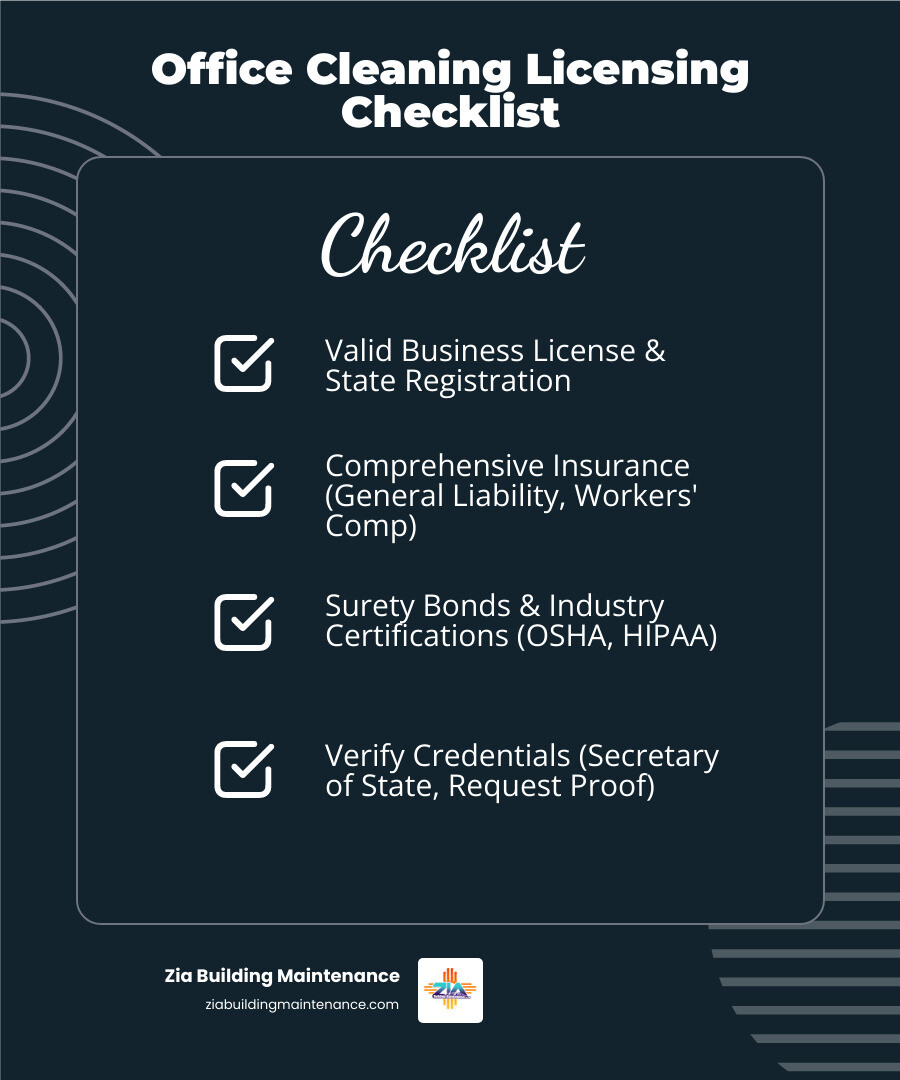
Key Licensing Requirements:
- Valid business license and registration with the state
- General liability insurance (typically $1 million minimum coverage)
- Workers’ compensation insurance if employing staff
- Surety bonds for commercial contracts
- Industry-specific certifications (OSHA, bloodborne pathogens for medical facilities)
How to Verify a Cleaner is Licensed:
- Request proof of business registration from your state’s Secretary of State
- Ask for current insurance certificates
- Check for bonding documentation
- Verify specialized certifications for your facility type
Why It Matters:
Licensed cleaners protect your business from liability, ensure consistent quality, and comply with regulatory standards. Unlicensed providers can expose you to financial penalties exceeding $600,000 in some jurisdictions, plus property damage claims and legal complications.
When you hire a cleaning company, you’re not just bringing someone in to empty trash cans and vacuum floors. You’re granting access to your facility, entrusting them with your property, and relying on them to maintain a safe environment for your employees and clients.
Yet many business owners don’t realize that the person holding a mop might not have the proper legal standing to be there at all. No business license. No insurance. No accountability. Just a person working out of their car who disappears the moment something goes wrong.
The commercial cleaning industry has relatively low barriers to entry, which means anyone can claim to be a “professional cleaner” without meeting basic legal requirements. This creates real risk for facility managers who need reliable, compliant service.
The difference between a licensed cleaning company and an unlicensed one isn’t just paperwork—it’s about protection, professionalism, and peace of mind. Licensed providers carry proper insurance, maintain trained staff, follow safety protocols, and operate under legal oversight. Unlicensed cleaners offer none of these protections.
I’m Ashley Cordova, Vice President of Zia Building Maintenance, where we’ve served New Mexico businesses since 1989 with fully licensed and insured commercial cleaning services. Our experience has shown that understanding what makes Licensed office cleaners truly “licensed” helps facility managers make better decisions and avoid costly mistakes.
Why Hiring Licensed Office Cleaners Protects Your Business
When we talk about licensing, we aren’t just checking boxes to satisfy a bureaucrat. We are talking about the safety net that catches your business if something falls. Hiring Licensed office cleaners provides a layer of security that “under-the-table” services simply cannot match.

One of the primary reasons licensing is vital is liability protection. If an unlicensed individual trips over their own mop bucket and breaks their arm on your property, your business could be held liable for their medical expenses. However, a licensed company carries workers’ compensation insurance, which covers their employees and shields you from these costs.
Furthermore, 3 Ways Professional Cleaners Improve Office Safety include much more than just a wet floor sign. Licensed providers are trained in risk management. They understand how to store chemicals safely, how to prevent cross-contamination, and how to protect your property from damage. The Benefits of Hiring a Commercial Cleaning Service extend to long-term property protection; for instance, using the wrong chemical on a high-end marble floor can cause thousands of dollars in permanent damage. A licensed professional has the accountability and the insurance to ensure that if a mistake happens, it is rectified on their dime, not yours.
How to Verify the Credentials of Licensed Office Cleaners
Verifying credentials is the most important step in your hiring process. You wouldn’t hire a doctor without a medical license, so why hire a cleaning crew without a business license?
When researching What to Look For in a Commercial Cleaning Service, you should start by asking for their paperwork upfront. A reputable company will have these documents organized and ready to share. If they hesitate or offer excuses, that’s a major red flag. There are 10 questions to ask before hiring a commercial cleaning company, but the most critical ones revolve around their legal standing with the Secretary of State and local municipalities.
Steps to Confirm a Valid Business License
In New Mexico, specifically in Albuquerque and Rio Rancho, businesses must be registered to operate legally. You can verify a company’s status by:
- Checking the Secretary of State website: Search for the company name to ensure they are an active legal entity.
- Contacting the City Clerk: Confirm they have a local business permit for the specific city (like Albuquerque or Bernalillo) where they are working.
- EIN Verification: Ask for their Federal Tax ID (EIN). This proves they are a legitimate business registered with the IRS.
- Performance Reviews: Knowing How to Evaluate Janitorial Service Performance often starts with seeing if they have a history of compliant operations.
Checking for Insurance and Bonding
Insurance is non-negotiable. Licensed office cleaners should carry at least $1 million in general liability insurance. This covers things like property damage or bodily injury to third parties. For example, knowing How to Prevent Slips, Falls, and Trips in the Workplace is part of their training, but the insurance is there if a slip happens despite those efforts.
Additionally, ask about a janitorial bond. This is a type of surety bond that protects you in the event of theft by a cleaning employee. While we hope it never happens, a bond provides financial security and shows the company has undergone the vetting necessary to be bonded.
Essential Qualifications and Certifications for Commercial Cleaning
A license is just the starting point; certifications prove that the team knows how to clean correctly and safely. In the commercial world, cleaning isn’t just about looking tidy—it’s about health and compliance.
Professional cleaners must adhere to OSHA standards regarding chemical safety and workplace hazards. For businesses in the healthcare sector, understanding How to Avoid OSHA and HIPAA Violations in Healthcare is mandatory. Licensed cleaners also follow CDC Cleaning and Disinfecting Guidance to ensure they are effectively removing pathogens rather than just spreading them around.
| Feature | Licensed Office Cleaners | General Cleaning Service (Unlicensed) |
|---|---|---|
| Insurance | General Liability & Workers’ Comp | Often None |
| Training | OSHA, HIPAA, & Safety Protocols | Informal/Minimal |
| Accountability | Legal Entity with Local Presence | Hard to Track / “Cash Only” |
| Equipment | Commercial-grade (HEPA, etc.) | Household Vacuums/Mops |
| Background Checks | Standard Practice | Rare |
Specialized Licensing for Medical and Educational Facilities
Medical and school environments require a much higher level of scrutiny. For doctors’ and dental offices, cleaners must be trained in HIPAA compliance to protect patient privacy and bloodborne pathogen protocols to handle biohazards. Your Guide to Cleaning Medical Offices highlights that a specialized approach is needed to prevent cross-contamination.
Similarly, in schools, safety is the top priority. Using Cleaning Protocols for Medical Offices to Reassure Parents can be adapted to educational settings to ensure that the disinfectants used are safe for children yet effective against common school-borne illnesses.
Industry-Standard Safety Certifications
Beyond basic business licenses, look for expertise in modern cleaning technologies. For instance, Electrostatic Cleaning Explained shows how specialized equipment can provide 360-degree coverage for disinfection. It is also vital that your team knows The Difference Between Cleaning, Sanitizing, and Disinfecting. Using a disinfectant on a dirty surface without “cleaning” it first is a waste of time—licensed pros know the science behind the shine.
The Financial and Legal Risks of Unlicensed Services
Hiring an unlicensed service might seem like a way to save a few dollars in the short term, but the long-term risks are astronomical. If an unlicensed cleaner causes a fire by improperly storing oily rags or mixing chemicals, your own business insurance might deny the claim because you failed to hire a “qualified” and “licensed” contractor.
Unlicensed services often lead to labor violations, such as paying workers under the table or ignoring safety regulations. If an audit occurs, your business could be caught in the middle of a legal nightmare. How Janitorial Services Can Actually Save You Money is by preventing these disasters before they happen. Furthermore, Why Having Dirty Floors Harms Your Business isn’t just about aesthetics; it’s about avoiding lawsuits from slip-and-fall accidents that an unlicensed crew won’t be able to cover.
Typical Costs for Licensed Office Cleaners
Licensed cleaners do cost more than a “guy with a van,” but the price reflects the overhead of insurance, training, and quality equipment. Most commercial cleaning in the Albuquerque and Rio Rancho area is priced based on square footage and frequency.
Why Hiring Professional Janitorial Service Is More Cost-Effective Than DIY Cleaning becomes clear when you factor in the cost of your own time and the risk of a lawsuit. On average, you might see rates ranging from $0.07 to $0.25 per square foot, depending on the complexity of the job. A medical office will naturally cost more than a standard warehouse because of the specialized sanitation requirements.
Frequently Asked Questions about Licensed Office Cleaners
What is the difference between a licensed cleaner and a general cleaning service?
The difference is legal and professional standing. A licensed cleaner is a registered business entity with the state of New Mexico, carrying insurance and bonding to protect the client. A general, unlicensed service lacks these protections. When you know What to Look For in a Janitorial Company, you’ll notice that professionals use commercial-grade equipment like HEPA-filter vacuums, whereas unlicensed services often use household tools that just blow dust back into the air.
Are there specific licensing requirements for medical offices?
Yes. Beyond a general business license, cleaners in medical settings must comply with OSHA and HIPAA standards. This ensures that How Cleaner Surfaces Mean Fewer Sick Days in Healthcare is achieved through scientifically backed protocols rather than just “wiping things down.”
How does licensing ensure accountability and quality?
Licensing creates a paper trail and a standard of conduct. Licensed companies typically have management oversight and quality control systems in place. Why You Should Have Routine Cleaning Inspections is a hallmark of a licensed professional service. They also perform background checks on their employees, ensuring that the people entering your office after hours are trustworthy.
Conclusion
Navigating commercial cleaning doesn’t have to be a legal headache. By prioritizing Licensed office cleaners, you are investing in the longevity of your building and the safety of everyone inside it.
At Zia Building Maintenance, we take the “Legal Lowdown” seriously. We’ve spent over three decades perfecting our services in Albuquerque, Rio Rancho, and Bernalillo. We aren’t just here to clean; we’re here to be your dependable, fully compliant partner in facility maintenance. Whether you need daily Office Cleaning Services or specialized medical sanitation, we provide the professional touch your business deserves. Don’t leave your liability to chance—choose a licensed team that stands behind every sweep, mop, and scrub.