

TL;DR:
- School administrators often sign cleaning contracts without fully understanding their terms, leading to compliance issues and disputes. A clear understanding of scope, service plans, procurement thresholds, and special provisions is essential to manage school janitorial agreements effectively. Focusing on well-defined service plans and documentation helps prevent downstream performance problems and ensures accountability.
School administrators and facilities managers often sign cleaning contracts without fully understanding what they’ve agreed to. That gap creates real problems: missed compliance requirements, disputed invoices, and service quality that drifts without accountability. Getting school cleaning contract terms explained clearly is not just a legal exercise. It directly affects how well your campus is maintained, how disputes are resolved, and whether your procurement decisions hold up to scrutiny. This guide breaks down every critical component of school janitorial agreements so you can manage them with confidence.
Table of Contents
- Key takeaways
- School cleaning contract terms explained: the key components
- Service plans and performance management
- Procurement and budgeting for cleaning contracts
- Special provisions worth knowing
- What I’ve learned from years of school cleaning contracts
- How Zia Building Maintenance supports your school’s cleaning standards
- FAQ
Key takeaways
| Point | Details |
|---|---|
| Scope defines your service | A well-written scope of services prevents gaps in cleaning coverage and sets clear provider accountability. |
| Procurement thresholds matter | Contract value determines how many quotes you need, with formal tenders required above $150,000. |
| Service plans drive performance | Customized cleaning service plans set measurable standards that make performance reviews fair and enforceable. |
| Extensions require formal steps | Contract extensions up to five years must be approved and documented through signed agreements. |
| Special provisions protect schools | Confidentiality clauses and additional service arrangements guard against risk and handle edge cases. |
School cleaning contract terms explained: the key components
A school cleaning contract, formally called a cleaning services agreement, is a legally binding document that governs the relationship between your school and its cleaning provider. Understanding cleaning contracts starts with recognizing what each section is designed to do.
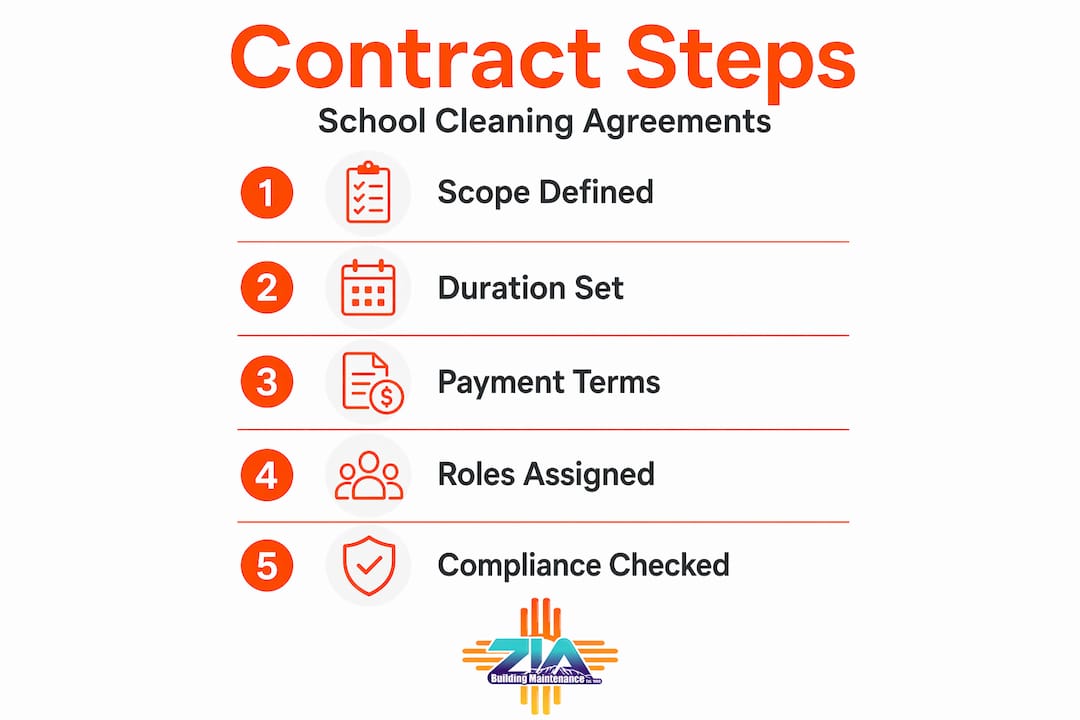
Scope of services is the foundation. This section defines exactly what cleaning tasks the provider is responsible for: daily vacuuming, restroom sanitization, floor maintenance, window cleaning, and any deep cleaning cycles. Vague scope language leads to arguments about who handles what. Be specific. List rooms, frequency, and tasks.
Contract duration and extensions set the timeline. Contract extensions for school cleaning can total up to five years, typically structured as a three-year initial term with options for two one-year extensions, each formalized through signed letters. Knowing this structure helps you plan budget cycles and avoid automatic renewals you did not intend.
Payment terms cover deposits, invoicing schedules, and consequences for late payment. Cleaning service agreements commonly specify deposits ranging from 10 to 50 percent of the total contract value, along with payment deadlines and late fees. Reviewing this section carefully protects your school from unexpected financial exposure.
The contract also defines responsibilities on both sides. The provider’s obligations include delivering services on schedule and to specified standards. Your school’s obligations typically include granting access, reporting issues promptly, and paying invoices on time.
Termination clauses specify how either party exits the agreement. Performance reviews including termly and annual evaluations with break clause provisions are common in well-structured contracts, giving schools a defined process to exit if service quality falls short.
Compliance with cleaning standards is the final core component. This section references the specific cleaning specifications or standards the provider must meet. For multi-campus education contracts, some providers fix pricing firm for 24 months with APPA-aligned quality standards built into the agreement.
Pro Tip: Before signing, ask your provider to walk through the scope section line by line. Discrepancies between what was proposed and what the contract actually says are far more common than most administrators realize.
Service plans and performance management
A cleaning services plan is the operational backbone of any school janitorial agreement. It translates the contract’s general scope into specific, campus-level instructions: which rooms are cleaned at what frequency, what products are used, and what the expected outcome looks like for each area.
Schools collaborate with providers to finalize these plans, tailoring requirements to the unique layout and needs of each campus. A primary school with high-traffic corridors and art rooms needs a very different plan than a secondary school with science labs and gymnasium locker rooms.
Here is how effective performance management works within these agreements:
- Establish baseline standards. The cleaning services plan documents the agreed standard for each area. This creates an objective reference point for all future evaluations.
- Schedule regular inspections. Build formal review cycles into the contract. Termly walkthroughs with your provider keep standards visible and problems from accumulating.
- Use standardized reporting tools. Many school districts use property management systems like AIMS to track contract details and log performance data. Consistent documentation makes disputes easier to resolve.
- Address issues through a defined process. A good contract specifies how underperformance is reported, what response time is required, and what remedies are available. Do not rely on informal complaints.
- Conduct annual contract reviews. Use these to assess whether the service plan still reflects your campus needs and to negotiate adjustments before they become contract variations.
In Victoria, school councils enter contracts while principals manage day-to-day provider performance and update contract details in the Asset Information Management System. That division of responsibility is worth replicating regardless of your jurisdiction. Clear internal ownership prevents things from falling through the cracks.
Pro Tip: Attach the cleaning services plan as a formal schedule to your contract. If it lives only in an email thread or a separate folder, it has no legal weight when a dispute arises.
Procurement and budgeting for cleaning contracts
Many administrators underestimate the procurement complexity behind school cleaning services. The dollar value of your contract determines how much market engagement you are required to complete before signing, and skipping steps creates audit exposure.
| Contract value | Required procurement action |
|---|---|
| Under $2,500 | One quote (verbal or written) |
| $2,500 to $25,000 | One written quote |
| $25,000 to $150,000 | Three written quotes |
| Over $150,000 | Formal tender process |
Procurement thresholds like these govern cleaning contract procurement in many education jurisdictions. The critical calculation is the total estimated contract cost, which means you must include all optional extension years when assessing which threshold applies. A two-year contract worth $60,000 per year that includes two one-year extension options has a total estimated value of $240,000. That triggers a formal tender, not just three quotes.
School councils and principals both play roles in the procurement process. Councils authorize the contract and bear ultimate accountability. Principals typically manage the operational side, including reviewing quotes, assessing provider capability, and recommending the preferred supplier. Using standardized contract templates simplifies this process and reduces legal risk.
Fee adjustments and contract variations also require documentation. If your school adds buildings, changes cleaning frequencies, or requests new services mid-contract, those changes should be captured in a formal variation agreement. A variation that exists only in email is difficult to enforce and may create liability. For additional budget context on contractor costs, tax deductions for cleaners can affect how providers price their services, which is worth understanding when evaluating quotes.
Special provisions worth knowing
Beyond the standard framework, school cleaning contracts often include provisions that protect schools from specific risks. These do not always appear in every agreement, but knowing when to request them puts you in a stronger position.
Additional and ad-hoc services are a practical necessity for schools. Events, facility hires, and unexpected situations generate cleaning needs outside the regular schedule. Schools may procure additional cleaning for special needs through work order agreements or standing orders under the primary contract. Having this mechanism written into your agreement means you do not have to renegotiate every time a one-off situation arises.
Here are the other special provisions you should consider including:
- Confidentiality clauses. Such clauses restrict cleaners from disclosing confidential information encountered during their work, both during and after the contract term. Schools hold student data, personnel files, and administrative records. A confidentiality clause is a straightforward protection.
- Extension formalization. Any decision to exercise an extension option should be documented through a formal signed agreement, not just an assumption that the provider will continue. Informal extensions create ambiguity about whether original contract terms still apply.
- Contract variation procedures. Define in advance how changes to scope, pricing, or schedule will be agreed, documented, and executed. This prevents disputes from arising over verbal agreements or email exchanges that one party later interprets differently.
- Legal support and dispute resolution. Consider including a clause that specifies the jurisdiction and process for resolving disputes. This is especially relevant for larger contracts where financial exposure is significant.
Clear documentation throughout the contract lifecycle is what separates schools that manage their cleaning agreements effectively from those that find themselves arguing over what was actually agreed. A useful starting point is a cleaning contract checklist that covers each of these provisions systematically.
What I’ve learned from years of school cleaning contracts
In my experience, the contracts that cause the most problems are not the ones with missing clauses. They are the ones where the scope was written broadly on purpose so neither side had to have a hard conversation upfront.
I’ve seen schools accept vague language like “all areas will be cleaned as needed” and then spend months arguing over whether a gym storage room qualifies as an “area.” The contract technically covers it. The provider says the frequency was never specified. Both are right, and the school ends up in a position with no leverage.
The other pattern I see repeatedly is administrators treating the cleaning services plan as a formality. They sign it, file it, and forget it. Then six months later, when hallway floors are not being mopped at the agreed frequency, there is no documented standard to point to. Performance conversations without written benchmarks almost always end in the provider explaining why what they delivered was “within expectations.”
My honest advice for first-time administrators: spend more time on the scope and service plan than on any other section. The termination clause and payment terms matter, but they are backstops. The scope and service plan are where the actual relationship is defined. Get them right and most of the downstream problems disappear. For a broader look at what makes school cleaning services work well, effective cleaning service agreements are worth reviewing before you finalize your own approach.
— Ashley
How Zia Building Maintenance supports your school’s cleaning standards
School cleaning contracts set the standard. Zia Building Maintenance helps you meet it. Since 1989, Zia Building Maintenance has provided schools in Albuquerque with janitorial services built around consistency, detailed service planning, and clear accountability. Every engagement starts with understanding the specific needs of your campus, from high-traffic hallways to specialized spaces like labs and gymnasiums.
If you are managing a school cleaning contract and want a provider that works within your established terms, tracks performance, and communicates proactively, Zia Building Maintenance is ready to partner with you. Explore professional school cleaning services tailored to meet contract standards, or review our school cleaning services guide to understand what a well-structured service agreement looks like in practice. Request an estimate today and see what reliable school cleaning services look like.
FAQ
What should be included in a school cleaning contract?
A school cleaning contract should include scope of services, contract duration, payment terms, performance standards, a cleaning services plan, termination clauses, and dispute resolution procedures. Including a confidentiality clause is also advisable given the sensitive information present in school environments.
How long can a school cleaning contract last?
School cleaning contracts can extend up to five years total, typically structured as a three-year initial term with optional one-year extensions subject to provider performance and formal approval through signed documentation.
What procurement process is required for school cleaning contracts?
The required process depends on total contract value. Contracts under $2,500 need one quote, those between $25,000 and $150,000 require three written quotes, and contracts over $150,000 require a formal tender process.
Who is responsible for managing a school cleaning contract?
In most education systems, the school council or governing body enters the formal contract, while the principal or facilities manager oversees day-to-day performance, conducts reviews, and logs contract details in the relevant property management system.
What is a cleaning services plan and why does it matter?
A cleaning services plan details the specific tasks, frequencies, and standards required for each area of a school campus. It serves as the performance benchmark for evaluating the provider and is most effective when attached as a formal schedule to the contract itself.