

Why Commercial Kitchen Cleaning Is a Matter of Public Health and Business Survival
Commercial kitchen cleaning is one of the most critical — and most underestimated — responsibilities in the foodservice industry.
A clean kitchen isn’t just about appearances. It directly affects whether your customers stay healthy, whether your staff works safely, and whether your business stays open.
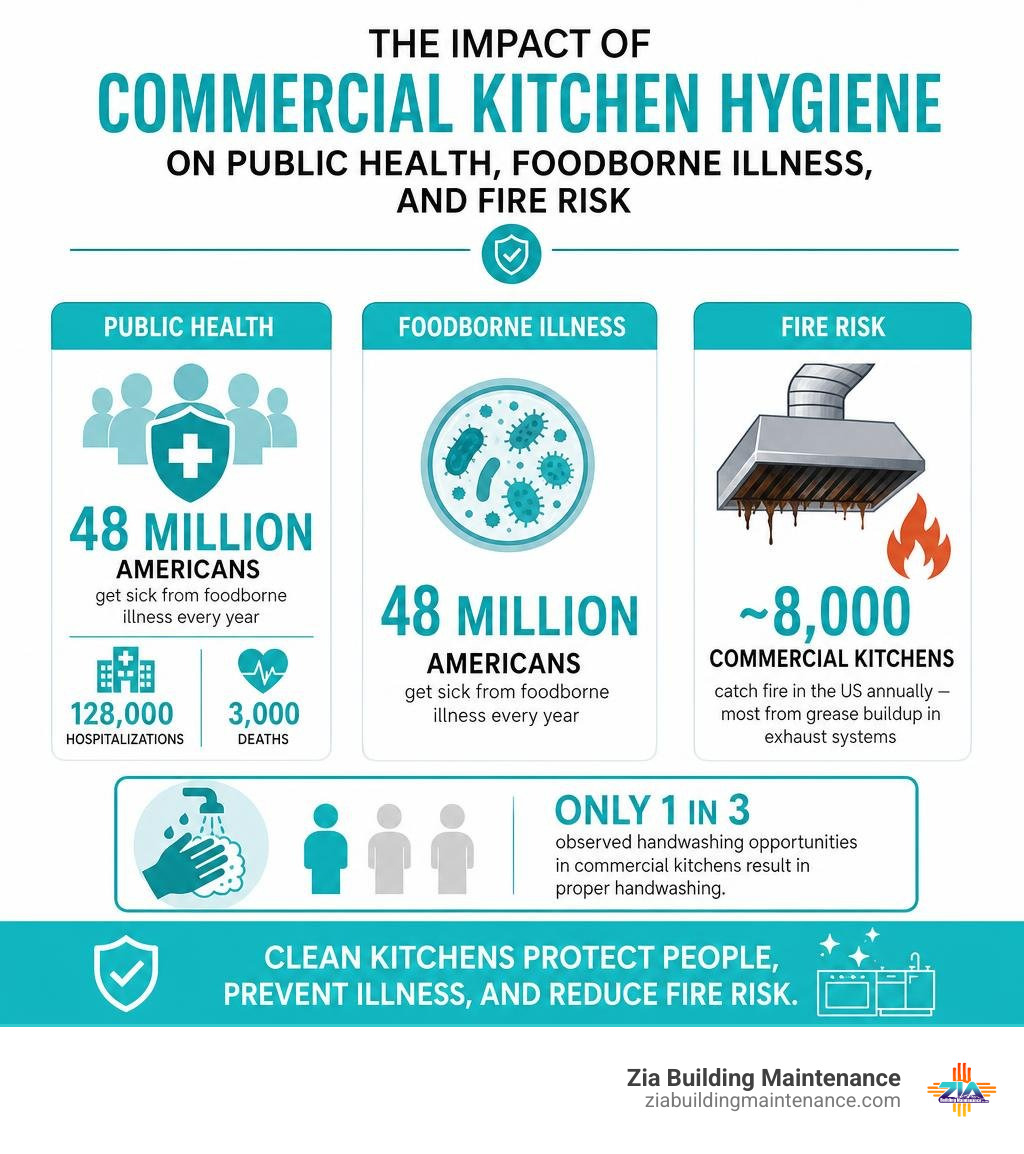
The numbers make this hard to ignore:
- 48 million Americans get sick from foodborne illness every year, leading to 128,000 hospitalizations and 3,000 deaths
- ~8,000 commercial kitchens catch fire in the US annually — most from grease buildup in exhaust systems
- Only 1 in 3 observed handwashing opportunities in commercial kitchens result in proper handwashing
Here’s a quick overview of what commercial kitchen cleaning involves:
| What You Need to Know | Quick Answer |
|---|---|
| What is it? | Cleaning, sanitizing, and degreasing all surfaces, equipment, and systems in a commercial kitchen |
| Daily tasks | Wipe prep surfaces, degrease floors, clean cooking equipment, sanitize food-contact surfaces |
| Weekly tasks | Clean hood filters, deep clean fryers, scrub floor drains, sanitize refrigerator interiors |
| Monthly/quarterly tasks | Clean grease traps, descale dishwashers, clean refrigerator coils, professional duct cleaning |
| Key standards | FDA Food Code, NFPA 96, ANSI IKECA C10, HACCP guidelines |
| How often to deep clean | Every 1–3 months for high-volume kitchens; every 3–6 months for lower-volume operations |
| Professional vs. in-house | Professionals handle exhaust systems, grease traps, and hard-to-reach areas that daily staff routinely miss |
The challenge most facility managers face isn’t knowing that cleaning matters — it’s knowing exactly what to clean, how often, and to what standard. A surface that looks clean can still harbor dangerous bacteria. An exhaust hood that looks shiny on the outside can have dangerous grease buildup deep inside the ductwork.
This guide breaks it all down clearly: daily checklists, deep cleaning schedules, exhaust system standards, food-safe products, and how to choose a provider you can actually trust.
I’m Ashley Cordova, Vice President of Zia Building Maintenance — a family-owned janitorial company serving New Mexico since 1989 — and commercial kitchen cleaning is one of the most specialized services our team delivers every day. In this guide, I’ll walk you through everything you need to keep your kitchen safe, compliant, and running smoothly.
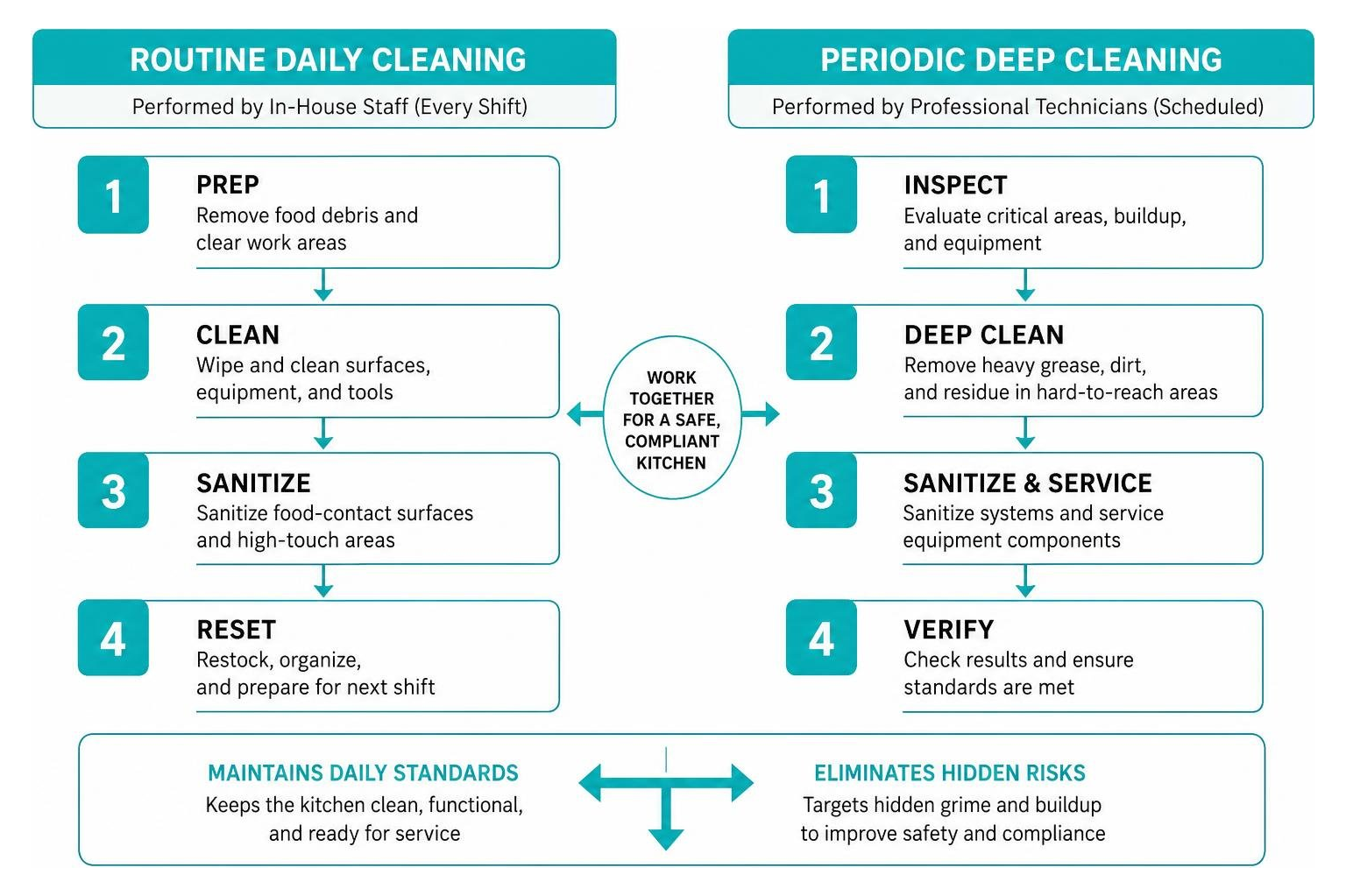
Routine Daily Cleaning vs. Periodic Deep Cleaning
To run a successful, compliant kitchen in Albuquerque or Rio Rancho, it is vital to understand that daily routine tidying and periodic deep cleaning are two entirely different beasts. They do not replace one another; instead, they work in harmony to protect your facility.
Routine daily cleaning is performed by your back-of-house staff at the end of every shift. It focuses on the visible, high-traffic areas of the kitchen. The goal is to keep the workspace functional, remove immediate food debris, and maintain basic sanitation.
Periodic deep cleaning, on the other hand, targets the areas that are invisible to the naked eye or physically inaccessible during a busy dinner rush. Deep cleaning addresses compounding grease accumulation, hidden bacteria breeding grounds, and mechanical components. To understand what goes into these intensive visits, you can read our detailed breakdown on what is included in deep commercial cleaning.
| Cleaning Aspect | Routine Daily Cleaning | Periodic Deep Cleaning |
|---|---|---|
| Primary Focus | Visible surfaces, immediate sanitation, and operational readiness. | Inaccessible zones, heavy grease removal, and mechanical sanitation. |
| Responsible Party | In-house kitchen staff (line cooks, dishwashers, prep cooks). | Specialized professional cleaning technicians. |
| Key Areas Addressed | Prep tables, line equipment surfaces, high-traffic floors, trash bins. | Exhaust ducts, behind/under heavy appliances, walk-in condenser coils. |
| Tools & Chemicals | Standard dish detergents, surface sanitizers, basic floor mops. | Heavy-duty alkaline degreasers, steam cleaners, rotary floor scrubbers. |
| Frequency | After every shift and at nightly closing. | Monthly, quarterly, or semi-annually (based on cooking volume). |
Without consistent daily maintenance, grease and organic debris build up so quickly that a periodic deep clean becomes incredibly difficult. Conversely, without professional deep cleaning, hidden grease and bacteria will accumulate to dangerous levels, regardless of how hard your staff scrubs each night.
The Critical Risks of Inadequate Commercial Kitchen Cleaning
Neglecting your kitchen’s hygiene routine carries severe real-world consequences. In our 35+ years of helping Albuquerque businesses stay compliant, we have seen how a single overlooked area can lead to operational disaster. The primary risks of poor maintenance fall into three major categories:
1. Fire Hazards
Grease is highly flammable. When vaporized grease escapes the cooking line, it settles inside your exhaust hoods, filters, ducts, and fans. If a flare-up occurs on the stovetop or fryer, the flames can easily reach the grease-laden hood filters. If the system is dirty, the fire will ignite the accumulated grease and roar through your ductwork, spreading to the roof and structure of your building in minutes. This is why approximately 8,000 commercial kitchens catch fire in the US every year, causing millions of dollars in damages and permanent business closures.
2. Health Code Violations and Legal Liability
The New Mexico Environment Department enforces strict sanitation standards. If an inspector finds heavy grease buildup on equipment, mold inside walk-in coolers, or dirty floor drains, you face costly fines or immediate closure. More importantly, inadequate sanitation leads to foodborne illnesses. Foodborne illness affects 48 million Americans every year, resulting in 128,000 hospitalizations and 3,000 deaths. Serving contaminated food can destroy your restaurant’s reputation overnight and expose you to catastrophic lawsuits.
3. Pest Infestations
Insects and rodents do not need a massive feast to survive; they thrive on the tiny food particles and grease residues trapped behind your hot line, under prep tables, and inside grout lines. Pests carry dangerous pathogens like Salmonella and E. Coli, contaminating your food prep surfaces.
To protect your business, it is crucial to understand the scientific differences between basic surface preparation and true pathogen elimination. You can learn more about this by reading our guide on the difference between cleaning, sanitizing, and disinfecting.
Exhaust System and Hood Cleaning Standards
The exhaust system is the lungs of your commercial kitchen. It pulls heat, smoke, steam, and vaporized grease away from the cooking line to maintain indoor air quality. Because it handles highly flammable grease vapors, this system is heavily regulated by local fire marshals and insurance underwriters.
To ensure safety, your kitchen must comply with NFPA 96 (National Fire Protection Association) standards and ANSI/IKECA C10 standards. These regulations dictate that a kitchen exhaust cleaning service must clean the entire system, not just the parts you can see.
A compliant cleaning must address all four major components:
- The Hood: The visible canopy over the cooking line, which must be degreased inside and out.
- Baffle Filters: These metal filters extract grease from the air before it enters the ductwork. They must be removed, thoroughly degreased, and reinstalled daily or weekly.
- Ductwork: The vertical and horizontal pathways that channel exhaust air out of the building. Cleaning these requires specialized tools and sometimes the installation of code-compliant access panels.
- Exhaust Fans: The fan unit located on your roof that pulls the air through the system. It must be cleaned, checked for grease containment, and fitted with a hinge kit to prevent damage to the electrical wiring during maintenance.
A shiny hood exterior is meaningless if the ductwork above it is packed with flammable grease. To understand why this is a job best left to certified specialists, read our article on why every chef needs a reliable commercial hood cleaning company.

The Ultimate Commercial Kitchen Cleaning Checklist
Establishing a structured, frequency-based cleaning program is the best way to keep your kitchen inspection-ready at all times. By dividing tasks into clear daily, weekly, monthly, and quarterly schedules, you ensure that no critical areas are missed. For a comprehensive look at modern facility standards, you can read the 2026 commercial kitchen cleaning checklist from Facility Management Insights.
Daily and Weekly Commercial Kitchen Cleaning Tasks
Daily tasks are non-negotiable for food safety and operational flow. Every single day, your team must:
- Clean and sanitize all food prep surfaces, cutting boards, and line equipment.
- Sweep and mop the kitchen floor using a high-quality floor degreaser to prevent slips.
- Empty trash cans, wash the bins, and sanitize handwashing stations.
- Clean beverage dispenser heads and soda gun tips to prevent yeast and mold buildup.
The daily handwashing routine is especially critical, yet highly neglected: CDC data shows that only 1 in 3 observed handwashing opportunities in commercial kitchens actually result in proper handwashing. Ensuring your handwashing stations are clean, stocked, and accessible is a direct way to combat this statistic.
Weekly tasks require a slightly deeper level of effort:
- Pull and clean range hood baffle filters.
- Boil out deep fryers: drain the oil, fill with water and a specialized fryer cleaner, heat to loosen carbon buildup, rinse, and dry.
- Scrub and treat floor drains using enzymatic cleaners to prevent drain flies and foul odors.
- Wash all kitchen rags, aprons, and anti-fatigue mats.
To keep your staff organized, we recommend posting clear, physical checklists in the kitchen. For more tips on setting up these routines, check out our kitchen and break room cleaning service page.
Monthly and Quarterly Commercial Kitchen Cleaning Tasks
Monthly and quarterly tasks focus on preventive maintenance and deep sanitation. These are the tasks that protect your expensive equipment from breaking down.
On a monthly basis, you should:
- Empty, clean, and sanitize walk-in coolers and freezers, paying close attention to rubber door gaskets.
- Dust and clean refrigerator condenser coils to keep units running efficiently.
- Descale commercial dishwashers to remove mineral buildup and ensure proper sanitizing temperatures.
- Clean and sanitize ice machines (at least once every 6 months, though monthly checks are safer).
On a quarterly basis, your kitchen requires specialized attention:
- Clean the grease traps: Grease traps intercept fats, oils, and grease (FOG) before they enter the city sewer system. Regular cleanings prevent backups, odor issues, and massive municipal fines.
- Deep clean behind the hot line: Pull out fryers, ovens, and ranges to scrub the grease and food debris that accumulates on the walls and floors behind them.
- Inspect and clean walk-in cooler drain lines: This prevents standing water, which is a prime breeding ground for Listeria.
Listeria is a highly resilient bacterium that thrives in cold, damp environments. It is a major health hazard, especially since CDC’s research found that 1-in-7 cooling observations recorded temperatures above 41°F (the FDA Food Code’s cold holding limit). If your walk-in cooler is running too warm and has standing water or dirty shelves, you are at a high risk for a major health code violation.
To keep your facility running smoothly, you can explore our comprehensive commercial cleaning services to see how we handle these high-stakes cleaning tasks.
Food-Safe Cleaning Products and Technical Methods
When cleaning a commercial kitchen, you cannot simply grab any bottle of cleaner off the shelf. The chemicals used must be highly effective at cutting through tough carbon and grease, yet completely food-safe so they do not contaminate prep surfaces.
Choosing the Right Chemistry
- Alkaline Degreasers: These are essential for breaking down organic soils like animal fats, vegetable oils, and heavy grease. They work by saponifying the grease, turning it into a water-soluble substance that can be easily rinsed away.
- Acidic Descalers: Used primarily in dishwashers, steam tables, and ice machines to dissolve hard water scale, rust, and mineral deposits.
- Sanitizers and Disinfectants: Food-contact surfaces must be treated with EPA-registered, food-safe sanitizers (such as quaternary ammonium compounds or chlorine-based solutions). Always use test strips to verify that the chemical concentration is correct—too weak is ineffective, while too strong leaves toxic chemical residues.
- Enzymatic Cleaners: These use live, beneficial bacteria to biologically digest organic waste. They are perfect for daily floor mopping and treating drains, as they continue working long after application to break down grease and eliminate odors.
Advanced Cleaning Methods
For a truly deep clean, manual scrubbing is often not enough. Modern kitchen sanitation relies on advanced technical methods:
- Steam Cleaning: Commercial steam cleaners exit the nozzle at temperatures up to 100°C (212°F) and high pressure. This allows them to melt grease instantly and sanitize hard-to-reach crevices, dials, switches, and grout lines without using harsh chemicals.
- Scrubber Driers: For kitchen floors, we use compact scrubber driers with counter-rotating roller brushes. These machines are designed to agitate dirt out of high-traction, anti-slip tiles (which typically require a slip resistance rating of R11 to R13 to prevent workplace accidents) and dry the floor instantly.
For a deeper dive into these professional techniques, you can read Kärcher’s technical guide on cleaning in the commercial kitchen or explore commercial cleaning methods on our blog to see how facility managers optimize their sanitation programs.
Professional Services vs. In-House Kitchen Staff
Many restaurant owners and facility managers in Albuquerque and Corrales initially try to save money by assigning all deep cleaning tasks to their in-house kitchen staff. While your team is fully capable of handling daily surface sanitation, relying on them for deep cleaning is often a costly mistake.
Why In-House Deep Cleaning Falls Short
- Labor Fatigue and High Turnover: Kitchen staff are hired to cook and prep, not to perform heavy industrial cleaning. Forcing them to scrub grease ducts or crawl behind hot lines after a grueling 10-hour shift leads to burnout, low morale, and high employee turnover.
- Lack of Specialized Equipment: Your staff does not have access to high-pressure steam cleaners, rotary floor scrubbers, or duct-cleaning equipment. Without these tools, they cannot remove stubborn carbon buildup or reach deep inside ventilation systems.
- Overlooked Areas: There are several critical, high-risk areas that in-house staff routinely miss. For example, cool rooms are often overlooked because employees only enter them briefly to grab ingredients, allowing mold to quietly grow on walls and shelving. Similarly, grease and bacteria build up in the deep pores of tiled floor grout lines, which standard mops simply slide over.
By outsourcing these heavy tasks to a professional crew, you reduce your business’s liability, extend the lifespan of your expensive appliances, and ensure your staff can focus entirely on delivering great food and service. To learn more about selecting the right partner, read our guide on why choosing the best back of house cleaning matters.
wp:html
/wp:html
wp:html
/wp:html
How to Choose a Reliable Commercial Kitchen Cleaning Provider
When hiring a commercial kitchen cleaning service in New Mexico, you must verify that they are qualified to handle the high stakes of food safety and fire prevention. Here is what you should look for:
- Proper Credentials and Certifications: Ensure the company’s technicians are trained in NFPA 96 standards and understand local health department codes.
- Comprehensive Insurance: The provider must carry liability insurance and workers’ compensation to protect your business in the event of accidental damage or injury.
- Photographic Verification: A reliable provider will always supply detailed before-and-after photo reports. Because you cannot easily look inside your rooftop exhaust fan or deep horizontal ductwork, photos are the only way to verify that the job was actually done correctly.
- Detailed Compliance Documentation: The provider should supply you with a signed cleaning log and inspection report after every service. Keep these documents on file—they are your proof of compliance for health inspectors, fire marshals, and insurance audits.
To see how we maintain these rigorous standards on every single job, you can learn more about our commercial cleaning standards.
Frequently Asked Questions about Commercial Kitchen Cleaning
How often should a commercial kitchen be deep cleaned?
The frequency of a commercial kitchen deep clean depends entirely on your cooking volume, equipment type, and local regulations.
- High-Volume Kitchens: Facilities that use wood-burning ovens, charbroilers, or operate 24/7 (such as busy diners, hotels, or hospitals) should have their exhaust systems and kitchens deep cleaned monthly.
- Medium-Volume Kitchens: Standard sit-down restaurants, school cafeterias, and mid-sized commercial kitchens typically require a professional deep clean quarterly (every 3 months).
- Low-Volume Kitchens: Seasonal operations, church kitchens, or small break rooms can usually maintain safety with a deep clean semi-annually (every 6 months).
What are the most commonly overlooked areas in a commercial kitchen?
During routine nightly cleanings, staff members naturally focus on flat, easily accessible surfaces. The areas most frequently missed—which require specialized attention during a deep clean—include:
- Cool room shelving and walls: Condensation creates a damp environment where mold and bacteria thrive.
- Refrigerator door gaskets: The rubber seals trap food crumbs and moisture, leading to mold growth and compromised temperature seals.
- Behind and underneath heavy appliances: Grease, flour, and food debris accumulate in these dark spaces, attracting rodents and insects.
- High-touch electronic controls: Knobs, digital control pads, and light switches are frequently touched but rarely sanitized. You can read more about these critical zones in our guide on high touch areas often missed during disinfection.
What documentation is required for health and fire safety compliance?
To pass inspections and satisfy insurance requirements, your facility must maintain:
- Daily Cleaning Sign-off Logs: Documenting that your staff completed daily sanitation tasks.
- Professional Service Reports: Invoices and inspection reports from your certified exhaust cleaning provider, verifying compliance with NFPA 96.
- Grease Trap Maintenance Logs: Showing the dates, times, and volume of grease pumped by your licensed hauler.
- Before-and-After Photos: Providing photographic proof of cleanliness for inaccessible ductwork.
Conclusion
At the end of the day, a clean commercial kitchen is the backbone of a successful foodservice business. Maintaining pristine sanitation protects your customers from foodborne illness, safeguards your employees from workplace injuries, and keeps your facility safe from devastating fires.
Since 1989, Zia Building Maintenance has been the trusted partner for commercial facilities throughout Albuquerque, Rio Rancho, Corrales, and Los Ranchos. As a family-owned business, we pride ourselves on our attention to detail, highly trained staff, and unwavering dependability. We understand the complex regulations of the food industry, and we are here to ensure your kitchen remains safe, clean, and fully compliant.
Don’t wait for a surprise inspection or a fire hazard to disrupt your business. Contact us today to schedule your professional restaurant cleaning and experience the peace of mind that comes with a truly clean kitchen.