

Why seasonal deep cleaning for school buildings matters
School breaks are the best window you have to reset your facility. When students and staff clear out, every surface, duct, and floor finish can finally get the attention it needs without disrupting a single class period. Seasonal deep cleaning for school buildings is the systematic, thorough sanitation and maintenance performed during those breaks to prepare facilities for safe, healthy occupancy. Done right, it reduces illness-related absences, extends the life of your floors and equipment, and keeps your building aligned with CDC and EPA standards for indoor environments.
The core targets during any seasonal clean are classrooms, restrooms, hard and carpeted floors, HVAC systems, and shared spaces like cafeterias, gyms, and libraries. Each area carries its own risks and its own protocol. A checklist-based approach keeps nothing overlooked and gives your team a clear record of what was done and when.
Key tasks every seasonal deep clean should cover:
- Wipe and disinfect all high-touch surfaces: desks, doorknobs, light switches, faucet handles, and shared equipment
- Strip, clean, and refinish hard floors; deep-clean carpeted areas
- Inspect, clean, and replace HVAC filters; clear vents and ducts
- Disinfect restrooms from ceiling to floor, including fixtures, dispensers, and grout lines
- Clean and sanitize cafeteria surfaces, kitchen equipment, and gym floors
- Address pest control as part of the break-period walkthrough
- Dispose of waste properly and set up recycling stations before reopening
How to clean classrooms and common areas step by step
Classrooms accumulate a full semester’s worth of dust, germs, and grime on surfaces that students touch dozens of times a day. The break period is the right time to go beyond routine wiping and address every surface, corner, and piece of shared equipment.
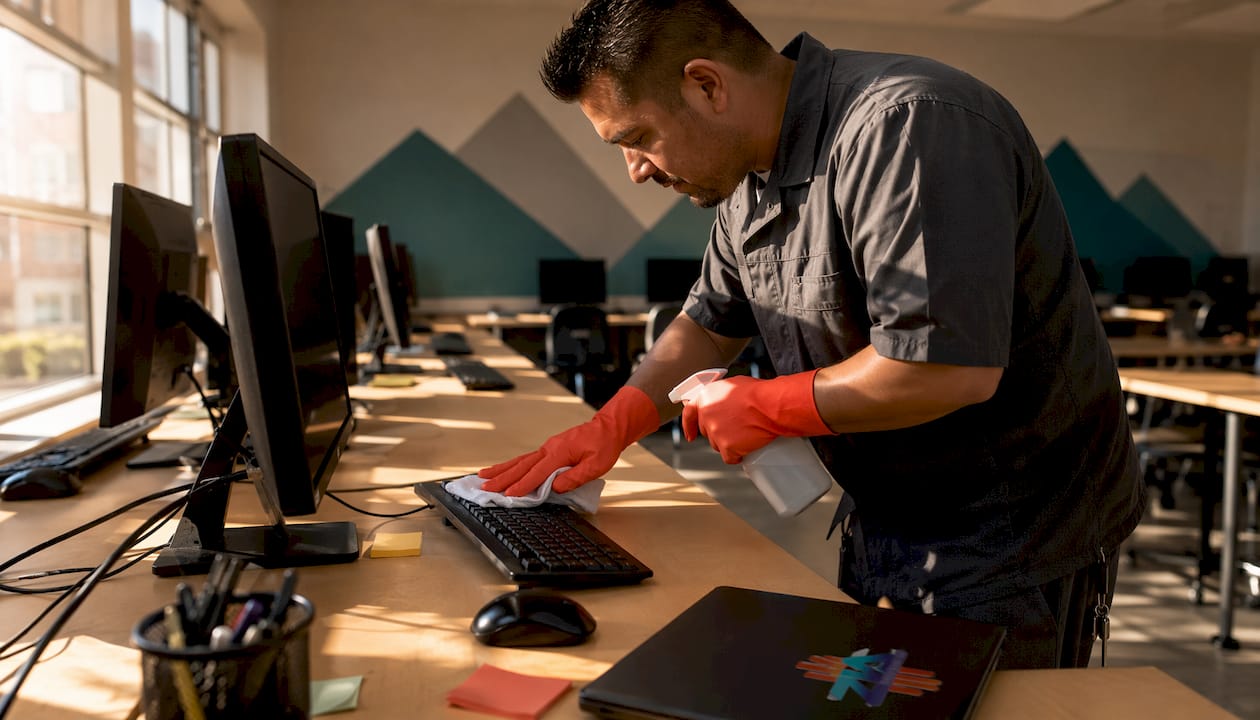
Classroom cleaning checklist
Start at the top and work down. Dust ceiling fans, light fixtures, and the tops of cabinets before touching any horizontal surface. Then move to walls, whiteboards, and window sills. Finish with desks, chairs, and floors.
- Dust and wipe all high surfaces: shelves, tops of lockers, ceiling vents
- Clean windows and window tracks inside
- Wipe down walls and baseboards with a damp cloth
- Sanitize desks, chairs, and tabletops with an EPA-registered disinfectant
- Clean and disinfect shared classroom technology (keyboards, tablets, interactive boards)
- Empty, wipe, and reline all trash and recycling bins
- Mop or vacuum floors after all surface work is complete
Cleaning electronic devices safely: Use disinfecting wipes approved for electronics. The CDC recommends paying close attention to contact time on the wipe label and confirming the device can tolerate moisture before applying any product. Never spray liquid directly onto a screen or keyboard.
Common areas: cafeterias, gyms, and libraries
Cafeterias need food-safe disinfectants on all prep surfaces, tables, and chairs. Gym floors require specialized cleaning products matched to the floor type, whether wood, rubber, or synthetic. Library shelves benefit from a full wipe-down of every shelf face and a check for moisture damage near exterior walls.
Waste disposal and recycling after deep cleaning: Collect all cleaning waste, used PPE, and empty chemical containers in labeled bags. Follow your district’s hazardous waste disposal policy for concentrated cleaning products. Set up clearly labeled recycling stations before students return so the system is ready from day one.
Eco-friendly product selection: The EPA’s Safer Choice Standard identifies cleaning products with reduced health and environmental impact. Choosing products that meet this standard protects students with sensitivities and supports better indoor air quality throughout the building.
Restroom disinfection protocols that actually prevent infection
School restrooms are the highest-risk spaces in any building for cross-contamination. A thorough break-period clean goes well beyond daily maintenance and addresses every surface, fixture, and hidden corner.
Restroom deep cleaning checklist:
- Scrub and disinfect all toilets, urinals, and sinks, including undersides and flush handles
- Wash walls, stall partitions, and doors from top to bottom
- Clean and refill all soap, paper towel, and hand sanitizer dispensers
- Scrub grout lines on tile floors and walls to remove mold and bacteria buildup
- Mop floors with a disinfectant solution, paying attention to corners and drain surrounds
- Check and repair caulking around fixtures to control moisture intrusion
- Ventilate the space during and after cleaning to reduce humidity
The CDC’s guidance on bleach solutions provides a reliable fallback when EPA-registered disinfectants are unavailable. Mix 1 tablespoon of bleach per 1 quart of water, apply to the surface, and allow a contact time of 3–5 minutes before rinsing. For larger batches, the ratio scales to ¼ cup of bleach per gallon of water.
Humidity control is often overlooked in restroom deep cleaning. Mold can grow on any organic surface when moisture and oxygen are present, and a restroom that dries slowly after cleaning will develop odors and microbial growth before the next school year begins. Run exhaust fans continuously after mopping and leave windows cracked where possible.
Floor care: stripping, waxing, and carpet cleaning during breaks
School floors take more punishment than almost any other surface in the building. A break-period floor restoration does two things: it removes the damage accumulated over the semester and lays a protective finish that holds up through the next one.
Floor care checklist by surface type:
- Vinyl and terrazzo: Strip old finish completely, clean the bare floor, apply multiple coats of new finish, and allow full curing time before foot traffic returns
- Wood gym floors: Screen and recoat or sand and refinish based on wear level; check for moisture damage before applying any finish
- Tile: Regrout cracked lines, scrub with a low-pH cleaner, and seal grout after drying
- Carpet: Hot-water extraction (commonly called steam cleaning) removes embedded soil and allergens that vacuuming cannot reach; allow 24–48 hours of drying time
Timing is critical for floor finishes. Environmental conditions, including temperature and humidity, affect how well a finish cures. Applying wax in a humid room or before the previous coat is fully dry leads to cloudy, peeling results that require rework. Schedule floor work early in the break period so finishes have maximum time to cure before the building reopens.
Follow manufacturer guidelines for every product you use. The EPA’s guidance on school flooring maintenance recommends matching cleaning products to the specific floor type and performing restorative maintenance as needed rather than on a fixed calendar. A floor maintenance guide can help your team match the right method to each surface in your building.
HVAC cleaning and indoor air quality during school breaks
HVAC systems are the most commonly neglected part of a school deep clean, and also the most consequential. A clogged or dirty system reintroduces allergens, dust, and mold spores the moment it runs, undoing hours of surface cleaning in minutes.
HVAC and IAQ checklist:
- Replace all air filters at the start of every seasonal clean
- Vacuum supply and return vents with a HEPA-filter vacuum to capture fine particles
- Inspect ductwork for visible mold, pest activity, or debris accumulation
- Check that exhaust fans in restrooms and kitchens are operating correctly
- Place barrier floor mats at all building entrances to reduce incoming dust load
- Remove dust from desks and chairs with a damp cloth rather than dry dusting, which redistributes particles into the air
- Test thermostat and humidity controls before the building reopens
The EPA recommends using vacuums with high-efficiency filters and placing barrier mats at entrances as core indoor air quality steps for schools. HEPA-filter vacuums capture particles that standard vacuums recirculate, making them the right tool for any surface near a vent or in a high-dust area.
Pro Tip: Neglected HVAC systems can counteract your entire deep clean by spreading trapped allergens and mold spores the moment the system kicks on. Schedule HVAC inspection and filter replacement as the first task of every break-period clean, not the last.
Routine HVAC preventive maintenance also protects your budget. A missing filter leads to plugged coils over time, reduces system effectiveness, and can result in costly component replacement. Catching these issues during a break-period walkthrough costs far less than an emergency repair mid-semester.
How to plan and schedule a seasonal deep clean efficiently
A well-planned seasonal clean runs on phases, not on improvisation. Facility managers who map tasks to a timeline before the break begins finish on schedule and catch fewer surprises.
Phased planning checklist:
- Conduct a facility walkthrough before the break to identify priority areas and any deferred maintenance
- Build a written schedule that assigns tasks, staff, and deadlines to each phase
- Train all cleaning staff on product labels, safe use, and required PPE before work begins
- Integrate pest control inspection into the first phase of the walkthrough
- Schedule floor work and HVAC service early so curing and drying time is built in
- Use checklists for every room and area so completion is documented, not assumed
- Conduct a final walkthrough before reopening to verify all tasks are signed off
The EPA’s preventive maintenance guidance recommends conducting facility walkthroughs and assessments at least once per year to evaluate your plan and confirm systems are operating correctly. A seasonal cleaning checklist gives your team a reusable framework that improves with each cycle.
Sample phased timeline for a summer break clean:
| Phase | Timing | Key Tasks |
|---|---|---|
| Phase 1: Assessment | Days 1–2 | Facility walkthrough, pest inspection, task assignment |
| Phase 2: HVAC and Floors | Days 3–7 | Filter replacement, duct inspection, floor stripping and refinishing |
| Phase 3: Deep Cleaning | Days 8–17 | Classrooms, restrooms, cafeteria, gym, library |
| Phase 4: Final Check | Days 18–20 | Walkthrough, sign-off, restock supplies |
Pest control belongs in Phase 1, not as an afterthought. Rodents and insects exploit unoccupied buildings quickly, and an infestation discovered in Phase 3 disrupts the entire schedule. Integrating an integrated pest management (IPM) inspection early keeps the rest of the plan on track.
Research-backed practices that improve health outcomes
The case for thorough seasonal cleaning is well supported. Research shows that maintaining proper ventilation and cleaning protocols in schools can reduce respiratory illness absences by up to 33%. That figure reflects what happens when cleaning is treated as a health intervention, not just a maintenance task.
Evidence-based practices that deliver results:
- Focus cleaning effort on high-touch, high-traffic areas rather than distributing effort evenly across all surfaces
- Train staff on reading product labels, using correct dilutions, and wearing appropriate PPE
- Monitor cleaning effectiveness with documented checklists and periodic supervisor walkthroughs
- Use targeted cleaning strategies that prioritize critical intervention areas over simply increasing cleaning frequency
- Apply bi-weekly desktop cleaning during the school year to reduce gastrointestinal illness absences, as longitudinal research has linked this practice to lower absence rates
- Select green cleaning products that meet EPA’s Safer Choice Standard to protect occupant health and reduce chemical exposure
Pro Tip: Effective school cleaning depends on research-based approaches and quality control, not just larger budgets. Redirecting effort toward high-touch surfaces and investing in staff training typically produces better outcomes than adding cleaning frequency across the board.
Staff training on label reading, safe product use, and PPE dramatically improves disinfection outcomes. The EPA offers no-cost, on-demand online training covering IAQ preventive maintenance, green cleaning, HVAC upkeep, and mold prevention, giving facility teams access to authoritative guidance without additional budget. Adopting sustainable cleaning practices also reduces long-term chemical costs while protecting student and staff health.
Zia Building Maintenance: your partner for school facility care
Zia Building Maintenance has served schools and commercial facilities in Albuquerque since 1989, building a reputation for consistent, thorough cleaning that facility managers can count on. Whether you need a full summer deep clean, targeted floor restoration, or ongoing janitorial support, Zia’s team brings the experience and the protocols to get it done right.
Zia’s school cleaning services are tailored to the specific needs of educational facilities, from elementary classrooms to high school gyms. Every plan is built around your schedule, your building, and your standards. Contact Zia Building Maintenance today to request an estimate and put a proven cleaning plan in place before your next school break.
Key Takeaways
Seasonal deep cleaning for school buildings, when planned in phases and grounded in CDC and EPA protocols, can reduce respiratory illness absences by up to 33% while extending the life of floors, HVAC systems, and shared equipment.
| Point | Details |
|---|---|
| Prioritize HVAC first | Replace filters and inspect ducts at the start of every break-period clean to prevent allergen recirculation. |
| Use phased scheduling | A four-phase timeline covering assessment, floors, deep cleaning, and final walkthrough keeps the process on track. |
| Focus on high-touch areas | Targeting doorknobs, desks, and shared tech improves health outcomes more than spreading effort evenly. |
| Train staff before cleaning begins | Label reading, correct dilutions, and PPE use directly improve disinfection results. |
| Document everything | Checklists and sign-offs create a record that supports compliance and improves each future clean. |
FAQ
How do you deep clean a school building?
Work in phases: start with a facility walkthrough and HVAC service, then move to floor restoration, followed by full surface disinfection in classrooms, restrooms, and common areas. Use EPA-registered disinfectants on high-touch surfaces and HEPA-filter vacuums near vents and dusty areas.
What do school janitors do during the summer?
Summer break is when janitorial staff perform restorative tasks that cannot happen during the school year, including stripping and waxing floors, deep cleaning carpets, inspecting HVAC systems, disinfecting restrooms thoroughly, and addressing any deferred maintenance identified during the end-of-year walkthrough.
How do you keep school premises clean and healthy?
Combine seasonal deep cleaning during breaks with a documented daily routine during the school year that targets high-touch surfaces. The CDC recommends daily sanitizing of desks, doorknobs, faucet handles, and shared equipment, supported by trained staff and EPA-approved products.
What is the 3:30 rule for cleaning?
The 3:30 rule is not a CDC or EPA standard protocol. Cleaning schedules for schools are best built around documented checklists tied to surface type, traffic level, and break-period timing rather than any single informal rule.
How much can proper cleaning reduce illness absences?
Research indicates that maintaining proper ventilation and cleaning protocols can reduce respiratory illness absences by up to 33%, and longitudinal studies link regular desktop cleaning to lower gastrointestinal-related absences as well.