
The three authorities that govern school cleaning in the U.S. are the ISSA Clean Standard: K–12, the CDC’s school cleaning and disinfection toolkit, and the EPA’s List N disinfectant registry. Together, they cover the three things every K–12 program needs: a measurable performance framework (ISSA), situational guidance on when and how to clean versus disinfect (CDC), and a vetted product list for when disinfection is genuinely required (EPA). No single document does all three jobs, which is why facilities managers who rely on just one source tend to either over-disinfect or under-document.
Three actions you can take this week:
- Adopt an ATP audit cadence. Schedule at least one baseline ATP reading per priority zone (restrooms, nurse’s office, cafeteria) and set a corrective-action threshold using the ISSA device-specific RLU tables.
- Prioritize high-touch surfaces daily. Door handles, light switches, faucet handles, and shared equipment should be cleaned every day, per CDC guidance, not just when they look dirty.
- Audit your product cabinet against third-party certifications. Replace any routine-use product that lacks a Green Seal, EPA Safer Choice, or equivalent certification, and confirm disinfectants carry an EPA registration number that appears on List N.
Key Takeaways
School cleaning standards in the U.S. require a combination of ISSA’s audit framework, CDC situational guidance, and EPA-registered products to achieve measurable, defensible cleanliness outcomes in K–12 facilities.
| Point | Details |
|---|---|
| Use three authorities together | ISSA Clean Standard: K–12, CDC toolkit, and EPA List N each cover a different part of the program. |
| Clean before you disinfect | Disinfectants are significantly less effective on soiled surfaces; mechanical cleaning with microfiber comes first. |
| ATP audits need corrective action | ATP data only improves outcomes when paired with documented retraining and follow-up audits. |
| Certify your product cabinet | Routine products should carry Green Seal or EPA Safer Choice certification; disinfectants must match EPA List N. |
| Zia Building Maintenance | Provides audit-based school cleaning in Albuquerque with trained staff, SDS management, and certified products. |
Table of Contents
- What “school cleaning standards” actually mean for your program
- Key U.S. standards and guidance you should rely on
- Cleaning, sanitizing, and disinfecting: what each one actually does
- Which school areas to prioritize and how often to clean them
- How to measure whether your cleaning program is actually working
- How to write cleaning policies and SOPs your staff will actually follow
- Choosing safer cleaning products and managing chemical safety
- Staffing levels, training requirements, and competency verification
- Practical daily and weekly cleaning schedules you can use now
- How to handle outbreaks, spills, and special-event cleaning
- What to require from a professional janitorial provider
- What facilities managers get wrong about school cleaning programs
- Zia Building Maintenance delivers audit-ready school cleaning in Albuquerque
- Sources
- FAQ
What “school cleaning standards” actually mean for your program
The phrase “school cleaning standards” covers two distinct types of requirements, and confusing them leads to wasted effort. Outcome-based standards define what a clean school looks like: acceptable microbial load on a surface, visible soil removal, odor control, and documentation completeness. Prescriptive rules specify exactly which product to use or how many times per day to mop a floor. Most U.S. guidance leans toward outcomes rather than prescriptions, which gives facilities managers flexibility but also places the burden of measurement on them.
Scope matters here. A complete school cleaning program addresses four categories: daily maintenance (routine cleaning of classrooms, restrooms, and common areas), periodic deep cleaning (floor care, vent cleaning, carpet extraction), outbreak or incident response (targeted disinfection following a confirmed illness or a blood/body-fluid spill), and documentation and recordkeeping (audit logs, SDS binders, training records). Each category involves different staff, products, and verification methods.
The stakeholders who shape these standards extend well beyond the custodial crew. School nurses and health officials set the infection-control bar, particularly for the health office and outbreak response. Administrators approve policy and budget. Teachers and food-service staff affect cleaning schedules and surface conditions. Union representatives, where applicable, must be consulted on training and workload changes. Getting all of them aligned early prevents the most common implementation failures.
Key U.S. standards and guidance you should rely on
Understanding which authority to consult for which decision saves time and prevents policy gaps. Here is a source-by-source breakdown.
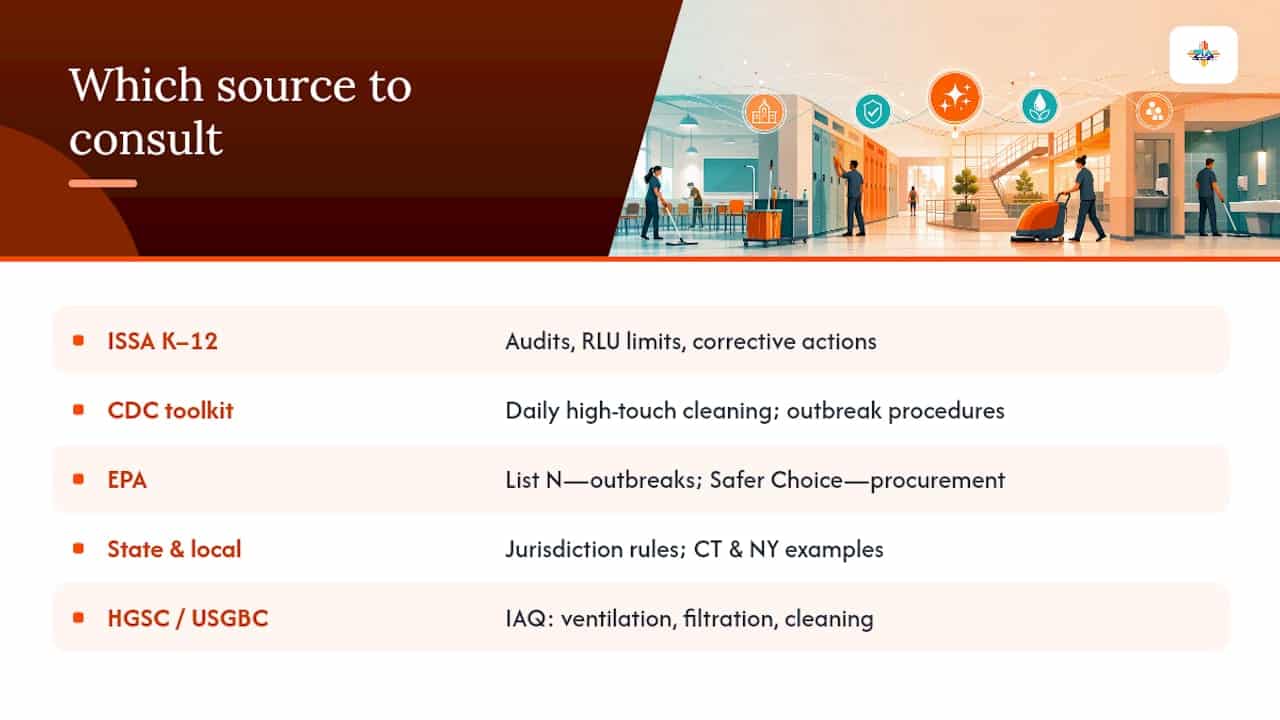
ISSA Clean Standard: K–12 is the most operationally specific framework available for U.S. schools. It pairs facility audits with ATP testing tables, device-specific RLU limits, corrective-action rules, and recordkeeping guidance. Critically, it does not mandate specific brands or products, so it works alongside any product certification program. Use it when drafting your audit protocol, setting pass/fail thresholds, and designing corrective-action workflows.
CDC cleaning and disinfection toolkit for schools ties cleaning decisions to infection control outcomes. It recommends cleaning high-touch surfaces at least daily, cleaning before disinfecting when surfaces are soiled, and reserving disinfection for situations where it is genuinely required. Use it when writing outbreak response procedures and when training staff on the difference between routine maintenance and targeted disinfection.
EPA List N and EPA Safer Choice serve two different purposes. List N identifies disinfectants approved against SARS-CoV-2 and is the reference to consult when a situation requires a registered disinfectant. EPA Safer Choice certifies products that meet environmental and health criteria for routine use. Use List N for outbreak and incident response; use Safer Choice (alongside Green Seal) for everyday product procurement.
State and local guidance adds a jurisdictional layer that federal standards do not cover. The Connecticut DPH handbook is one of the most detailed state-level resources available, providing three-tier microbe-control definitions and practical SOP language. New York’s green cleaning program collects procurement rules and sample policies specific to that state. Your own state health department and education agency will have equivalent resources, and their requirements take precedence over general federal guidance on procurement and product approval.
Healthy Green Schools & Colleges (HGSC) and USGBC IAQ toolkits address the intersection of cleaning and indoor air quality. The HGSC standard stresses documented SOPs, stakeholder engagement, and verified tracking systems. The USGBC/CFGS IAQ toolkit recommends integrating ventilation, filtration, and cleaning policies, including ASHRAE 62.1 ventilation targets and portable HEPA air cleaners where needed.
A few practical notes on state variance: some states mandate specific product lists or green cleaning laws (New York’s Education Law §409-I is one example). Others leave procurement entirely to the district. Always check with your state education agency and local health department before finalizing a product list or cleaning frequency schedule.
Cleaning, sanitizing, and disinfecting: what each one actually does
These three terms are not interchangeable, and using the wrong one in an SOP creates real risk, either from under-protecting students or from unnecessary chemical exposure.
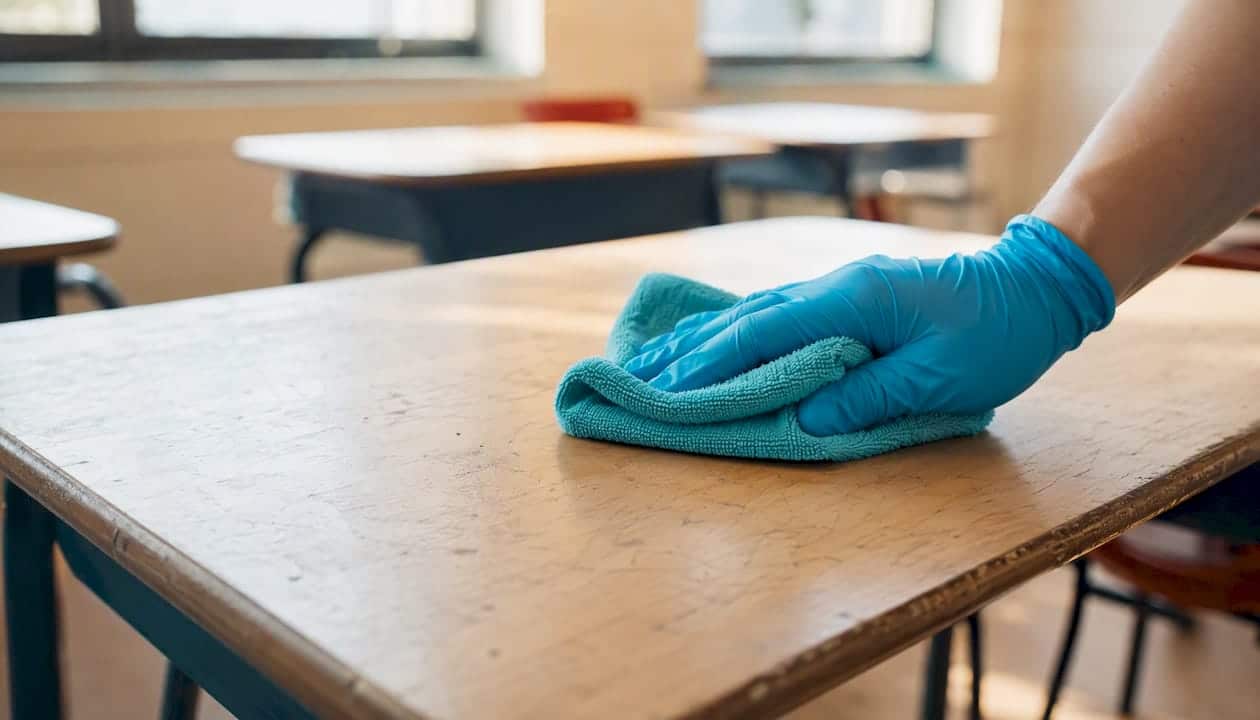
Cleaning means physically removing soil, organic matter, and microbes from a surface using detergent and mechanical action (scrubbing, wiping). It does not kill pathogens, but it removes most of them. The Connecticut DPH handbook notes that microfiber cloths and mops can remove a very high percentage of microbes on nonporous surfaces, making thorough cleaning the primary defense against disease transmission in most school settings.
Sanitizing reduces microbial counts on a surface to a level considered safe by public health standards. It is typically used on food-contact surfaces in cafeterias and requires a shorter contact time than disinfection. Sanitizers are EPA-registered but operate at lower concentration levels than disinfectants.
Disinfecting kills or inactivates a broader spectrum of pathogens on a surface. It requires a longer dwell time (contact time), proper PPE, adequate ventilation, and a pre-cleaned surface. The EPA registration number on the product label must match an entry on EPA List N when disinfection against SARS-CoV-2 is required.
| Method | Primary purpose | Common school use cases | Typical contact time | When to choose it |
|---|---|---|---|---|
| Cleaning | Remove soil and microbes physically | Classrooms, hallways, gym floors, electronics, carpets | N/A (mechanical action) | Daily maintenance; always first step before sanitizing or disinfecting |
| Sanitizing | Reduce microbial count to safe level | Cafeteria tables, food prep surfaces, lunch trays | 30 seconds (product-specific) | Food-contact surfaces; low-risk shared surfaces |
| Disinfecting | Kill or inactivate pathogens | Nurse’s office, restrooms, outbreak areas, blood spill sites | 1 minute (product-specific) | Confirmed illness, outbreak, or regulatory requirement |
Pro Tip: Reserve disinfectants for targeted, documented needs. Routine disinfection of every classroom surface every day increases chemical exposure for students and staff, degrades surfaces faster, and adds cost without a proportional health benefit. Microfiber plus a quality detergent handles the vast majority of daily cleaning needs.
The EPA’s guidance on chemicals in schools reinforces this: microfiber tools outperform cotton or basic synthetic cloths for microbe removal, and the agency explicitly recommends third-party-certified, low-VOC products to protect children, who are more sensitive to chemical exposures than adults.
Which school areas to prioritize and how often to clean them
Not every surface in a school carries the same infection risk or requires the same frequency. A ranked approach lets you allocate staff time where it matters most.
-
Nurse’s office and health suite. Clean and disinfect exam surfaces, cots, and door handles between each student use. This area carries the highest concentration of symptomatic individuals and warrants disinfection (not just cleaning) as a routine step, using an EPA List N product at the labeled contact time.
-
Restrooms. Clean and disinfect toilets, sinks, faucet handles, door handles, and dispensers at least once daily during the school day, with a second pass after peak use periods. High-traffic restrooms may need a midday check. Restroom floor care should be included in the daily schedule.
-
Cafeteria and serving lines. Sanitize food-contact surfaces (tables, serving counters) before and after each meal period. Sweep and mop floors after each meal. Deep-clean kitchen equipment weekly and conduct a thorough floor-and-drain cleaning monthly.
-
Classrooms, high-touch points. Door handles, light switches, shared equipment (keyboards, tablets, projector remotes), and pencil sharpeners should be cleaned daily. For electronics, use a slightly dampened microfiber cloth; avoid spray application directly on devices. Desk surfaces benefit from a daily wipe-down, particularly in lower grades.
-
Gymnasium and athletic equipment. Wipe down shared equipment (mats, weight machines, balls) after each use period. Mop gym floors daily. Deep-clean locker rooms daily, with a weekly scrub of shower areas and drains.
-
Buses and transportation vehicles. Clean high-touch surfaces (seat backs, handrails, windows) daily. A full interior cleaning should occur weekly, with a seasonal deep clean at the start and end of each school year. For guidance on planning those larger events, the seasonal deep cleaning guide for school buildings that offers a practical planning framework.
-
Common areas and hallways. Sweep or vacuum daily; mop or extract as needed based on foot traffic. Lockers and water fountain handles should be wiped down daily.
Weekly and monthly tasks include floor stripping and refinishing (as needed), carpet extraction, HVAC filter checks, vent cleaning, and window cleaning. HVAC and ventilation maintenance directly affects indoor air quality: the USGBC/CFGS IAQ toolkit recommends annual building inspections, adherence to ASHRAE 62.1 ventilation targets, and avoiding air-cleaning technologies that produce ozone as a byproduct.
For staffing planning, a general rule of thumb is that a single custodian can maintain approximately 18,000–22,000 square feet of school space on a daily cleaning schedule, though this varies significantly by building age, floor type, and task complexity.
How to measure whether your cleaning program is actually working
Visual inspection alone is not a reliable measure of cleanliness. A surface can look clean and still carry a significant microbial load. A credible monitoring program combines routine visual audits with periodic quantitative testing.
Start with visual audits. Conduct a structured walkthrough of each zone at least weekly, using a standardized checklist. The inspector should check for visible soil, odor, supply levels, equipment condition, and SDS binder completeness. Document the date, location, inspector name, findings, and any corrective actions required.
Add ATP testing for quantitative verification. ATP (adenosine triphosphate) meters measure biological residue on a surface by detecting the light emitted when ATP reacts with a reagent. The result is expressed in relative light units (RLUs). The ISSA Clean Standard: K–12 provides device-specific RLU limit tables for different surface types; pass/fail thresholds vary by meter brand, so always use the table matched to your specific device. ATP testing is most useful on high-touch surfaces and food-contact areas where visual inspection is insufficient.
Pros and cons of ATP meters:
- Pro: Provides an objective, quantifiable result that can be tracked over time and used to justify corrective action.
- Pro: Fast results (typically under 30 seconds per surface) allow real-time feedback to custodial staff.
- Con: ATP measures biological material broadly, not specific pathogens, so a high RLU reading does not confirm illness risk.
- Con: Meters and reagent cartridges represent an ongoing cost; without a corrective-action protocol, the data produces no improvement.
- Con: Results are only meaningful when compared against the device-specific RLU table, not a generic benchmark.
Data tracking fields to maintain in your audit log:
| Field | Purpose |
|---|---|
| Date and time | Establishes audit cadence and trend data |
| Location / zone | Identifies problem areas by room or surface type |
| Inspector name | Accountability and training follow-up |
| ATP RLU reading (if used) | Quantitative pass/fail against device-specific table |
| Visual pass/fail | Baseline check independent of ATP |
| Corrective action required | Specific task, product, or method change needed |
| Follow-up date and result | Confirms correction was made and effective |
The most common failure in audit programs is collecting data without acting on it. Without documented corrective steps and retraining tied to failed audits, the program only surfaces problems without producing sustained improvement.
How to write cleaning policies and SOPs your staff will actually follow
A workable SOP must state five things clearly: the expected outcome, the frequency, the method, the accountable person, and the verification method. Anything shorter than that leaves room for inconsistency; anything longer tends to go unread.
Minimal SOP template sections:
- Purpose: One sentence stating what the SOP achieves (e.g., “Maintain a visibly clean, low-microbial-load restroom environment throughout the school day”).
- Scope: Which rooms, surfaces, or events the SOP covers.
- Materials: Specific products (with EPA registration numbers where applicable), equipment, and PPE required.
- Steps: Numbered, sequential tasks with dwell times noted where relevant.
- PPE requirements: Gloves, eye protection, and ventilation requirements tied to specific products.
- Verification: How the task is confirmed complete (visual check, ATP reading, supervisor sign-off).
- Recordkeeping: Where the completed checklist is filed and how long records are retained.
The Healthy Green Schools & Colleges standard specifically calls for SOPs to be available in staff members’ preferred languages and for tracking systems (digital or paper) to verify that high-touch daily cleaning is actually performed. This is not a formality: programs that pair written SOPs with verification consistently outperform those that rely on verbal instruction alone.
Stakeholder approval checklist before publishing any SOP:
- Facilities director sign-off on method and materials
- School nurse or health coordinator review for infection-control alignment
- Administration approval for policy-level documents
- Union representative notification (where applicable) for workload or PPE changes
- Training confirmation for all affected custodial staff, with signed acknowledgment
Sample escalation language for administrators: “If an audit result falls below the established pass threshold on two consecutive inspections, the facilities supervisor will initiate a documented corrective-action review within 48 hours, including retraining of assigned staff, product or method adjustment, and a follow-up audit within five school days.”
Pro Tip: Keep the daily task checklist to one printed page. A two-sided laminated card posted in each custodial closet, with tasks listed in order and checkboxes for sign-off, produces better compliance than a multi-page binder that stays on a shelf.
For more on managing custodial teams effectively, the school janitorial staff management guide covers supervision methods and performance verification in practical detail.
Choosing safer cleaning products and managing chemical safety
Favor third-party-certified, low-VOC products for routine use and avoid routine reliance on high-hazard chemicals like bleach. Bleach is a respiratory irritant and asthmagen; many districts now prefer hydrogen peroxide, ethanol, lactic acid, or citric-acid-based products where performance and contact time requirements are met.
Certification logos and what they mean:
- Green Seal (GS-37 for cleaning products): Verifies low VOC content, biodegradability, and packaging standards. A reliable baseline for general-purpose school cleaners.
- EPA Safer Choice: Confirms that every ingredient meets EPA safety criteria for human health and environmental impact. Particularly relevant for products used in occupied spaces.
- UL Ecologo: Third-party certification covering performance, health, and environmental criteria; widely accepted in institutional procurement.
The EPA’s guidance on chemicals in schools recommends keeping powered cleaning equipment under approximately 70 dBA to limit noise disruption during school hours, a detail that often gets overlooked in equipment procurement.
Storage and PPE checklist:
- Store all cleaning chemicals in a locked cabinet inaccessible to students.
- Maintain a current SDS (Safety Data Sheet) binder for every product in use, accessible to all custodial staff.
- Never mix products unless the label explicitly permits it; mixing bleach with ammonia-based cleaners produces toxic chloramine gas.
- Use dilution-control dispensing systems to prevent over-concentration and reduce waste.
- Post PPE requirements (gloves, eye protection, ventilation) at the point of use for each product category.
- Conduct a quarterly product inventory to remove expired or discontinued items.
Pro Tip: Concentrates paired with a dilution-control system typically reduce per-use chemical cost, lower VOC exposure for staff, and cut plastic waste compared with ready-to-use products. The upfront cost of a wall-mounted dilution station is usually recovered within one school year for a mid-size building.
For a broader look at green product selection and indoor air quality practices, the guide to a clean school environment covers product criteria and IAQ considerations in accessible terms.
Staffing levels, training requirements, and competency verification
Staff levels should be set to achieve the defined cleaning cadences and audit targets, not the other way around. A common starting point is one FTE per 18,000–22,000 square feet for daily cleaning, adjusted upward for older buildings, high-traffic areas, or programs that include food service. For more detailed staffing models, the janitorial staffing models guide for schools provides FTE rules of thumb by building size and cadence requirements.
Mandatory training modules for all custodial staff:
- Chemical safety and SDS literacy. Staff must be able to read an SDS, identify hazard categories, and locate PPE requirements before handling any product.
- Infection control basics. Covers the difference between cleaning, sanitizing, and disinfecting; hand hygiene; and when to escalate to a supervisor or school nurse.
- Microfiber use and care. Proper folding, color-coding by zone, laundering temperature requirements, and replacement schedules.
- Equipment operation and maintenance. Safe use of floor machines, wet/dry vacuums, and any powered equipment; noise limits in occupied spaces.
- PPE selection and use. Correct glove type by chemical category, eye protection, and respiratory protection where required.
- Hand hygiene communication. Staff should be able to reinforce hand hygiene messaging with students and teachers as part of their daily interaction.
Language access is a compliance and equity issue, not just a courtesy. SDS documents must be available in the languages spoken by custodial staff, and training must be delivered in each staff member’s preferred language with signed acknowledgment of completion. The Healthy Green Schools & Colleges standard specifically requires this, and it aligns with OSHA Hazard Communication Standard requirements.
Competency verification schedule:
- Initial competency check within the first 30 days of employment.
- Annual refresher training for all modules, with updated content when products or procedures change.
- Immediate retraining triggered by any failed audit result tied to a specific task or product.
- Supervisor observation of at least one full cleaning cycle per staff member per semester.
The role of staff training in commercial cleaning provides additional module outlines and competency-verification approaches that translate directly to school settings.
Practical daily and weekly cleaning schedules you can use now
Daily classroom checklist (estimated time: 20–30 minutes per standard classroom):
- Empty and reline waste bins.
- Wipe down door handles, light switches, and shared equipment with a microfiber cloth and appropriate cleaner.
- Clean desk surfaces (wipe with damp microfiber; allow to air dry).
- Sweep or dust-mop hard floors; spot-clean spills.
- Vacuum carpeted areas.
- Check and restock hand sanitizer dispensers.
- Spot-clean interior windows and glass panels.
- Sign and date the classroom checklist posted inside the custodial supply area.
Daily restroom checklist (estimated time: 15–20 minutes per restroom):
- Clean and disinfect toilets and urinals, including handles and seats.
- Clean and disinfect sinks, faucet handles, and countertops.
- Wipe door handles and push plates.
- Mop floors with a disinfectant cleaner.
- Restock paper products and soap.
- Empty waste bins.
- Check for and report any maintenance issues (leaks, broken fixtures).
Weekly and monthly tasks:
- Weekly: Damp-wipe baseboards and door frames; clean interior glass; scrub restroom grout lines; inspect and clean floor drains.
- Monthly: Strip and refinish hard floors as needed; extract carpets in high-traffic areas; clean HVAC vents and diffusers; inspect and restock SDS binders.
- Seasonally: Full floor restoration, window washing (interior and exterior), deep-clean gymnasium and locker rooms, inspect and clean roof drains and exterior entries.
Post schedules in each custodial closet and share a summary version with classroom teachers so they understand when deep-cleaning tasks will affect their rooms. Digital tracking tools (a shared spreadsheet or a facility management app) reduce the administrative burden of paper logs and make audit data easier to aggregate. For programs just starting with digital tracking, a simple shared Google Sheet with the audit fields listed in the measurement section above is a practical first step.
How to handle outbreaks, spills, and special-event cleaning
When a confirmed illness, outbreak, or body-fluid spill occurs, the response must be faster, more targeted, and better documented than routine cleaning. The CDC toolkit is clear: clean before you disinfect, and only use EPA List N disinfectants when disinfection is actually required by the situation.
Outbreak response checklist:
- Isolate the affected area immediately; restrict student and staff access.
- Don appropriate PPE (gloves, eye protection, and mask as indicated by the product label and situation).
- Ventilate the space: open windows or increase HVAC airflow before and during cleaning.
- Clean all surfaces with detergent and water to remove visible soil and organic matter.
- Apply an EPA List N disinfectant at the labeled concentration; observe the full contact time before wiping.
- Dispose of used materials (gloves, cloths, mop heads) in a sealed plastic bag.
- Remove PPE carefully to avoid self-contamination; wash hands immediately.
- Document the incident: date, location, products used, contact time, staff involved, and supervisor sign-off.
- Notify the school nurse and, if required by your local health department, file an incident report.
Blood and body-fluid spill protocol:
- Contain the spill with absorbent material; do not spread it.
- Don gloves and eye protection before touching any contaminated material.
- Remove bulk material with disposable paper towels; seal in a biohazard bag.
- Clean the area with detergent and water.
- Disinfect with an EPA List N product at the labeled contact time.
- Dispose of all materials per your district’s regulated waste policy.
- Complete a spill log entry and notify the school nurse.
Contact list to keep posted in every custodial closet:
- School nurse (direct line)
- Facilities supervisor (cell and office)
- District health coordinator
- Local health department (non-emergency line)
- Poison Control (1-800-222-1222)
Special events (assemblies, sports tournaments, community use of facilities) require a pre-event walkthrough and a post-event deep clean. Schedule post-event cleaning within 12 hours of the event’s conclusion, and use the same priority-area ranking from the daily schedule as your starting point.
What to require from a professional janitorial provider
When contracting cleaning services for a school, the vendor’s program should be auditable, documented, and aligned with the same standards your internal team follows. Require the vendor to demonstrate an audit-based program, staff training records, SDS management, and use of third-party-certified products where requested.
Contract checklist for school cleaning services:
- Written audit protocol specifying frequency (at minimum monthly), method (visual plus ATP for high-touch zones), and reporting format.
- ATP or visual audit reports delivered to the facilities manager after each audit cycle, including location, date, inspector, RLU readings where applicable, and corrective actions taken.
- Minimum staffing levels stated in the contract, with a process for notifying the school when a substitution occurs.
- Proof of general liability and workers’ compensation insurance, current certificates on file.
- Training documentation for all assigned staff, including chemical safety, infection control, and microfiber use.
- SDS binder maintained on-site for all products used, accessible to school staff.
- Product list submitted for approval, with certification documentation (Green Seal, EPA Safer Choice) for each routine cleaning product.
- Escalation procedure: how the vendor notifies the school of a failed audit, what corrective action is taken, and the timeline for follow-up verification.
A vendor moving a school from visual-only checks to an audit-plus-corrective-action program typically follows this sequence: establish baseline ATP readings across priority zones, identify the highest-RLU areas, retrain assigned staff on technique and dwell time for those zones, adjust product or frequency where needed, and conduct a follow-up ATP audit within two weeks to confirm improvement. That cycle, documented and repeatable, is what separates a compliance-oriented program from a schedule-filling one.
For a detailed look at contract language that aligns with audit and training requirements, the school cleaning contract terms guide covers sample clauses and reporting expectations in practical terms.
What facilities managers get wrong about school cleaning programs
The most persistent mistake in K–12 cleaning programs is treating documentation as a bureaucratic add-on rather than the mechanism that makes the program work. Facilities managers who invest in SOPs, training records, and audit logs consistently see better outcomes than those who invest the same budget in products and equipment alone. The reason is straightforward: without verification, you cannot distinguish a well-cleaned room from one that only looks clean.
A second underappreciated issue is the gap between initial training and sustained performance. Staff who are trained once and then left to work independently tend to drift from the SOP within a few months, particularly on steps that are hard to observe, like dwell time for disinfectants or the correct folding technique for microfiber cloths. The programs that hold their audit scores over time are the ones that build in supervisor observation, periodic refresher training, and a clear corrective-action loop tied to audit data.
The third pitfall is over-reliance on disinfectants as a substitute for thorough cleaning. A disinfectant applied to a soiled surface is significantly less effective than the same product applied after proper cleaning, and the chemical exposure to students and staff is identical either way. The evidence increasingly points toward well-documented cleaning programs focused on mechanical removal with microfiber and detergent as the primary control, with disinfectants reserved for targeted, documented incidents.
Zia Building Maintenance delivers audit-ready school cleaning in Albuquerque
Schools that contract with Zia Building Maintenance get more than a cleaning schedule. They get a program built around the same ISSA, CDC, and EPA standards covered in this guide: written SOPs, trained staff, SDS-compliant product management, and audit reporting that gives administrators real visibility into cleaning performance.
Zia Building Maintenance has served schools, offices, and commercial facilities in Albuquerque since 1989, earning the title of the #1 office cleaning service in South Valley for 2025. For school administrators evaluating a vendor, here is a minimal checklist to apply: Does the provider submit a written audit protocol? Can they produce training records for assigned staff? Do their routine products carry Green Seal or EPA Safer Choice certification? Do they deliver written corrective-action reports after failed audits? Zia Building Maintenance meets each of these criteria and can provide sample SOPs and checklists during a facility walkthrough. To schedule that walkthrough or request a service estimate, visit the school cleaning services page and contact the team directly.
Sources
These are the primary documents to consult when drafting policy, selecting products, or designing an audit program.
- What does the Standard consist of? – ISSA | The Association for Cleaning & Facility Solutions
- Cleaning for Healthier Schools – Connecticut Department of Public Health
- Cleaning, disinfection, and hand hygiene in schools : a toolkit for school administrators
- List N: Disinfectants for Use Against SARS-CoV-2 | US EPA
- Healthy Green Schools & Colleges standard (Standard 9.22)
Always check your state health department and state education agency for jurisdiction-specific requirements that may supersede or supplement federal guidance.
This article is general information, not a substitute for advice from a qualified doctor. Consult a qualified healthcare professional about your own circumstances before acting on anything here.
FAQ
What are the main standards that govern school cleaning in the U.S.?
The three primary authorities are the ISSA Clean Standard: K–12 (audit and measurement framework), the CDC’s school cleaning and disinfection toolkit (situational and frequency guidance), and the EPA’s List N registry (approved disinfectants). State health departments and education agencies add jurisdiction-specific requirements on top of these.
What is the difference between cleaning, sanitizing, and disinfecting in a school?
Cleaning physically removes soil and most microbes using detergent and mechanical action. Sanitizing reduces microbial counts to a safe level on food-contact surfaces. Disinfecting kills or inactivates a broader range of pathogens and requires a longer contact time, proper PPE, and a pre-cleaned surface.
How often should high-touch surfaces be cleaned in schools?
CDC guidance recommends cleaning high-touch surfaces, including door handles, light switches, faucet handles, and shared equipment, at least once daily. The nurse’s office and restrooms warrant additional attention, with disinfection between uses in the health suite.
What should you look for in a school cleaning product?
Routine cleaning products should carry Green Seal or EPA Safer Choice certification, confirming low VOC content and verified safety for occupied spaces. Any disinfectant used must carry an EPA registration number that appears on EPA List N, and the product label must specify the required contact time and PPE.
What are the five basic principles of effective school cleaning?
A practical framework covers five principles: clean before disinfecting (remove soil first), prioritize high-touch and high-risk areas, use the right tool for the job (microfiber for routine cleaning, registered disinfectants for targeted incidents), verify outcomes through audits rather than assuming tasks were completed, and document everything including products used, staff trained, and corrective actions taken.