
A commercial vacuum system is the collection of commercial-grade vacuum machines, attachments, and structured cleaning processes that a professional janitorial service uses to maintain offices, medical facilities, schools, and other occupied commercial properties. It is not the same as a residential vacuum you’d find at a hardware store, and it is not an industrial dust-collection unit bolted to a factory floor. The distinction matters when you are writing an RFP or evaluating a cleaning contractor’s equipment list.
Residential vacuums are built for occasional use on small floor areas. Commercial vacuums are engineered for continuous daily operation, larger capacities, HEPA or sealed filtration, and modular parts that can be swapped out rather than replaced wholesale. Industrial vacuums go further still, handling hazardous dusts with self-cleaning filters and specialized certifications that janitorial work simply does not require. The difference between commercial and industrial models is significant enough that specifying the wrong category in a contract creates real compliance and performance gaps. The Carpet and Rug Institute Seal of Approval program is widely recognized as a U.S. standard for identifying vacuums that meet commercial carpet-care performance thresholds, and Zia Building Maintenance uses SOA-referenced equipment as part of its floor-care programs.
Key Takeaways
A commercial vacuum system is the commercial-grade equipment, attachments, and processes a janitorial provider uses to maintain occupied commercial spaces, and specifying it correctly in your RFP protects both carpet lifespan and occupant health.
| Point | Details |
|---|---|
| Definition | A commercial vacuum system covers machines, attachments, and processes used by janitorial services in offices, medical facilities, and schools. |
| Filtration standard | Require sealed HEPA filtration (99.97% at 0.3 microns) and CRI Seal of Approval for all carpeted areas. |
| Noise guideline | Specify less than 70 dB for any vacuum used during occupied hours to protect occupant productivity. |
| Maintenance and TCO | Modular commercial vacuums with replaceable parts lower total cost of ownership versus disposable residential-grade units. |
| Zia Building Maintenance | Zia Building Maintenance specifies HEPA-capable, low-noise equipment for Albuquerque offices, medical facilities, and schools since 1989. |
Table of Contents
- What a commercial vacuum system includes
- Which vacuum type fits your facility?
- Features you should require in every proposal
- How vacuuming fits into a full carpet-care program
- Maintenance, serviceability, and total cost of ownership
- Extractor vs. routine vacuum: when each is needed
- How to specify vacuum equipment when hiring a cleaning service
- Next steps after reading this guide
- A practitioner’s perspective on specifying vacuum fleets
- Zia Building Maintenance serves Albuquerque facilities with the right equipment
- Sources
- FAQ
What a commercial vacuum system includes
A working commercial vacuum setup is more than a single machine. Understanding the full scope helps you confirm what a contractor is actually bringing to your facility.
Core hardware:
- Upright vacuums — single-pass carpet cleaning for open office areas and corridors
- Canister vacuums — flexible hose-and-wand configurations for stairs, cubicle bases, and hard-to-reach areas
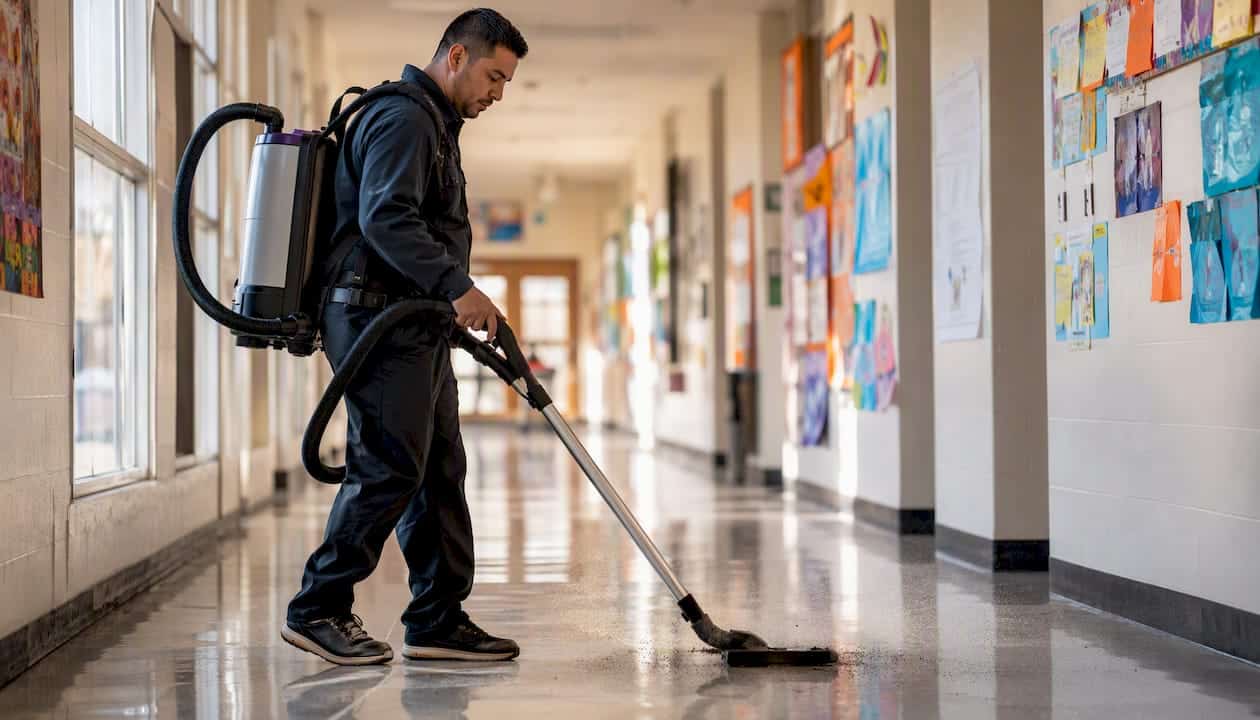
- Backpack vacuums — worn on the operator’s back for high-mobility daytime cleaning; preferred for occupied spaces
- Wide-area (walk-behind) vacuums — cover large open carpeted areas quickly, often 24–36 inches wide
- Wet/dry vacuums — handle liquid spills and debris in breakrooms, restrooms, and loading areas
- Extractors — inject cleaning solution and recover it under suction for deep carpet restoration (covered separately in Section 7)
Support components:
- Hoses, wands, crevice tools, upholstery attachments, and floor tools matched to surface type
- HEPA-sealed filter canisters or bags rated to capture nearly all particles around 0.3 microns
- Replacement bags, belts, and brush rolls kept in a documented inventory
- Batteries and chargers for cordless backpack fleets, with planned swap cycles to avoid incomplete shifts
- Equipment carts or storage closets with labeled slots for each unit
Site infrastructure:
Outlet placement, cord lengths (typically 50 feet on commercial models), and a dedicated storage area affect how efficiently a crew can work. Central vacuum systems — where in-wall inlets replace portable units — can reduce staff fatigue and improve speed in multi-story buildings like hotels or campuses, though they require a capital installation. This article focuses on portable commercial vacuum fleets, not stationary industrial dust collectors.
Pro Tip: Ask any prospective cleaning contractor to provide a written equipment inventory before the contract is signed. It should list make, model, filter class, and last service date for every machine assigned to your facility.
Which vacuum type fits your facility?
Matching the machine to the space is where many facilities go wrong. A backpack vacuum that works beautifully in a school hallway is the wrong tool for a 20,000-square-foot open-plan office floor.
| Type | Best for | Key spec priorities | Typical coverage |
|---|---|---|---|
| Upright | Carpeted offices, corridors | Brush agitation, bag capacity | Medium areas |
| Canister | Stairs, cubicles, hard floors | Hose length, sealed filtration | Detail work |
| Backpack | Daytime cleaning, occupied spaces | Noise (<70 dB), battery runtime | High-mobility routes |
| Wide-area | Large open carpeted floors | Path width (24–36 in.), motor duty cycle | Large open areas |
| Wet/dry | Breakrooms, restrooms, spills | Tank capacity, drain valve | Spot and zone work |
| Extractor | Deep carpet restoration | Solution tank, CFM, drying time | Scheduled deep cleans |
Daytime cleaning programs succeed when contractors pair battery-powered backpack units with HEPA filtration, keeping noise low enough that occupants stay productive. Cordless backpacks require disciplined battery-management protocols, including planned charging cycles, so crews don’t run out of power mid-shift. For healthcare settings, sealed canister units with HEPA exhaust are preferred because they prevent allergens and pathogens from re-entering the air. Spec thresholds like CFM, static lift, and sealed suction determine whether a vacuum handles the debris type and facility demand you actually have.
Features you should require in every proposal
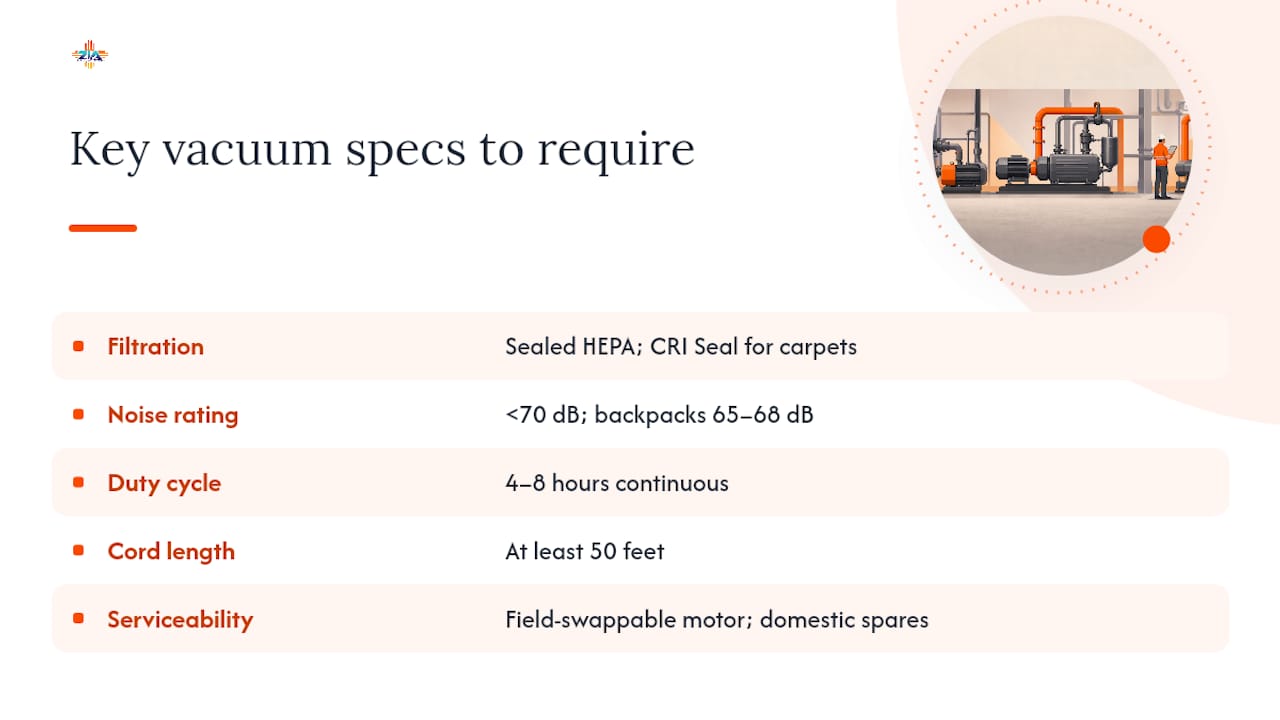
Filtration is the non-negotiable starting point. A sealed HEPA system captures the vast majority of particles around 0.3 microns, which is important in medical offices, schools, and other spaces where occupant health is a priority. Look for the CRI Seal of Approval on any vacuum specified for carpeted areas; it confirms the machine meets tested soil removal and dust containment standards.
Noise: Specify less than 70 dB for any cleaning performed during occupied hours. Many backpack models operate at 65–68 dB, which is quiet enough for open offices without disrupting calls or meetings. Requiring a noise rating in writing prevents contractors from substituting louder equipment after the contract is signed.
Modularity and serviceability: Commercial vacuums built with replaceable brushes, hoses, and motors cost less to maintain over time than disposable consumer-grade units. Ask for part numbers and confirm replacement parts are available domestically. A machine whose motor can be swapped in the field keeps your facility on schedule; one that requires a full-unit replacement creates service gaps.
Capacity and duty cycle: Tank or bag size should match the square footage being cleaned per shift. Motor duty cycle—the number of continuous operating hours before a cool-down is needed—should be rated for commercial use, generally in the 4–8 hour range, though always confirm the manufacturer’s specifications, as requirements may vary for certain applications. Cord length of at least 50 feet reduces outlet changes and speeds up coverage.
Pro Tip: Request energy-efficiency data (watts per square foot cleaned) alongside noise ratings. Energy Star-qualified commercial vacuums reduce operating costs and support sustainability reporting for LEED-certified buildings.
How vacuuming fits into a full carpet-care program
The CRI 204 Commercial Carpet Standard defines a three-level maintenance model that every facility manager should understand before writing a cleaning contract.
Level 1 — Routine vacuuming: Removes dry soil before it migrates deeper into carpet fibers. CRI guidance establishes that vacuuming removes the majority of dry soil from carpet, making frequency the single biggest lever in carpet lifespan. Use CRI SOA-approved vacuums at this level.
Level 2 — Interim maintenance: Techniques like counter-rotating brush (CRB) cleaning or encapsulation address soil that routine vacuuming misses. Scheduled quarterly or semi-annually depending on traffic.
Level 3 — Deep extraction: Hot-water extraction or low-moisture extraction for embedded soils and restorative cleaning. Covered in detail in the next section.
Frequency by area, based on industry survey data and office cleaning frequency guidance:
| Area | Traffic level | Recommended vacuuming frequency |
|---|---|---|
| Building entry / lobby | Very high | Daily |
| Main corridors | High | Daily |
| Conference rooms | Medium-high | 3–5 times per week |
| Private offices | Low-medium | 1–2 times per week |
| Storage / utility rooms | Low | Weekly or as needed |
Maintenance, serviceability, and total cost of ownership
Short-term price comparisons between cleaning contractors often ignore equipment quality, and that gap shows up in service disruptions and carpet replacement costs within two to three years.
- Filter replacement: HEPA filters typically require monthly inspections and should be replaced according to manufacturer schedules, often every 3–6 months with daily use. A clogged filter reduces suction and exhausts unfiltered air.
- Brush roll and belt checks: Inspect weekly; replace brush rolls when bristles are worn below the contact surface. Worn brushes reduce soil agitation and leave carpet looking flat.
- Motor cooling: Allow motors to cool between extended runs. Overheating is the leading cause of premature motor failure in commercial vacuums.
- Bag disposal: Seal bags before removal to prevent dust re-release. In healthcare settings, treat used bags as contaminated waste.
- Service contracts: Reputable contractors maintain documented service records for each machine. Request these records during vendor evaluation; a contractor who cannot produce them is likely running equipment past its service life.
Modular commercial vacuums with field-replaceable components extend service life well beyond consumer-grade units, lowering the per-square-foot cost of cleaning over a multi-year contract. Understanding how equipment choices affect contract pricing helps you evaluate bids more accurately than comparing hourly rates alone.
Extractor vs. routine vacuum: when each is needed
These are two distinct tools with different jobs. Confusing them leads to either under-cleaned carpets or unnecessary downtime.
A vacuum removes dry soil from carpet fibers through suction and brush agitation. It is fast, requires no drying time, and should happen on the frequency schedule above. A carpet extractor injects a cleaning solution into the carpet pile and recovers it under suction, lifting embedded soils, greasy residues, and stains that vacuuming cannot reach.
Schedule extraction when you see:
- Visible soiling or discoloration that vacuuming does not resolve
- Sticky or greasy residues (common near food-service areas or building entries)
- Carpet warranty requirements (most manufacturers specify periodic extraction)
- Post-event cleanup after high-traffic gatherings
Routine vacuuming handles:
- Daily dry soil removal in all traffic zones
- Maintenance between extraction cycles
- Spot debris pickup after meetings or deliveries
| Factor | Routine vacuum | Extractor |
|---|---|---|
| Drying time | None | 2–6 hours |
| Frequency | Daily to weekly | Quarterly to annually |
| Downtime | Minimal | Moderate (area closed) |
| Soil type | Dry, loose | Embedded, greasy, stained |
How to specify vacuum equipment when hiring a cleaning service
Getting the right equipment written into a contract requires asking the right questions before you sign.
Vendor question checklist:
- What is the filtration class of each vacuum assigned to this facility? (Require HEPA/CRI SOA documentation.)
- What are the noise ratings (dB) for each machine used during occupied hours?
- How does your team manage battery cycles for cordless units to avoid incomplete shifts?
- What is the lead time for replacement parts, and do you stock them locally?
- Do you carry a service contract or warranty for each machine? What does it cover?
- How are staff trained on filter replacement and equipment maintenance?
Red flags to watch for:
- Contractor arrives with residential-grade vacuums (no commercial duty cycle, no HEPA)
- Cannot provide part numbers, maintenance records, or filter replacement logs
- Lacks CRI SOA documentation or equivalent filtration certification
- Offers a single cleaning schedule for the whole facility rather than area-by-area cadence
- Vague answers about what happens when a machine breaks mid-contract
Sample contract language to request:
Include a clause specifying minimum motor duty cycle, filter replacement frequency (e.g., “HEPA filters should generally be replaced at intervals recommended by manufacturers, often around every 90 days.”), and noise limits for daytime cleaning. Align vendor training expectations with HVAC and facilities onboarding standards to confirm staff know how to operate and maintain the equipment they’re assigned.
Pro Tip: Require the contractor to submit a written equipment inventory — make, model, filter class, and last service date — as an exhibit to the contract. Review it at each contract renewal.
Next steps after reading this guide
You now have enough to move from understanding to procurement. Here is a short action list:
- Map your facility now: Walk each area and note floor type, traffic level, and any special requirements (healthcare, food service, daytime cleaning). This becomes the foundation of your RFP.
- Add CRI SOA and HEPA to your RFP spec: Write filtration class and noise rating as minimum requirements, not preferences.
- Request an equipment inventory from every bidder: Make it a required submission, not an optional attachment.
- Schedule a walkthrough with shortlisted vendors: Watch how they assess your space and whether their equipment recommendations match your floor map.
- Assign ownership: Designate one person on your facilities or property team to own the vacuum-spec checklist and track compliance after the contract starts.
For broader context on what separates great janitorial service from mediocre service, equipment quality is consistently one of the clearest differentiators.
A practitioner’s perspective on specifying vacuum fleets
A local janitorial service provider in Albuquerque has extensive experience serving offices, medical facilities, and schools since 1989., and the most consistent lesson from that experience is straightforward: the right vacuum for a facility is rarely the cheapest one on the contractor’s truck. When Zia Building Maintenance specifies equipment for daytime cleaning programs, the starting point is always noise and filtration together. A low-decibel backpack with a sealed HEPA system lets crews work during business hours without disrupting staff or compromising air quality. Modular maintenance matters just as much. Machines with field-replaceable parts stay in service longer, which means fewer gaps in your cleaning schedule and a lower cost per square foot over the life of the contract. That combination of occupant comfort, air quality protection, and equipment reliability is what Zia Building Maintenance brings to every facility it serves.
Zia Building Maintenance serves Albuquerque facilities with the right equipment
Facility managers in Albuquerque who want consistent, specification-grade floor care don’t have to piece together a vendor checklist from scratch. Zia Building Maintenance provides professional office cleaning services that include routine vacuuming with HEPA-capable equipment, deep extraction on scheduled cycles, and documented maintenance programs for offices, medical facilities, schools, and retail spaces. Every fleet is specified to match your facility’s traffic levels and daytime-cleaning requirements, with CRI-referenced filtration standards built in.
Request a site assessment and receive a written equipment inventory as part of your proposal. Contact Zia Building Maintenance to schedule a walkthrough and get a quote tailored to your facility’s floor plan and cleaning frequency needs.
Sources
- How to Implement Vacuums into Daytime Cleaning Schedules
- Commercial vs Industrial vacuums
- Commercial vacuum cleaners buying guide
- Commercial central vacuum system for council offices
- Comparing commercial and industrial vacuum cleaners — features and functionalities
FAQ
What is a commercial vacuum system in janitorial services?
A commercial vacuum system is the set of commercial-grade vacuum machines, attachments, and cleaning processes a professional janitorial service uses to maintain offices, schools, medical facilities, and other occupied commercial spaces. It differs from residential vacuums in duty cycle, filtration class, and modular serviceability.
What filtration standard should I require for commercial vacuums?
Require sealed HEPA filtration rated at 99.97% particle capture at 0.3 microns, and look for the CRI Seal of Approval on any vacuum used on carpeted surfaces. These two standards together confirm the machine protects indoor air quality and meets commercial carpet-care performance benchmarks.
How often should commercial carpets be vacuumed?
According to industry survey data and the CRI 204 standard, building entry/lobbies and main corridors (very high and high traffic) should be vacuumed daily, conference rooms (medium-high traffic) three to five times per week, private offices (low-medium traffic) one to two times per week, and storage or utility rooms (low traffic) weekly or as needed. Set frequency by traffic level rather than applying a single schedule to the whole facility.
When does a carpet need extraction instead of vacuuming?
Extraction is needed when visible soiling, sticky residues, or embedded soils are present that routine vacuuming cannot remove, or when carpet warranty terms require periodic deep cleaning. Extractors inject cleaning solution and recover it under suction, with a typical drying time of 2–6 hours.
How does Zia Building Maintenance approach commercial vacuum specifications?
Zia Building Maintenance specifies low-noise, HEPA-capable equipment for daytime cleaning programs in Albuquerque offices, medical facilities, and schools, with modular maintenance built into every service contract. The company has provided professional janitorial and floor-care services since 1989 and includes a written equipment inventory as part of its facility proposals.