

TL;DR:
- A retail store cleaning routine is a structured schedule that maintains hygiene, appearance, and safety for staff and shoppers. It involves daily tasks, periodic deep cleans, and reactive spot cleaning, tailored to store size and foot traffic. Implementing consistent cleaning practices enhances customer perception, staff morale, and regulatory compliance.
A retail store cleaning routine is a structured schedule of cleaning tasks designed to maintain hygiene, visual appeal, and a safe environment for customers and staff. In commercial facility management, this practice is formally called a janitorial maintenance program or commercial cleaning schedule. Both terms describe the same discipline: a repeatable, documented system that keeps your store spotless across every shift. A well-executed routine directly affects customer perception, employee morale, and your store’s compliance with health and safety standards. This guide breaks down how to build one that actually holds up under daily retail pressure.
What is a retail store cleaning routine and why does it matter?
A retail store cleaning routine is the operational backbone of store hygiene. Without a documented schedule, cleaning becomes reactive rather than preventive. Reactive cleaning means visible dirt, odors, and safety hazards accumulate before anyone addresses them.
Cleaning also shapes brand perception more directly than most managers realize. A customer who encounters a sticky POS terminal or a fitting room with debris on the floor forms an immediate judgment about your business. That judgment is hard to reverse. Consistent cleanliness signals professionalism and care, two qualities that drive repeat visits.
The standard retail cleaning schedule covers three tiers: daily maintenance, periodic deep cleaning, and reactive spot cleaning. Each tier serves a different purpose. Daily maintenance preserves appearance throughout operating hours. Periodic deep cleaning restores surfaces and prevents long-term wear. Reactive spot cleaning addresses spills, messes, and unexpected situations as they arise.
How should you schedule cleaning by store size and foot traffic?
Cleaning frequency is not one-size-fits-all. Store size and daily foot traffic are the two primary variables that determine how often each area needs attention and how many staff hours to allocate.
Stores over 1,000 square feet generally require nightly professional cleaning, while smaller boutiques under that threshold can manage with weekly professional visits plus daily staff upkeep. The presence of customer restrooms and hard floors increases the required frequency in any store, regardless of size.
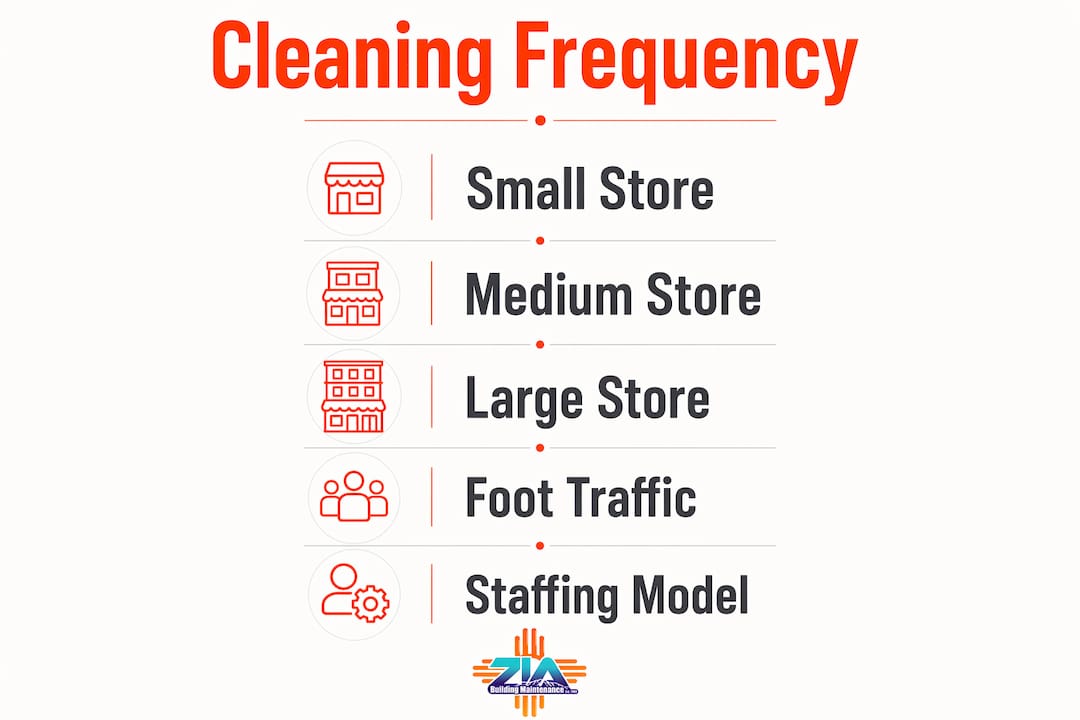
Professional cleaning contracts reflect this reality directly. Retail cleaning costs vary significantly by store size: boutiques under 5,000 sq ft run $1,200–$2,400 per month, mid-size stores of 5,000–15,000 sq ft run $2,800–$6,000 per month, and anchor stores over 15,000 sq ft run $7,000–$15,000 per month. Larger stores often require daily two-person crews, which drives that cost premium.
| Store Category | Square Footage | Recommended Cleaning Frequency | Staffing Model |
|---|---|---|---|
| Small boutique | Under 5,000 sq ft | Daily staff upkeep + weekly professional | 1 staff member per shift |
| Mid-size retail | 5,000–15,000 sq ft | Daily staff upkeep + nightly professional | Day porter + nightly crew |
| Large format/anchor | Over 15,000 sq ft | Multiple daily rounds + nightly professional | Day porter team + two-person nightly crew |
| High-traffic specialty | Any size, 500+ daily visitors | Continuous day porter + nightly professional | Dedicated day porter staff |
Labor allocation should prioritize high-traffic zones like entryways and checkout areas with disproportionate attention relative to total square footage. A 10,000 sq ft store does not need equal cleaning effort across all 10,000 sq ft. The checkout lane and entrance handle ten times the contact that the back stockroom does.
Pro Tip: Schedule a cleaning frequency audit every six months. Foot traffic patterns shift with seasons and promotions, and your cleaning schedule should shift with them.
What are the critical daily cleaning tasks in retail?
Daily cleaning in retail divides cleanly into three time blocks: opening, midday, and closing. Structuring tasks by shift ensures consistent appearance and prevents the visible midday decline that drives customer complaints.
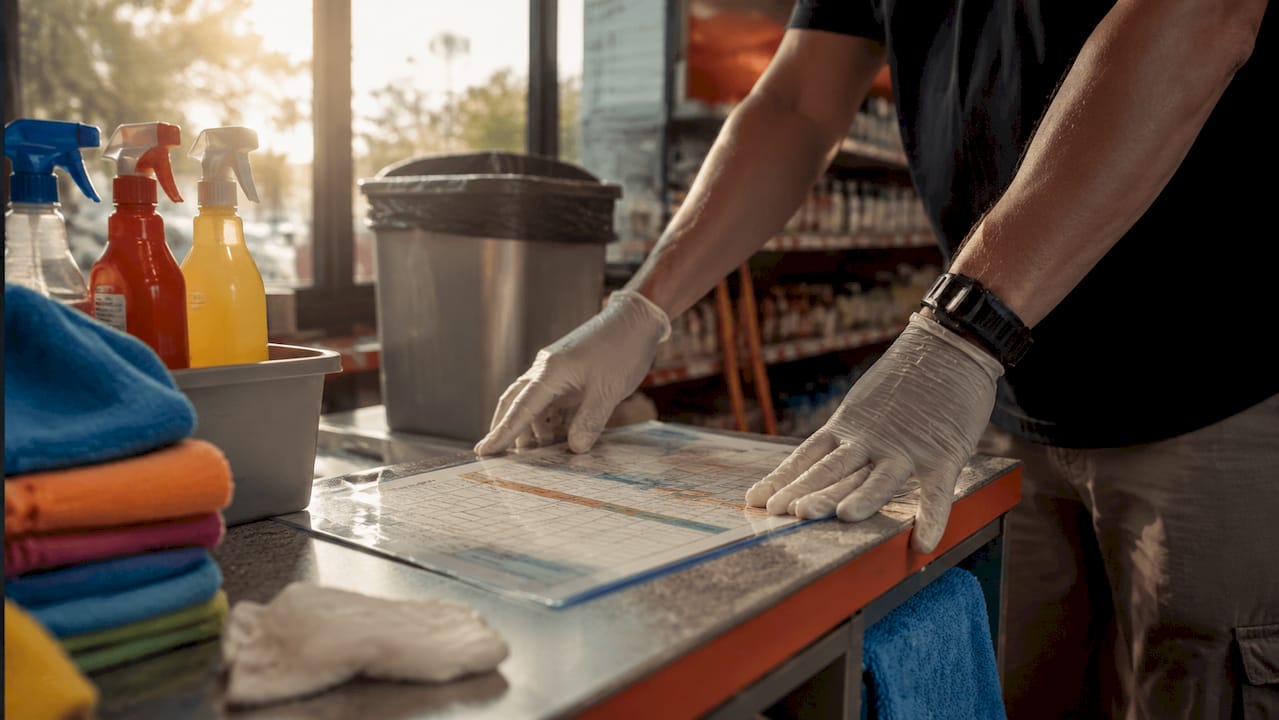
Opening cleaning focuses on a 15–20 minute presentation prep designed to create strong first impressions. This is not the time for deep scrubbing. Reserve that for evenings. Morning prep keeps staff energized and the store ready for the first customer.
High-touch points such as POS terminals and fitting room door handles require multiple daily sanitizations. A single morning wipe is not sufficient given how many hands contact these surfaces throughout the day. Sanitizing them at opening, midday, and closing is the minimum standard.
Daily cleaning task checklist:
- Opening: Sweep and mop entrance area, wipe down POS terminals and card readers, sanitize door handles and push plates, spot-clean display surfaces, check and restock restrooms
- Midday: Sanitize POS terminals and fitting room handles, spot-clean high-traffic floor areas, empty trash receptacles near checkout, wipe down any visibly soiled surfaces
- Closing: Full floor sweep and mop, deep sanitize all high-touch surfaces, clean fitting rooms thoroughly, sanitize restrooms, take out all trash, wipe down shelving and display fixtures
Pro Tip: Post a laminated daily task checklist at the staff station. Checklists reduce missed tasks by 40% compared to verbal instructions alone, and they create accountability without micromanagement.
How do periodic deep cleans sustain long-term store appearance?
Daily maintenance keeps a store presentable. Periodic deep cleaning keeps it structurally sound and visually sharp over months and years. These are two different goals that require two different approaches.
Floor care is the most critical periodic task in any retail environment. Floor cleaning methods vary by surface type and wear level. Hard floors require scrubbing, resealing, and burnishing on a rotating schedule. Carpet requires extraction cleaning to remove embedded debris that daily vacuuming misses. Using the wrong chemical on a hard floor finish accelerates wear and increases long-term maintenance costs.
Post-construction or renovation cleaning follows a specific timeline. Final post-construction cleaning should occur within 24–72 hours before store opening to deliver a dust-free, retail-ready space. Skipping this step or rushing it creates compliance risks and leaves a poor first impression on opening day. Professional post-construction cleanup is worth the investment for any new or renovated location.
| Cleaning Type | Frequency | Key Tasks | Notes |
|---|---|---|---|
| Floor scrub and recoat | Monthly | Strip, scrub, reseal hard floors | Use manufacturer-approved chemicals only |
| Carpet extraction | Quarterly | Hot water extraction, deodorize | More frequent in high-traffic zones |
| Window and glass cleaning | Weekly (interior), monthly (exterior) | Streak-free glass cleaner, squeegee | Exterior may require professional service |
| Restroom deep clean | Weekly | Grout scrubbing, fixture descaling, vent cleaning | Supplement daily maintenance |
| Back-of-house cleaning | Weekly | Stockroom floors, break room surfaces, loading dock | Often neglected; directly affects staff morale |
| HVAC vent and filter cleaning | Quarterly | Dust removal, filter replacement | Improves air quality and reduces allergens |
| Seasonal deep clean | Twice yearly | Full store reset, fixtures, walls, ceiling fans | Align with inventory resets or seasonal transitions |
Back-of-house areas deserve specific attention. Neglected stockrooms and break rooms negatively affect employee morale and retention. Staff who work in dirty back areas develop a lower standard for the sales floor as well. Clean back-of-house spaces reinforce a culture of cleanliness throughout the entire team.
What are the most common retail cleaning challenges?
Even well-designed cleaning programs run into consistent problems. Knowing the most common failure points helps you address them before they become visible to customers.
Overcleaning hard floors with improper chemicals causes faster finish wear. Undercleaning fitting rooms is equally common. Fitting rooms accumulate debris, discarded tags, and body contact residue faster than most managers account for. Neglected back-of-house areas compound the problem by lowering overall staff standards.
“The most overlooked cleaning failure in retail is not the sales floor. It’s the fitting room and the break room. Fix those two areas and your overall cleanliness score improves dramatically.” — Facility management best practice, Allied Facility Care
Day porter shifts during peak weekend hours are the most effective tool for maintaining restrooms and high-touch areas between deep cleans. A nightly cleaning crew cannot compensate for eight hours of unaddressed foot traffic on a Saturday. Day porters fill that gap in real time.
Retail managers can also benefit from reviewing commonly missed areas in daily disinfection routines. Light switches, cart handles, and interior glass panels near entrances are frequently skipped even in otherwise thorough programs.
Common challenges and solutions:
- Fitting room neglect: Assign a dedicated fitting room check every 90 minutes during operating hours
- Floor finish wear: Audit chemical products quarterly and confirm compatibility with your floor type
- Staff burnout: Separate opening prep (15–20 minutes) from deep cleaning tasks; do not assign both to the same shift
- Back-of-house decline: Include stockroom and break room in the weekly deep clean schedule, not just the sales floor
- Peak hour degradation: Schedule day porter coverage on Fridays, Saturdays, and any promotional event days
Key takeaways
A consistent retail store cleaning routine, structured by store size, foot traffic, and time-of-day task blocks, is the single most effective way to protect customer experience and store appearance.
| Point | Details |
|---|---|
| Structure by time blocks | Divide daily tasks into opening, midday, and closing rounds to prevent midday decline. |
| Match frequency to store size | Boutiques under 5,000 sq ft need weekly professional visits; larger stores need nightly crews. |
| Prioritize high-touch surfaces | POS terminals and fitting room handles require sanitization at least three times daily. |
| Schedule periodic deep cleans | Floor extraction, restroom deep cleaning, and back-of-house resets prevent long-term wear. |
| Use day porters during peak hours | Day porter shifts on weekends maintain standards that nightly crews alone cannot sustain. |
What i’ve learned after years of retail cleaning programs
The conventional advice on retail cleaning focuses almost entirely on the sales floor. That focus is understandable but incomplete. In my experience working with retail clients, the stores that struggle most with cleanliness are not neglecting their floors. They are neglecting their fitting rooms, their restrooms during peak hours, and their back-of-house areas.
The fitting room is where customers make their final purchase decision. A dirty fitting room communicates that the store does not care about the customer experience at the most critical moment. That is a costly message to send.
The other pattern I see consistently is the mismatch between opening prep and deep cleaning expectations. Managers often assign both tasks to the same morning staff. That creates burnout fast and results in neither task being done well. The difference between quick presentation prep and comprehensive evening cleaning is not just a scheduling detail. It is a staffing philosophy that determines whether your program is sustainable.
My honest recommendation: build your cleaning program around your three highest-risk areas first. For most retail stores, those are the entrance, the fitting rooms, and the restrooms. Get those right on a consistent basis, and the rest of the program falls into place more naturally.
— Ashley
How Zia Building Maintenance supports your cleaning program
Retail managers who try to handle all cleaning in-house often find that periodic deep cleans get delayed or skipped when operations get busy. That gap is exactly where professional janitorial services deliver the most value.
Zia Building Maintenance has served commercial clients in Albuquerque since 1989, providing tailored janitorial programs for retail spaces, offices, and medical facilities. Their approach covers everything from nightly maintenance to intensive floor care, with schedules built around your store’s specific size, traffic patterns, and operational hours. Professional janitorial services reduce labor costs, improve consistency, and free your staff to focus on customers rather than cleaning tasks. If you want a cleaning program that holds up under real retail conditions, Zia Building Maintenance is ready to build one with you. Request an estimate today.
FAQ
What is a retail store cleaning routine?
A retail store cleaning routine is a documented schedule of janitorial tasks divided into daily, periodic, and reactive categories. It covers everything from opening presentation prep to nightly deep cleaning and quarterly floor maintenance.
How often should retail stores be professionally cleaned?
Stores over 5,000 sq ft require nightly professional cleaning, while smaller boutiques can manage with weekly professional visits plus daily staff upkeep. The presence of customer restrooms increases required frequency for any store size.
What are the highest-priority areas in a daily retail cleaning checklist?
POS terminals, fitting room handles, entrance door hardware, and customer restrooms are the highest-priority areas. These high-touch surfaces require sanitization at opening, midday, and closing at minimum.
What is the difference between daily cleaning and deep cleaning in retail?
Daily cleaning maintains appearance and hygiene throughout operating hours. Deep cleaning restores surfaces, removes embedded debris, and addresses areas like grout, floor finish, and HVAC vents on a weekly, monthly, or quarterly schedule.
How do day porters fit into a retail cleaning schedule?
Day porters handle real-time cleaning during operating hours, particularly during peak traffic periods on weekends and promotional events. They complement nightly crews by maintaining restrooms and high-touch areas throughout the day.