

TL;DR:
- Healthcare janitorial training must meet federal, state, and accreditation standards by ensuring staff are proficient in infection control, chemical safety, and pathogen-specific protocols. Regular hands-on evaluations, documentation, and updates whenever protocols change are essential to maintain compliance and pass surveys. Investing in certified programs and conducting frequent staff knowledge assessments enhance overall readiness and quality of healthcare cleaning.
Janitorial training requirements for healthcare are defined as the mandatory and recommended education, certification, and competency verification standards that environmental services (EVS) staff must meet to safely clean and disinfect clinical environments. Three regulatory bodies govern this space: OSHA (Occupational Safety and Health Administration), the Joint Commission, and the CDC’s Healthcare Infection Control Practices Advisory Committee (HICPAC). Together, they require training on bloodborne pathogens, infection control, chemical safety, and isolation protocols. Facilities that treat these requirements as a checkbox exercise face serious accreditation risk. The ones that build genuine staff competency pass surveys and protect patients.
1. janitorial training requirements for healthcare: federal mandates first
OSHA’s Bloodborne Pathogens Standard (29 CFR 1910.1030) is the federal baseline every healthcare facility must meet. It requires training at the time of hire and at least once every 12 months after that. The content must cover epidemiology, transmission modes, personal protective equipment (PPE) use, and post-exposure protocols. Critically, pure video-only training fails OSHA standards because the standard requires interactive question-and-answer sessions. That means a passive online module does not satisfy the requirement on its own.
Record retention is equally non-negotiable. Training records must be kept onsite for a minimum of three years and must include employee names, dates, and detailed attendance information. OSHA inspectors can request these records at any time.
The Joint Commission adds another layer. Surveyors conduct direct staff interviews to verify knowledge of product contact times and isolation protocols. Signed training records alone are insufficient. A staff member who cannot verbally explain why a disinfectant requires a two-minute contact time is a compliance liability, regardless of what their training file says.
Pro Tip: Run a brief verbal quiz with your EVS team before any scheduled accreditation survey. Ask them to name the contact time for your primary disinfectant and describe the steps for cleaning an isolation room. If they hesitate, your documentation is ahead of your actual compliance.
2. CDC HICPAC training cadence and documentation standards
CDC HICPAC defines when training must occur, not just what it must cover. Healthcare EVS programs require training upon hire, annually, and whenever cleaning protocols change. That third trigger is the one most facilities miss. When your facility switches disinfectant products or updates its C. difficile (Clostridioides difficile) cleaning protocol, that change requires a documented retraining event.
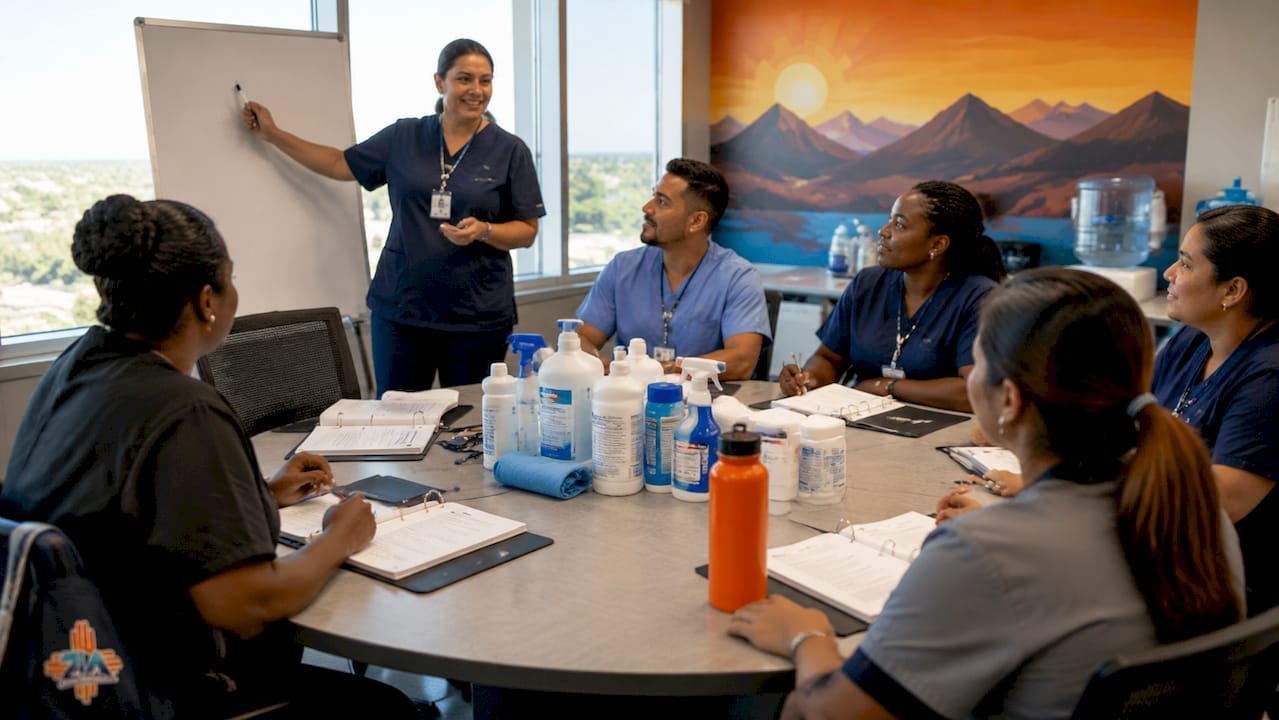
Written cleaning schedules are also a HICPAC and Joint Commission requirement. Cleaning schedules must define frequency, method, responsible staff, and specialized procedures for high-touch surfaces and specific pathogens. These documents serve as the backbone of any accreditation audit. Without them, even a well-trained team cannot demonstrate a defensible compliance program.
Administrators should treat the “protocol change” trigger as a standing agenda item in EVS management meetings. Any product substitution, new pathogen alert, or updated SOP should automatically generate a retraining record. This practice protects you during surveys and builds a culture where staff expect to be kept current.
3. healthcare janitorial certification programs worth pursuing
Beyond federal minimums, several certification programs raise the standard of competency for EVS staff. The most recognized is the ISSA Healthcare Environmental Hygiene Professional (HEHP) certification. It offers three-tiered credentialing with classroom instruction, hands-on practicums, and ongoing performance measurement. This program is designed specifically for hospital environmental services teams, not general janitorial workers.
Other programs worth considering include:
- OSHAcademy online courses covering bloodborne pathogens, hazard communication, and healthcare-specific safety standards.
- CloroxPro infection control training, which covers EPA-registered disinfectant use, contact times, and pathogen-specific protocols.
- P&G Professional training modules focused on surface disinfection and cleaning product science in clinical settings.
Each of these programs provides documented completion records, which support your training files during audits. Hands-on practicums are particularly valuable because they close the gap between knowing a protocol and executing it correctly under real conditions. Modern healthcare EVS training integrates competency validation and continuous improvement measures, not just course completion.
Pro Tip: If your EVS team includes staff whose primary language is not English, prioritize programs that offer multilingual delivery. 50% of healthcare EVS staff were born outside the United States. Training delivered only in English creates comprehension gaps that show up during surveyor interviews.
4. ongoing compliance: how facilities verify competency over time
Training completion is a starting point, not a destination. Facilities that maintain strong compliance use three verification methods consistently: ATP (adenosine triphosphate) testing, direct observation audits, and corrective action loops. ATP testing and corrective action loops integrated with training updates move a program from written SOP documentation to defensible, measurable compliance.
The table below compares in-house EVS staff and contracted janitorial vendors across key compliance dimensions.
| Compliance Factor | In-House EVS Staff | Contracted Janitorial Vendors |
|---|---|---|
| OSHA training responsibility | Facility-owned and documented | Must be specified in the contract |
| Joint Commission survey exposure | Direct; staff are interviewed | Contractors may be interviewed too |
| Training record access | Centralized in HR or EVS files | Vendor holds records; facility must request |
| Protocol change retraining | Managed internally | Requires contract clause and notification process |
| Multilingual training delivery | Facility controls the program | Vendor must confirm capability in writing |
Contractor training compliance varies by the exposure risk of the assigned unit, not by generic learning management system (LMS) assignments. A contractor cleaning an oncology ward faces different training requirements than one servicing administrative offices. Your contract must reflect that distinction explicitly.
5. critical cleaning protocols every EVS staff member must know
Healthcare janitorial certification and training programs are only as good as the protocols they teach. Staff must be trained on pathogen-specific procedures, not just general cleaning techniques. The following protocols are non-negotiable in any clinical environment:
- C. difficile: Requires EPA-registered sporicidal disinfectants. Standard quaternary ammonium products do not kill C. diff spores. Staff must know which products on your approved list are sporicidal and what the required contact time is.
- Candida auris: This emerging fungal pathogen requires specific EPA List P disinfectants. Many facilities added C. auris protocols after 2022 outbreaks, and staff must be retrained whenever the approved product list changes.
- Norovirus: Requires a minimum 1,000 ppm sodium hypochlorite solution or an EPA List G disinfectant. Contact time and surface coverage are critical.
- MDROs (multidrug-resistant organisms): Includes MRSA (methicillin-resistant Staphylococcus aureus) and VRE (vancomycin-resistant Enterococcus). Isolation room terminal cleaning procedures must be documented and practiced, not just described in a binder.
- Isolation-specific protocols: Staff must understand the difference between contact, droplet, and airborne precautions and how cleaning procedures change for each.
Written cleaning schedules and pathogen-specific protocols are mandatory under CDC HICPAC guidance. Posting laminated protocol cards in supply closets is a practical reinforcement tool that supports recall during actual cleaning tasks.
6. compliance challenges healthcare administrators face
The most common misconception in managing staff training for healthcare sanitization is that HIPAA (Health Insurance Portability and Accountability Act) does not apply to janitorial staff. It does. Healthcare cleaning staff with routine access to protected health information (PHI) must receive documented HIPAA security awareness training annually. Janitorial vendors operating under a Business Associate Agreement carry specific workforce training and audit obligations. Many facilities discover this gap only during an audit.
“Relying on training records without verifying actual knowledge is the single most common compliance failure we see during accreditation preparation. A signed form proves attendance. It does not prove understanding.”
Multilingual workforce management is the second major challenge. When training is delivered only in English to a team where a significant portion of staff speak Spanish, Somali, or another primary language, comprehension gaps are predictable. Those gaps become visible when a Joint Commission surveyor asks a frontline worker to explain an isolation protocol in plain terms.
Contract clarity is the third challenge. When you outsource janitorial services, the training obligation does not transfer automatically. Your contract must specify which training programs the vendor must deliver, how records are maintained, and what happens when a protocol changes. Facilities that onboard janitorial services with clear written expectations avoid the compliance gaps that generic vendor agreements create.
Key takeaways
Effective healthcare janitorial training requires OSHA compliance, Joint Commission-ready staff knowledge, pathogen-specific protocols, and documented verification, not just completed training records.
| Point | Details |
|---|---|
| OSHA training is the federal baseline | Deliver bloodborne pathogens training at hire and annually; retain records for three years onsite. |
| Joint Commission tests knowledge verbally | Staff must explain contact times and isolation protocols out loud, not just sign a training form. |
| CDC HICPAC defines three training triggers | Train upon hire, annually, and every time a protocol or product changes. |
| Certifications raise competency beyond minimums | ISSA HEHP and programs like CloroxPro and OSHAcademy build verified, practical skills. |
| Contractor training must be contractually specified | Assign training obligations by unit exposure risk, not generic LMS completion. |
What i’ve learned about training quality vs. training volume
I have reviewed a lot of EVS training programs over the years, and the pattern is consistent. Facilities with thick training binders and weak survey outcomes share one trait: they measure training by volume, not by retention. They track hours completed and modules assigned. They do not track whether a staff member can walk into an isolation room and execute the correct protocol without prompting.
The Joint Commission’s shift toward direct staff interviews changed the game. Surveyors now ask frontline workers specific questions. “What disinfectant do you use in this room?” “How long do you wait before wiping it off?” “What do you do differently when a patient is on contact precautions?” These are not trick questions. They are the minimum standard. But they expose facilities that treated training as a paperwork exercise.
My honest recommendation to any healthcare facility administrator is this: run mock surveys quarterly. Pull three EVS staff members at random and ask them the questions a surveyor would ask. Score their answers. Use the gaps to drive your next training cycle. This approach is more predictive of your actual compliance posture than any LMS completion report. It also builds staff confidence, because workers who are regularly asked to demonstrate their knowledge perform better under real survey conditions. Pair that practice with OSHA and HIPAA compliance reviews and you have a program that holds up under scrutiny.
— Ashley
How Zia Building Maintenance supports healthcare cleaning compliance
Zia Building Maintenance has served medical facilities in Albuquerque since 1989, and healthcare cleaning compliance is built into every service program. The team trains on pathogen-specific protocols, EPA-registered disinfectant use, and area-specific cleaning standards that align with OSHA, Joint Commission, and CDC HICPAC requirements. Every staff member assigned to a medical facility understands contact times, isolation procedures, and documentation expectations before they set foot in a clinical space. If your facility needs a cleaning partner that arrives ready to meet your healthcare cleaning standards without a lengthy onboarding gap, Zia Building Maintenance is ready to help. Contact the team today to discuss a customized plan for your facility through their professional cleaning services page.
FAQ
What does OSHA require for healthcare janitorial training?
OSHA requires bloodborne pathogens training at hire and annually, with interactive Q&A components and records retained for three years. Pure video-only training does not satisfy the standard.
Does HIPAA apply to janitorial staff in healthcare facilities?
Yes. Janitorial staff with routine access to PHI must receive documented HIPAA security awareness training annually under the Business Associate framework.
How often must healthcare EVS staff be retrained?
CDC HICPAC requires training upon hire, annually, and whenever cleaning protocols or products change. Protocol changes are a mandatory retraining trigger that many facilities overlook.
What is the ISSA HEHP certification?
The ISSA Healthcare Environmental Hygiene Professional (HEHP) certification is a three-tiered credentialing program with classroom instruction, hands-on practicums, and performance measurement designed for hospital EVS teams.
How do joint commission surveyors evaluate janitorial staff training?
Surveyors conduct direct verbal interviews with frontline EVS staff, asking about disinfectant contact times and isolation protocols. Signed training records are reviewed but do not substitute for demonstrated staff knowledge.