

TL;DR:
- Common office cleaning mistakes include neglecting high-touch surfaces, failing to observe disinfectant dwell times, and using incorrect products on sensitive surfaces. These errors increase contamination risks, damage office assets, and lead to higher employee sick days. Implementing zone-specific protocols and proper product use can significantly improve workplace sanitation and asset longevity.
Common office cleaning mistakes are defined as recurring errors in workplace sanitation protocols that leave surfaces contaminated, damage office assets, and drive up employee sick days. These mistakes range from ignoring high-touch surfaces like door handles and light switches to misusing cleaning products on sensitive equipment. The consequences are real: inconsistent sanitation leads directly to higher absenteeism and reduced productivity. This article identifies the most damaging office hygiene errors, explains why each one persists, and gives you the practical knowledge to fix them before they cost you more.
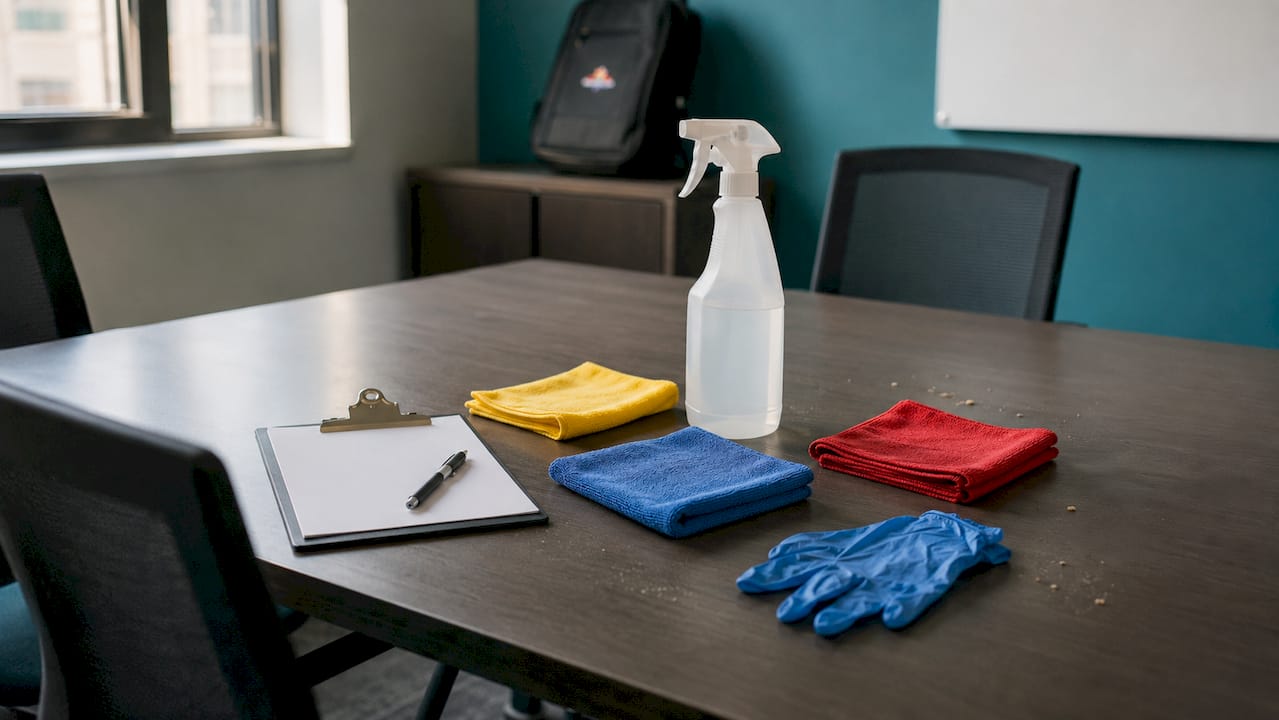
1. common office cleaning mistakes: neglecting high-touch surfaces
High-touch surfaces are the primary transmission points for pathogens in any shared workspace. Door handles, elevator buttons, light switches, shared keyboards, and conference room phones collect bacteria and viruses throughout the day. Most standard cleaning routines focus on desks and floors while these surfaces go untouched for days at a time.
Relying on office staff for cleaning shared spaces results in inconsistent sanitation and missed high-touch surfaces. Informal cleaning arrangements lead to higher employee sick days and lost productivity. A dedicated protocol that specifically lists every high-touch point by room is the only reliable fix.
Pro Tip: Use a printed or digital checklist that names every high-touch surface in each room. Review it weekly and update it when office layouts change.
2. ignoring disinfectant dwell time
Dwell time is the amount of time a disinfectant must remain wet on a surface to kill pathogens effectively. Most office cleaners spray a surface and wipe it dry within seconds. That practice renders the disinfectant nearly useless.
Failure to observe disinfectant dwell times negates chemical effectiveness entirely. This means a surface can look clean while still harboring active bacteria and viruses. EPA-approved disinfectants typically require a dwell time of 30 seconds to 10 minutes depending on the product. Always read the label and train your cleaning staff to time their wipe-downs accordingly.
3. using the wrong cleaning products on office surfaces
Using all-purpose cleaners on sensitive surfaces causes permanent damage such as coating erosion or stone etching. This is one of the most costly mistakes in office sanitation because the damage is often irreversible. Granite countertops, laptop screens, and powder-coated metal finishes all require surface-specific products.
The table below shows common office materials and the correct product approach for each:
| Office Surface | Wrong Product | Correct Product Type |
|---|---|---|
| Laptop and monitor screens | All-purpose spray cleaner | Alcohol-free screen wipe |
| Granite or stone countertops | Vinegar-based cleaner | pH-neutral stone cleaner |
| Powder-coated metal surfaces | Bleach-based solution | Mild soap and water |
| Upholstered chairs | Wet mop or steam | Dry foam upholstery cleaner |
| Hardwood floors | Ammonia-based cleaner | Hardwood-specific floor cleaner |
Proper surface care and product selection safeguard office assets and reduce long-term replacement costs. Training your cleaning team on surface-specific products is not optional. It is the difference between a maintained office and one that deteriorates quietly over time.
4. spreading germs through cross-contamination
Cross-contamination during cleaning arises from using the same cloth across kitchen surfaces, workstations, and restroom fixtures. Wiping surfaces dry too soon or cross-using cloths transfers germs from one zone to another rather than removing them. This is a systemic error that turns a cleaning routine into a pathogen distribution system.
Color-coded microfiber cloth systems are the industry standard solution. Assign red cloths to restrooms, blue to workstations, green to breakrooms, and yellow to glass surfaces. This single change eliminates most cross-contamination risk without requiring additional products or time.
Pro Tip: Post a color-code chart in your supply closet and include it in onboarding for any new cleaning staff or contractors.
5. treating all office zones the same way
Treating office cleaning as a uniform task rather than a risk-based process leads to neglected high-frequency zones and wasted resources. The reception area, breakroom, and server room each carry different contamination risks and require different cleaning schedules and methods. Applying the same routine to every zone means high-risk areas are under-cleaned and low-risk areas consume time they do not need.
Risk-based protocols tailored for office zones are the standard approach in professional facility management. Reception areas and restrooms need daily attention. Private offices and storage rooms may only need weekly service. Building your schedule around zone risk levels produces better sanitation outcomes with the same labor budget.
6. overlooked areas: server rooms, cables, and breakroom appliances
Some of the most contaminated zones in any office are the ones that never appear on a standard cleaning checklist. Hidden dust traps in server rooms and under-desk cables impact air quality and equipment health. Neglected dust reduces equipment lifespan and increases airborne allergens that affect staff respiratory health.
Breakroom appliances are another overlooked reservoir. Microwave interiors, refrigerator handles, coffee machine drip trays, and toaster crumb trays accumulate organic buildup that breeds bacteria. These surfaces require weekly cleaning at minimum. For a detailed breakdown of which surfaces get missed most often, the guide on missed disinfection areas covers the full list by zone.
The table below shows contamination risk levels by office zone based on usage patterns:
| Office Zone | Contamination Risk | Recommended Frequency |
|---|---|---|
| Restrooms | Very High | Daily |
| Breakroom surfaces and appliances | High | Daily to 3x weekly |
| Reception and entry areas | High | Daily |
| Open-plan workstations | Medium | 3x weekly |
| Private offices | Low to Medium | Weekly |
| Server rooms and cable areas | Medium (dust/allergens) | Monthly deep clean |
Pro Tip: Add server rooms and under-desk cable areas to your monthly deep-cleaning schedule. Assign a specific staff member to these zones so accountability is clear.
7. masking restroom odors instead of eliminating them
Restroom odor is a common complaint in office buildings, and the standard response is to add an air freshener. That approach treats the symptom while the cause continues to grow. Restroom odors require addressing root organic buildup in grout lines, drain seals, and fixture bases rather than masking them with fragrances.
Enzymatic cleaners break down organic matter at the source and are the correct product for grout lines and floor drains. Air fresheners only layer scent over the problem. Offices that switch to enzymatic treatments for restroom floors report a measurable reduction in persistent odor within two to three weeks.
8. inconsistent cleaning schedules and reactive-only cleaning
Cleaning only when dirt becomes visible is one of the most common office hygiene errors. By the time a surface looks dirty, it has already been a contamination risk for hours or days. Reactive cleaning protects appearance but not health.
Professional cleaning frequency standards for offices with 10 or more employees recommend 3 to 5 cleanings weekly of high-traffic areas. Daily cleaning should focus on restrooms and high-touch surfaces, with deep cleaning scheduled monthly or quarterly. For offices trying to build the right schedule, the cleaning frequency manager’s guide provides a practical framework by office size and zone type.
Customized cleaning frequencies by zone, employee count, and usage patterns optimize both resource use and sanitation outcomes. A 20-person office with a shared breakroom has different needs than a 100-person open-plan floor. Build your schedule around actual usage data, not assumptions.
Pro Tip: Track sick day patterns by month. A spike in absences often correlates with gaps in your cleaning schedule and gives you data to justify a more frequent service.
9. relying on staff to handle office cleaning
Assigning cleaning duties to office employees is a cost-saving measure that consistently backfires. Staff clean inconsistently, skip high-touch surfaces, and rarely follow disinfection protocols. The result is a workspace that appears maintained but carries ongoing sanitation risks.
Informal cleaning leads to higher employee sick days and measurable lost productivity. Professional cleaning services bring trained staff, standardized protocols, and accountability systems that informal arrangements cannot replicate. For offices evaluating their options, understanding the difference between cleaning and janitorial services helps clarify which level of service your facility actually needs.
Key takeaways
Avoiding common office cleaning mistakes requires zone-specific protocols, correct product selection, and consistent scheduling rather than reactive or informal cleaning.
| Point | Details |
|---|---|
| Dwell time is non-negotiable | Always allow EPA-approved disinfectants to remain wet for the full contact time before wiping. |
| Zone-based scheduling beats uniform routines | Assign cleaning frequency by contamination risk, not by convenience or appearance. |
| Product mismatch causes asset damage | Use surface-specific products on screens, stone, and coated metals to prevent permanent erosion. |
| Cross-contamination requires a system fix | Color-coded microfiber cloths by zone eliminate most germ transfer during routine cleaning. |
| Professional service outperforms staff cleaning | Trained cleaners with standardized protocols reduce sick days and protect office assets consistently. |
What i’ve learned after years of watching offices get this wrong
After working in commercial cleaning for a long time, the pattern I see most often is not ignorance. It is overconfidence. Office managers assume their current routine is working because the space looks presentable. Presentable and sanitary are two completely different things.
The mistake I find most damaging is the dwell time error. Cleaners spray and wipe in one motion, every time, and nobody corrects it because the surface looks clean afterward. The bacteria are still there. They just cannot be seen. I have walked into offices that had professional cleaning contracts and still found active contamination on high-touch surfaces because nobody had ever trained the crew on contact time.
The second pattern I see is the product mismatch problem. A well-meaning office manager buys a bulk supply of all-purpose cleaner and considers the job done. Six months later, the granite in the conference room is etched, the monitor screens are streaked with residue, and the upholstered chairs smell faintly of bleach. Surface-specific training is not a luxury. It is basic asset protection.
My practical advice: start with a zone audit. Walk your office and assign a risk level to every area. Then build your cleaning schedule and product list around those risk levels. You will spend the same amount of money and get dramatically better results. The offices that get this right are the ones that treat cleaning as a managed process, not a background task.
— Ashley
How Zia Building Maintenance helps you avoid these mistakes
Zia Building Maintenance has served offices across Albuquerque since 1989, and the team understands exactly where standard cleaning routines fall short. Every client receives a customized cleaning plan built around their office size, zone risk levels, and foot traffic patterns.
Trained staff follow documented protocols that cover dwell times, color-coded cloth systems, and surface-specific product use. High-touch surfaces, breakroom appliances, and server room dust traps are all included in the service scope. If your office is ready for a cleaning program that actually protects your team’s health and your assets, explore professional office cleaning in Albuquerque and request an estimate today.
FAQ
What are the most common office cleaning mistakes?
The most common errors include neglecting high-touch surfaces, ignoring disinfectant dwell times, using the wrong products on sensitive surfaces, and relying on staff for sanitation. Each of these mistakes leaves contamination in place despite visible cleanliness.
How often should an office be professionally cleaned?
Offices with 10 or more employees should have high-traffic areas cleaned 3 to 5 times weekly, with daily attention to restrooms and high-touch surfaces. Monthly or quarterly deep cleaning covers lower-risk zones and equipment areas.
Why does disinfectant dwell time matter?
Dwell time is the contact period a disinfectant needs to kill pathogens on a surface. Wiping a surface dry before that time is up renders the product ineffective and leaves bacteria and viruses active.
What is cross-contamination in office cleaning?
Cross-contamination occurs when the same cloth or mop is used across multiple zones, such as restrooms and workstations, transferring pathogens from one surface to another. Color-coded microfiber systems prevent this by assigning specific cloths to specific zones.
Can the wrong cleaning products damage office surfaces?
Yes. All-purpose cleaners can etch stone countertops, strip protective coatings from electronics, and degrade upholstery. Surface-specific products matched to each material type protect assets and extend their lifespan.