

TL;DR:
- Retail janitorial supply comprises cleaning chemicals, application tools, paper products, and waste management essentials used routinely to maintain hygiene and safety. Managing inventory effectively through thresholds, zone-based checklists, and reliable vendors ensures continuous cleanliness and regulatory compliance. Proper training on disinfectant contact times, container labeling, and zone segregation is crucial for operational safety and health standards.
Retail janitorial supply refers to the complete set of cleaning chemicals, tools, paper products, and waste management consumables that businesses use on a recurring basis to maintain hygiene, safety, and operational consistency. Also known in the industry as a commercial janitorial supply program, this system covers everything from floor care equipment and surface disinfectants to restroom dispensers and color-coded scrubbers. A well-structured supply program focuses on recurring categories like floor care, surface cleaners, and restroom products to keep facilities running without gaps. For business owners and facilities managers, understanding what these supplies are, how they differ, and how to manage them is the foundation of a clean, compliant, and professional environment.
What are the essential categories in retail janitorial supply?
Retail janitorial supplies fall into four primary categories: cleaning chemicals, application tools, paper and dispensing products, and waste management supplies. Each category serves a distinct operational function, and gaps in any one of them create visible problems fast, whether that means empty paper towel dispensers, cross-contaminated mop heads, or surfaces that look clean but carry pathogens.
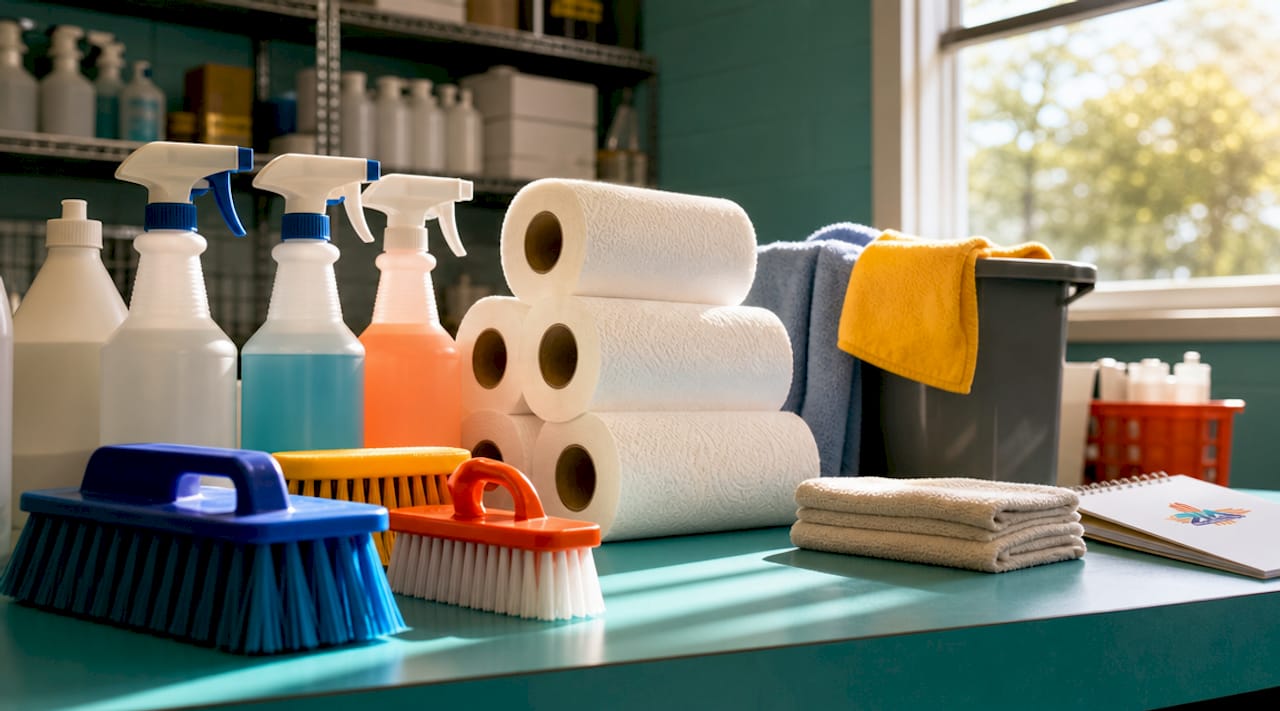
Cleaning chemicals include all-purpose detergents, floor strippers, glass cleaners, restroom bowl cleaners, and EPA-registered disinfectants. Products like Zep, Spartan Chemical, and Betco are widely used in commercial settings because they are formulated for high-frequency use and come with Safety Data Sheets (SDS) that meet OSHA requirements.
Application tools cover wet mops, microfiber flat mops, brooms, scrub brushes, squeegees, and trigger sprayers. The quality and condition of these tools directly affect cleaning outcomes. A worn mop head redistributes soil rather than removing it, which is why scheduled replacement is part of any serious janitorial supply buying plan.
Paper and dispensing products include toilet tissue, paper towels, seat covers, and the dispensers that hold them. Choosing the right dispenser format, whether roll, folded, or jumbo roll, affects both consumption rates and restroom appearance. High-traffic retail restrooms benefit from high-capacity dispensers that reduce refill frequency.
Waste management supplies round out the program with trash liners, recycling containers, and odor control products. Liner gauge and size must match the container to prevent tears and spills.
Here is a quick comparison of retail versus bulk purchasing to help you decide which approach fits your operation:
| Factor | Retail purchasing | Bulk purchasing |
|---|---|---|
| Upfront cost | Lower per order | Higher per order |
| Cost per unit | Higher | Lower |
| Storage requirement | Minimal | Significant |
| Best for | Single locations | Multi-location facilities |
| Supply chain risk | Higher (frequent reorders) | Lower (buffer stock) |
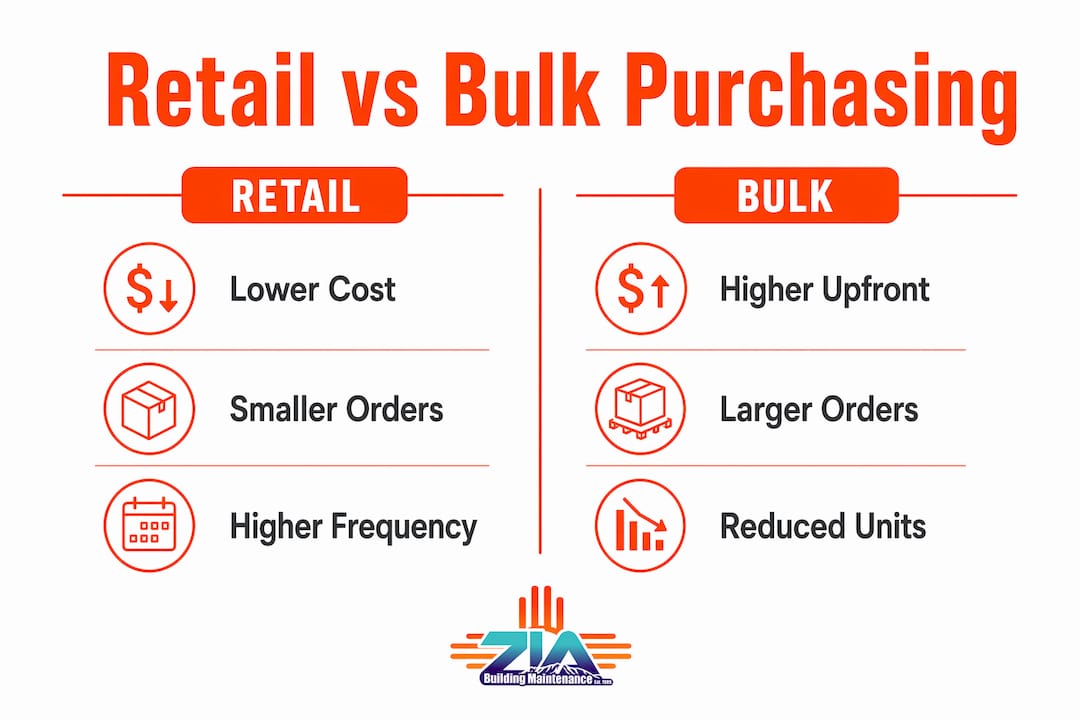
For multi-location businesses, bulk purchasing from a single vendor reduces per-unit cost and simplifies inventory management across sites. Single-location operations often benefit from retail purchasing until volume justifies a supply contract.
How do cleaning, sanitizing, and disinfecting differ in practice?
These three terms are not interchangeable, and using the wrong method in the wrong situation creates real compliance and health risks. Cleaning physically removes dirt, grease, and debris using detergent and water. Sanitizing reduces microbial counts to safe levels on food-contact surfaces. Disinfecting kills a broader spectrum of pathogens using EPA-registered products that require specific wet-contact times to work.
The sequence matters as much as the product choice. Disinfectants are less effective on visibly soiled surfaces, which means cleaning must always come first. Skipping the cleaning step before applying a disinfectant is one of the most common errors in retail facility maintenance, and it renders the disinfectant largely ineffective.
Here is how each method applies in a typical retail environment:
- Cleaning applies to floors, windows, counters, and general surfaces during routine daily maintenance. Use a pH-neutral detergent appropriate to the surface material.
- Sanitizing applies to food-prep counters, break room tables, and any surface that contacts consumables. Products like quaternary ammonium sanitizers are common in food-adjacent retail settings.
- Disinfecting applies to high-touch areas: door handles, light switches, point-of-sale terminals, restroom fixtures, and elevator buttons. For high-touch surface disinfection, following the full contact time listed on the product label is non-negotiable.
Disinfecting following the longest stated surface contact time on EPA-approved labels ensures broad-spectrum pathogen control in retail facilities. That means leaving the product visibly wet on the surface for the full dwell time, which ranges from 30 seconds to 10 minutes depending on the product and target pathogen.
Pro Tip: Never wipe a disinfectant surface dry before the contact time has elapsed. Set a timer during staff training so the correct dwell time becomes a habit rather than a guess.
What are best practices for managing retail janitorial supplies effectively?
Effective supply management prevents two costly problems: running out of critical products mid-shift and overstocking items that expire or degrade before use. The solution is a system, not a shopping list.
-
Set minimum stock limits by category. Facilities should set reorder thresholds by tracking actual usage habits rather than purchasing only when supplies run out. For example, if your facility uses two cases of paper towels per week, your reorder point should trigger when you have three cases remaining, not zero.
-
Build a product checklist by zone. Divide your facility into zones: restrooms, sales floor, break room, entrance, and back-of-house. Assign specific products to each zone and track consumption separately. This reveals which areas consume supplies fastest and where waste is occurring.
-
Enforce chemical safety protocols. Chemical safety requires providing hazard information through SDS and proper labeling, especially when decanting products into smaller containers. Decanting into unlabeled containers is a major safety violation. Every secondary container must carry the product name, hazard warnings, and concentration. Personal protective equipment (PPE) instructions must accompany each chemical in use.
-
Implement color-coded tool management. Color-coded brooms and scrubbers assigned to specific zones reduce cross-contamination risk, which is especially critical in retail environments adjacent to food service. A red brush stays in the restroom. A green mop stays on the sales floor. This physical separation works better than relying on staff memory alone.
-
Audit and adjust quarterly. Review your product checklist every quarter to identify items that are consistently overstocked, substituted, or running short. Adjust reorder quantities based on seasonal foot traffic patterns, since a retail location in December will consume significantly more supplies than the same location in February.
Pro Tip: Create a laminated product card for each zone that lists the approved products, dilution ratios, and PPE requirements. Post it inside the supply closet door so every staff member has the information at the point of use.
How does partnering with reliable vendors impact facility maintenance?
The right supplier is as important as the right product. A vendor that delivers inconsistently, substitutes products without notice, or cannot scale with your order volume creates operational gaps that no checklist can fix. Janitorial supply decisions must prioritize reliable, high-volume suppliers with communication transparency over simply choosing the lowest catalog price.
When evaluating vendors, facilities managers should look for these capabilities:
- Predictable delivery scheduling. Suppliers who offer fixed delivery windows allow you to plan receiving, storage, and staff coverage without disruption. Predictable delivery schedules and supplier communication are the backbone of lean inventory management.
- High-volume order capability. A vendor who can fulfill large orders consistently matters most for multi-location retail operations. If your supplier cannot fulfill a 500-case order on short notice during a high-traffic season, you need a backup or a better primary vendor.
- Product standardization support. The best vendors help you standardize products across all locations so that staff training, SDS documentation, and PPE requirements remain consistent. Inconsistent products across sites create training gaps and compliance risks.
- Inventory forecasting tools. Some commercial janitorial suppliers offer online portals or account managers who track your order history and flag when you are trending toward a shortage. This turns reactive purchasing into proactive supply management.
The benefits of professional janitorial services extend to supply management as well. A professional cleaning partner often brings vendor relationships and purchasing leverage that individual facilities cannot access on their own.
Key takeaways
A retail janitorial supply program succeeds when product selection, safety compliance, inventory discipline, and vendor reliability work together as a single system rather than separate tasks.
| Point | Details |
|---|---|
| Four core categories | Every program needs chemicals, tools, paper products, and waste supplies to function without gaps. |
| Clean before you disinfect | Disinfectants fail on soiled surfaces; cleaning is always the required first step. |
| Set reorder thresholds early | Track usage by zone and reorder before stock runs out, not after. |
| Label every container | Decanting into unlabeled containers is a safety violation; every secondary container needs full hazard labeling. |
| Choose vendors for reliability | Supplier consistency and communication matter more than unit price for multi-location operations. |
What 35 years of janitorial work taught me about supply programs
After spending decades working in and around commercial cleaning in Albuquerque, the single biggest operational failure I see in retail facilities is not a bad product choice. It is a training gap on disinfectant contact time. Facilities invest in quality EPA-registered disinfectants and then watch staff wipe surfaces dry in under 30 seconds. The product never had a chance to work. Wet-contact compliance is not a detail. It is the entire point of disinfection, and auditing it should be as routine as checking stock levels.
The second issue I see constantly is decanting. Someone fills an unlabeled spray bottle with a concentrated cleaner, sets it on a shelf, and three shifts later nobody knows what is in it. That is not just a compliance problem. It is a genuine safety risk for your staff. The fix costs nothing: a roll of labels and 30 seconds per bottle.
Color-coded tools are underused in retail settings outside of food service. Operational segregation by zone is one of the most effective contamination control measures available, and it requires no technology, no software, and no ongoing cost beyond the initial tool purchase. A red mop in the restroom and a blue mop on the sales floor is a simple, physical rule that works.
My honest recommendation: treat your janitorial supply program as a facility system, not a shopping errand. Build the checklist, set the thresholds, train on the chemistry, and choose a vendor who communicates proactively. The facilities that do this consistently are the ones that never have a cleanliness crisis.
— Ashley
How Zia Building Maintenance supports your facility’s cleaning program
Zia Building Maintenance has served commercial facilities across Albuquerque since 1989, building tailored janitorial programs for offices, medical facilities, schools, and retail environments. The team brings the product knowledge, vendor relationships, and operational discipline that facilities managers need to maintain spotless, safe, and compliant spaces every day.
Whether you are building a janitorial supply program from scratch or looking to fix gaps in an existing one, Zia Building Maintenance delivers the expertise and consistency your facility deserves. Explore the expert cleaning strategies that have made Zia Building Maintenance the number one office cleaning service in South Valley for 2025, and see how a professional partner can take the guesswork out of facility maintenance.
FAQ
What does retail janitorial supply include?
Retail janitorial supply includes cleaning chemicals, application tools such as mops and brooms, paper and dispensing products, and waste management supplies used regularly to maintain hygiene in business facilities.
What is the difference between cleaning and disinfecting?
Cleaning removes visible dirt and debris using detergent and water, while disinfecting uses EPA-registered products that must remain wet on a surface for a specified contact time to kill pathogens effectively.
How often should retail facilities reorder janitorial supplies?
Facilities should set reorder thresholds based on tracked usage patterns, triggering a new order when stock reaches a two-to-three-week buffer rather than waiting until supplies are depleted.
Why are color-coded janitorial tools important?
Color-coded tools assign specific equipment to designated zones, physically preventing cross-contamination between high-risk areas like restrooms and general sales floor spaces without relying on staff memory.
What are the key factors when choosing a janitorial supply vendor?
The most reliable vendors offer predictable delivery schedules, high-volume order capacity, product standardization support, and proactive communication, all of which reduce supply gaps and simplify compliance management.