

How to Build an Office Cleaning Checklist That Works
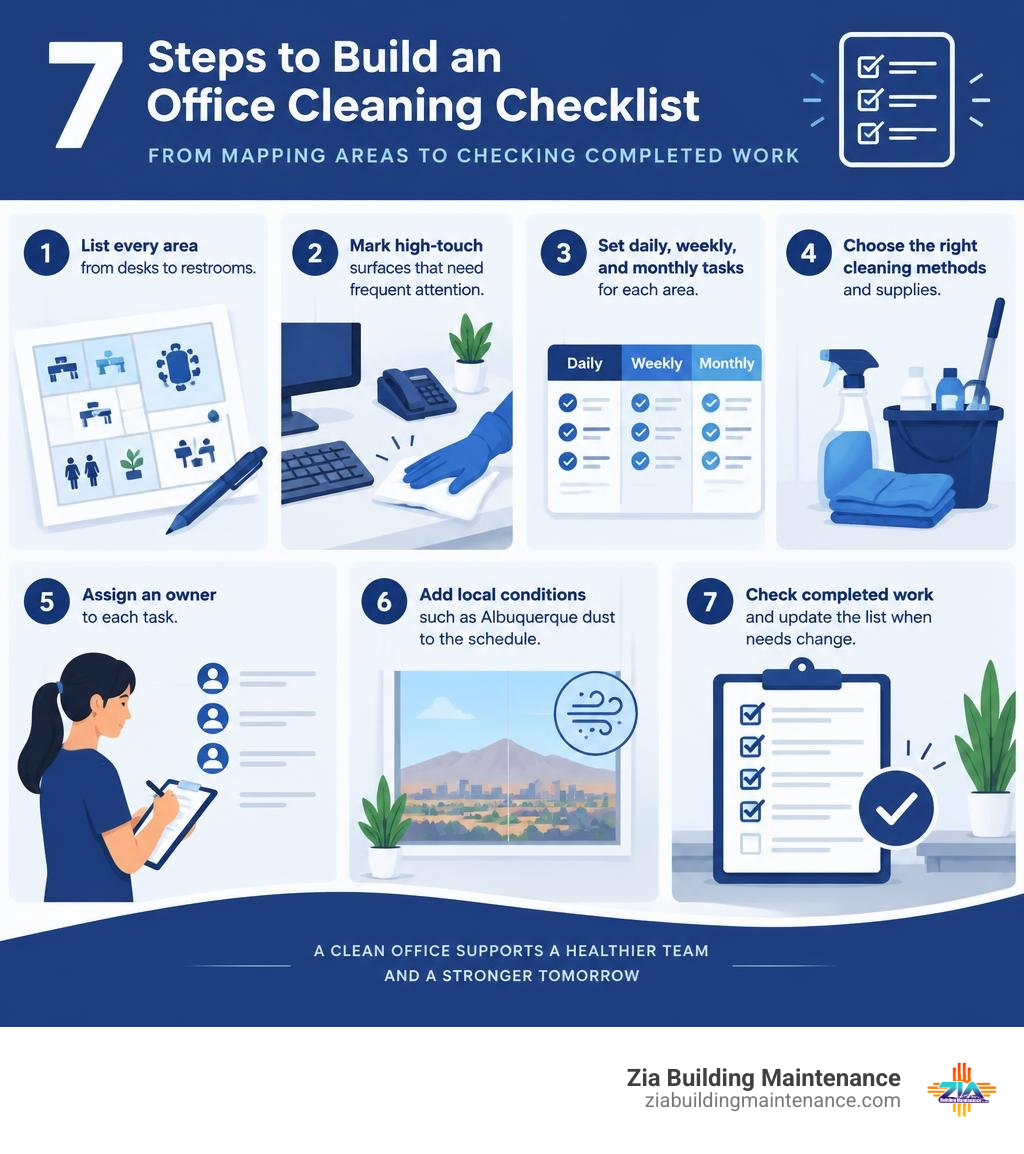
An Office cleaning checklist should tell your team what to clean, how often to clean it, and who checks the work. Build yours in seven steps:
- List every area, from desks to restrooms.
- Mark high-touch surfaces that need frequent attention.
- Set daily, weekly, and monthly tasks for each area.
- Choose the right cleaning methods and supplies.
- Assign an owner to each task.
- Add local conditions, such as Albuquerque dust, to the schedule.
- Check completed work and update the list when needs change.
A written list makes missed details easier to spot and helps keep service consistent.
I’m Ashley Cordova, vice president of Zia Building Maintenance, where I oversee day-to-day operations for our family-owned Albuquerque janitorial company. Office cleaning checklist planning draws on that hands-on work and my focus on reliable, detail-driven service.
wp:html
/wp:html
wp:html
/wp:html
The Business Case: Hygiene, Health, and Workplace Productivity
Maintaining a clean office is far more than an aesthetic preference; it is a foundational business investment. Modern studies show that the average commercial desk harbors roughly 10 million bacteria, making it nearly 400 times dirtier than a standard toilet seat. Keyboards alone carry up to 70% more bacteria than a restroom fixture, while office telephone handsets host approximately 25,000 germs per square inch. Because common flu viruses linger on hard surfaces for 24 to 48 hours, these high-touch zones quickly turn into transmission vectors across your team.
A deliberate sanitation plan yields measurable performance gains. Industry surveys reveal that employees working in clean environments are 12% more productive, with 94% of workers reporting they feel motivated in tidy spaces and 77% stating they deliver higher-quality work. Knowing what belongs on your office cleaning checklist to boost workplace health helps facility managers reduce unplanned sick days and boost day-to-day morale.
Neglected maintenance also affects facility efficiency. Dust accumulation on overhead light fixtures and diffuser lenses cuts indoor illumination by 20% to 30% over the course of a single year, increasing strain on eyes and energy systems. Prioritizing indoor environmental quality protects employee health, reinforces your brand’s reputation with visiting clients, and creates a welcoming atmosphere from the lobby to the back office.
7 Steps to Build an Effective Office Cleaning Checklist
Developing a functional checklist requires turning high-level sanitation goals into clear, repeatable tasks. Whether managing an in-house crew or auditing a janitorial contractor, these seven steps will help you organize facility mapping, task cadences, and quality control.
Step 1: Map Your Facility Zones and High-Risk Areas
Begin with a comprehensive physical walkthrough to divide your building into distinct operational zones. Every room presents unique contamination risks, foot-traffic levels, and surface requirements:
- Reception and Entryways: First-impression areas subject to exterior soil, grit, and airborne pollen.
- Open Workstations: Shared desk clusters requiring regular surface wipe-downs. You can reference our practical guide for open office layout maintenance to address these high-density zones.
- Conference and Meeting Rooms: High-turnover hubs where shared tables, chairs, and AV remotes exchange hands quickly. Review our dedicated meeting space cleaning protocols to standardize these rooms between gatherings.
- Breakrooms and Kitchenettes: Food-prep surfaces prone to cross-contamination. Follow structured breakroom hygiene standards to maintain refrigerators, sinks, and small appliances.
- Restrooms: High-risk sanitation environments that need daily deep sanitization, touchpoint disinfection, and supply replenishment.
Step 2: Differentiate Cleaning, Sanitizing, and Disinfecting
A common failure in facility maintenance is treating all cleaning tasks the same. Applying a disinfectant directly over a dusty, grease-laden desk neutralizes the chemical before it can destroy pathogens. Your operational team must understand the distinct stages of surface care:
| Process | Objective | Typical Method | Contact/Dwell Time |
|---|---|---|---|
| Cleaning | Removes organic matter, dirt, dust, and debris mechanically. | Microfiber cloths, neutral detergents, and warm water. | Immediate mechanical action. |
| Sanitizing | Reduces bacteria counts by 99.9% to levels judged safe by public health codes. | Food-safe chemical sanitizers or steam applications on prep counters. | 30 to 60 seconds of wet contact. |
| Disinfecting | Destroys or irreversibly inactivates specific pathogens, viruses, and fungi on hard surfaces. | EPA-registered broad-spectrum hospital-grade chemical disinfectants. | 3 to 10 minutes of undisturbed wet dwell time. |
Always clean soils from surfaces before applying chemical agents, and strictly follow the manufacturer’s dwell time printed on the EPA label.
Step 3: Structuring Your Daily Office Cleaning Checklist by Zone
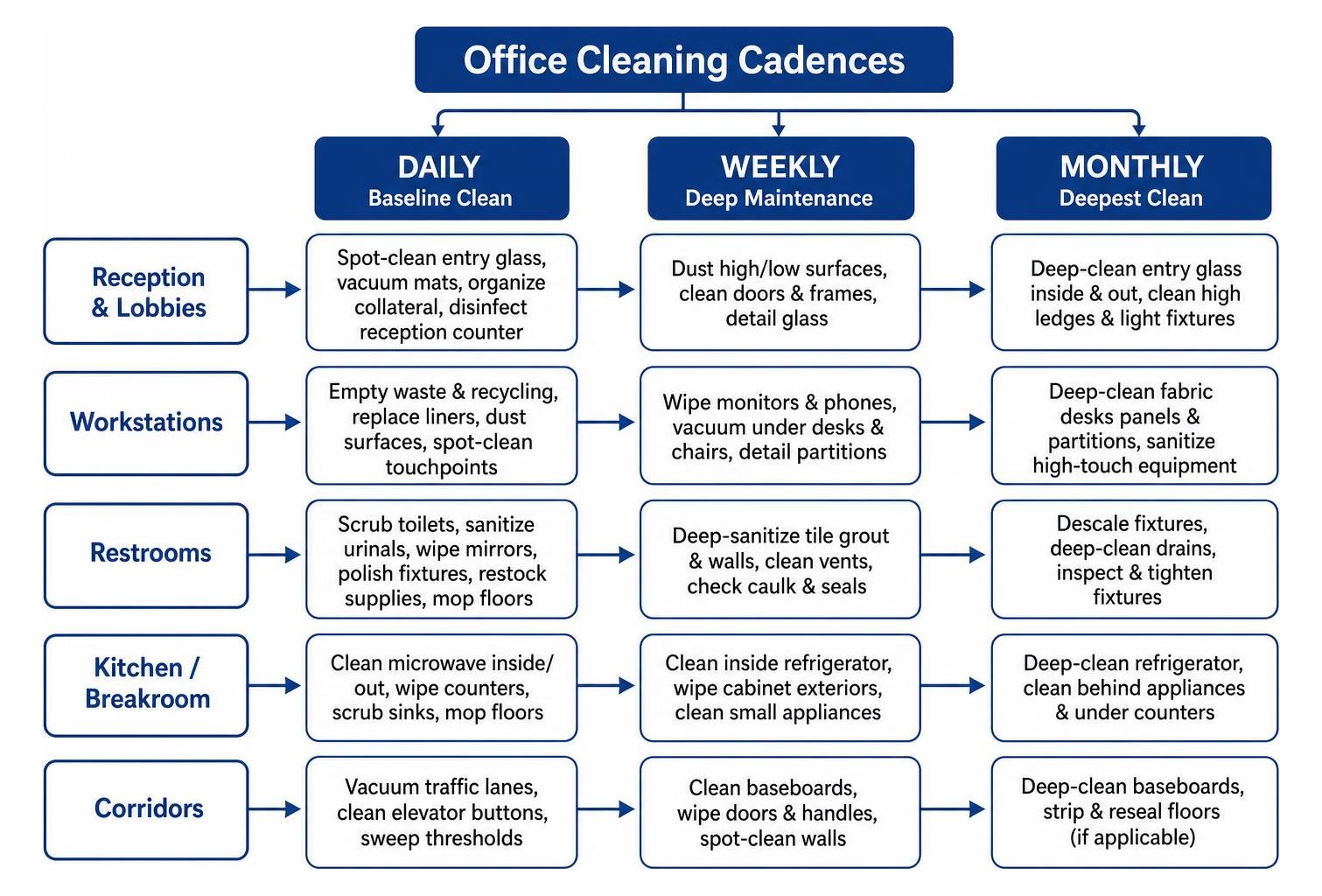
Daily cleaning protects baseline hygiene and keeps shared spaces ready for business. Essential daily tasks include:
- Reception & Lobbies: Spot-clean entry glass, vacuum walk-off mats, organize collateral, and disinfect the reception check-in counter.
- Workstations: Empty waste and recycling receptacles, replace liners, dust horizontal surfaces, and spot-clean desk touchpoints.
- Restrooms: Follow rigorous office restroom cleaning standards by scrubbing toilet bowls, sanitizing urinals, wiping mirrors, polishing chrome fixtures, restocking soap and paper products, and damp-mopping tile floors with neutral disinfectant.
- Kitchen / Breakroom: Clean interior/exterior microwave splatters, wipe food-prep counters, scrub sink basins, and mop hard flooring.
- Corridors: Vacuum traffic lanes, clean elevator call buttons, and sweep high-traffic thresholds.
For digital or physical tracking across recurring shifts, you can use the Office Cleaning Checklist Template | CleanConfirm to establish clear accountability.
Step 4: Creating a Weekly and Monthly Office Cleaning Checklist for Deep Maintenance
Daily surface cleaning must be supported by scheduled deep maintenance. Establishing clear scheduling office cleaning cadences prevents dirt, allergens, and grime from accumulating in hard-to-reach areas.
Weekly Tasks:
- Disinfect interior refrigerator shelves and discard expired food items.
- Detail-vacuum hard floor edges, baseboards, and under desk footwells.
- Polish interior glass partitions, conference room doors, and sidelights.
- Scrub and deep-sanitize breakroom trash cans.
- Damp-wipe leather and vinyl seating in executive and waiting areas.
Monthly Tasks:
- High-dust ceiling supply vents, return air grilles, and overhead light diffusers.
- Detail-scrub hard-surface tile grout lines in restrooms and kitchenettes.
- Vacuum upholstered ergonomic office chairs and soft lobby seating.
- Wipe window blinds, ledges, and architectural trim.
Quarterly Deep Cleaning:
- Perform hot-water carpet extraction across all carpeted footprints.
- Machine-scrub, strip, or buff hard surface flooring (VCT, concrete, tile).
- Wash exterior windows and architectural panels.
For larger facilities, reviewing a comprehensive commercial cleaning framework can help match these intervals with your building’s foot-traffic volume.
Step 5: Prioritize High-Touch Office Germ Hotspots
Research shows that bacteria and viruses concentrate heavily on a handful of shared surfaces. Routine cleaning must focus on these primary germ vectors:
- Breakroom sink faucet handles and splash zones
- Microwave push buttons and door handles
- Computer keyboards and mice
- Refrigerator door handles
- Water cooler taps and fountain push pads
- Shared printer control screens and copier covers
- Elevator buttons and stairwell handrails
Implementing a targeted workplace sanitization strategy using pre-moistened disinfectant wipes can reduce bacterial contamination by over 99% within 48 hours, significantly lowering the risk of office-wide illness.
Step 6: Assemble Standardized Tools, Supplies, and PPE
Equipping your janitorial team with professional-grade supplies ensures consistent cleaning while protecting your building’s finishes:
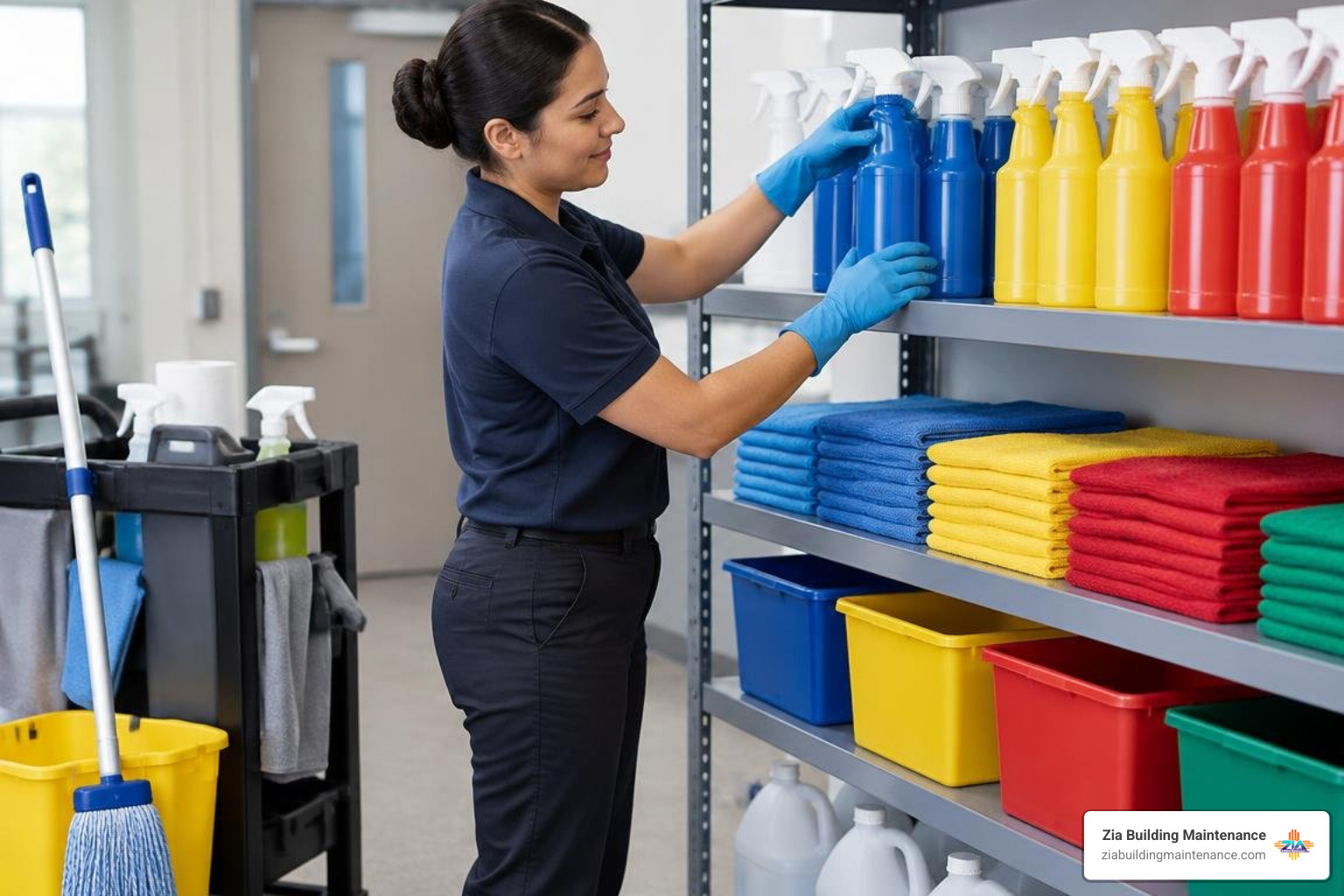
- Color-Coded Microfiber System: Use red cloths for restroom toilets and urinals, yellow for sinks and bathroom counters, green for food-prep zones, and blue for general desks and glass. This eliminates cross-contamination between restrooms and workstations.
- HEPA Commercial Vacuums: Use multi-stage HEPA filtration units to capture 99.97% of fine particles down to 0.3 microns, including pollen, pet dander, and fine particulate matter.
- Chemical Dilution Control: Use closed-loop dispensers for neutral pH floor cleaners, glass cleaners, and broad-spectrum disinfectants to prevent chemical residue and surface damage.
- PPE & Safety Documentation: Supply technicians with powder-free nitrile gloves, safety goggles, and slip-resistant footwear. Keep Safety Data Sheets (SDS) accessible in the primary janitorial closet to meet safety compliance standards.
Step 7: Factor in Regional Climates and Regulatory Compliance
A functional checklist must adapt to local environmental challenges and regulatory codes. OSHA housekeeping standards mandate clean, dry walking surfaces and prompt spill remediation, while Hazard Communication standards require active chemical labeling and SDS management.
In arid, high-desert climates like Albuquerque, Rio Rancho, Corrales, and Los Ranchos, airborne dust, sand, and seasonal spring pollen quickly settle on surfaces. Exterior doors and lobbies require double walk-off carpet matting to trap debris before it enters main corridors. Facility managers should also consult comprehensive resources such as The Ultimate Office Cleaning & Maintenance Checklist to ensure seasonal adjustments align with building lease obligations.
If you are looking to save internal management time, partnering with dedicated office cleaning services ensures these technical and environmental standards are maintained consistently.
Implementing Quality Control, Compliance, and Facility Audits
A checklist only delivers value when completed consistently. To ensure quality, facility managers should set up a structured inspection and auditing program:

- Visual Scorecards (1–5 Scale): Conduct weekly walkthroughs evaluating each zone on dust control, surface shine, trash removal, and restroom sanitation.
- ATP Bioluminescence Testing: Use rapid adenosine triphosphate (ATP) swabs on high-touch points to measure organic residue and verify chemical disinfection.
- Shift Handover Logs: Require cleaning technicians to document completed daily tasks, note skipped areas due to locked doors, and flag maintenance issues like leaking faucets or burnt-out bulbs.
- Quarterly Account Reviews: Review audit logs every quarter alongside your janitorial partner to update task frequencies based on changes in office headcount or seasonal demands.
Exploring our full suite of commercial cleaning checklists will help you build reliable inspection templates customized to your building’s footprint.
Frequently Asked Questions About Office Cleaning
What are the five dirtiest surfaces in an office environment?
The five most contaminated office surfaces are breakroom sink faucet handles, microwave door handles, computer keyboards, refrigerator door handles, and water fountain buttons. These shared touchpoints harbor high concentrations of bacteria and viruses, making daily targeted disinfection essential to stop cross-contamination.
How often should office carpets and HVAC vents be deep cleaned?
In standard commercial settings, carpets should receive professional hot-water extraction at least once every quarter in high-traffic corridors, and every six months in enclosed executive offices. HVAC supply grilles, returns, and diffusers should be high-dusted monthly, with deep ductwork inspections completed annually to maintain healthy indoor air quality.
What is the primary difference between sanitizing and disinfecting?
Sanitizing reduces the number of bacteria on a surface to levels deemed safe by public health codes (typically a 99.9% reduction) within 30 to 60 seconds. Disinfecting uses stronger EPA-registered chemical agents to kill or permanently deactivate broad-spectrum viruses, bacteria, and fungi, typically requiring 3 to 10 minutes of wet surface contact.
Conclusion
A well-crafted cleaning plan helps facility managers maintain a safe, productive, and welcoming workplace. Standardizing your daily, weekly, and monthly tasks ensures high-touch points receive regular attention, floor surfaces stay protected, and cross-contamination risks are minimized across every department.
For businesses throughout Albuquerque, Rio Rancho, Corrales, and Los Ranchos, Zia Building Maintenance delivers dependable janitorial solutions built around your exact schedule and facility needs. As a family-owned commercial cleaning company serving New Mexico since 1989, our crews bring detail-driven care, clear quality-control systems, and reliable service to every shift.
Ready to upgrade your building’s daily maintenance? Start using the office cleaning checklist that covers everything your team keeps missing, or get in touch with our Albuquerque team today to build a custom commercial cleaning program for your property.