

TL;DR:
- Cleaning frequency should be tailored to each office zone’s risk level, usage, and surface contact patterns to prevent disease spread and optimize budget. High-traffic areas like restrooms and reception require daily disinfection, while low-risk spaces can be cleaned less frequently, with adjustments based on occupancy data. Implementing a monitored, accountable, and flexible schedule ensures consistent, effective cleanliness that supports employee health, morale, and a professional business image.
Getting the cleaning frequency for office spaces right is one of the most overlooked decisions an office manager makes. Clean too little and you risk spreading illness, frustrating employees, and leaving a poor impression on clients. Clean too often in the wrong places and you waste budget that could go toward higher-risk zones. This guide walks you through how to assess your office zones, set realistic schedules by space type and size, assign ownership, and verify results. Whether you manage a 10-person suite or a 200-person floor, what follows is grounded in real-world practice, not just theory.
Table of Contents
- Key takeaways
- Understanding cleaning frequency for office spaces by zone
- Recommended cleaning frequencies by space type and office size
- How to build a practical office cleaning schedule
- Common mistakes that undermine cleaning frequency
- Benefits of getting cleaning frequency right
- My take on what actually makes office cleaning work
- Ready to set the right cleaning schedule for your office?
- FAQ
Key takeaways
| Point | Details |
|---|---|
| Zone-based cleaning wins | Different office areas carry different risk levels; cleaning frequency must reflect usage, not assumption. |
| Size changes everything | Small offices need quarterly deep cleans; large, high-traffic offices require monthly deep cleaning at minimum. |
| Accountability drives results | A cleaning schedule without assigned ownership and verification almost always breaks down within weeks. |
| Dynamic schedules outperform static ones | Adjusting frequency based on real occupancy data reduces waste and closes gaps in high-risk areas. |
| Health gains are measurable | Teams following structured cleaning schedules see a 15% to 25% reduction in sick days. |
Understanding cleaning frequency for office spaces by zone
Not every square foot of your office carries the same cleaning burden. A storage closet used twice a week is not the same as a restroom serving 40 people. Before you set any office cleaning schedule, you need to understand what each zone actually demands.
The six zones that appear in most office environments are:
- Reception and lobby: High foot traffic from both employees and visitors. Surfaces here carry outside contaminants and directly shape client impressions.
- Open office areas: Shared desks, keyboards, and phone handsets create a constant transfer surface. Occupancy density matters more than raw square footage here.
- Restrooms: The highest hygiene risk zone in any building. Frequency here is non-negotiable regardless of office size.
- Break rooms and kitchens: Food preparation and communal appliances make these zones second only to restrooms in contamination risk.
- Conference rooms: Usage spikes unpredictably. A room that sits empty Monday and hosts six back-to-back meetings Tuesday needs a flexible, use-triggered approach.
- Support spaces (copy rooms, server rooms, storage): Lower traffic and lower risk, but dust accumulation can damage equipment and degrade air quality over time.
Two factors determine how often each zone needs attention: traffic volume and shared surface density. A space with 10 people touching the same door handle every hour needs more frequent disinfection than one where each person has a private workstation. Frequently touched surfaces like door handles, shared keyboards, elevator buttons, and light switches require daily attention in most office settings.
A useful mental model is “cleaning by consequence.” Ask what happens if this area is missed once. For a restroom, the answer is immediate and serious. For a private storage room, the answer is minimal. That severity gap should directly shape your frequency decisions.
Pro Tip: Walk your office with a clipboard and mark every surface that more than three people touch daily. That map becomes the backbone of your high-frequency cleaning list.
Recommended cleaning frequencies by space type and office size
One of the most common mistakes managers make is applying a single cleaning frequency across the entire office. Office cleaning frequency by space type must account for actual use patterns, not just floor plans.
Here is a straightforward breakdown of recommended frequencies by area and task type:
| Area | Daily | Weekly | Monthly | Quarterly |
|---|---|---|---|---|
| Restrooms | Disinfect all surfaces, restock supplies | Deep scrub grout and fixtures | Check and seal grout lines | Full sanitation inspection |
| Break rooms | Wipe counters, clean appliance exteriors | Deep clean refrigerator and microwave | Degrease exhaust vents | Full equipment pull-out cleaning |
| Open office | Empty trash, wipe shared surfaces | Vacuum and mop floors, clean glass | Disinfect all workstations | Detail clean walls and vents |
| Reception | Vacuum, wipe high-touch surfaces | Clean windows and door glass | Deep clean furniture and fixtures | Full floor restoration if needed |
| Conference rooms | Wipe table and tech equipment | Full surface clean and vacuuming | Inspect and clean upholstery | Deep clean walls and carpet |
| Support spaces | Empty trash | Dust equipment and shelves | Vacuum and mop floors | Deep clean including above ceiling tiles |
Office size also changes the math significantly. Small to medium-sized offices with low foot traffic should schedule deep cleaning and disinfection at least once every three months. That cadence works when daily and weekly maintenance is handled consistently. However, large offices with high foot traffic and numerous shared spaces require a full deep clean and disinfection at least once a month.
The rationale is straightforward. More people, more surfaces touched per day, more pathogen transfer opportunities, more residue buildup on floors and fixtures. Monthly deep cleaning for high-traffic offices is not a premium add-on. It is the baseline that keeps daily and weekly maintenance actually effective.
Pro Tip: If your office runs on a hybrid schedule, do not base your cleaning frequency on headcount alone. Track peak attendance days and cluster your higher-intensity cleaning around those windows.
How to build a practical office cleaning schedule
A schedule that lives on a printed sheet pinned to the wall rarely gets followed past the first month. An effective office cleaning schedule defines scope, frequency, ownership, and proof of completion in a single system, and it works best when integrated into a digital platform.
Here is how to build one that holds up:
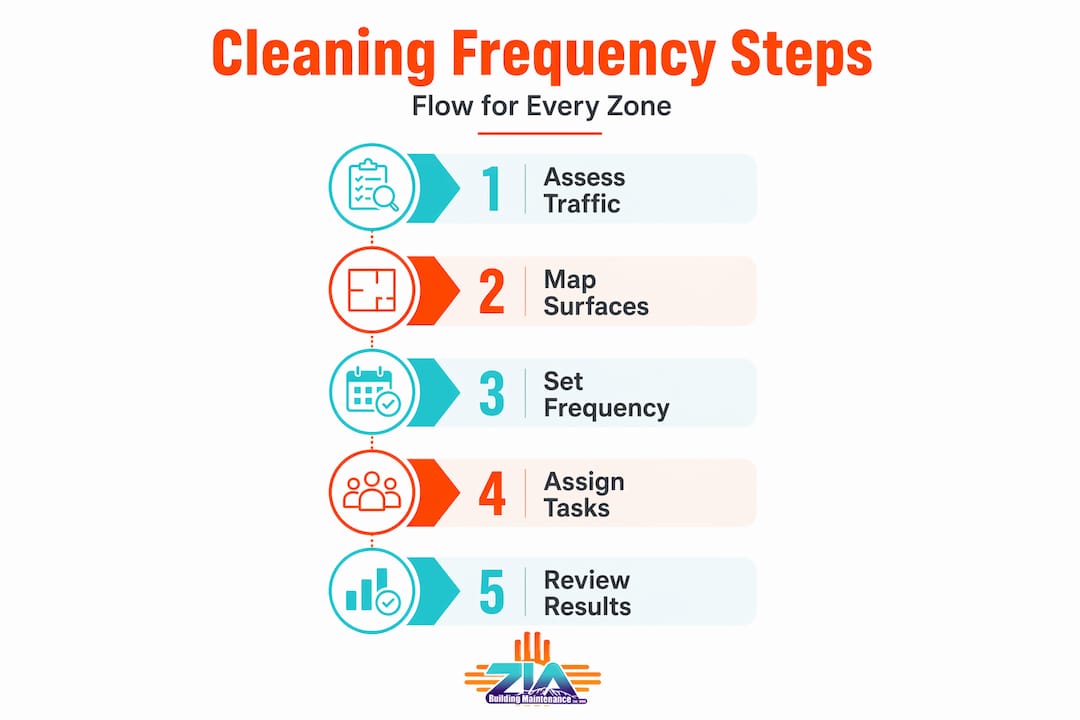
- Map your zones. Walk every area of the office and assign it a zone name, a risk level (high, medium, or low), and an estimated daily occupancy. This becomes your zone list.
- Build a task library. For each zone, write out every cleaning task using action language. Not “clean restroom” but “disinfect toilet bowl, wipe exterior of toilet, clean sink basin, sanitize faucet handle, mop floor.” Specificity prevents shortcuts.
- Assign frequencies. Match each task to a frequency: daily, weekly, monthly, or quarterly. Use your zone risk levels to guide decisions on borderline tasks.
- Set completion standards. Define what “done” looks like. A mopped floor should have no visible residue. A wiped counter should pass a white-cloth test. Without a standard, “completed” is subjective and compliance drops.
- Assign ownership. Cleaning success depends on who owns each task. In-house staff, facility porters, and third-party vendors each have strengths. Assign each task to a specific role, not just a team.
- Integrate verification. Use digital checklists, work order software, or a CMMS (Computerized Maintenance Management System) to log completions. Paper logs get lost. Digital records create accountability trails.
Additional scheduling considerations worth noting:
- Align cleaning shifts with office hours. Vacuuming during peak work hours disrupts focus; schedule it before staff arrive or after they leave.
- Hybrid work models create variable occupancy. Build two versions of your weekly schedule: one for high-attendance days and one for low-attendance days.
- Assign one person per building or floor to own the schedule review monthly. Schedules drift without a single accountable reviewer.
Effective office maintenance routines also require that cleaning tasks are organized by shift timing to align with office traffic. Cleaning tasks should be organized by zone and shift to avoid disruption and maximize coverage.
Common mistakes that undermine cleaning frequency
Even well-designed schedules fail. The most common failures are not about cleaning products or techniques. They are about process and culture.
- Unclear ownership. When a task belongs to “everyone,” it belongs to no one. If your break room wipe-down is assigned to whoever is free, it will be skipped on busy days precisely when it matters most.
- Over-cleaning low-risk areas. Some managers obsess over visible spaces like lobbies while neglecting restrooms and break rooms because those feel less public. Cleaning budget should follow risk, not visibility.
- Static schedules in dynamic environments. A schedule built when you had 30 employees needs a revision when you grow to 80. Cleaning schedules should allow real-time adjustments based on actual traffic and usage data.
- No feedback loop. Employees notice cleaning gaps before managers do. Create a simple way for staff to report issues, whether through a shared form, a messaging channel, or a physical log near the break room.
- Skipping verification. A task marked “complete” by the person who did it is self-reported data. Add spot checks, photographic confirmation, or third-party audits for high-risk zones.
Pro Tip: Review your cleaning logs monthly and look for patterns. If a specific zone consistently shows skipped tasks on certain days, that is a scheduling problem, not a personnel problem. Adjust the window, not the person.
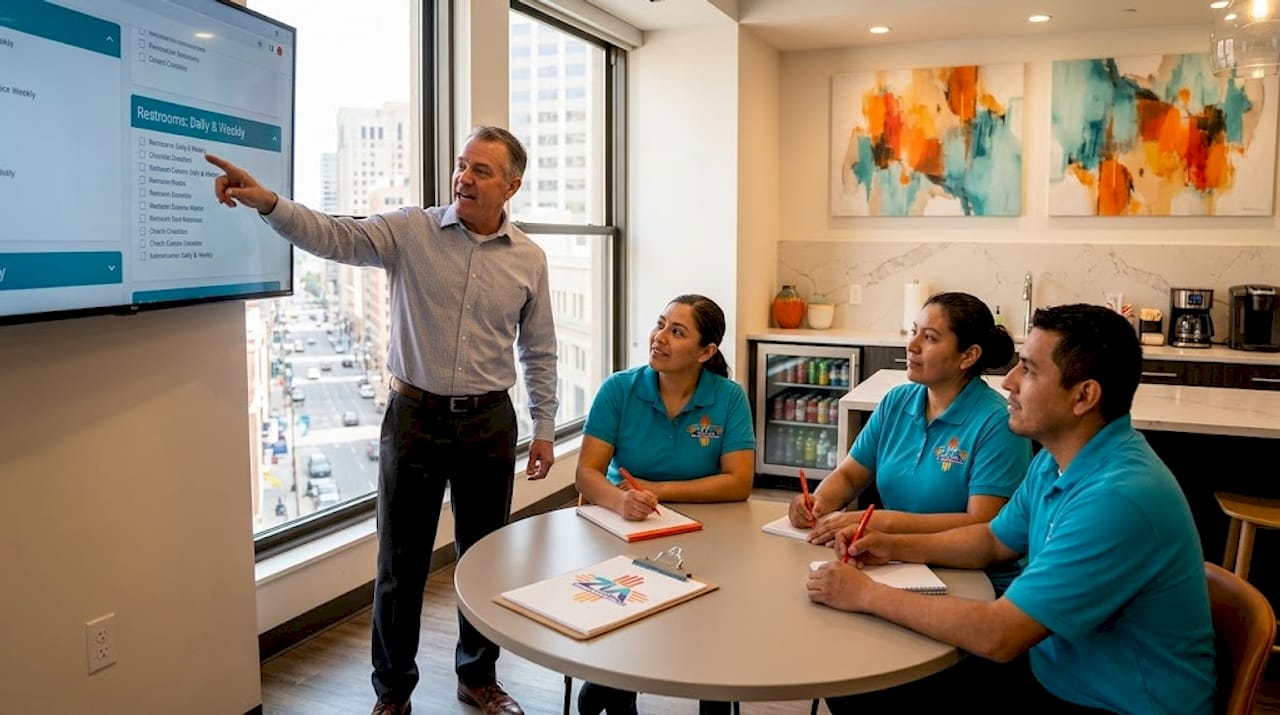
Training also matters more than most managers realize. Staff turnover in cleaning is high. Without regular training on standards and procedures, quality degrades gradually until a problem becomes visible enough to act on. Build a 15-minute refresher into the quarterly calendar.
Benefits of getting cleaning frequency right
The case for investing in the right cleaning frequency is not just about appearances. The data on workplace health and productivity is clear.
“Teams adhering to structured cleaning schedules see a 15% to 25% reduction in sick days, directly reducing absenteeism costs and keeping operations running at full capacity.”
Fewer sick days mean less disruption, less coverage scrambling, and lower healthcare costs. For a 50-person office, even a 15% reduction in illness-related absences can add up to dozens of recovered work days per year.
Beyond health, consistent professional cleaning measurably improves employee morale and reinforces a professional brand image. Employees who work in clean, well-maintained spaces report higher job satisfaction and are less likely to leave. That connection between a clean workplace and employee retention is one that many managers underestimate until it shows up in exit interview data.
Client impressions matter too. A conference room with stained carpet or a restroom running low on supplies signals neglect. Clients notice, even if they never say anything. Maintaining the right frequency of office sanitation is a direct investment in how your business presents itself.
Financially, correct cleaning frequency also reduces long-term maintenance costs. Floors that are regularly stripped and refinished last longer. Grout that is cleaned on schedule resists permanent staining. Filters that are changed on time protect HVAC systems. Cleaning, done right, is preventive maintenance.
My take on what actually makes office cleaning work
I’ve seen offices with beautiful cleaning contracts and spotless-looking lobbies that still had sick employees cycling through every few weeks. The schedules looked fine on paper. The problem was always the same: no one owned verification, and the schedule had not been updated since the office expanded two years earlier.
What I’ve learned is that the best cleaning programs treat frequency as a living variable. You set a baseline, then you adjust it. If your meeting rooms are suddenly booked solid every day because your team grew, your weekly wipe-down needs to become a daily one. That kind of responsiveness only happens when someone has accountability for the schedule, not just for the cleaning.
I’ve also noticed that offices where employees feel respected tend to have cleaner break rooms and restrooms. Not because those employees clean more. Because management invested in making those spaces genuinely clean, and employees responded by treating them with more care. Cleaning culture and workplace culture are more connected than most managers realize.
Technology helps. A digital cleaning management system that flags missed tasks and sends alerts when a zone has gone 48 hours without service is worth more than the most detailed paper checklist. It removes the ambiguity and creates data you can actually use to make decisions.
Treat your cleaning frequency as an operational control, not a background task. The offices I’ve seen get it right are the ones where cleaning sits on the same level of operational seriousness as IT maintenance or facilities management. That shift in mindset makes every other detail easier to get right.
— Ashley
Ready to set the right cleaning schedule for your office?
Building a cleaning program that actually holds up requires more than a checklist. It requires the right partner with real-world experience across office sizes and space types.
Zia Building Maintenance has been delivering tailored commercial cleaning solutions in Albuquerque since 1989. Whether you manage a compact office suite or a large multi-floor facility, the team builds customized plans around your specific zones, traffic patterns, and schedule. If you are ready to move from guesswork to a verified, consistent program, start with expert guidance on large office cleaning frequency or review the commercial vs. janitorial cleaning differences to identify which service type fits your needs. You can also use the cleaning contract checklist to evaluate your current arrangements. Contact Zia Building Maintenance today to request a consultation.
FAQ
How often should office restrooms be cleaned?
Restrooms in active offices should be cleaned and disinfected at least once daily, with restocking checks mid-day for high-traffic facilities. High-touch surfaces like faucet handles and door hardware should be wiped down more frequently in large offices.
What is the recommended deep cleaning frequency for offices?
Small offices with low foot traffic should deep clean every three months, while large offices with heavy daily use require a full deep clean monthly. Daily and weekly maintenance tasks must stay consistent for those benchmarks to hold.
How do I build an office cleaning schedule that gets followed?
Assign every task to a specific role, set clear completion standards, and track results digitally rather than on paper. Schedules without ownership and verification break down quickly regardless of how well they are designed.
Does office cleaning frequency affect employee productivity?
Yes. Offices that follow structured cleaning routines see measurably fewer sick days and report higher employee satisfaction. The link between a clean office and employee focus is well documented and shows up most clearly in long-term absenteeism data.
How should cleaning frequency change for hybrid offices?
Track actual attendance by day and adjust your cleaning intensity accordingly. High-attendance days should receive the same treatment as a fully occupied office, while lighter days can scale back non-critical tasks. Review occupancy patterns monthly and update your schedule to match.