
TL;DR:
- A cleaning checklist for open offices emphasizes daily, weekly, and monthly routines to maintain hygiene and reduce employee sick days. It covers high-touch surfaces, shared spaces, and air vents, with specific tools and products to ensure effective disinfection. Consistent implementation, supervision, and accessible supplies are key to sustaining a clean and healthy workspace.
A cleaning checklist for open offices is a structured list of tasks designed to maintain a clean, healthy, and productive workspace through systematic daily, weekly, and periodic cleaning routines. Open office layouts create unique hygiene challenges because dozens of people share surfaces, air, and equipment throughout the day. Structured daily cleaning reduces employee sick days by 15%–25%, and daily cleaning cuts germ presence by up to 80%. Zia Building Maintenance has applied these standards in Albuquerque commercial spaces since 1989, and the protocols that work in practice are more specific than most generic guides suggest.
What areas and surfaces must a cleaning checklist for open offices cover?
A workplace hygiene checklist must account for every zone where people gather, touch shared surfaces, or move between workstations. Open offices concentrate risk because the same door handle, coffee machine, or printer button gets touched by dozens of people before it is ever wiped down.
The main zones that belong on every open office maintenance checklist are:
- Workstations and desks: Keyboards, mice, monitors, desk surfaces, and chair armrests are high-touch points that collect bacteria throughout the day.
- Kitchen and break room: Appliance handles, countertops, the inside of microwaves, and sink faucets require daily disinfection. Neglecting wet zones like kitchens and restrooms quickly leads to employee dissatisfaction, even when other areas look clean.
- Restrooms: Toilet handles, faucets, soap dispensers, door handles, and floor drains need both daily cleaning and periodic deep attention.
- Meeting rooms: Shared tables, presentation remotes, whiteboard markers, and chairs accumulate germs between back-to-back meetings.
- Reception and entrance areas: High foot traffic means floors, door handles, and reception desks need attention multiple times daily.
- Air vents and HVAC registers: Dirty air vents above workstations re-contaminate cleaned surfaces by distributing particles back into the air. These must be included in every deep cleaning cycle.
- Partitions and dividers: Fabric partitions trap dust and allergens. Hard partitions collect fingerprints and should be wiped weekly.
The frequency of cleaning each zone depends directly on how many people use it and how often. A kitchen used by 50 people needs twice-daily attention. A small storage room used by two people weekly does not.
What is an effective cleaning schedule for open offices?
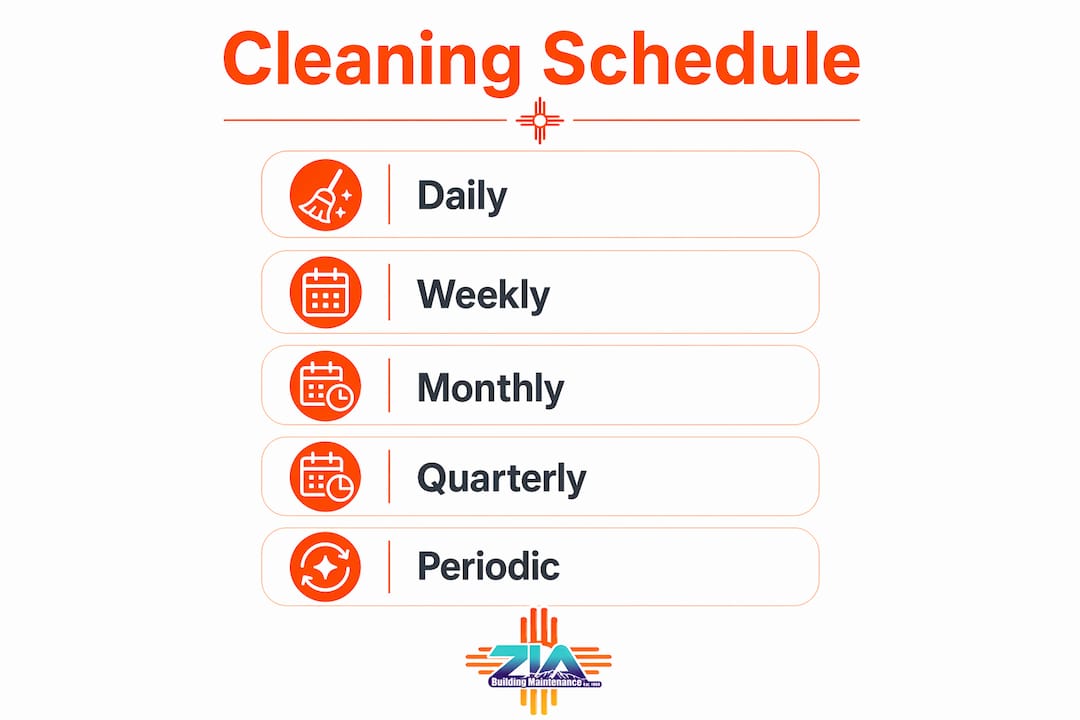
A structured office cleaning routine divides tasks by frequency: daily, weekly, and monthly. This prevents both over-cleaning low-traffic areas and under-cleaning the spots that matter most.
Daily tasks
- Empty all waste bins and replace liners.
- Disinfect high-touch surfaces: door handles, light switches, elevator buttons, printer controls, and shared appliances.
- Clean and disinfect restrooms fully, including fixtures, floors, and dispensers.
- Wipe down kitchen countertops, appliance exteriors, and sink areas.
- Spot-clean glass partitions and entrance doors.
- Vacuum or sweep high-traffic floor areas.
- Restock soap, paper towels, and hand sanitizer at all stations.
In hot-desking environments, surface disinfection must happen between each user shift, not just at the end of the day. Bacteria counts peak after lunch, so a midday touchpoint cleaning round is not optional in busy open offices.
Weekly tasks
- Dust all horizontal surfaces, including shelves, monitor tops, and window ledges.
- Clean interior glass and partition surfaces fully.
- Wipe down chair upholstery and armrests with an appropriate fabric or hard-surface cleaner.
- Clean air vent covers and registers.
- Mop all hard floors with a disinfectant solution.
- Sanitize shared equipment such as phones, printers, and copiers.
Monthly and periodic tasks
- Deep clean carpets using hot water extraction or dry compound methods. Carpet deep cleaning is advised every 3–6 months depending on foot traffic.
- Clean HVAC filters and replace them on schedule.
- High-dust ceiling fans, light fixtures, and tops of cabinets.
- Detail fabric partitions and upholstered furniture.
- Inspect and clean floor drains in kitchens and restrooms.
Pro Tip: Schedule midday cleaning rounds specifically for kitchen surfaces and shared touchpoints. Bacteria counts rise sharply after the lunch hour, and a 10-minute wipe-down at 1:00 PM cuts contamination before the afternoon work block begins.
What tools, products, and techniques ensure effective open office cleaning?
The right products and methods make the difference between surfaces that look clean and surfaces that are actually safe. Open offices require specific tools because of the volume of shared surfaces and the risk of spreading contamination from one zone to another.
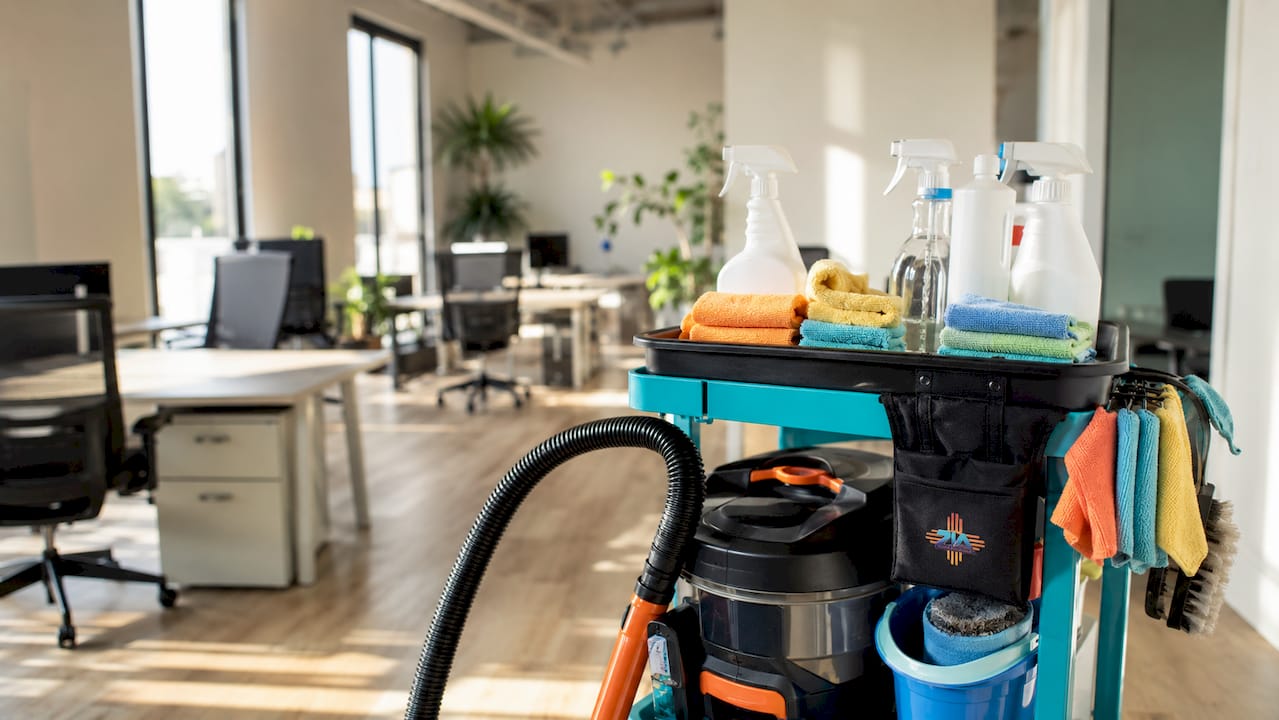
Key tools and products for an effective cleaning tasks for shared spaces include:
- EPA-registered disinfectant wipes and sprays: These are the standard for high-touch surface disinfection in commercial environments. Always check the product label for contact time, which is the number of seconds or minutes the surface must stay wet to kill pathogens.
- EN 14476 compliant virucidal products: Hot-desking requires virucidal products with proper contact time adherence to be effective. Standard all-purpose cleaners do not meet this standard.
- Color-coded microfiber cloth systems: Assign a specific color to each zone. Red for restrooms, blue for general surfaces, green for kitchens, and yellow for glass is a common system. Color-coded microfiber cloths must be washed and stored separately to prevent cross-contamination between zones.
- HEPA-filter vacuum cleaners: HEPA vacuums capture 99.97% of particles at 0.3 microns. This matters in open offices where dust and allergens settle on carpet and upholstery throughout the day.
- HVAC filter replacements: Filters should be replaced every 30–90 days depending on office occupancy and local air quality conditions.
- Hand hygiene stations: Place hand sanitizer dispensers at every desk cluster entry point and at all building entrances. Visible stations increase use without requiring reminders.
Pro Tip: Always clean from top to bottom and from clean areas to dirty areas. Start with high surfaces like shelves and monitors, then work down to desks and finally floors. This prevents dust and debris from falling onto already-cleaned surfaces.
The cleaning sequence matters as much as the products used. Spraying a disinfectant and immediately wiping it off defeats the purpose. Every product has a dwell time printed on its label. Training your cleaning team to respect that contact time is one of the highest-return habits you can build.
How can office managers implement and maintain cleaning checklists successfully?
A checklist only works if someone is accountable for it. 40% of cleaning schedules fail due to inconsistent execution. A completed log does not prove a clean office. It proves someone checked a box.
Practical steps for successful implementation include:
- Treat cleanliness as a shared expectation, not just a service. Post the cleaning schedule in common areas. When staff see the schedule, they understand what is being done and when, which builds trust and reduces complaints.
- Audit outcomes, not just logs. Supervisors should audit cleaning outcomes by physically inspecting surfaces, not just reviewing completion sheets. A quick ATP swab test on a kitchen counter tells you more than a signed checklist.
- Use flexible cleaning contracts. Office occupancy fluctuates. A contract that allows you to scale cleaning frequency up during busy periods and down during holidays protects both quality and budget.
- Train on contact time and sequence. Most cleaning errors come from skipping dwell time or cleaning in the wrong order. A one-hour training session on these two points improves results immediately.
- Address common blind spots. The most commonly missed areas in open offices are air vents, the undersides of desks, chair adjustment levers, and the backs of toilet handles. Add these explicitly to your checklist.
“Effective cleaning in open offices uses a three-layer approach: between-user surface disinfection, midday touchpoint cleaning, and thorough nightly professional cleaning. Skipping any layer creates gaps that accumulate over the week and show up as sick days, complaints, and a workspace that never quite feels clean.”
Document your cleaning program with dated inspection records, not just daily logs. When an employee raises a hygiene concern, a documented audit trail shows you take the issue seriously and gives you a baseline to improve from. Good documentation also protects you if a health or safety review ever occurs.
Key Takeaways
A structured cleaning checklist for open offices, applied consistently across daily, weekly, and monthly cycles, is the most reliable way to reduce sick days, protect employee wellbeing, and maintain a professional workspace.
| Point | Details |
|---|---|
| Zone-based prioritization | Kitchens, restrooms, and high-touch surfaces need daily attention before any other area. |
| Three-layer cleaning approach | Combine between-user disinfection, midday touchpoint cleaning, and nightly deep cleaning for full coverage. |
| Product compliance matters | Use EN 14476 virucidal products with correct contact time, especially in hot-desking environments. |
| Audit outcomes, not logs | Supervisory inspections of actual surfaces catch failures that signed checklists miss. |
| Air vents are not optional | Dirty HVAC vents re-contaminate cleaned surfaces and must be included in every monthly deep clean. |
What I’ve learned managing open office cleaning programs
The hardest part of running a cleaning program in an open office is not the cleaning itself. It is the consistency. I have seen well-designed checklists fall apart within two weeks because no one owned the follow-through. The checklist becomes a formality, the midday round gets skipped when the office is busy, and the air vents never make it onto anyone’s radar until someone files a complaint.
The offices that maintain genuinely clean environments share one habit: they treat the cleaning schedule as a non-negotiable operational standard, the same way they treat network uptime or fire safety. The moment cleanliness becomes optional, it degrades fast in a shared space.
One thing most guides understate is the value of visible hygiene supplies. When staff can see hand sanitizer at their desk cluster and wipes near the printer, they use them. That between-user layer of disinfection that happens organically throughout the day is worth more than any single nightly cleaning round. Make the supplies accessible and people will do part of the work themselves.
Budget pressure is real, and I understand the instinct to cut cleaning frequency first. But the cost of a sick team, reduced output, and a workspace that feels neglected is always higher than the cost of a proper cleaning contract. The right cleaning frequency is not the cheapest one. It is the one that keeps your team healthy and your office presentable every single day.
— Ashley
Professional open office cleaning from Zia Building Maintenance
Zia Building Maintenance has delivered consistent, professional office cleaning services in Albuquerque since 1989, earning the title of the #1 office cleaning service in South Valley for 2025. Their team works with office managers to build customized cleaning plans that match the specific demands of open office layouts, including hot-desking protocols, HVAC maintenance schedules, and compliant disinfection products.
Every service plan from Zia Building Maintenance includes trained staff who follow proven cleaning sequences, use color-coded microfiber systems, and document their work for your records. If your open office needs a cleaning program that holds up under scrutiny, contact Zia Building Maintenance to request a consultation and a plan built around your schedule and occupancy.
FAQ
What should a daily office cleaning checklist include?
A daily checklist covers waste removal, restroom and kitchen disinfection, high-touch surface wiping, floor vacuuming or sweeping, and restocking of hygiene supplies. In hot-desking offices, between-user surface disinfection is also a daily requirement.
How often should carpets be deep cleaned in an open office?
Carpets in open offices should be deep cleaned every 3–6 months, depending on foot traffic volume and occupancy levels. High-traffic areas may need attention at the shorter end of that range.
What products are required for hot-desking hygiene?
Hot-desking surfaces require EN 14476 compliant virucidal products applied with correct contact time. Standard all-purpose cleaners do not provide sufficient disinfection for shared desk environments.
Why do 40% of cleaning schedules fail?
Cleaning schedules fail most often due to inconsistent execution rather than poor planning. Supervisory audits of actual surfaces, not just completion logs, are the most reliable way to maintain standards.
How often should HVAC filters be replaced in an open office?
HVAC filters in open offices should be replaced every 30–90 days. Dirty filters distribute particles back over cleaned surfaces, which undermines the rest of your cleaning program.