

What Is Water Fed Window Cleaning — and Why Does It Matter?
Water fed window cleaning is a method that uses purified water pumped through a telescoping pole to a brush head, letting cleaners wash windows from the ground — no ladders required.
Here’s a quick summary of how it works:
- Purified water is produced using RO (reverse osmosis) and/or DI (deionization) filtration, removing all dissolved minerals
- Water travels up through the inside of a telescoping pole to a brush at the top
- The brush agitates dirt and grime on the glass and frame
- A final pure water rinse flushes everything away — and because the water has zero mineral content, it dries completely spot-free
- No squeegee, no soap, no ladder needed
The result? Streak-free windows cleaned faster, more safely, and without harsh chemicals.
Window cleaning hasn’t changed much in decades — a bucket, a squeegee, and a ladder. But that’s shifting fast. Water fed window cleaning has transformed how professional cleaning companies approach the job, especially on multi-story commercial buildings where ladder work is slow, risky, and expensive.
Ladder accidents cause approximately 164,000 emergency room injuries every year across trades in the US. Water fed systems reduce ladder use by around 80% on residential jobs alone — and can cut job completion time by up to 40% compared to traditional squeegee methods. For facility managers who need reliable, consistent results without disrupting daily operations, that’s a meaningful difference.
I’m Ashley Cordova, Vice President of Zia Building Maintenance, a family-owned commercial cleaning company serving New Mexico since 1989. Overseeing our operations and service quality has given me a front-row seat to how water fed window cleaning technology is raising the bar for what professional results actually look like. In this guide, I’ll walk you through everything you need to know — from how the technology works to how to choose the right system for your building.
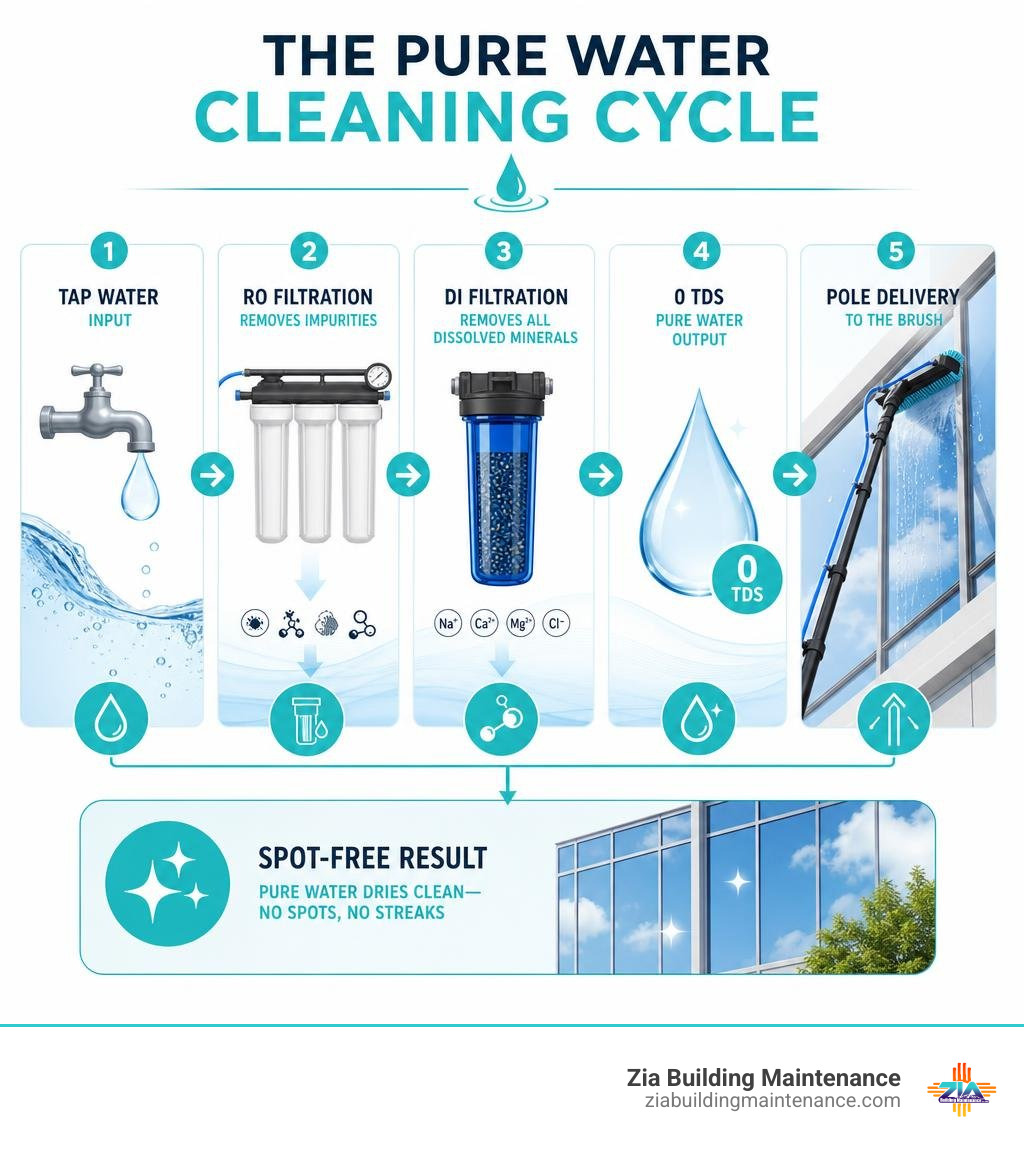
Basic water fed window cleaning vocab:
Why Water Fed Window Cleaning is the Future of the Industry
The commercial cleaning industry is constantly evolving, but few innovations have made as much of an impact as pure water technology. When we look at traditional window washing, we see a process that is physically demanding, inherently risky, and highly time-consuming. Traditional squeegee methods require a technician to climb a ladder, apply soapy water, squeegee it off, and wipe the edges with a microfiber cloth.
With pure water systems, we completely bypass these bottlenecks. By pumping purified water directly to the glass through lightweight telescoping poles, technicians can clean both the window frames and the glass panes simultaneously from the safety of the ground.
This modern shift brings three massive benefits:
- Unmatched Efficiency: Because there is no ladder to constantly reposition, pack up, and carry around the perimeter of a property, jobs are completed up to 40% faster.
- Superior Safety: Keeping our technicians’ feet firmly on the ground virtually eliminates the risk of high-altitude slips and falls.
- Better Environmental Profile: Traditional window cleaning relies on chemical detergents to lift dirt. Purified water acts like a natural solvent, pulling dirt away from the glass without any soaps, which means zero chemical runoff into local New Mexico soil.
For a deeper dive into how this fits into a complete building care plan, check out our guide to commercial window cleaning and hard water stain removal.
| Feature | Traditional Squeegee Method | Water Fed Pole System |
|---|---|---|
| Working Heights | Requires ladders, lifts, or scaffolding above 10 feet | Cleans safely up to 90 feet from the ground |
| Chemical Usage | Uses soaps and chemical detergents | Uses 100% pure, chemical-free water |
| Speed & Efficiency | Slower; requires extensive setup and repositioning | Up to 40% faster completion times |
| Frame Cleaning | Often billed separately or skipped | Frames are scrubbed and rinsed automatically |
| Drying Process | Must be hand-dried with squeegees and cloths | Air-dries naturally to a spot-free finish |
wp:html
/wp:html
wp:html
/wp:html
Key Equipment Needed for Water Fed Window Cleaning
To operate a successful water fed window cleaning setup, you need more than just a long stick and a hose. The system relies on a carefully engineered chain of equipment designed to purify tap water and deliver it smoothly to high surfaces.
- The Water Purification System: This is the heart of the operation. It takes local tap water and runs it through filtration stages (such as sediment filters, carbon filters, reverse osmosis membranes, and deionization resin) to bring the Total Dissolved Solids (TDS) down to 0 parts per million (ppm).
- The Telescopic Pole: These poles are designed to extend to incredible heights while remaining rigid enough for the operator to apply scrubbing pressure.
- Specialized Brushes: Unlike standard household brooms, these brushes feature dual-trim bristles. The inner bristles are stiffer to scrub away stubborn bird droppings and dirt, while the outer bristles are softer to glide smoothly over the glass.
- High-Pressure Hose and Fittings: A lightweight, kink-resistant hose runs from the purification system, up the inside or outside of the pole, and connects directly to the brush head jets.
For those looking to invest in their own hardware, exploring Complete Window Cleaning Water Fed Packages is an excellent way to ensure all your hoses, couplings, and filtration tanks are fully compatible from day one.

Step-by-Step Guide to Water Fed Window Cleaning
Using a pure water system is highly intuitive, but it requires a specific technique to ensure a flawless, streak-free finish.
- Step 1: Pre-Rinsing the Frames: Before you touch the glass, use the water fed brush to rinse the top and sides of the window frame. This washes away loose dust and cobwebs. If you skip this, dirty water from the frame will drip down onto your clean glass as it dries.
- Step 2: Scrubbing the Glass: Place the brush flat against the glass pane. Work from top to bottom, using overlapping vertical or horizontal strokes. Let the bristles agitate and break up the dirt, pollen, and hard water spots.
- Step 3: The Final Pure Water Rinse: Pull the brush a few inches away from the glass surface and use the pure water spray jets to rinse the window thoroughly from top to bottom. This flushes away the suspended dirt particles.
- Step 4: Natural Air Drying: Walk away! Because the water is completely purified and free of minerals, it will evaporate naturally without leaving a single spot or streak behind.
If you want to compare these commercial steps to standard residential practices, take a look at our home window cleaning guide
Pure Water Systems: RO vs. DI Filtration
To understand why purified water is so critical, we have to look at what is actually inside our tap water. When tap water dries on a window, it leaves behind dissolved minerals like calcium, magnesium, and sodium. These minerals are what create those annoying white spots and cloudy streaks.
Pure water systems use two primary methods to strip these minerals out: Reverse Osmosis (RO) and Deionization (DI).
- Deionization (DI): This process uses a tank filled with charged resin beads. As water passes through, the resin acts like a magnet, capturing all the charged mineral ions and replacing them with pure hydrogen and oxygen molecules. It is incredibly effective at producing 0 ppm water instantly, but the resin degrades quickly if used on highly mineralized water.
- Reverse Osmosis (RO): This is a mechanical filtration process where water is forced under high pressure through a semi-permeable membrane. The membrane filters out up to 95-98% of all impurities.
To measure the purity of the water, technicians use a handheld TDS (Total Dissolved Solids) meter. Tap water with a TDS under 100 ppm is considered relatively soft, while anything over 150 ppm is hard. For a spot-free finish, the water coming out of the brush head must read 0 ppm.
If you are looking for a highly reliable, plug-and-play solution, the Best Water Fed Pole System For Window Cleaning offers an exceptional balance of RO and DI filtration, ensuring perfect results even on tough commercial sites. To learn more about the science behind mineral-free cleaning, read our article on using distilled water for a streak-free shine.
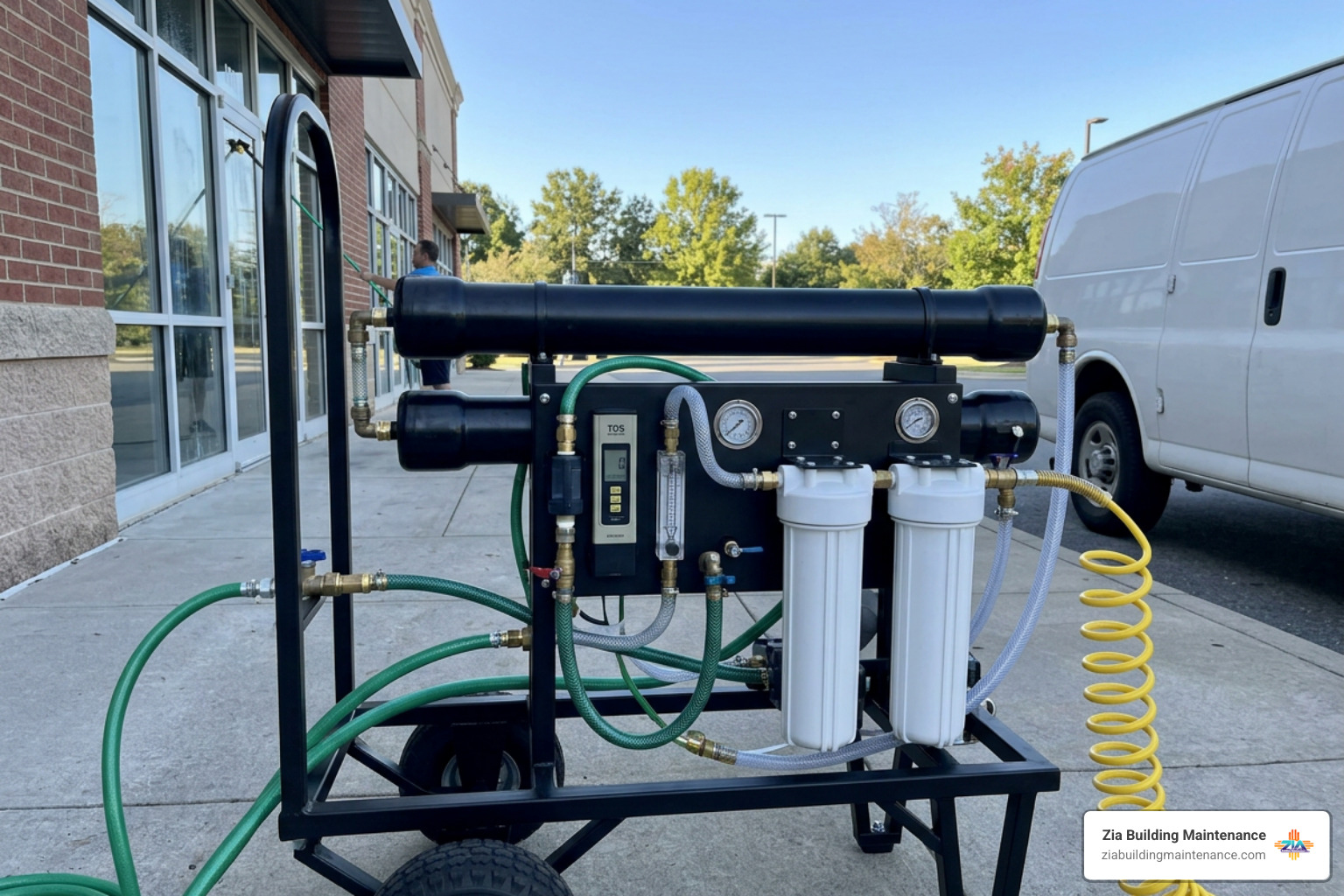
Single-Stage vs. Multi-Stage Systems
When choosing a pure water system, you will generally choose between a single-stage DI system and a multi-stage RO/DI system.
- Single-Stage DI Systems: These systems consist of a single tank filled with DI resin. They are lightweight, highly portable, and have a lower upfront cost. However, because DI resin absorbs all minerals directly, hard tap water will exhaust the resin very quickly. If your local tap water has high TDS, a single-stage system will quickly become expensive to run due to frequent resin replacements.
- Multi-Stage RO/DI Systems: These systems combine carbon and sediment pre-filters, an RO membrane, and a final DI polishing stage. The pre-filters remove chlorine and large sediments to protect the RO membrane. The RO membrane then does 95% of the heavy lifting, removing the bulk of the minerals. The DI stage only has to clean up the tiny remaining fraction. While multi-stage carts are heavier and more expensive upfront, they dramatically extend your resin’s lifespan, making them much cheaper to operate over time in hard water areas.
Choosing the Right Water Fed Pole: Materials and Sizing
Choosing the right pole is all about balancing height, weight, and rigidity. If a pole bends too much when extended, it becomes incredibly difficult to control and apply scrubbing pressure to the glass.
- Hybrid Poles: Made from a blend of fiberglass and carbon fiber, these poles are budget-friendly and durable. They are excellent for residential cleaning up to 30 feet, but they become too heavy and flexible at greater heights.
- Carbon Fiber Poles: This is the gold standard for daily professional use. Carbon fiber is incredibly light and stiff, meaning a 47-foot pole can weigh as little as 5 pounds. It allows for precise control and minimal muscle strain during long workdays.
- High Modulus Carbon Fiber: For extreme heights (50 to 90 feet), high modulus carbon fiber is required. These poles are engineered to be exceptionally rigid, preventing the “bendy” feeling that makes high-reach work exhausting.
For a comprehensive breakdown of brands, models, and specifications, refer to this detailed Water Fed Poles Guide.
Determining Pole Length and Material for Your Job
To select the perfect pole, consider the typical height of the properties you service:
- Residential (1 to 2 stories): A 20 to 30-foot hybrid or standard carbon fiber pole is ideal. It is compact, easy to maneuver around tight residential landscaping, and highly cost-effective.
- Mid-Reach Commercial (3 to 4 stories): A 35 to 50-foot carbon fiber pole provides the perfect balance of reach and rigidity.
- High-Reach Commercial (5+ stories): To reach up to 90 feet, you will need a premium high modulus or ultra-high modulus carbon fiber pole.
Additionally, look for poles with ergonomic features, such as oval cross-sections. These prevent the pole sections from twisting in your hands while you work and provide a more comfortable grip.
Safety, Maintenance, and ROI of Pure Water Systems
Safety is the single most compelling reason to transition to water fed window cleaning. Ladder falls are a leading cause of workplace injuries in the cleaning industry. By allowing technicians to clean multi-story buildings while keeping both feet on the ground, we eliminate the risks associated with high-altitude work.
However, keeping this equipment running safely and efficiently requires regular maintenance:
- Winterization: If water freezes inside your RO membrane or DI housings, it will expand and crack the expensive components. Always drain your system completely and store it in a climate-controlled space during cold New Mexico winters.
- Filter Replacements: Sediment and carbon pre-filters should be replaced every 3 to 6 months to protect the RO membrane from chlorine damage. RO membranes typically last 2 to 3 years, while DI resin must be changed as soon as your output TDS climbs above 0 ppm.
For a broader look at commercial cleaning economics and budgeting, read our guide to window cleaning costs.
Calculating Your Return on Investment (ROI)
While a professional multi-stage pure water system and carbon fiber pole can require an upfront investment of $1,500 to $4,000, the return on investment is incredibly fast.
Consider the math:
- Labor Savings: Because water fed poles cut job completion times by up to 40%, a two-man crew can complete more properties in a single day.
- Reduced Equipment Costs: You will spend less on renting expensive scissor lifts or boom lifts for mid-rise commercial buildings.
- Expanded Service Offerings: With a high-reach pole, you can safely bid on larger commercial contracts that you previously had to turn down due to height limitations.
Most professional window cleaning businesses find that their pure water system pays for itself within just a few months of consistent use.
Frequently Asked Questions about Water Fed Systems
How long do pure water filters and DI resin last?
Filter life depends entirely on your source water’s TDS levels and your daily water usage. In areas with soft tap water (under 100 ppm), a single DI resin charge can last for 20 to 30 hours of continuous cleaning. In hard water areas, sediment pre-filters should be changed every 3 to 6 months, and the RO membrane should be replaced when the TDS of the water leaving the RO stage rises above 10 ppm.
Can water fed poles be used for solar panel cleaning?
Yes, absolutely! In fact, pure water is the absolute best way to clean solar panels. Because pure water leaves no soap residue or mineral film behind, it ensures the panels can absorb the maximum amount of sunlight. The soft, non-abrasive bristles of a water fed brush safely remove dust, pollen, and bird droppings without scratching the sensitive tempered glass.
Do water fed systems work in areas with very hard water?
Yes, but you must use a multi-stage RO/DI system. If you try to use a single-stage DI tank in an area with hard water, the minerals will exhaust your resin cartridge in just a few hours, making it incredibly expensive to operate. A multi-stage system uses the RO membrane to strip away 95% of the heavy mineral load first, ensuring your DI resin only has to handle the final polish.
In Albuquerque and surrounding areas like Rio Rancho, Corrales, and Los Ranchos, our municipal water is notoriously hard and mineral-heavy. Because of this, we always utilize multi-stage RO/DI filtration systems to protect our equipment and guarantee a flawless, spot-free shine for our clients.
Conclusion
Water fed window cleaning is no longer just an alternative method; it is the modern standard for safe, efficient, and environmentally friendly property maintenance. By harnessing the power of pure water filtration and advanced carbon fiber engineering, we can deliver crystal-clear views while keeping our teams safe on the ground.
At Zia Building Maintenance, we have been providing dependable, high-quality janitorial and commercial cleaning services across Albuquerque, Rio Rancho, Corrales, and Los Ranchos, New Mexico since 1989. As a trusted, family-owned business, we combine attention to detail with state-of-the-art cleaning technology to keep your commercial spaces looking pristine.
Ready to see the difference pure water can make for your facility? Schedule your professional window cleaning service today and let our team bring a streak-free shine to your building.