

TL;DR:
- Hiring professional office cleaners reduces sick days and enhances employee productivity through effective surface sanitization and improved air quality. Outsourcing cleaning services lowers management overhead, extends asset lifespan, and ensures consistent, high-quality results compared to in-house efforts. Regular, specialized cleaning programs positively impact safety, branding, employee morale, and overall operational efficiency.
Professional office cleaning, also called commercial janitorial services, is defined as contracted hygiene management performed by trained technicians using industry-grade equipment and protocols. Businesses that hire professional office cleaners recover up to 46% fewer sick days compared to those relying on informal or in-house cleaning. The financial and operational case is direct: reduced absenteeism, preserved assets, and a healthier workforce. This article covers the core reasons facility managers and business owners choose professional cleaning services over alternatives, backed by research from Allied Facility Care, Prime Facility Services, and AMRUS Clean.
Why hire professional office cleaners: the health and productivity case
The most documented reason to hire professional office cleaners is the direct reduction in employee sick days. Research shows businesses investing in professional commercial cleaning see up to 46% fewer sick days. For a 50-person office, that translates to hundreds of recovered work hours annually, with each lost workday costing between $200 and $400 per employee.
The productivity gains go beyond attendance. Improved indoor environmental quality through professional cleaning produces an 8% increase in cognitive performance among office workers. That improvement shows up in measurable outputs: faster crisis response, sharper strategic thinking, and fewer errors on complex tasks.
Surface sanitization is the mechanism behind these results. Professional cleaners follow structured disinfection schedules that target high-touch surfaces such as keyboards, door handles, and shared equipment. Routine cleaning schedules combined with HEPA filtration remove airborne allergens and pathogens that standard cleaning misses entirely.
“Cleaning should be approached as a preventative health method to protect workforce resilience and corporate profitability, not as a low-cost transaction.” — UK Commercial Hygiene Report
Pro Tip: Schedule professional disinfection of shared surfaces at least three times per week in open-plan offices. High-touch zones accumulate pathogens faster than any other area in the building.
The benefits of a clean workplace extend to presenteeism as well. Poor air quality and clutter create low-grade cognitive stress that reduces focus without triggering a formal sick day. Professional cleaning programs improve HVAC function and reduce airborne particulate load, addressing this hidden productivity drain at its source.
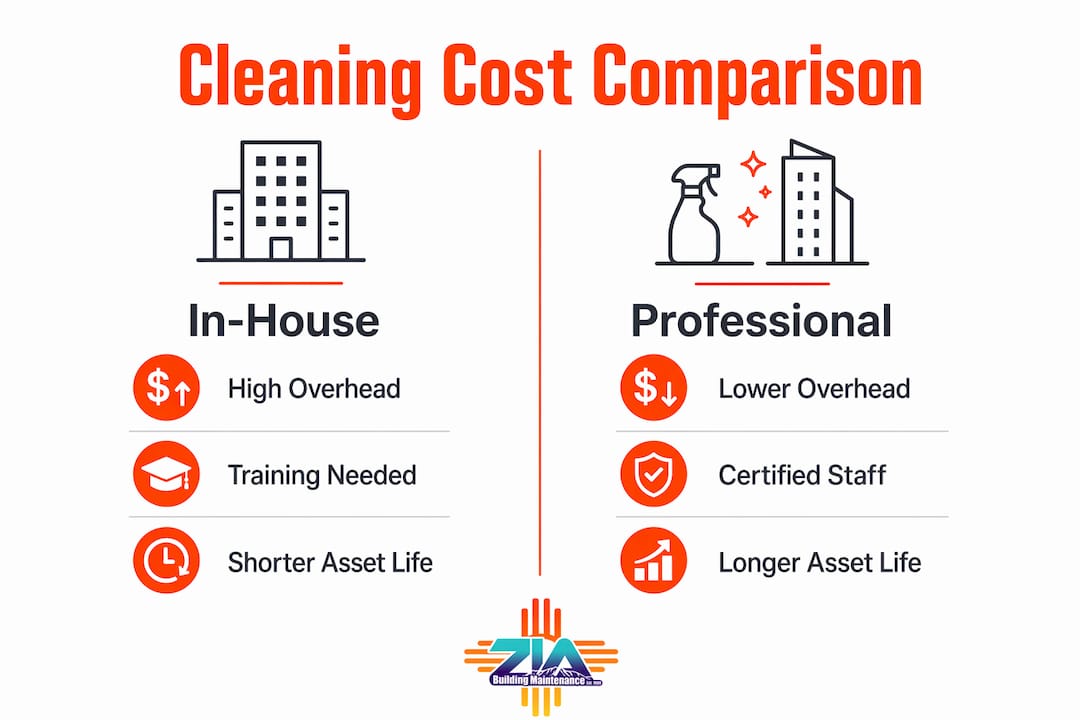
In-house vs. professional cleaning: what does it actually cost?
Many facility managers underestimate the true cost of managing cleaning in-house. The management overhead of an in-house cleaning program includes training, supervision, supply procurement, and coverage for staff absences. Outsourcing cleaning consolidates all of these responsibilities under one reliable contract, removing the administrative burden from your team.
The table below compares the two models across the factors that matter most to business owners and facility managers.
| Factor | In-House Cleaning | Professional Cleaning Service |
|---|---|---|
| Management overhead | High: training, supervision, HR | Low: handled by the provider |
| Supply procurement | Facility manager’s responsibility | Included in service contract |
| Staff absence risk | Disrupts cleaning schedule | Provider manages coverage |
| Cleaning consistency | Variable by individual | Standardized protocols |
| Asset protection | Often reactive | Preventative and scheduled |
| Floor life extension | Minimal | Up to 30–50% longer |
The asset protection row deserves particular attention. Professional maintenance extends commercial flooring life by 30–50%, which directly delays costly capital expenditure. Replacing commercial carpet costs $3 to $7 per square foot. In a 5,000-square-foot office, that is a potential $15,000 to $35,000 replacement bill that proper maintenance can push years into the future.
The cost of presenteeism adds another layer to this analysis. Employees who come to work sick or distracted by a dirty environment still cost the business money. Professional cleaning reduces these environmental frictions, making the investment in professional janitorial services a net positive when measured against total operational costs rather than just the cleaning invoice.
Pro Tip: When evaluating cleaning contracts, ask providers to itemize supply costs separately. Many businesses discover they were overspending on supplies by 20–30% when managing procurement in-house.
How does a clean office affect safety, branding, and employee morale?
A clean office reduces physical safety risks in ways that are easy to overlook. Clutter in walkways, spills on hard floors, and dust buildup on equipment all create hazards. Professional cleaners follow protocols that address these risks on a scheduled basis, reducing the likelihood of slip-and-fall incidents and equipment failures caused by dust accumulation.
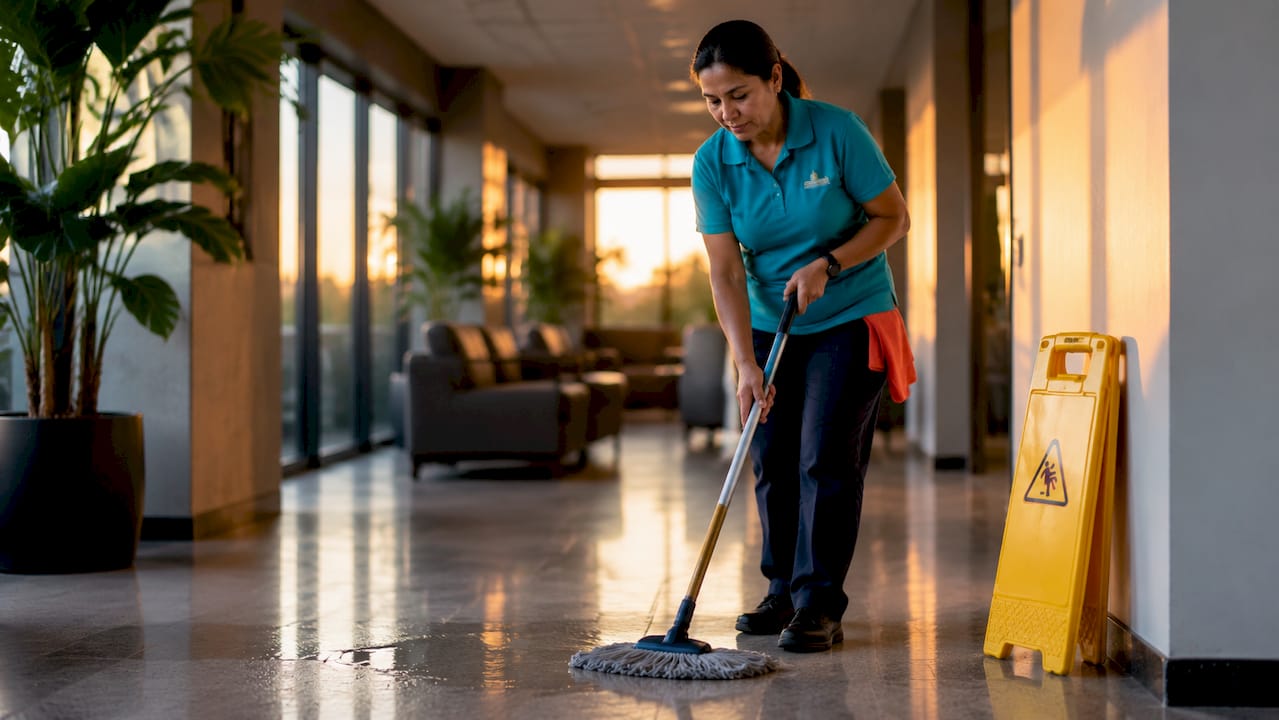
Client and visitor perception is shaped within seconds of entering your office. A spotless reception area, clean restrooms, and well-maintained common spaces signal organizational competence before a single word is spoken. That first impression directly supports your brand’s credibility with prospective clients and partners.
Employee morale is the third dimension of this benefit. Employee comfort and hygiene directly affect morale, engagement, and company culture, influencing long-term business performance. Unclean workplaces correlate with disengagement and lower productivity. When employees see that their employer maintains a clean, well-ordered environment, it communicates respect for their wellbeing.
Office hygiene is an essential component of employee wellbeing and long-term engagement, not just a janitorial task. HR professionals increasingly recognize workplace cleanliness as part of company culture. Businesses that treat it as such report stronger retention and higher scores on internal engagement surveys.
Allergen control is a specific safety benefit worth calling out. Professional cleaners use HEPA filtration equipment that captures fine particulates, reducing the allergen load in the air. Employees with asthma or allergies experience fewer symptoms, which translates directly to fewer sick days and higher daily output.
What expertise and equipment do professional cleaners actually bring?
The true value of professional cleaning lies in technical knowledge that most in-house staff simply do not have. Here is what a qualified commercial cleaning team brings to your facility:
-
Correct disinfectant dwell times. Disinfectants only kill pathogens when left on a surface for the manufacturer-specified contact time. Most non-professional cleaning wipes surfaces immediately, rendering the product ineffective. Trained technicians follow label instructions precisely.
-
Proper chemical dilution. Over-concentrated cleaning solutions damage surfaces and leave residue. Under-diluted solutions fail to sanitize. Professional teams use calibrated dispensing systems to get this right every time.
-
HEPA filtration vacuums. Standard vacuums recirculate fine dust and allergens back into the air. Industrial-grade HEPA vacuums capture particles down to 0.3 microns, genuinely removing contaminants rather than redistributing them.
-
Surface-specific protocols. Carpet, hardwood, tile, and laminate each require different cleaning agents and techniques. Applying the wrong product to the wrong surface causes premature wear. Professional cleaners carry surface-specific knowledge that protects your flooring investment. For a detailed look at what this means for your floors, the professional floor cleaning benefits guide from Zia Building Maintenance covers this thoroughly.
-
HVAC and air quality maintenance. Dust buildup on vents and filters reduces HVAC efficiency and circulates contaminants through the building. Professional cleaning programs include vent cleaning and filter checks that keep air quality at a healthy standard.
Non-professional cleaning often only redistributes dust without true removal. That distinction matters enormously for offices where air quality directly affects employee health and cognitive performance. Facility managers who understand this difference make better decisions about what to expect from office cleaning contracts and how to evaluate provider quality.
Pro Tip: Ask any prospective cleaning provider to show you their disinfectant product data sheets and explain their dwell time protocols. A provider who cannot answer that question clearly is not delivering true sanitization.
Key takeaways
Professional office cleaning is a direct investment in workforce health, asset longevity, and operational efficiency that consistently outperforms in-house cleaning on cost, consistency, and measurable outcomes.
| Point | Details |
|---|---|
| Sick day reduction | Professional cleaning cuts sick days by up to 46%, recovering hundreds of work hours annually. |
| Cognitive performance | Improved indoor air quality produces an 8% gain in employee cognitive function. |
| Asset protection | Professional floor care extends commercial flooring life by 30–50%, delaying major replacement costs. |
| Operational efficiency | Outsourcing eliminates training, supervision, and supply procurement from facility management workloads. |
| Technical expertise | Correct dwell times, HEPA filtration, and surface-specific protocols deliver results in-house cleaning cannot replicate. |
What i’ve learned after years of watching businesses get this wrong
Most businesses that resist professional cleaning do so because they see the invoice and compare it only to the cost of a part-time cleaner. That comparison misses the full picture entirely. The real cost of inadequate cleaning shows up in sick day patterns, employee turnover, flooring replacement schedules, and client perception. None of those costs appear on the cleaning line of a budget.
I have seen facility managers make the switch to contracted commercial cleaning and then express genuine surprise at how much time their team recovered. Procurement, scheduling, supply orders, and coverage calls for absent cleaning staff consumed hours every week. A single well-structured contract eliminated all of it.
The other misconception I encounter regularly is that professional cleaning is a luxury for large corporations. Zia Building Maintenance has served Albuquerque businesses since 1989, including small offices and medical facilities that operate on tight budgets. The right provider builds a plan around your actual square footage, traffic patterns, and cleaning frequency needs. You are not paying for services you do not need.
My honest advice: evaluate providers on their protocols, not just their price. Ask about dwell times, surface-specific training, and how they handle staff absences. A provider who answers those questions confidently is one you can trust with your facility.
— Ashley
Keep your office clean, healthy, and running smoothly
A well-maintained office does not happen by accident. Zia Building Maintenance has delivered consistent, professional commercial cleaning to Albuquerque businesses across offices, medical facilities, and schools since 1989. Whether you need routine daily upkeep, periodic deep cleaning, or specialty floor care, the team builds a plan around your specific facility requirements.
Partnering with a reliable provider means fewer sick days, lower management overhead, and office assets that last longer. If you are ready to see what a customized cleaning program looks like for your space, explore the office cleaning services Zia Building Maintenance offers in Albuquerque. Request an estimate and get a plan built around your schedule, your space, and your standards.
FAQ
How much do professional office cleaning services cost?
Professional office cleaning costs vary by square footage, cleaning frequency, and service scope. Most commercial contracts are priced per visit or per square foot, with routine cleaning typically more affordable than one-time deep cleaning sessions.
How often should an office be professionally cleaned?
Most offices benefit from professional cleaning three to five times per week, with high-traffic areas and restrooms requiring daily attention. The right cleaning frequency depends on headcount, foot traffic, and the nature of work performed in the space.
Can professional cleaning actually reduce employee sick days?
Yes. Businesses investing in professional commercial cleaning see up to 46% fewer sick days, with each recovered workday worth $200 to $400 in avoided productivity loss.
What is the difference between office cleaning and janitorial services?
Office cleaning typically refers to scheduled surface and hygiene maintenance, while janitorial services often include broader facility upkeep such as floor care, restocking, and minor maintenance tasks. The office cleaning versus janitorial service guide from Zia Building Maintenance explains the distinction in detail.
Does professional cleaning improve indoor air quality?
Professional cleaning programs that use HEPA filtration vacuums and include HVAC vent maintenance significantly reduce airborne particulates. Standard cleaning redistributes dust rather than removing it, making professional-grade equipment the critical difference.