

Sterile environment cleaning means commercial janitorial sanitation and disinfection protocols designed to reduce pathogens and keep offices, clinics, schools, and similar spaces infection-control ready. It is not clinical sterilization of surgical instruments. Four core elements define a sound program:
- Risk-based SOPs that zone spaces by infection risk and assign task frequencies accordingly
- EPA-registered hospital disinfectants applied per manufacturer Instructions for Use (IFU), including required dwell time
- Trained staff equipped with appropriate PPE and bloodborne pathogen (BBP) awareness
- Auditable documentation recording task, product, responsible person, and completion date
CDC environmental cleaning guidance, EPA-registered product lists (including List G and List K for specific pathogen claims), and OSHA’s bloodborne pathogen standard together form the regulatory backbone. In Albuquerque, Zia Building Maintenance delivers programs built on exactly these elements for medical offices, schools, and commercial facilities.
Key Takeaways
Sterile environment cleaning in commercial facilities requires risk-based SOPs, EPA-registered hospital disinfectants applied at correct dwell times, trained and BBP-aware staff, and auditable documentation to maintain infection-control-ready conditions.
| Point | Details |
|---|---|
| Definition | Commercial sterile cleaning means infection-control-ready sanitation, not clinical sterilization of instruments. |
| Four SOP must-haves | Risk zoning, EPA-registered disinfectants with dwell time, PPE and BBP training, and written documentation. |
| Verification basics | Use visual audits, fluorescent marker tests, and ATP meters; tie pass/fail thresholds to your SLA. |
| Frequency by risk | High-touch surfaces daily; terminal cleans after each discharge; outbreak protocols on a pre-planned surge schedule. |
| Zia Building Maintenance | Zia delivers documented, infection-control-ready cleaning for Albuquerque offices, medical facilities, and schools since 1989. |
Table of Contents
- Why does infection-control cleaning matter for your facility?
- What do “clean,” “sanitize,” and “disinfect” actually mean?
- What must your SOP and cleaning contract actually specify?
- How should staff handle blood and body-fluid spills?
- How do you verify that cleaning is actually working?
- What does a practical cleaning schedule look like?
- Who is responsible for what?
- What should you ask before hiring a cleaning service?
- Systems beat tactics every time
- Zia Building Maintenance: infection-control-ready cleaning for Albuquerque facilities
- Sources
- FAQ
Why does infection-control cleaning matter for your facility?
Poor cleaning protocols carry real operational costs. Occupants who doubt their building’s hygiene report lower satisfaction, and hygiene directly affects occupant experience and business outcomes in ways facility managers can measure, from absenteeism to tenant retention. Restroom cleanliness alone is one of the strongest proxies occupants use to judge an entire building’s safety.
Compliance pressure adds another layer. Healthcare-adjacent spaces must align with OSHA’s BBP standard (29 CFR 1910.1030), which requires written exposure control plans, PPE, and documented staff training. Facilities that ignore CDC and EPA guidance risk both regulatory exposure and reputational damage when an outbreak occurs.
- Fewer sick days and complaints when high-touch surfaces are disinfected on a documented schedule
- Stronger occupant trust, which translates to lease renewals and patient retention
- Reduced liability when written SOPs and audit records demonstrate due diligence
Pro Tip: Reframe cleaning as a building-health investment, not a line-item expense. Experts recommend integrating building science with infection-control cleaning to improve both occupant health and facility performance.
What do “clean,” “sanitize,” and “disinfect” actually mean?
These terms have distinct, operational meanings. Using them interchangeably in a contract creates gaps that auditors and inspectors will find.
- Cleaning removes visible soil, dust, and organic matter. It is always the first step because organic matter blocks disinfectant chemistry.
- Sanitizing reduces microbial counts to public-health levels on food-contact surfaces. It is not sufficient for clinical or healthcare-adjacent spaces.
- Disinfecting uses an EPA-registered hospital disinfectant to destroy or inactivate pathogens on non-porous surfaces. The product must carry the correct label claim, be applied at the correct dilution, and remain wet for the full contact time listed on the label.
- “Sterile” in this article means infection-control ready: a documented, risk-stratified cleaning and disinfection program that keeps pathogen loads at safe levels. It does not mean every microorganism has been eliminated, which is the clinical definition used in surgical sterilization.
When soil is present, a two-step process is required: clean first, then apply disinfectant. Some one-step cleaner-disinfectants are labeled for lightly soiled surfaces, but the CDC guideline confirms that thorough cleaning must precede disinfection whenever visible contamination is present.
Pro Tip: Require contractors to provide the EPA registration number and IFU for every disinfectant they use. If a product is not on EPA List G or List K for the pathogens relevant to your space, it may not deliver the protection the label implies.
What must your SOP and cleaning contract actually specify?
System design, not effort, drives consistent outcomes in commercial cleaning. A written SOP is the mechanism that turns effort into a repeatable program.
- Risk stratification and zoning. Map every area as high-touch (exam rooms, restrooms, reception desks, elevator buttons) or low-touch (private offices, storage). Assign disinfection frequency to each zone.
- Product policy. List approved EPA-registered hospital disinfectants by name, EPA registration number, dilution ratio, and required dwell time. Ready-to-use products reduce dilution error; concentrated products require verified dispensing equipment.
- PPE requirements. Specify gloves, eye protection, and gowns for high-risk tasks. BBP-exposed tasks require additional respiratory protection per OSHA guidance.
- Tool and equipment control. Require color-coded microfiber systems and dedicated carts to prevent cross-contamination between clean and dirty zones. HEPA-rated vacuums reduce re-aerosolization of allergens and fine particulates.
- Documentation. Every completed task must be logged with the product used, responsible staff member, date, time, and verification result.
| SOP Field | What to Capture |
|---|---|
| Task | Surface or area cleaned/disinfected |
| Product used | Name, EPA reg. number, dilution |
| Responsible person | Staff name or ID |
| Date and time | Completion timestamp |
| Verification result | Pass/fail, corrective action taken |
Pro Tip: Ask vendors to upload IFUs to a shared folder and require automated dilution verification on dispensing equipment. A single dilution error can render an entire disinfection run ineffective.
How should staff handle blood and body-fluid spills?
OSHA’s BBP standard requires a written exposure control plan, documented staff training, appropriate PPE, and a defined waste-handling procedure. Medical facility janitorial services must manage these requirements differently from general commercial cleaning, and your contract should reflect that distinction.
For any blood or body-fluid spill, the priority sequence is:
- Isolate the area and restrict access
- Don gloves, eye protection, and gown before approaching the spill
- Remove gross soil with absorbent material; dispose of it in a labeled biohazard bag
- Clean the surface with a detergent solution
- Apply an EPA-registered hospital disinfectant at the correct dilution and allow full contact time
- Dispose of all contaminated materials per facility waste policy; remove and bag PPE before leaving the area
- Document the incident, the products used, and the staff involved
Pro Tip: Include an escalation and record-keeping clause in every cleaning contract. Any potential BBP exposure incident must be reported, documented, and reviewed within 24 hours. Contracts that omit this clause leave both parties exposed.
How do you verify that cleaning is actually working?
Verification closes the loop between what the SOP requires and what staff actually deliver. Three practical methods cover most commercial facilities:
- Visual audits catch obvious misses: missed surfaces, product residue, improperly stored equipment. They are fast but subjective.
- Fluorescent marker tests (UV-detectable gel applied before cleaning, checked after) reveal whether staff wiped the marked surface at all. They are an effective training and accountability tool.
- ATP meters measure adenosine triphosphate, a proxy for organic residue. They give a numeric result that can be trended over time and tied to pass/fail thresholds in an SLA.
The CDC recommends working clean-to-dirty and high-to-low, and audit sample points should mirror that logic: start with the highest-risk surfaces in each zone.
| Audit Field | What to Record |
|---|---|
| Area and sample point | Room, surface, or fixture audited |
| Verification method | Visual, fluorescent marker, or ATP |
| Result | Pass/fail or numeric ATP reading |
| Corrective action | Immediate re-clean, retraining, or SOP revision |
Pro Tip: Tie ATP pass/fail thresholds directly into your service-level agreement. When a zone fails two consecutive audits, the SLA should trigger an automatic competency review for the assigned crew.
What does a practical cleaning schedule look like?
Frequency should follow risk, not habit. A flat “clean everything daily” schedule wastes resources on low-risk areas while under-protecting high-touch zones.
- Daily: Disinfect all high-touch surfaces (door handles, light switches, faucet handles, shared equipment), clean and disinfect restrooms, empty waste receptacles, mop hard floors in traffic areas.
- Weekly: Detail low-touch surfaces, clean interior glass, sanitize breakroom appliances, inspect and restock PPE and product supplies.
- Terminal/turnover clean: Full room disinfection after a patient discharge, room changeover, or extended occupancy. Includes all surfaces, fixtures, and equipment in the space.
- Outbreak/enhanced response: Increase high-touch disinfection to multiple times per day, add fluorescent marker verification, and document every cycle.
| Task Category | Recommended Frequency |
|---|---|
| High-touch surfaces | Daily (minimum); multiple times daily during outbreaks |
| Restrooms | Daily; more frequently in high-traffic facilities |
| Low-touch surfaces | Weekly |
| Floors (hard) | Daily traffic areas; weekly detail |
| Terminal/room turnover | After each discharge or occupancy change |
Plan surge capacity before an outbreak, not during one. Identify which tasks can be accelerated and which staff are trained to handle enhanced protocols.
Who is responsible for what?
Clear accountability prevents gaps. Responsibilities split across three groups.
Facilities manager: Defines the risk profile and zoning map, procures approved disinfectants, schedules and reviews audits, integrates the cleaning program with the infection prevention committee (IPC), and owns the SOP document.
Cleaning contractor: Delivers SOP-compliant service, maintains staff training and BBP competency records, manages PPE and product inventory, and submits documentation after every service visit. Healthcare-grade janitorial training requirements should be a contract attachment, not an assumption.
Clinical or operational staff: Handle point-of-care waste appropriately, notify the cleaning team immediately when a high-risk event occurs, and participate in multidisciplinary IPC coordination.
Pro Tip: Include a RACI-style clause in the statement of work. Assign Responsible, Accountable, Consulted, and Informed roles for at least five scenarios: routine cleaning, spill response, outbreak response, audit failure, and exposure incident.
What should you ask before hiring a cleaning service?
Procurement is where most programs succeed or fail. Use this checklist before signing any contract.
- Does the vendor carry documented BBP training records for every staff member assigned to your site?
- Can they provide the EPA registration numbers and IFUs for all disinfectants they plan to use?
- Do they use color-coded microfiber and dedicated carts? Do they have HEPA-rated vacuums?
- What is their audit cadence, and will they share results with you in writing?
- How do they handle an outbreak or a BBP exposure incident?
Red flags in proposals include vague product lists (“hospital-grade cleaner” without an EPA number), no mention of dwell time, and no written SOP or training documentation. A commercial cleaning contract checklist should require SOP attachments, IFU adherence clauses, and SLA metrics tied to audit results.
Pro Tip: Build a 30-day trial period into the contract with defined pass/fail ATP thresholds. A vendor confident in their protocols will accept performance-based milestones.
Systems beat tactics every time
The facilities that maintain the cleanest, safest environments in Albuquerque share one trait: they treat cleaning as a system, not a series of tasks. A mop and a bottle of disinfectant accomplish nothing without a zoning map, a trained crew, a documented SOP, and a verification loop that catches failures before they become incidents.
Ad-hoc cleaning, even with good products, produces inconsistent results because it depends on individual memory rather than repeatable procedure. The investment in system design, including training, audit routines, and written accountability, pays back in fewer complaints, fewer sick days, and a facility that can demonstrate compliance when it matters.
Pro Tip: Schedule a quarterly SOP review with your contractor. Protocols that made sense when the building had 50 occupants may need adjustment at 200. Cleaning programs should evolve with the facility.
Zia Building Maintenance: infection-control-ready cleaning for Albuquerque facilities
Albuquerque facility managers and healthcare administrators who need a cleaning partner that already understands SOPs, EPA-registered disinfectants, and audit documentation don’t have to build that program from scratch.
Zia Building Maintenance has served offices, medical facilities, and schools in Albuquerque since 1989, earning the #1 office cleaning service ranking in South Valley for 2025. The team delivers professional medical office cleaning with documented BBP training, color-coded microfiber systems, HEPA-rated equipment, and written audit reports after every visit. Whether you need a full SOP review, a sample statement of work, or a site assessment to map your risk zones, Zia Building Maintenance is ready to support your program. Contact Zia Building Maintenance today to request a site assessment and a sample office cleaning services proposal tailored to your facility’s risk profile.
Sources
- Think Holistically for Healthy Buildings
- Cleaning commercial buildings: a complete program for FMs – Facility Management Insights
- Guideline for Disinfection and Sterilization in Healthcare Facilities, 2008
- Compliance to culture: how facility managers can transform hygiene into competitive advantage | Buildings
- Medical facility janitorial services: compliance and infection control | Janitorial Authority
Manufacturer IFUs and product labels are legal and operational sources of truth. When a label and an SOP conflict, the label governs.
This article is general information, not a substitute for advice from a qualified doctor. Consult a qualified healthcare professional about your own circumstances before acting on anything here.
FAQ
What does sterile environment cleaning mean in a commercial facility?
It means a documented sanitation and disinfection program that reduces pathogens to safe levels in offices, clinics, and schools using EPA-registered hospital disinfectants, trained staff, and written SOPs. It is not the same as clinical sterilization used for surgical instruments.
What is the difference between cleaning, sanitizing, and disinfecting?
Cleaning removes visible soil; sanitizing reduces microbial counts to public-health levels; disinfecting uses an EPA-registered hospital disinfectant to destroy pathogens. Cleaning must always come first because soil blocks disinfectant chemistry.
Why does dwell time matter so much?
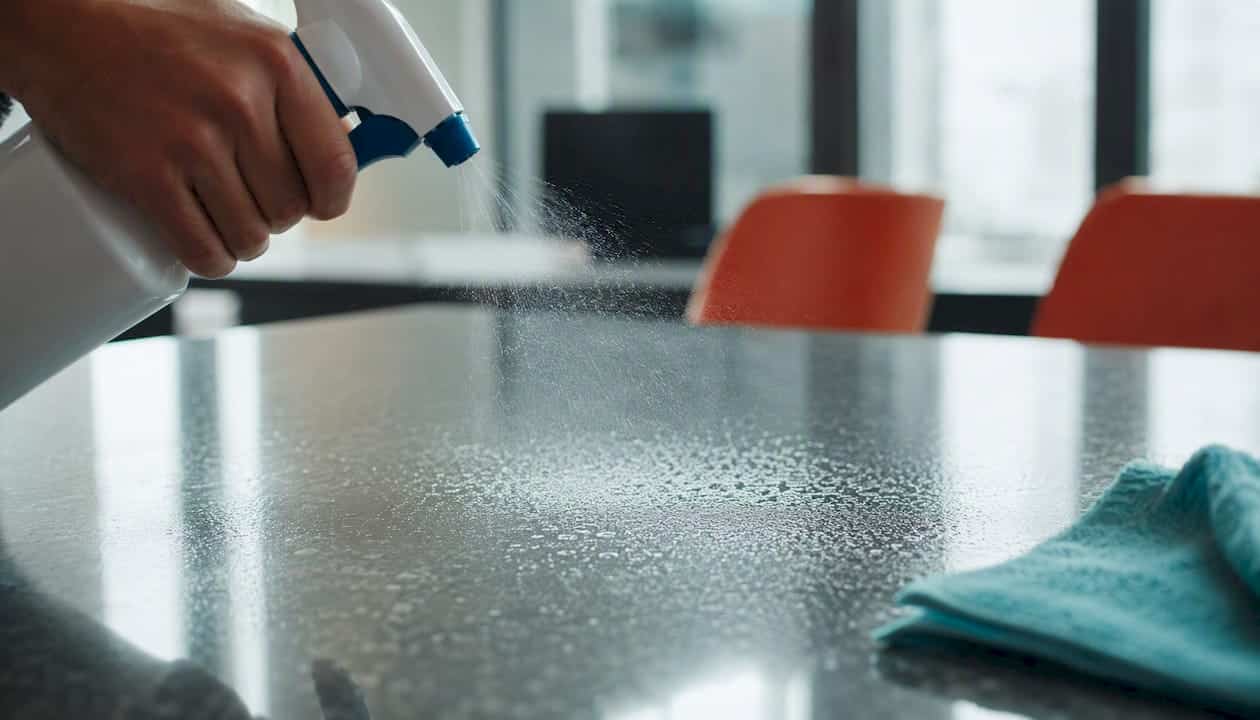
A disinfectant only works if the surface stays wet for the full contact time listed on the label. Wiping the product away too soon, a common “spray-and-wipe” mistake, nullifies the disinfectant claim regardless of the product’s EPA registration.
What should a cleaning contract include for infection-control-ready facilities?
The contract should attach the SOP, list approved EPA-registered disinfectants with registration numbers and IFUs, specify audit cadence and ATP thresholds, and include escalation procedures for spills and BBP exposure incidents.
How can Zia Building Maintenance support a sterile-environment cleaning program?
Zia Building Maintenance provides documented BBP training, EPA-registered disinfectant programs, color-coded microfiber systems, and written audit reports for Albuquerque offices, medical facilities, and schools. Contact Zia to request a site assessment and a sample statement of work.