
Key Takeaways
| Point | Details |
|---|---|
| Three-zone system is the standard | Use an exterior scraper, transition/wiper, and interior walk-off mat at every commercial entry. |
| Run length drives capture rate | A mat run around 12–15 feet captures a high proportion of tracked-in soil; shorter runs cannot compensate with pile quality alone. |
| Maintenance determines performance | Saturated mats shed dirt back into the building; vacuum by foot count and launder on a documented schedule. |
| ROI is measurable | Avoided strip-and-wax cycles and reduced extraction frequency typically offset mat program costs within one year. |
| Zia Building Maintenance operationalizes the program | Zia provides entry audits, three-zone specification, scheduled servicing, and condition reporting as part of a complete floor care contract. |
Table of Contents
- The role of floor matting in building maintenance, explained directly
- How do mats actually stop dirt and moisture from entering a building?
- How do floor mats improve safety and reduce slip-and-fall risk?
- How matting protects floors and lowers your total maintenance costs
- What types of commercial mats do you need, and where does each one go?
- Where should floor mats be placed? The three-zone entrance system
- Maintaining mats so your program keeps working
- Building the business case: KPIs and a simple ROI example
- What to specify when purchasing or renting commercial mats
- Common matting mistakes and how to fix them
- How Zia Building Maintenance treats matting as part of a complete cleaning program
- Why matting must be treated as a system, not a product
- Zia Building Maintenance: a professional partner for your matting and floor care program
- Sources
- FAQ
The role of floor matting in building maintenance, explained directly
Entryway matting is the first and most cost-effective line of defense in any commercial facility: it captures tracked-in soil and moisture before they reach interior floors, reduces slip risk at the most dangerous transition points in a building, and extends the service life of floor finishes. When correctly specified and maintained, a 15-foot matting run can stop a substantial share of entry soil before it ever reaches your interior. That single figure is why the importance of floor matting belongs at the top of every facility manager’s maintenance budget conversation, not buried in a supply line item.
The National Floor Safety Institute (NFSI) and OSHA both identify wet and contaminated walking surfaces as leading contributors to workplace slip-and-fall incidents. A properly designed matting system addresses that risk at the source. Here is what to act on immediately:
- Measure your current entry mat run. If it is shorter than 12 feet, you are not capturing the majority of tracked-in soil.
- Confirm you have three zones covered: an exterior scraper, a transition/wiper mat, and an interior walk-off mat.
- Inspect mat condition today. Curled edges, flat pile, and visible soil saturation are replacement signals, not cosmetic issues.
- Add a servicing cadence to your cleaning scope of work (SOW). Vacuuming frequency should match foot traffic volume, not a calendar date.
How do mats actually stop dirt and moisture from entering a building?
The mechanics work in stages, and each stage depends on the one before it. An exterior scraper mat uses stiff bristles or rubber nibs to dislodge coarse grit, gravel, and heavy mud from shoe soles before a person crosses the threshold. That coarse debris is the most abrasive material your floors will encounter. Stopping it outside is the highest-leverage action in any matting program.
The transition or wiper mat, positioned just inside the door, handles finer particles and begins absorbing surface moisture. By the time a person takes their fourth or fifth step, the worst of the contamination has already been removed. The interior walk-off mat finishes the job: it captures residual fine soil and dries the sole completely, so the person walking into your building leaves a clean, dry footprint on your floor.
The lift-the-mat diagnostic: Lift your interior walk-off mat and compare the floor beneath it to the floor just beyond the mat’s edge. If the floor under the mat is noticeably cleaner, the mat is working. If both surfaces look the same, the mat is saturated and has stopped capturing. This single test tells you more about mat performance than any visual inspection of the mat surface itself.
Contact time is what makes the system work. The more steps a person takes across matting, the more soil and moisture are removed. A single 3-foot mat at a doorway gives a person roughly two steps of contact. Industry playbooks recommend 12–15 feet of coverage to achieve meaningful capture rates, because that length corresponds to the number of steps needed to transfer the bulk of surface contamination from the shoe to the mat. No amount of pile quality compensates for a run that is simply too short.
How do floor mats improve safety and reduce slip-and-fall risk?
Water and tracked-in contaminants dramatically reduce the coefficient of friction on hard floor surfaces. Polished concrete, vinyl composition tile (VCT), and ceramic tile all become significantly more slippery when wet. Matting interrupts that chain: it absorbs moisture at the entry point, so the walking surface beyond the mat stays dry and maintains its rated traction.
Practical measurements to run on your site:
- Static coefficient of friction (SCOF) checks: Use a drag sled or tribometer to baseline your entry floor’s SCOF in dry and wet conditions. NFSI guidelines target a wet SCOF of 0.6 or higher for pedestrian surfaces.
- Wet-weather observation logs: After rain or snow events, walk your entries and document where water is tracking beyond the mat edge. Photograph the wet zone and measure its distance from the door.
- Incident-trend tracking: Cross-reference slip-and-fall incident reports with entry points and weather conditions. A pattern of incidents at one entry during wet weather is a direct specification failure.
Pro Tip: After a heavy rain event, inspect each entry within the first 30 minutes of peak morning traffic. Note whether the mat is visibly saturated, whether water is tracking past the mat edge, and whether the floor beyond the mat is wet. Log these observations with a timestamp and photo. Three consecutive wet-weather failures at the same entry justify an immediate mat upgrade or run extension.
Reducing slip incidents also reduces liability exposure. Workers’ compensation claims and premises liability settlements tied to slip-and-fall incidents carry costs that dwarf the annual budget for a well-specified matting program. Framing mat investment as risk mitigation, not just cleanliness, tends to move procurement decisions faster.
How matting protects floors and lowers your total maintenance costs
Silica grit is the primary enemy of hard floor finishes. It is microscopic, angular, and abrasive. Every step that tracks silica across a waxed VCT floor or a sealed concrete surface acts like fine sandpaper on the finish layer. The result is accelerated dulling, micro-scratching, and finish failure that requires stripping and recoating far sooner than the floor’s design life would suggest. Carpet fares no better: grit works its way into the fiber base and cuts the backing over time, shortening carpet life significantly.
Matting interrupts that process at the door, so fewer abrasive particles reach the interior, which means:
- Fewer strip-and-wax cycles on hard floors
- Reduced carpet extraction frequency
- Lower chemical consumption per cleaning cycle
- Less labor time spent on floor restoration tasks
A simple ROI framework for your facility: add up your annual mat cost (purchase or rental) plus servicing labor. Then estimate the avoided costs: one fewer strip-and-wax cycle per year, reduced carpet extraction frequency, and lower chemical spend. For a medium-traffic commercial entry, the Opora Supply matting playbook documents cases where increasing mat zone coverage and servicing frequency produced measurable reductions in extraction and refinishing cycles. The payback period on a properly specified mat program is typically well under one year when avoided floor maintenance costs are included.
| Cost category | Without adequate matting | With three-zone matting program |
|---|---|---|
| Strip-and-wax cycles per year | 4–6 | 2–3 |
| Carpet extraction frequency | Monthly | Quarterly |
| Entry cleaning labor per week | Higher (wet mopping, spot treatment) | Lower (dry maintenance dominant) |
| Floor finish lifespan | Shortened by grit abrasion | Extended by reduced particle load |
Matting also supports green-building certification credits under frameworks such as LEED and WELL, which recognize permanent entryway matting as a contributor to indoor air quality and reduced chemical use. If your facility is pursuing or maintaining a sustainability certification, a documented matting program belongs in your submission.
What types of commercial mats do you need, and where does each one go?
Commercial matting falls into five functional categories. Choosing the right type for each zone is as important as the run length.
Outdoor scraper mats
Heavy-duty rubber or vinyl mats with raised nibs, open-grid patterns, or stiff bristles. Their job is mechanical: dislodge coarse debris before it enters the building. They must tolerate weather exposure, UV, and heavy foot traffic without degrading. Rubber-backed open-grid designs allow debris to fall through rather than accumulate on the surface.
Transition/wiper mats (indoor-outdoor)
Positioned just inside the threshold, these mats combine a scraping function with initial moisture absorption. Polypropylene or nylon pile over a rubber backing is the standard specification. They handle the transition from outdoor to indoor conditions and begin the drying process.
Interior walk-off mats
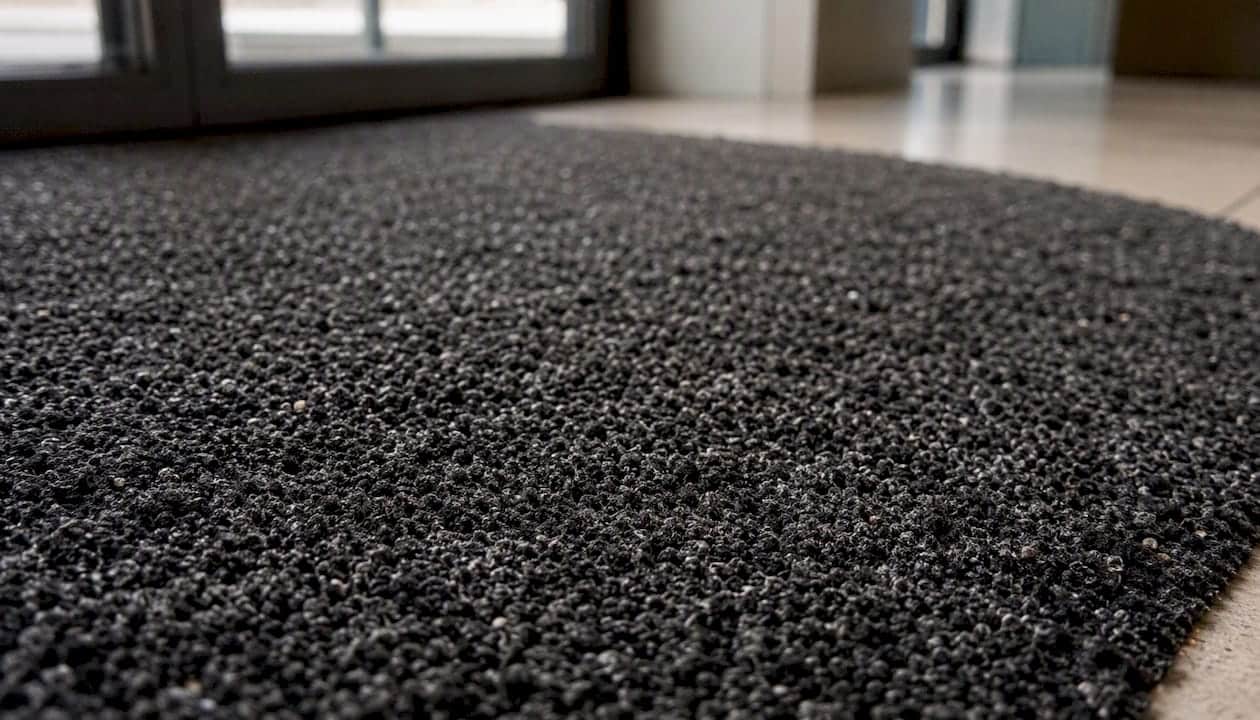
Placed 6–10 feet inside the entry, these mats complete moisture removal and capture fine soil. Nylon or microfiber pile offers the highest absorption capacity. These mats see less abrasive loading than scrapers, so pile quality matters more here than durability.
Anti-fatigue mats
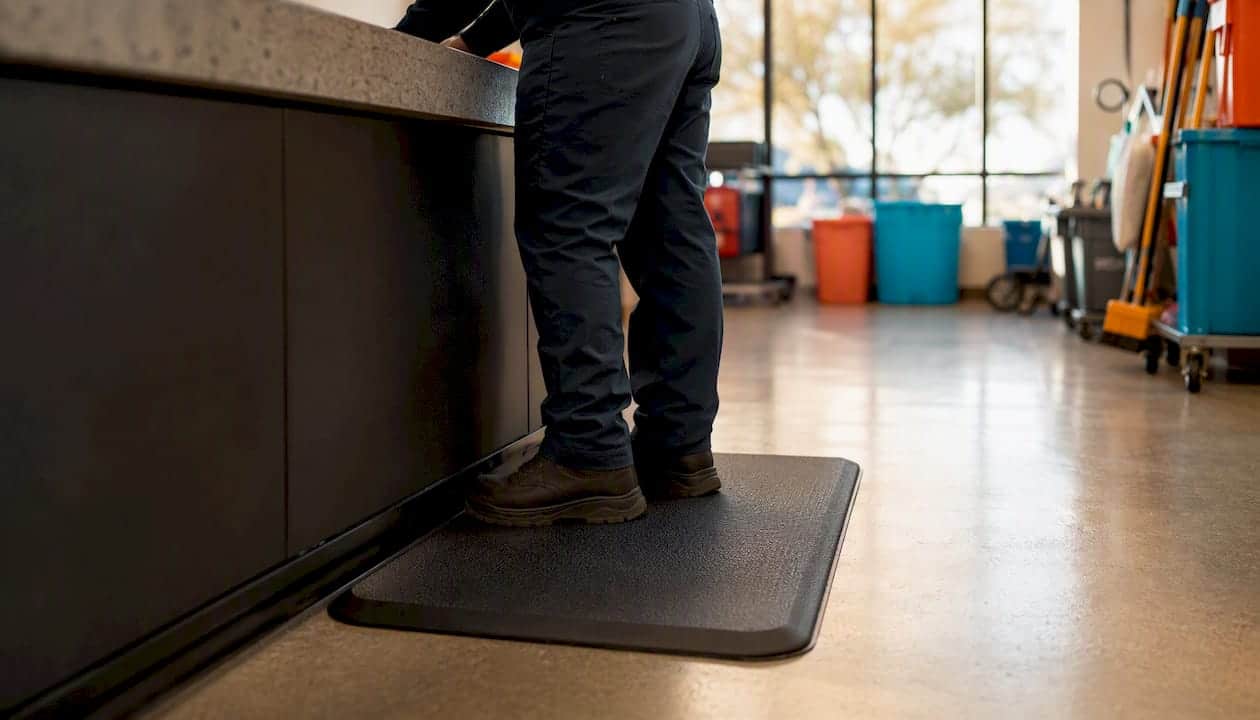
Used at standing workstations, service counters, and kitchen areas. Their function is ergonomic, not soil capture. Foam or gel cores reduce fatigue for staff who stand for extended periods. They are not a substitute for walk-off matting at entries.
Specialty mats
Oil-resistant rubber mats for service areas and kitchens, tacky mats for cleanrooms and controlled environments, and chemical-resistant mats for laboratory or industrial zones. Each is specified for a hazard type, not general soil capture.
Pro Tip: If you use a rental mat program, confirm that the rental supplier’s standard mat dimensions match your zone specifications before signing. Many rental programs default to 3-foot by 5-foot mats, which are undersized for most commercial entries. Negotiate custom dimensions or supplement with owned mats at high-traffic zones. For a detailed look at how one-size-fits-all cleaning approaches fall short, the same principle applies directly to mat programs.
Where should floor mats be placed? The three-zone entrance system
The three-zone system is the standard framework recommended by manufacturers and facility maintenance professionals for commercial entries. It works because each zone targets a different contamination load and a different phase of the shoe-cleaning process.
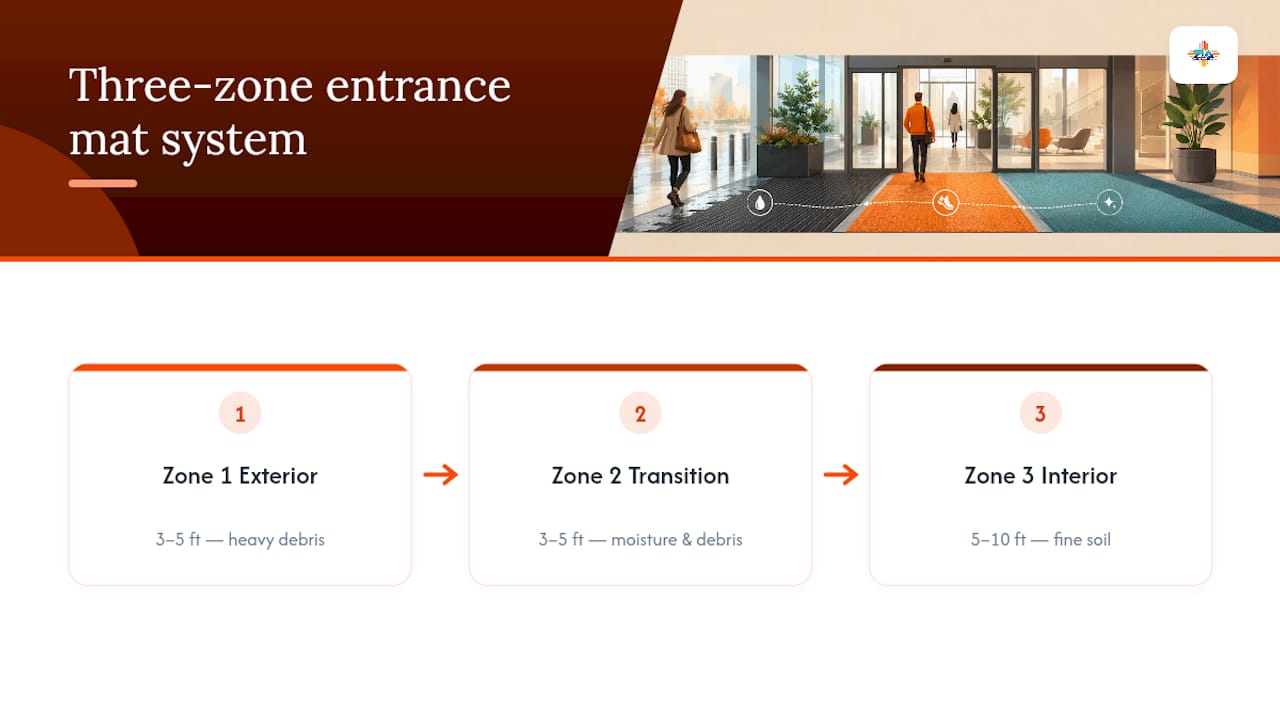
Zone 1 (exterior scraper): Positioned outside the entry door, extending at least 3–5 feet from the threshold. This zone handles the heaviest debris load. The mat must be anchored securely to prevent trip hazards and must drain freely so it does not pool water.
Zone 2 (transition/wiper): Positioned at the threshold or just inside the door, extending 3–5 feet. This zone bridges outdoor and indoor conditions, handles moderate debris and initial moisture, and must lie flat with no curled edges that could catch a foot.
Zone 3 (interior walk-off): Positioned 5–10 feet inside the entry, extending to complete the 12–15-foot total run. This zone finishes moisture removal and captures fine soil. It should be sized to the full width of the traffic path, not just the door width.
Entry audit checklist
Run this during your next site walk:
- Measure the total mat run from the exterior door to the end of the interior walk-off mat. Record the distance.
- Observe the natural walk path. Do pedestrians step off the mat before reaching the end of the run? If so, the mat is too narrow or the traffic pattern has shifted.
- Lift the interior walk-off mat and inspect the floor beneath it (the lift-the-mat diagnostic described earlier).
- Check all mat edges for curling, bubbling, or separation from the backing.
- Document any gaps between zones where bare floor is exposed.
- Note the floor condition at the first unmatted surface beyond the run. Visible soil or moisture tracking there confirms the run is insufficient.
Pro Tip: Size your mat run for footfall length, not door width. A wide entry with a short mat run will still fail. A narrower entry with a full 15-foot run will outperform it every time.
Maintaining mats so your program keeps working
A mat that is not serviced regularly stops capturing and starts contributing to the problem. CNA’s floor mat program guide is direct on this point: saturated or worn mats shed trapped dirt back into the building and become slip hazards rather than slip preventers. Servicing frequency must be driven by foot count, not calendar dates.
Daily and event-driven tasks:
- Vacuum walk-off and transition mats daily at high-traffic entries (500+ pedestrians per day). Lower-traffic entries can use a 2–3 day cycle.
- After rain or snow events, wet-vac or extract mats before they reach saturation. A saturated mat cannot absorb additional moisture and will transfer it to the floor.
- Shake or beat outdoor scraper mats daily to clear accumulated debris from the grid or bristles.
Laundering and deep extraction:
- Launder textile mats weekly for high-traffic entries, biweekly for moderate traffic. Rental programs typically handle this on a fixed schedule; owned mats require a designated laundering arrangement.
- Deep-extract walk-off mats quarterly regardless of traffic, or whenever the lift-the-mat diagnostic shows the mat is no longer capturing effectively.
Replacement triggers:
- Pile height reduced to less than half its original depth
- Backing delamination or visible cracking
- Persistent curling edges that cannot be flattened
- Mat fails the lift-the-mat diagnostic after laundering
Pro Tip: Add mat servicing as a named line item in your cleaning SOW, with specific frequencies tied to each entry’s foot count. A well-structured cleaning contract will include mat vacuuming, condition reporting, and replacement triggers as explicit deliverables, not assumptions.
Building the business case: KPIs and a simple ROI example
Presenting a matting program to building ownership or procurement requires measurable KPIs, not just a description of benefits. Track these:
- Interior soil reduction percentage (compare post-mat-program cleaning labor hours to baseline)
- Slip-and-fall incidents at matted entries versus unmatted entries
- Cleaning labor hours saved per week at entry zones
- Chemical use reduction (gallons of floor cleaner and stripper per quarter)
- Mat servicing cost per entry per month
- Mat replacement cadence and cost per entry per year
A worked example using conservative figures: a medium-traffic commercial entry with 300 daily pedestrians, previously using a single 3-foot mat, switches to a three-zone 15-foot system. The facility previously ran four strip-and-wax cycles per year on the adjacent VCT floor at a labor and materials cost of approximately $400 per cycle. After the mat upgrade, strip-and-wax frequency drops to two cycles per year, saving $800 annually. Mat program cost (rental or owned plus servicing) runs approximately $300–$400 per entry per year. Net savings in year one: $400–$500 per entry, before accounting for reduced carpet extraction and chemical spend.
To collect the data for this case:
- Record current foot count at each entry (door counter or manual tally for one week).
- Pull the last 12 months of floor maintenance invoices and identify entry-adjacent floor costs.
- Document current mat run lengths and servicing frequency.
- Run the lift-the-mat diagnostic at each entry and photograph results.
- Present the side-by-side cost table with a payback period and a risk-reduction narrative tied to incident history.
| KPI | Baseline (single mat) | After three-zone program |
|---|---|---|
| Strip-and-wax cycles per year | 4–6 | 2–3 |
| Slip incidents at entry (annual) | Tracked, unresolved | Reduced with documented mat coverage |
| Mat servicing cost per entry/year | Minimal (no program) | Moderate annual cost (including rental or owned service) |
| Net floor maintenance savings | Baseline | $400–$500+ per entry annually |
What to specify when purchasing or renting commercial mats
A clear specification protects you from undersized or underperforming mats and gives suppliers a measurable standard to meet. Build your RFP around these elements:
Material trade-offs:
- Rubber scrapers: highest durability outdoors, low absorption, best for heavy debris zones
- Polypropylene pile: good scraping action, moderate absorption, cost-effective for transition zones
- Nylon pile: highest moisture absorption and soil capture for interior walk-off zones
- Microfiber: premium absorption for high-traffic interior zones; requires more frequent laundering
Slip resistance documentation to request:
- NFSI certification or third-party SCOF test results for the mat backing
- Anti-slip backing specification (rubber, vinyl, or anchor-point system for matwell installations)
- Compliance with ADA requirements for mat edge height and flatness
Vendor deliverables to require:
- Pile height at delivery (minimum spec in millimeters)
- Backing type and anti-slip test results
- Laundering specification (temperature, cycle type, drying method)
- Service-level agreement for rental programs (swap frequency, condition standards)
- Replacement trigger definitions in writing
- Quarterly condition report format
Pro Tip: Align your mat SOW language with your floor maintenance contract. If your floor care provider tracks strip-and-wax frequency, add a clause that links mat replacement triggers to floor condition reports. When both programs share data, you can demonstrate the mat program’s direct impact on floor maintenance costs, which strengthens your next budget request.
Common matting mistakes and how to fix them
The most frequent program failures are predictable, and most are correctable without a full program overhaul.
What not to do:
- Place a single 3-foot mat at a doorway and call it a matting program. Two steps of contact cannot capture meaningful soil load.
- Treat matting as a seasonal purchase. Tracked-in soil and moisture are year-round problems; a mat program that goes away in summer leaves floors unprotected during dry, dusty conditions that are equally damaging.
- Rely entirely on a rental program’s default mat size without verifying it matches your zone specifications.
- Skip documentation. If mat servicing and replacement are not recorded, you cannot demonstrate the program’s value or identify when it is failing.
- Allow the “matting graveyard” pattern to develop: small, mismatched mats scattered at entries create trip hazards and provide inconsistent coverage.
Best practices to implement instead:
- Design by footfall length. Specify a minimum 12-foot run at every entry, extended to 15 feet at high-traffic doors.
- Use all three zones. Each zone targets a different contamination phase; skipping one leaves a gap the others cannot fill.
- Document servicing. Log vacuum dates, launderings, wet-weather extractions, and condition observations for each entry.
- Set replacement triggers in writing and act on them. A mat past its service life is a liability, not an asset.
- Review mat performance quarterly. Use the lift-the-mat diagnostic, incident logs, and floor condition reports together.
How Zia Building Maintenance treats matting as part of a complete cleaning program
Zia Building Maintenance has provided professional floor care services in Albuquerque since 1989, and matting is treated as a system component within every facility cleaning program, not an afterthought. A typical engagement begins with an entry audit: measuring existing mat runs, documenting zone gaps, running the lift-the-mat diagnostic at each entry, and recording foot traffic patterns.
From that audit, Zia specifies a three-zone configuration for each entry, selects mat types matched to the traffic load and floor finish, and builds a servicing cadence into the cleaning SOW. Servicing includes scheduled vacuuming tied to foot count, wet-weather extraction protocols, condition reporting, and replacement management so facility managers are not tracking mat inventory manually.
What the program delivers in practice: When mat coverage is increased from a single entry mat to a full three-zone run and servicing is added to the SOW, facilities typically see a measurable reduction in the frequency of strip-and-wax cycles and carpet extraction, along with a cleaner floor condition at the first unmatted surface beyond the entry. Those outcomes are documented in condition reports and tied directly to the mat program’s servicing record.
Zia’s service features for matting programs include:
- Entry-by-entry site audits with documented findings
- Three-zone mat specification and placement guidance
- Scheduled mat vacuuming and wet-weather extraction
- Laundering coordination for owned mats
- Condition reporting and replacement management
- Integration with broader floor care service programs
Why matting must be treated as a system, not a product
The most consistent mistake facilities make is purchasing mats as a product decision rather than designing a system. A mat sitting in a box is inert. A mat placed at the wrong location, in the wrong size, without a servicing plan, will fail within weeks and may actually make conditions worse once it saturates.
What changes the outcome is treating the entry as a filtration system with three stages, each sized to the actual foot traffic and walk pattern of that specific door. The 12–15-foot run guidance exists because it reflects the number of steps a person needs to transfer the bulk of surface contamination. Shortening the run to save money on mat rental does not save money; it transfers the cost to floor maintenance.
The one action to take in the next 30 days: measure and document one entry’s footfall count and mat run length. Compare the run length to the 12-foot minimum. If there is a gap, you have a quantified, correctable problem. Add that measurement to your next site report, and you have the beginning of a business case. Integrating mat KPIs into routine site reports, alongside cleaning labor hours and floor maintenance frequency, is what turns a matting program from a supply expense into a documented facility asset.
Zia Building Maintenance: a professional partner for your matting and floor care program
Facility managers who want a turnkey matting program without managing it internally have a straightforward option with Zia Building Maintenance. Zia’s office cleaning services in Albuquerque include entry audits, three-zone mat specification, scheduled servicing, and condition reporting, all built into a single cleaning contract.

The practical advantage is consolidation: mat servicing, floor care, and routine janitorial work are coordinated under one SOW, so servicing frequencies stay aligned and condition reports feed directly into floor maintenance planning bundled with air quality programs. Zia has served offices, medical facilities, schools, and commercial properties since 1989, with the operational depth to match servicing cadences to actual foot traffic rather than generic calendar schedules.
To scope a matting program into your cleaning contract, or to request an entry audit, contact Zia Building Maintenance directly. A commercial cleaning contract checklist is available to help you structure the SOW before the conversation.
Sources
- Improving Facility Matting Programs with Manufacturer Guidance
- Entryway and Walk-Off Matting Program Playbook – Opora Supply
- RC-Floor-Mat-Programs-Guide (CNA)
- Matting: The Most Overlooked Part of Floor Care | Great Western Supply Co.
- Entrance Mats for Commercial Buildings: Cut Cleaning Costs
FAQ
What is the purpose of floor mats in a commercial building?
Floor mats capture tracked-in soil and moisture at entry points, reducing slip risk, protecting interior floor finishes from abrasive grit, and lowering the frequency of cleaning and floor restoration work.
Where should floor mats be placed for maximum effectiveness?
Mats should cover a minimum of 12–15 feet from the entry threshold, using three zones: an exterior scraper outside the door, a transition/wiper mat at the threshold, and an interior walk-off mat extending into the building.
What is floor matting, and how does it differ from a standard floor mat?
Floor matting refers to a coordinated system of mats specified by zone, material, and run length for a specific entry, rather than a single mat placed at a doorway. The system approach is what produces measurable soil capture and safety benefits.
What are commercial floor mats called by type?
The main categories are scraper mats (outdoor, heavy debris removal), transition or wiper mats (threshold zone, moisture and fine soil), walk-off mats (interior, final drying and capture), anti-fatigue mats (standing workstations), and specialty mats (oil-resistant, tacky, or chemical-resistant for specific hazard zones).
How often should commercial floor mats be serviced?
High-traffic entries (500+ pedestrians per day) require daily vacuuming and weekly laundering. Lower-traffic entries can use a 2–3 day vacuum cycle and biweekly laundering. After rain or snow events, wet-vac extraction should happen before the mat reaches saturation, regardless of the regular schedule.