

If you manage a building, the single most important thing you can do about cleaning is stop treating it as background noise and start treating it as a measurable service. Maintenance engineers who own this well define the scope of work in writing, set measurable service levels for every zone, and manage vendor performance against those numbers instead of relying on walk-through impressions. Everything else, staffing, pricing, and disputes over quality, traces back to whether that first document exists and whether anyone actually inspects against it.
The facilities custodial apprenticeship standard lays out exactly this kind of ownership. It lists preventive-maintenance duties, boiler checks, HVAC items, pump inspections, alongside custodial responsibilities, which tells you the two functions were never meant to operate in separate silos. A lifecycle approach to buying contract cleaning services backs this up: vague scopes produce wildly different bids that mask real staffing gaps. Zia Building Maintenance, which has run janitorial contracts in the Albuquerque area since 1989, builds every proposal around a written scope for exactly this reason.
Two things to do this week:
- Confirm a written scope-of-work document exists for every cleaning contract you manage, not a verbal understanding with the vendor.
- Schedule a joint site walk with your janitorial provider and your internal operations team before the next contract renewal.
Pro Tip: If your current contract has no inspection clause, that’s the gap to close first. Everything else, pricing disputes, staffing complaints, missed corners, traces back to the absence of a documented standard both sides agreed to.
Key Takeaways
Maintenance engineers who define scope in writing, set measurable inspection standards, and manage vendors against those standards see fewer disputes and better cleaning outcomes.
| Point | Details |
|---|---|
| Write the scope first | Define tasks, frequencies, and acceptance criteria before soliciting any bids. |
| Convert tasks to labor hours | Use time-on-task estimates to compare vendor bids on equal footing, not just square footage. |
| Require an inspection clause | Set a minimum inspection score with corrective-action deadlines built into the contract. |
| Coordinate calendars early | Give 24 to 48 hours notice before major maintenance work affects cleaning routes. |
| Pilot new vendors deliberately | Zia Building Maintenance, operating in Albuquerque since 1989, structures contracts around written scope and inspection from day one. |
Table of Contents
- What Do Maintenance Engineers Own Versus Janitorial Staff?
- How Often Should Different Areas Be Cleaned?
- How Do You Choose and Contract a Janitorial Service?
- How Do You Coordinate Cleaning Around Preventive Maintenance?
- What Safety and Training Standards Should Cleaning Crews Meet?
- What KPIs Prove a Cleaning Contract Is Working?
- Copy-Ready Checklists You Can Use Today
- What Procurement Mistakes Do Facilities Teams Keep Making?
- Let a Local Partner Handle the Details You Shouldn’t Have To
- Sources
- FAQ
What Do Maintenance Engineers Own Versus Janitorial Staff?
Maintenance engineers own the building’s systems: HVAC, boilers, pumps, electrical panels, fire alarm testing, and the preventive-maintenance calendar tied to those assets. Janitorial staff own the visible, recurring sanitation work: restrooms, floors, trash, breakrooms, and surface disinfection. The confusion starts at the boundary, and that’s where scopes fall apart.
A facilities engineer job profile from JLL describes the role as supervising in-house maintenance, running daily inspections, monitoring vendor reports, and managing inventory and asset logs. Notice that “supervising cleaning” sits inside the maintenance engineer’s job even when a contractor performs the actual work. You’re the checkpoint, not the mop.
| Task Category | Owned By | Notes |
|---|---|---|
| HVAC coil cleaning, boiler checks | Maintenance engineer | Preventive-maintenance calendar per apprenticeship standard |
| Restroom sanitation, floor care | Janitorial vendor | Daily/weekly per contracted schedule |
| Small repairs (fixtures, doors) | Maintenance engineer | Escalate if parts or licensing required |
| Supply stocking (paper, soap) | Janitorial vendor | Confirm ownership in SOW to avoid gaps |
| Specialty-area cleaning (medical, pool) | Specialist vendor | Requires certification beyond standard janitorial scope |
Edge cases deserve their own line in the contract. Equipment behind a lockout/tagout barrier is never a janitorial task, full stop. Medical surfaces requiring terminal cleaning protocols, and pool or spa chemical balancing, both call for licensed specialists rather than a general cleaning crew. Our guide on who does what in building maintenance breaks these boundary cases down further.
How Often Should Different Areas Be Cleaned?
Cleaning frequency should map to three defined levels: presentation (visible, high-traffic), standard (daily functional upkeep), and deep (periodic restoration). Restrooms and lobbies typically need presentation-level attention multiple times daily; offices and breakrooms usually run on a standard daily or every-other-day cycle; floors and carpets need periodic deep treatment on a monthly or quarterly rotation.
| Area | Frequency | Typical Time-on-Task |
|---|---|---|
| Restroom touchpoints (sinks, doors, dispensers) | Daily, 2x for high traffic | 8-12 minutes per restroom |
| Trash removal (offices, breakrooms) | Daily | 1-2 minutes per receptacle |
| Vacuuming (open office floor) | Daily or 3x weekly | 1 minute per 1,000 sq ft |
| Hard floor scrubbing/burnishing | Weekly to monthly | 15-20 minutes per 1,000 sq ft |
| Deep floor stripping and refinishing | Quarterly to annually | Varies by square footage and finish condition |
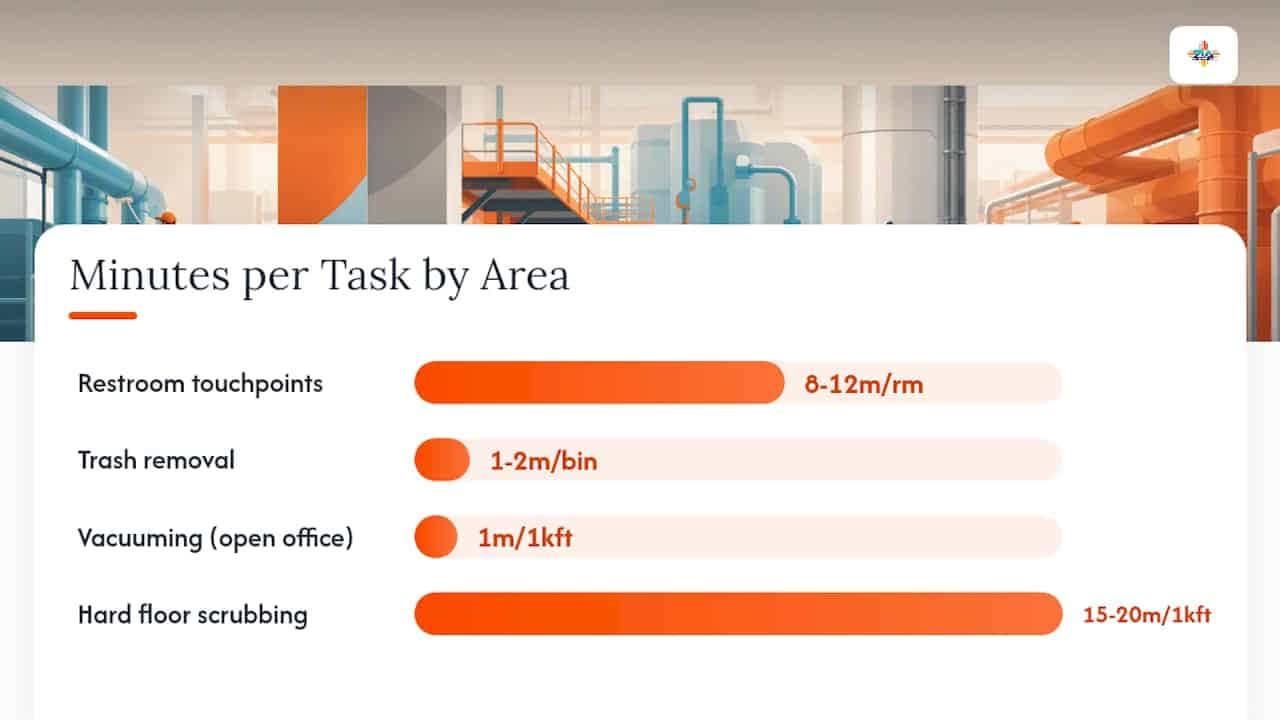
Labor makes up 70% to 80% of contract cleaning costs, which is why converting these frequencies into actual minutes matters more than most facilities managers realize. A vendor bidding on square footage alone can hide a staffing shortfall that a task-level bid exposes immediately. When you multiply time-on-task by frequency and headcount, you get labor hours you can compare across bids apples to apples, a method borrowed from BSCAI-style production-rate analysis. Our piece on commercial property maintenance cleaning covers how these standards differ from general upkeep tasks.
How Do You Choose and Contract a Janitorial Service?
Selecting a janitorial provider comes down to five checks: staffing model, supervision structure, training program, insurance and licensing, and references from facilities similar to yours. Skipping any one of these is how buildings end up with the low bidder and a service failure six months in.
- Verify general liability coverage, often suggested at $1,000,000 per occurrence, and confirm business licensing before signing anything.
- Ask whether the provider subcontracts any portion of the work, and if so, require disclosure in writing.
- Request at least two references from facilities of a comparable type, medical, school, or office, not just any client.
- Score proposals against a weighted rubric rather than picking the lowest number on the page.
Pricing models vary in what they reward. Fixed-fee contracts offer budget predictability but can incentivize a vendor to cut labor hours quietly. Per-square-foot pricing is easy to compare on paper but hides staffing assumptions unless you ask for the labor-hour math behind it. Time-and-materials pricing works well for one-off deep cleans or unpredictable scopes but makes budgeting harder for routine service.
Pro Tip: Never accept a proposal without asking the vendor to show their labor-hour assumptions. If they can’t explain how many minutes they’ve budgeted per restroom or per thousand square feet, they haven’t actually priced the job, they’ve guessed at it.
Your contract checklist should include defined cleaning frequencies by area, a written inspection regime, clear supply-responsibility language, an escalation process for missed service, termination rights with reasonable notice, and a requirement that the account manager notify you before staffing changes. Our commercial cleaning contract checklist walks through each clause in more detail, and the property maintenance cleaning contract guide offers sample language you can adapt directly.
How Do You Coordinate Cleaning Around Preventive Maintenance?
Cleaning routes and preventive-maintenance windows collide more often than most facilities managers expect, and the fix is a shared calendar both teams actually check. Boiler work, HVAC coil cleaning, and floor stripping all require advance notice to the other team, staging space, and sometimes a temporary shutdown of a zone.

Integrated planning pays off. Proactive maintenance correlates with roughly 30% fewer emergency repairs and about 15% longer equipment lifecycle for HVAC systems on a professional maintenance schedule, and that only holds when cleaning crews aren’t accidentally disrupting the work, spraying degreaser near an open electrical panel, or blocking access during a scheduled inspection.
| Coordination Point | Lead Time Needed | Responsible Party |
|---|---|---|
| Boiler room deep clean | 48 hours notice | Maintenance engineer confirms lockout status |
| HVAC coil cleaning | 24 hours notice | Janitorial team stages equipment offsite |
| Floor stripping/refinishing | 1 week notice | Both teams sequence around curing time |
| Chemical storage restocking | Ongoing | Maintenance engineer approves storage location |
- Notify the janitorial vendor before any lockout/tagout procedure affects a zone on their route.
- Set a designated storage and staging area for cleaning equipment so it never blocks mechanical room access.
- Sequence floor refinishing after major mechanical work, not before, so foot traffic from repairs doesn’t undo fresh finish.
Our guide to professional building maintenance covers how this kind of scheduling coordination fits into a broader upkeep plan.
What Safety and Training Standards Should Cleaning Crews Meet?
Every janitorial contract should require proof of safety data sheet availability, proper PPE, and a documented spill-response plan before the first day of service. These aren’t formalities, they’re the difference between a minor chemical mix-up and an evacuation.
- Confirm SDS binders are on-site and accessible to every crew member, not just the supervisor.
- Require documented chemical storage protocols, separating acids and bleach-based products, with ventilation during any deep-clean application.
- Ask whether the crew has site-specific onboarding beyond generic janitorial training, especially for medical or lab environments.
- Set retraining triggers: a near-miss incident, a new chemical introduced to the site, or turnover of more than a quarter of the crew.
Some cleaning tasks cross into permit territory. Hazardous-waste handling, for example, in a lab or medical setting, may require specialist vendors rather than a general janitorial crew, and that’s a conversation to have during procurement, not after an incident. The Essential Cleaning Products guide outlines which supplies belong in a standard inventory versus which call for specialized handling.
Pro Tip: *Build retraining triggers into the contract itself, not just your internal policy.
What KPIs Prove a Cleaning Contract Is Working?
Five metrics tell you almost everything: completion reliability, inspection score by zone, response time for urgent issues, supply compliance, and rework frequency. Track these monthly and you’ll catch a declining vendor relationship long before occupants start complaining.
| KPI | Target | Measurement Method |
|---|---|---|
| Completion reliability | 98%+ | Scheduled tasks completed vs. logged |
| Inspection score by zone | 90%+ | Weighted checklist walk-through |
| Urgent response time | Under 4 hours | Ticket timestamp to resolution |
| Supply compliance | Zero stockouts | Restock log review |
| Rework frequency | Under 5% of tasks | Repeat-service requests logged |
Dedicated inspection programs let supervisors catch recurring failures before they become chronic. Facilities that pair KPI tracking with structured corrective action have seen output improve 15% to 20% after retraining or route redesign, often without needing to rebid the contract at all.
- Run a monthly review meeting using inspection scores, not just anecdotes from tenants.
- Use rework frequency to decide whether a problem is a training gap or a staffing gap.
- Adjust scope, not just headcount, when a zone consistently underperforms.
Copy-Ready Checklists You Can Use Today
Restrooms need a daily touchpoint checklist: sinks, mirrors, dispensers, floors, and odor control, each scored pass or fail during inspection. Lobbies need a presentation-level checklist focused on glass, entry mats, and visible flooring. Offices run on a standard checklist covering trash, surfaces, and vacuuming. Floors need a separate acceptance checklist tied to gloss level and dryness after any wet process.
Sample SLA language for inspection scoring: “Vendor shall maintain a minimum inspection score of 90% across all zones, measured monthly via a weighted checklist, with corrective action required within 5 business days of any score below threshold.” For response times: “Vendor shall acknowledge urgent service requests within 1 hour and resolve within 4 hours during business days.”
Adapt these templates by facility type. A medical office needs terminal-cleaning acceptance criteria beyond standard janitorial scope. A school needs frequency adjusted around class schedules and summer deep-clean windows. Our floor maintenance guide and the commercial cleaning contract checklist both offer downloadable starting points you can adapt to your building’s needs.
What Procurement Mistakes Do Facilities Teams Keep Making?
The most common mistake isn’t picking the wrong vendor, it’s writing a scope so vague that three qualified vendors submit three completely different staffing plans, and the buyer can’t tell why the prices vary by 40%. One bid assumes a two-person crew doing a fast pass; another assumes a four-person crew doing a thorough job. Both look like reasonable numbers on paper until you ask for the labor-hour math behind them.
The fix isn’t complicated, but it does require discipline most facilities teams skip under deadline pressure. Write the scope in tasks and frequencies before soliciting bids, not after. And when a new vendor stumbles in the first month, resist the urge to terminate immediately. Short pilots paired with inspection data usually reveal whether the problem is a training gap that retraining fixes in weeks, or a structural staffing shortfall that no amount of coaching will solve.
My honest read after looking at how these contracts play out: the buildings with the fewest complaints aren’t the ones with the strictest contracts. They’re the ones where someone actually walks the site monthly with a checklist in hand. Paper standards without inspection cadence are just aspirations.
Pro Tip: Schedule your first vendor inspection within 30 days of contract start, not at the 90-day mark. Early problems are cheap to fix. Problems that fester for a quarter become staffing changes and awkward conversations.
Let a Local Partner Handle the Details You Shouldn’t Have To
Zia Building Maintenance is the alternative to managing every one of these moving parts yourself: scope drafting, staffing backups, supply monitoring, and quality inspections all handled by one accountable partner instead of scattered across your own to-do list.
Since 1989, Zia Building Maintenance has built cleaning plans around the same principle this guide walks through: define the scope first, then measure against it. That approach earned recognition as the #1 office cleaning service in South Valley for 2025, and it’s the same discipline applied to offices, medical facilities, schools, and property-managed buildings across Albuquerque. If staffing backups or supply stockouts have been eating into your week, an experienced provider absorbs that operational load so your team can focus on building systems instead of chasing vendor issues. Review how professional janitorial services save businesses money and time, or request a site evaluation to see what a written, inspected cleaning plan looks like for your building.
Sources
- FACILITIES CUSTODIAL ENGINEER – ApprenticeshipStandardsDotOrg
- Contract Cleaning Companies: Your Facility Manager’s Guide – Facility Management Insights
- How to Hire a Janitorial Service: Vetting and Selection Criteria | National Janitorial Authority
FAQ
What Is the Difference Between a Maintenance Engineer and Janitorial Staff?
Maintenance engineers manage building systems like HVAC, boilers, and preventive-maintenance schedules, while janitorial staff handle recurring sanitation tasks like restrooms, floors, and trash removal.
How Do I Price a Janitorial Contract Fairly?
Convert cleaning tasks into time-on-task estimates and multiply by frequency to get labor hours, since labor represents 70% to 80% of contract cleaning costs and reveals staffing gaps that square-foot pricing hides.
What Insurance Should a Janitorial Vendor Carry?
Verify general liability coverage, commonly suggested at a minimum of $1,000,000 per occurrence, along with valid business licensing before signing any contract.
How Often Should Restrooms Be Cleaned in a Commercial Building?
High-traffic restrooms typically need touchpoint cleaning at least twice daily, with a full presentation-level clean scheduled once per day at minimum.
When Should I Escalate to a Specialist Cleaning Vendor?
Escalate for tasks involving lockout/tagout equipment, medical terminal-cleaning protocols, or hazardous-waste handling, since these require certifications beyond standard janitorial training.