

Cleaning budgets are under pressure in nearly every office right now. When leadership asks you to reduce office cleaning costs, the instinct is often to cut hours or skip tasks. That approach backfires fast. Dirty restrooms, dusty surfaces, and neglected entryways generate complaints, hurt employee morale, and can even trigger health concerns that cost far more to fix than the savings ever justified. The good news is that real, sustainable savings come from working smarter, not just spending less. This guide walks you through exactly how to do that.
Table of Contents
- Key Takeaways
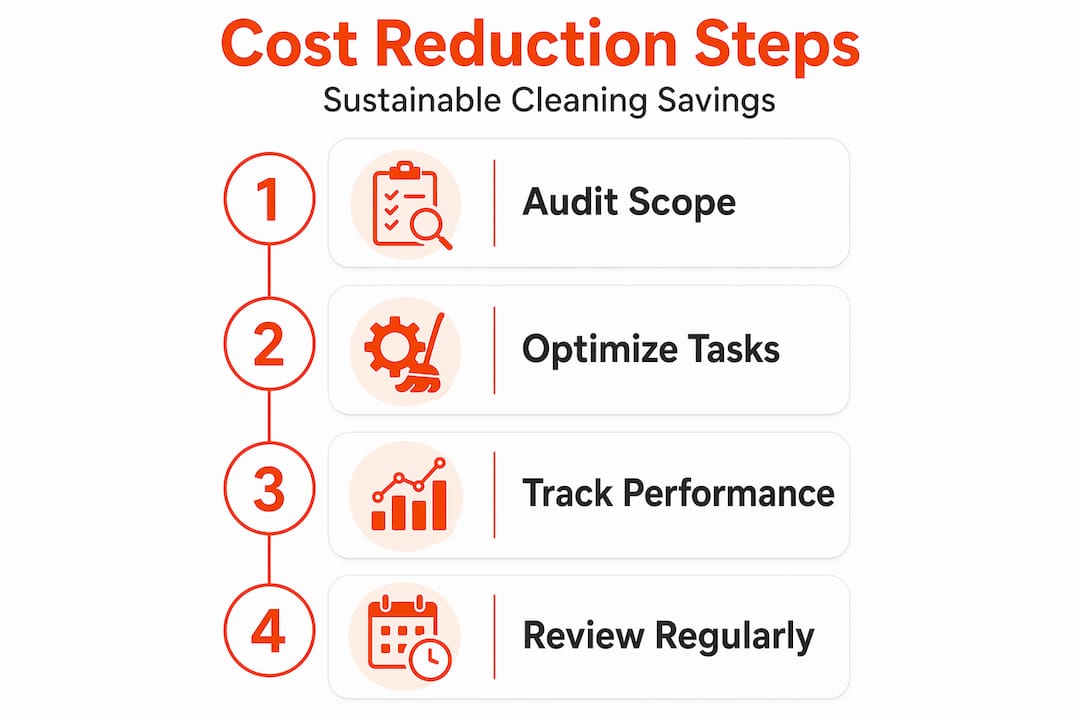
- How to reduce office cleaning costs with a proper audit
- Optimizing cleaning execution for better efficiency
- Cost-effective products, supplies, and technology
- Verifying effectiveness and monitoring performance
- Common mistakes and contract negotiation tips
- My honest take on cutting cleaning costs the right way
- Work with a team that makes your budget go further
- FAQ
Key Takeaways
| Point | Details |
|---|---|
| Audit before you cut | Map every cleaning task, zone, and frequency before adjusting any scope or contract. |
| Team cleaning saves labor | Specializing tasks by role reduces tool switches and improves output per labor hour. |
| Frequency is a spectrum | Shift light-duty tasks to monthly cycles without sacrificing perceived cleanliness. |
| Restrooms drive the most cost | Budget and scope protection here prevents complaints and costly rework. |
| Measure to sustain savings | Use inspection scores and productivity KPIs to keep quality from eroding over time. |
How to reduce office cleaning costs with a proper audit
Before you change a single task or renegotiate a contract, you need a clear picture of what you are currently paying for and what you are actually getting. Most offices operate on vague vendor agreements that list general services without defining task frequency, zone coverage, or labor expectations. That ambiguity is where budget waste hides.
Start by pulling your current contract and listing every cleaning task by zone. Break it down into areas: restrooms, common areas, private offices, kitchens, entryways, and conference rooms. For each zone, note how often each task occurs: daily, weekly, monthly, or quarterly. If your vendor cannot provide this level of detail, that is itself a red flag.
Use industry benchmarks to verify whether your costs make sense. Office cleaning rates typically range from $0.09 to $0.17 per square foot depending on building type, frequency, and complexity. If you are paying significantly above that range without a clear reason, you have room to negotiate. If you are paying below it, check whether critical tasks are simply being skipped.
Restrooms deserve special attention in any audit. Restrooms take up to four times longer to clean than general office areas due to fixture counts and disinfection requirements. Pricing them by square footage alone consistently underestimates the real labor involved.
Here is a practical starting checklist for your audit:
- List all cleaning zones and assign a task frequency to each
- Identify which tasks are tied to compliance or health standards (restroom disinfection, kitchen sanitation)
- Flag any zones that generate frequent complaints
- Compare your per-square-foot cost against ISSA benchmarks
- Ask your vendor for a written scope of work if one does not already exist
Pro Tip: Request a line-item breakdown from your vendor before any contract renewal. If they hesitate, that is a signal the current scope is vague enough to hide underperformance.
Optimizing cleaning execution for better efficiency
Once you understand your current scope, the next step is improving how cleaning work gets done. This is where you can cut office cleaning expenses without reducing the quality of the outcome.

The most effective method at this stage is team cleaning. Rather than assigning one person to fully clean an entire floor from top to bottom, team cleaning assigns specific tasks to specific people across the whole building. One person handles all trash. Another handles all restrooms. A third handles vacuuming and floor care. The result is fewer tool switches, faster task completion, and more consistent outcomes. Team cleaning methods improve efficiency by specializing tasks and standardizing workloads, which means better results with fewer total labor hours.
Here is how to approach execution optimization step by step:
- Map current labor hours by task type. Know how long each task actually takes before you restructure anything.
- Identify tasks that can be batched or specialized. Trash removal, glass cleaning, and restroom service are natural candidates for specialization.
- Use ISSA production rate benchmarks to set realistic time expectations per zone and task. This prevents both overstaffing and undercutting.
- Shift light-duty tasks to less frequent cycles. Cleaning frequency as a spectrum means moving tasks like baseboard wiping or interior window cleaning to monthly or quarterly schedules without noticeably affecting day-to-day cleanliness.
- Schedule deep cleans strategically. Shifting detailed tasks to deep cleaning cycles saves daily labor while preventing the kind of buildup that generates complaints.
- Match cleaning schedules to actual building usage. A conference room used twice a week does not need daily detailed cleaning. Align service frequency with real foot traffic patterns.
Pro Tip: Investing in powered floor machines increases upfront cost but reduces labor time significantly on large floor areas. Over a 12-month period, the labor savings typically exceed the equipment cost.
Cost-effective products, supplies, and technology
Cleaning products and supplies are an area where offices routinely overspend without realizing it. The fix is not always buying cheaper products. It is buying smarter and using them correctly.
Here are the most effective supply-side strategies:
- Buy multi-purpose concentrates in bulk. A single high-quality multi-surface cleaner used at the right dilution costs far less per application than buying separate products for every surface type.
- Install chemical dispensing systems. Improper dilution wastes chemicals and increases costs while also reducing cleaning effectiveness. Dispensing systems eliminate guesswork and reduce product waste by up to 30% in many facilities.
- Switch to color-coded microfiber systems. Microfiber cloths clean more effectively than traditional rags and last hundreds of wash cycles. Color-coding by zone (blue for glass, red for restrooms, green for kitchens) prevents cross-contamination and extends the life of each cloth.
- Use digital tracking tools. Several facility management platforms now allow you to log cleaning completion, flag issues, and monitor supply consumption by zone. This data helps you spot waste and justify budget decisions.
- Train staff thoroughly on product use. Untrained staff over-apply chemicals, skip contact times, and damage surfaces. A one-hour training session on dilution ratios and application methods pays back quickly.
The comparison below shows how supply choices affect both cost and cleaning outcomes over time:
| Approach | Upfront Cost | Long-Term Cost | Quality Impact |
|---|---|---|---|
| Single-use products, no system | Low | High (waste, rework) | Inconsistent |
| Bulk concentrates with dispensers | Medium | Low (controlled use) | Consistent |
| Color-coded microfiber system | Medium | Low (reusable, durable) | High |
| Generic rags, no training | Very low | High (damage, cross-contamination) | Poor |
For high-touch surfaces specifically, product choice matters beyond cost. Disinfectants require correct dwell times of 1 to 10 minutes to actually kill pathogens. Wiping a surface immediately after application is a common mistake that wastes product and creates a false sense of safety. You can learn more about safe disinfection protocols for offices to protect both your staff and your cleaning budget.
Verifying effectiveness and monitoring performance
Cutting costs without monitoring outcomes is how quality quietly erodes. You need a system that tells you whether your savings are holding and whether standards are being met.
Follow these steps to build a reliable performance monitoring process:
- Define your key performance indicators. Track productivity per labor hour, rework rates (tasks that had to be redone after a complaint), and inspection scores by zone.
- Create zone-specific inspection checklists. Each checklist should include pass/fail criteria for every task, not just a general “clean or not clean” judgment.
- Protect your service spine. The service spine refers to the critical areas that shape how clean your office feels to everyone in it: restrooms, entryways, trash management, and kitchen surfaces. These zones must be inspected every cycle without exception.
- Run monthly scorecards. Score each zone based on inspection results and share results with your cleaning vendor. This creates accountability and a paper trail if performance drops.
- Build a feedback loop. Encourage staff to report cleaning concerns through a simple form or app. Complaints that reach you quickly are far cheaper to address than ones that fester into health complaints or HR issues.
Pro Tip: Avoid cutting tasks that consistently generate complaints when removed. Trash removal and restroom servicing are the two most complaint-sensitive tasks in any office. Protect these even when trimming elsewhere.
Consistent measurement is what separates sustainable cost reduction from a temporary cut that rebounds into higher spending. Standardizing tasks and using production benchmarks gives you the data to identify real savings versus cuts that simply shift costs elsewhere.
Common mistakes and contract negotiation tips
Even well-intentioned cost-cutting efforts fail when they run into avoidable pitfalls. Knowing what to watch for protects your savings and your working environment.
- Vague contract scopes are the most common problem. A contract that says “clean offices nightly” without specifying which tasks, which zones, and at what frequency gives vendors room to cut corners without technically violating the agreement. Rewriting scopes into audit-friendly checklists removes that ambiguity entirely.
- Uniform frequency cuts create uneven results. Reducing cleaning frequency across all zones equally ignores the fact that restrooms, kitchens, and entryways soil at completely different rates than private offices. Cut frequency selectively based on actual usage data.
- Low per-square-foot pricing is not always a deal. Lower prices often hide omitted tasks. A vendor quoting $0.07 per square foot may simply be excluding restroom service, floor care, or trash removal from their scope.
- Vendor turnover costs more than you think. High staff turnover at your cleaning vendor means constant retraining, inconsistent results, and more complaints. Vendor stability is a real cost factor worth weighing when comparing bids.
- Negotiate equipment and chemical upgrades into contracts. If a vendor invests in better equipment or dispensing systems, their labor efficiency improves and your cost per clean goes down. Make this part of the conversation at renewal.
“A cleaning contract without a detailed scope is not a contract. It is an open invitation to scope creep and underperformance. The most cost-effective cleaning programs are built on specificity, not assumptions.”
Use periodic deep cleans strategically to offset reduced daily detailing. A well-executed monthly deep clean of restrooms and common areas can allow you to scale back some daily tasks without any noticeable drop in cleanliness standards. Explore professional restroom deep cleaning options to understand what that looks like in practice.
My honest take on cutting cleaning costs the right way
I have worked with enough facilities to say this plainly: the most expensive cleaning programs I have seen were not the ones with the highest rates. They were the ones with the most rework, the most complaints, and the most vendor turnover.
When managers cut labor hours without understanding which tasks those hours support, they almost always end up paying more within six months. Restrooms fall behind. Entryways get ignored. Complaints pile up. Then someone calls for an emergency deep clean that costs three times what the original service would have.
What actually works is protecting the spine of your cleaning program and measuring everything around it. The restrooms, the entryways, the trash. Those are non-negotiable. Everything else can be adjusted, shifted to a less frequent cycle, or restructured through team cleaning. But those core areas need to be funded, staffed, and inspected consistently.
I have also seen technology make a genuine difference when it is used to track completion and flag issues early. Not as a surveillance tool, but as a quality feedback system. When you know a zone was missed before a client walks through it, you can fix it. That is worth far more than the cost of the software.
The offices that manage cleaning budgets best are the ones where the manager understands the work well enough to ask the right questions. Not just “how much does it cost?” but “what exactly does that cost cover, and how do we know it is being done?”
— Bernadette
Work with a team that makes your budget go further
If you are ready to put these strategies into practice, Zia Building Maintenance has been helping Albuquerque offices do exactly this since 1989. The team at Zia Building Maintenance builds customized cleaning plans around your actual usage patterns, compliance needs, and budget. Their approach covers everything from daily janitorial service to intensive floor care and restroom maintenance. Discover how professional janitorial services save money through expertise, efficiency, and economies of scale. You can also review guidance on optimal office cleaning frequency to align your schedule with your budget. Contact Zia Building Maintenance today to request a tailored estimate.
FAQ
What is a realistic cost per square foot for office cleaning?
Office cleaning typically costs between $0.09 and $0.17 per square foot, depending on building type, cleaning frequency, and task complexity. Prices outside this range should prompt a detailed scope review.
Which areas cost the most to clean in an office?
Restrooms are the most labor-intensive area in any office. Restrooms require up to four times longer to clean than general office space due to fixture counts and disinfection requirements, making them the primary cost driver in most cleaning programs.
How can I lower cleaning costs without reducing quality?
Adopt team cleaning methods, shift light-duty tasks to monthly cycles, install chemical dispensing systems, and use color-coded microfiber tools. These changes reduce waste and labor time without affecting the cleanliness standards your staff and visitors experience.
What should a cleaning contract include to protect quality?
A good cleaning contract should list every task, the zone it covers, and how often it occurs. Audit-friendly checklists prevent scope creep, reduce disputes, and give you a clear standard to measure performance against.
How often should office restrooms be cleaned to control costs?
Restrooms should be serviced daily in most offices, with deep cleans scheduled weekly or monthly depending on usage. Cutting restroom frequency is one of the fastest ways to generate complaints and rework costs that exceed any short-term savings.