

Table of Contents
- Start here: the two-step protocol that works right now
- What counts as a high-touch surface and how to map your facility
- Cleaning, sanitizing, and disinfecting: what each one actually does
- How to choose and use disinfectants safely
- Step-by-step SOP for disinfecting high-touch surfaces
- Protocols for suspected or confirmed illness in the office
- Worker safety, SDS, PPE, ventilation, and training requirements
- Methods to avoid or use only when the label explicitly allows
- Ready-to-use schedule templates, staffing estimates, and log fields
- Key Takeaways
- What most offices get wrong about disinfection programs
- Zia Building Maintenance handles the protocols so you don’t have to
- Authoritative sources and further reading
- FAQ
Start here: the two-step protocol that works right now
Disinfect high-touch office surfaces by pre-cleaning visible soil first, then applying an EPA-registered disinfectant and keeping the surface visibly wet for the full contact time listed on the product label. That sequence, as confirmed by CDC guidance, is the non-negotiable foundation of every effective office disinfecting protocol.
Quick action checklist for a standard office:
- Entry and reception: — wipe door handles, push plates, reception counters, and sign-in tablets with an EPA-registered disinfectant wipe or cloth; verify contact time.
Minimum frequency baseline: clean frequently touched surfaces at least once daily. Increase to two or three passes per day in high-traffic zones or during an active illness event. Consult your Safety Data Sheets (SDS) for every product in use, follow CDC and EPA label guidance, and document every pass.
What counts as a high-touch surface and how to map your facility
A high-touch surface is any surface that multiple people contact repeatedly throughout the day, particularly one that is shared rather than assigned to a single person. Door hardware, elevator call buttons, shared keyboards, desk phones, light switches, breakroom appliance controls, restroom fixtures, and conference-room AV remotes all qualify. The defining factors are contact frequency and shared use, not surface size.
Common high-touch points in office environments:
- Door handles, push plates, and kick plates at every entry and interior door
- Elevator call buttons and interior panel buttons
- Shared keyboards, mice, and touchscreens
- Desk phones and speakerphone units
- Light switches and thermostat controls
- Breakroom appliance controls: microwave keypads, coffee-maker buttons, refrigerator handles
- Restroom fixtures: faucet handles, flush handles, soap dispensers, paper-towel dispensers, door hardware
- Conference-room AV remotes, video-conferencing equipment, and whiteboard markers
- Copier and printer touchscreens
- Vending machine keypads and water-cooler levers
Cleaning, sanitizing, and disinfecting: what each one actually does
These three terms are not interchangeable, and using the wrong one for a given situation wastes time or leaves your office at risk.
Cleaning removes visible dirt, dust, and organic matter using detergent or soap and water. It does not kill pathogens, but it is a required first step because organic soil physically shields microorganisms from disinfectant chemistry.
Sanitizing reduces the number of microbes on a surface to a level considered safe by public health standards. It is appropriate for food-contact surfaces in breakrooms and for routine maintenance of surfaces that are not shared heavily.
Disinfecting destroys or inactivates most pathogens, including bacteria and viruses, on a surface. It requires an EPA-registered product, the correct contact time, and a pre-cleaned surface to work as labeled.
When to clean only versus when to disinfect
Routine cleaning is sufficient for non-shared surfaces with low foot traffic and no known illness exposure. Disinfection is appropriate for all high-touch shared surfaces on a daily basis, for any surface in a zone where someone has been ill, and for high-traffic areas during peak occupancy or outbreak conditions. The two-step method applies whenever you disinfect: clean visible soil first, then apply the disinfectant and maintain wet contact for the full dwell time.
Pro Tip: Set a simple visual trigger for escalating from routine cleaning to full disinfection: if a surface is visibly soiled, if someone in the area has reported illness within 24 hours, or if occupancy has spiked above normal, treat it as a disinfection event, not a routine wipe-down.
How to choose and use disinfectants safely
Product selection is where many office programs go wrong. Choosing a product that is not EPA-registered, or using a registered product incorrectly, produces no reliable pathogen reduction.
Start with the EPA product list
Every disinfectant used in a US office should carry an EPA registration number. The EPA’s selected EPA-registered disinfectants page and its List N (for emerging pathogens) identify products by active ingredient, contact time, and approved use sites. Pull the EPA registration number from the product label and confirm it appears on the relevant list before purchasing.
Read the label and SDS before the first use
The product label is the legal document. It states approved use sites, dilution ratios, application method, contact (dwell) time, required PPE, and rinsing requirements. The SDS adds hazard, storage, and first-aid information. Both documents must be on file and accessible to every staff member who handles the product.
Key label compliance points:
- Use the product only on surfaces listed in the Directions for Use section.
- Prepare dilutions exactly as instructed; stronger is not more effective and may damage surfaces or create safety hazards.
- Keep the surface visibly wet for the full contact time. A product with a three-minute contact time that dries in 90 seconds has not disinfected the surface.
- Wear the PPE specified: typically nitrile gloves and, for spray application, eye protection.
- Follow rinsing instructions, especially on food-contact surfaces.
Contact time in practice
Contact time is the single most misunderstood element of office disinfecting protocols. A common quaternary ammonium (quat) product may list a contact time of three to ten minutes. That means the surface must remain visibly wet for that entire period. On a porous or absorbent surface, you may need to apply a second pass to maintain wetness. Document the time of application and the time of verification on your log.
Surface compatibility and electronics
Bleach-based products can corrode metal hardware and discolor coated laminates. Quat-based products are generally safer for most hard surfaces but can leave residue on electronics. For keyboards, touchscreens, desk phones, and other shared devices, use 70%+ alcohol wipes or apply disinfectant to a microfiber cloth before wiping. Never spray any liquid directly onto electronics. Test any new product on a small, inconspicuous area before full deployment, and document the result.
Pro Tip: Maintain a product inventory spreadsheet that lists each product’s EPA registration number, active ingredient, approved use sites, contact time, and a link to its SDS. Procurement staff can verify compliance in seconds, and frontline staff always know which product goes where.
Step-by-step SOP for disinfecting high-touch surfaces
This procedure is designed to be trained to, audited against, and adapted to your facility’s zone map.
Supplies required
- Nitrile gloves (and eye protection for spray applications)
- Detergent or all-purpose cleaner for pre-cleaning
- EPA-registered disinfectant (note the EPA registration number on your log)
- Color-coded microfiber cloths (one color per zone to prevent cross-contamination)
- Pre-saturated disinfectant wipes for electronics and quick passes
- Trigger sprayer labeled with product name and dilution
- Trash bags for disposable PPE and single-use wipes
- Logbook or digital form for documentation
Numbered procedure
- Apply the EPA-registered disinfectant — Spray onto a clean microfiber cloth or use a pre-saturated wipe. Wipe the surface with enough product to keep it visibly wet. Work from clean areas to dirtier ones; fold the cloth to a fresh face with each new surface.
Electronics protocol
Power down or lock devices before wiping when possible. Use a 70%+ isopropyl or ethyl alcohol wipe. Wipe gently across the keyboard, paying attention to the spaces between keys, ports, and seams where pathogens accumulate. Allow to air-dry fully before use. Never spray any liquid directly onto a device. For commonly missed areas like the undersides of keyboards or the backs of desk phones, a dedicated electronics pass at least once daily catches what a quick wipe misses.
Soft surfaces
Upholstered chairs and fabric cubicle panels cannot be disinfected with standard hard-surface products. Launder removable fabric covers per the manufacturer’s instructions. Steam cleaning is appropriate when the fabric can tolerate heat. Fabric-safe disinfectant sprays are available, but only use them if the product label explicitly lists fabric or soft surfaces as an approved use site. Heavily contaminated soft items that cannot be laundered or steam-cleaned should be removed and replaced.
Pro Tip: Use a four-fold microfiber technique: fold the cloth into quarters, giving you eight clean wiping faces before the cloth needs to be replaced. Assign one color per zone (blue for restrooms, green for breakroom, yellow for open-plan desks) and never cross zones with the same cloth. If a contact-time window lapses because you were interrupted, rewet the surface and restart the clock.
Protocols for suspected or confirmed illness in the office
When a staff member reports illness or a contagious agent is suspected, the standard daily protocol is not sufficient. Speed and thoroughness both matter.
Immediate steps:
- Isolate the affected area if possible; restrict access until disinfection is complete.
- Increase ventilation: open windows, run HVAC at maximum fresh-air exchange, and use portable fans directed toward open windows or exhaust vents.
- Identify all surfaces the ill person contacted: their workstation, shared devices, restroom fixtures, breakroom surfaces, and any conference rooms used.
- Don enhanced PPE: nitrile gloves, eye protection, and a face covering at minimum. If bodily fluids are present, add a disposable gown.
- Remove any visible bodily fluids with disposable absorbent material, seal in a plastic bag, and dispose of as directed by your SDS. Do not attempt to disinfect over unremoved fluids.
- Apply an EPA-registered disinfectant to all identified touchpoints, following label contact times. Reference CDC guidance for community settings for the specific pathogen if known.
When to escalate
Large contamination events, suspected highly contagious pathogens, or situations where standard label methods are insufficient may require a specialist cleaning contractor. Temporary closure of the affected zone is appropriate when the contamination area is large or when adequate ventilation and PPE cannot be guaranteed. Follow local health authority recommendations and, where applicable, consult CDC healthcare facility guidance to understand the more rigorous benchmarks that apply when the situation approaches clinical-level risk.
Pro Tip: After the event disinfection is complete, perform a verification pass: re-inspect every logged touchpoint, confirm contact times were met, and document findings with a supervisor signature. Communicate the timing and scope of the disinfection to building occupants in plain language so staff can return to the area with confidence.
Worker safety, SDS, PPE, ventilation, and training requirements
Effective disinfection and worker safety are inseparable. A product that is applied without proper PPE or in an unventilated space creates a new hazard while solving the original one.
Core safety obligations under OSHA Hazard Communication:
- Maintain a current SDS for every chemical product on-site, accessible to all employees during every shift. OSHA’s Hazard Communication Standard requires this, along with documented employee training on chemical hazards, PPE, and safe handling.
- Train all staff who handle disinfectants before their first use: cover product identification, PPE requirements, safe dilution, spill response, and SDS location.
- Conduct documented competency checks: verify that staff can locate the SDS, identify the correct PPE, and state the contact time for each product they use.
Storage and labeling rules:
- Store disinfectants in their original containers or in clearly labeled secondary containers that include the product name, concentration, and hazard warnings.
- Keep products locked or secured from unauthorized access, particularly in facilities that share space with schools, clinics, or the public.
- Dispose of diluted solutions per label instructions; do not store prepared dilutions beyond the label’s stated shelf life.
Mixing rules:
- Never mix bleach with ammonia, acids, or other cleaners. The resulting gases are toxic and can cause serious respiratory injury.
- Prepare dilutions exactly as the label instructs. Doubling the concentration does not double effectiveness and may create surface damage or inhalation hazards.
Ventilation:
- Open windows and run HVAC fresh-air exchange during and after disinfection passes.
- When the product SDS specifies a respirator, use the type and rating listed. Standard surgical masks do not substitute for a NIOSH-rated respirator when one is required.
Methods to avoid or use only when the label explicitly allows
Some application technologies are marketed aggressively to facility managers but carry significant limitations that the EPA and CDC have flagged.
Methods not recommended as primary disinfection strategies:
- Fogging and fumigation: — These methods disperse disinfectant as a mist or vapor. The EPA cautions that fogging and electrostatic spraying are not recommended as primary surface disinfection methods unless the product label explicitly permits that application. Fogging does not reliably achieve the contact time needed on all surfaces, and it creates inhalation exposure risks for occupants and workers.
- Indiscriminate outdoor surface spraying: — Spraying sidewalks, parking lots, or building exteriors with disinfectant is not supported by EPA or CDC guidance. Outdoor environmental conditions degrade disinfectants rapidly, contact time cannot be controlled, and runoff creates environmental concerns.
When these methods may be acceptable:
A method is permissible only when the disinfectant label explicitly lists it as an approved application method and when OSHA and SDS controls for worker exposure are fully in place. Even then, manual wipe-downs remain the most reliable primary method for office touchpoints.
Practical alternatives: Targeted manual wipe-downs with pre-saturated wipes, color-coded microfiber cloths, and scheduled porter rounds deliver consistent, verifiable contact time on every surface. For best cleaning methods for desks and shared workstations, a trained porter with the right chemistry and a logbook outperforms any spray technology.
Ready-to-use schedule templates, staffing estimates, and log fields
Converting your touchpoint audit into a shift-level schedule is what separates a policy document from an operating program. The structure below is adapted from professional janitorial routing practice and reflects frequency recommendations used in office and community settings.
Daily pass structure
AM arrival pass (before or at building open): Entry door hardware, elevator buttons, reception counter, restroom fixtures, breakroom appliance controls, shared device wipe-down.
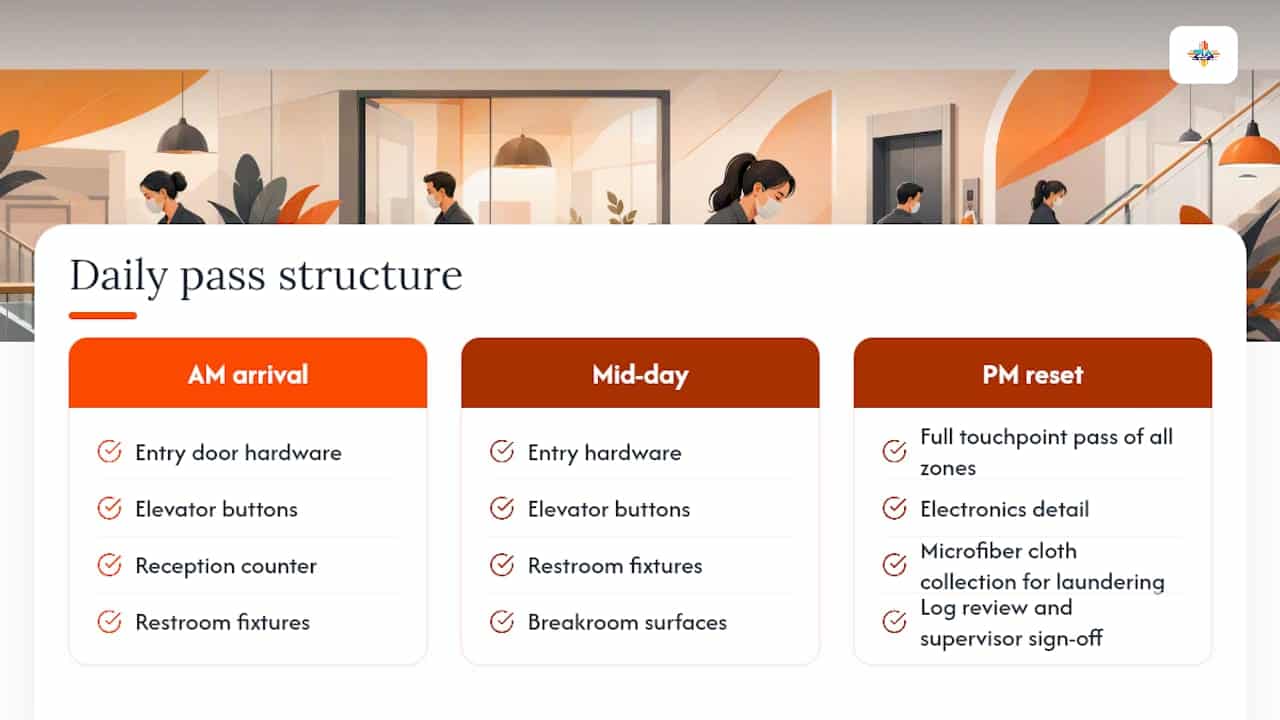
Mid-day pass (around noon or peak occupancy): Entry hardware, elevator buttons, restroom fixtures, breakroom surfaces, conference-room AV remotes and table surfaces after morning meetings.
PM reset pass (end of business day): Full touchpoint pass of all zones, electronics detail, microfiber cloth collection for laundering, log review and supervisor sign-off.
Weekly and monthly rotation items
Weekly: deep clean of breakroom appliances (interior microwave, coffee-maker components), detailed electronics pass on all shared devices, inspection of soft surfaces for soiling or damage.
Monthly: microfiber laundry audit (replace worn cloths), product inventory review (check EPA registration numbers, SDS currency, expiration dates), supervisor spot-check of log completeness.
Staffing and time estimate table
| Zone | Key touchpoints | Est. time per pass | Recommended frequency |
|---|---|---|---|
| Entry / reception | Door hardware, push plates, reception desk, sign-in tablet | 5 min | 3x daily |
| Elevators | Call buttons, interior panel, handrails | 3–5 min | 3x daily |
| Restrooms | Fixtures, faucets, flush handles, dispensers, door hardware | 8 min per restroom | 3x daily |
| Breakroom | Counters, appliance controls, sink, table, chairs | 8 min | 2–3x daily |
| Open-plan desks | Shared keyboards, phones, mice, desk surfaces | 10–15 min per cluster | 1–2x daily |
| Conference rooms | Table, chairs, AV remotes, light switches, door hardware | 6–10 min per room | After each use + 1x daily |
| Copy / print area | Touchscreen, paper tray handles, counters | 4–6 min | 2x daily |
For large office footprints, add a zone-routing map so porters move efficiently without backtracking, and build in a 10–15% time buffer for unexpected spills or illness events.
Sample log fields for each pass
- Date and time of pass
- Zone name
- Product name and EPA registration number
- Contact time achieved (in minutes)
- Staff initials
- Supervisor sign-off (for PM reset)
- Notes (any surface condition, rewet events, or escalation triggers)
Zia Building Maintenance uses time-stamped logs and supervisor spot-checks on every contracted account. For facilities that want a higher level of verification, QR-based proof-of-service systems allow managers to scan a zone marker and confirm the pass was completed, with a timestamp and staff ID attached.
Key Takeaways
Effective office disinfection requires a two-step method, EPA-registered products, verified contact time, and documented passes on every high-touch surface, every day.
| Point | Details |
|---|---|
| Two-step method is mandatory | Pre-clean visible soil before applying any disinfectant; skipping this step lets organic matter shield pathogens. |
| Contact time must be verified | Keep surfaces visibly wet for the full dwell time listed on the label; rewet if the surface dries early. |
| EPA registration and label compliance | Use only EPA-registered disinfectants, follow label directions exactly, and log the EPA registration number on every pass. |
| Document every disinfection pass | Record date, time, zone, product, contact time, and staff initials; supervisor spot-checks and timestamps make audits straightforward. |
| Zia Building Maintenance | Provides scheduled porter rounds, time-stamped logs, SDS management, and color-coded microfiber protocols for Albuquerque offices. |
What most offices get wrong about disinfection programs
The gap between a written disinfection policy and a working one is almost always operational, not chemical. The right product sitting in a supply closet does nothing if the porter runs out of time before the PM reset, or if the contact-time requirement is unknown to the person applying it.
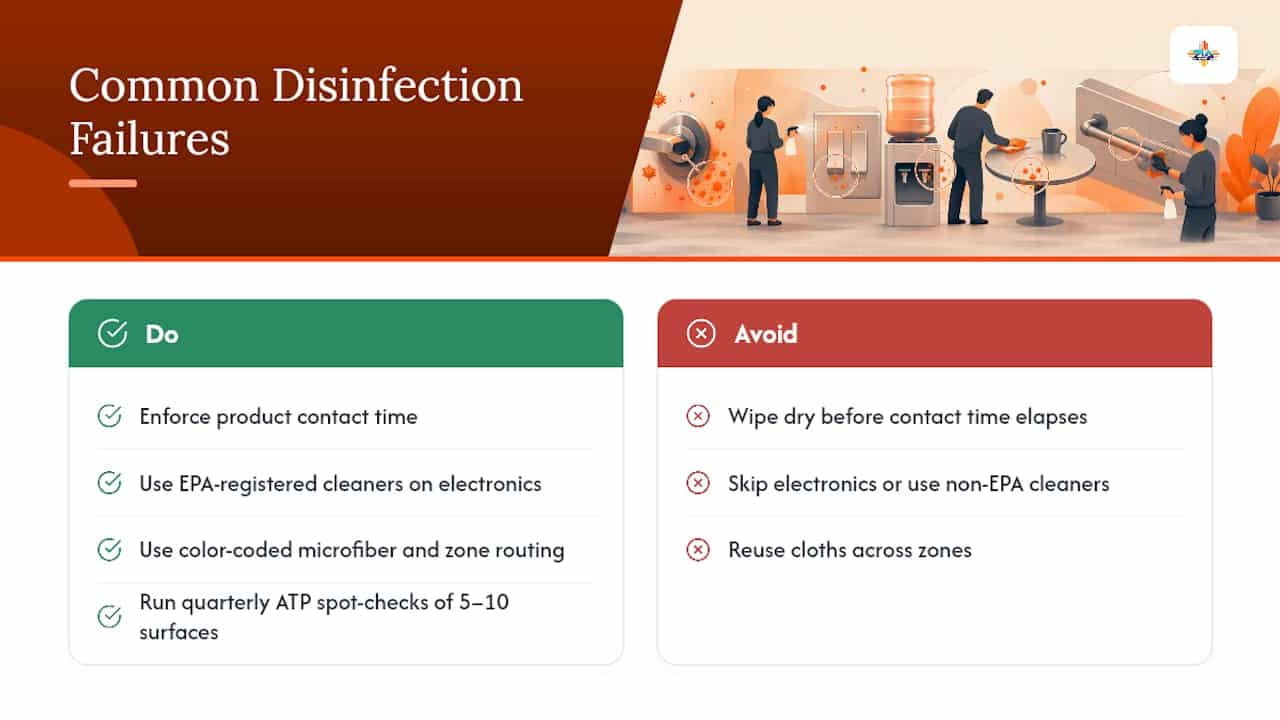
The most common failure point is contact time. A surface wiped dry 45 seconds after application has not been disinfected, regardless of how effective the product is on paper. The second most common failure is electronics. Shared keyboards and desk phones are touched dozens of times daily, yet they are often skipped entirely or wiped with a general-purpose cleaner that carries no EPA registration for pathogen reduction.
Color-coded microfiber and zone routing solve a third problem that most managers do not notice until an audit reveals it: cross-contamination. A cloth used in a restroom that then wipes a breakroom counter transfers rather than removes risk. The fix is simple and costs almost nothing, but it requires training and consistent enforcement.
Audit programs that include ATP (adenosine triphosphate) surface testing can validate whether a disinfection program is actually reducing bioburden, not just checking boxes. For most community offices, a quarterly spot-check of five to ten surfaces provides enough data to identify weak zones without significant cost.
The facilities that maintain the cleanest, most verifiable programs share one trait: they treat disinfection as a documented operational process, not a general cleaning task. Every pass is logged, every product is tracked by EPA registration number, and every staff member can state the contact time for the product they are holding.
Zia Building Maintenance handles the protocols so you don’t have to
Running a consistent, documented disinfection program across an entire office building takes trained staff, the right chemistry, and a routing system that holds up under daily operational pressure. That is exactly what Zia Building Maintenance delivers for offices in Albuquerque.
Since 1989, Zia Building Maintenance has provided professional office cleaning services that go beyond surface-level cleaning. Every contracted account receives scheduled porter rounds with time-stamped logs, EPA-registered product inventories with SDS documentation, color-coded microfiber protocols, and supervisor spot-checks built into the service agreement. Managers get proof-of-service records they can present to auditors, insurers, or health inspectors without scrambling to compile them.
A contracted service also removes the procurement burden: Zia Building Maintenance manages product selection, SDS currency, and label compliance so your team is not responsible for tracking EPA registration numbers or monitoring contact-time requirements across multiple products.
To see exactly what a scoped disinfection program would cover for your facility, review the commercial cleaning contract checklist and request a quote. The checklist outlines the SOP, staff training, proof-of-service logs, and SDS repository you should expect from any vendor before signing.
Authoritative sources and further reading
Use these resources for policy decisions, product procurement, and staff training materials.
- When and How to Clean and Disinfect a Facility (CDC)
- Selected EPA-registered disinfectants (EPA)
- General Recommendations for Cleaning for High-Touch Surfaces (Oregon State EHS)
- Evaluating electrostatic sprayers for disinfectant application (EPA)
- High-touch surface cleaning checklist guide for facilities (The Cleaning Station)
- Cleaning and Disinfecting High Touch Surfaces (UConn)
- OSHA guidance on Hazard Communication (OSHA)
Product labels and SDS are the primary authority for any specific disinfectant. Official guidance documents set the framework; the label tells you exactly how to use the product you have in hand. When in doubt, the label governs.
FAQ
How do you properly disinfect high-touch surfaces?
Pre-clean the surface with detergent and water to remove visible soil, then apply an EPA-registered disinfectant and keep the surface visibly wet for the full contact time listed on the product label. Document the product name, EPA registration number, and contact time achieved on every pass.
What kills strep and similar pathogens on office surfaces?
EPA-registered disinfectants with active ingredients such as quaternary ammonium compounds, hydrogen peroxide, or sodium hypochlorite (bleach) are effective against Streptococcus and most common office pathogens when used at the labeled concentration and contact time.
How often should high-touch areas be cleaned and disinfected?
At minimum, clean frequently touched surfaces once daily; high-traffic zones such as restrooms, entry hardware, and elevator buttons benefit from two to three passes per day. Increase frequency immediately after a known illness event or during periods of elevated occupancy.
Can you use regular alcohol wipes to sanitize office equipment like keyboards?
Yes. Wipes containing 70% or higher isopropyl or ethyl alcohol are the recommended method for electronics including keyboards, mice, and desk phones. Apply with light pressure, paying attention to key gaps and ports, and allow to air-dry fully before use.
Does hypochlorous acid disinfect soft surfaces?
Hypochlorous acid (HOCl) products are EPA-registered for hard surfaces and some are labeled for soft surfaces, but you must confirm the specific product’s label lists soft surfaces as an approved use site before applying it to upholstery or fabric panels. When the label does not authorize soft-surface use, laundering or steam cleaning is the appropriate method.