

How to Find the Best Carpet Stain Remover
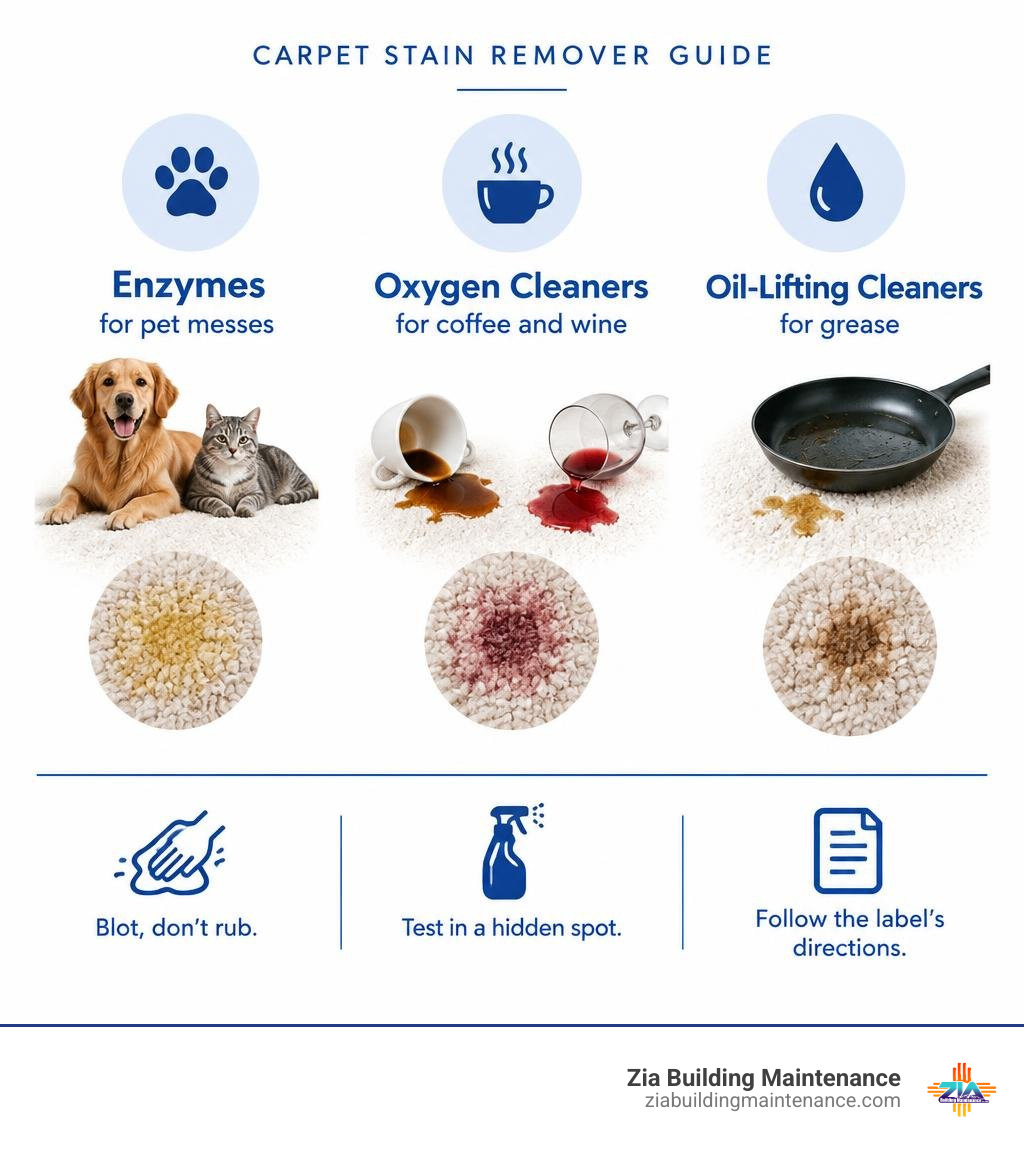
The best carpet stain remover depends on what spilled. For pet urine or vomit, choose an enzyme cleaner that targets odors as well as stains. For coffee or red wine, try an oxygen-based carpet spot remover. For grease, use a carpet-safe cleaner made to lift oils. Whatever you choose, test it in a hidden spot, blot the spill instead of rubbing it, and follow the label’s directions.
For an Albuquerque facility, a clean-looking spot is only part of the job. Too much product can leave residue that attracts dirt, while too much moisture can let a stain return as the carpet dries. This guide covers which cleaners suit common spills and when a stain needs more than spot treatment.
I’m Ashley Cordova, vice president of Zia Building Maintenance, where I oversee daily operations for our family-owned Albuquerque janitorial company. My work has taught me that finding the best carpet stain remover is only useful when it’s paired with careful, consistent cleaning.
Top Lab-Tested Contenders for the Best Carpet Stain Remover of 2026
Selecting an effective spot treatment requires looking past marketing claims to independent laboratory data. In standardized testing across consumer research organizations, commercial spot removers face demanding real-world conditions. For instance, in rigorous evaluations by independent testers, Consumer Reports carpet stain remover testing utilized 270 colorimeter readings across ten distinct stain profiles to quantify exact pigment reduction. Similarly, Good Housekeeping evaluated spot removers across 250 fresh and set-in stains to determine which chemical formulations consistently lift pigments without degrading carpet pile.
Portable spot-cleaning machines also provide deep extraction for localized disasters. Testing evaluated by Vacuum Wars revealed that dedicated spot extractors achieve an average stain reduction score of 84.5%. High-performing units like the Shark StainStriker HairPro reached an 87.2% reduction score, while compact battery units like the Bissell Little Green Mini Cordless offer rapid deployment without hunting for electrical outlets.
Whether you manage an office suite in Albuquerque or want to say goodbye to pet messes with the best stain remover for carpet in a residential property, matching the product chemistry to the spill is critical.
| Product | Primary Formula Chemistry | Best For (Stain Types) | Recommended Dwell Time | CRI Certified | Average Price / Fl. Oz. |
|---|---|---|---|---|---|
| Bissell Professional Stain & Odor | Bio-Enzymatic + Surfactants | Pet messes, blood, organic proteins | 5–10 min (up to 12 hrs for old odor) | Yes | ~$0.38 / oz |
| FOLEX Instant Carpet Spot Remover | Non-Ionic Water-Based Surfactant | Coffee, dirt smudges, grease, food | 1–3 min (Instant / No-Rinse) | Yes | ~$0.21 / oz |
| OxiClean Carpet Stain Remover | Oxygen-Activated Oxidizer (Oxy) | Red wine, fruit juice, tea, dyes | 10 minutes | Yes | ~$0.28 / oz |
| Rocco & Roxie Supply Co. Eliminator | High-Potency Bio-Enzymatic | Heavy pet urine, vomit, feces | 30–60 min (overnight for set-in) | Yes | ~$0.62 / oz |
| Carbona 2-in-1 Oxy Powered | Oxygen Peroxide + Built-In Brush | Ground-in mud, dried coffee, traffic paths | 3–5 minutes | Yes | ~$0.45 / oz |
| OdoBan Pet Oxy Stain Remover | Hydrogen Peroxide Oxidizer | Fast odor remediation, pet spots | 3–5 minutes | No | ~$0.19 / oz |
Choosing the Best Carpet Stain Remover by Chemistry and Formula Type
Chemical spotters generally fall into three distinct formulation classes:
- Bio-Enzymatic Formulas: Enzymatic cleaners utilize non-pathogenic bacteria that produce target-specific enzymes (such as proteases for proteins, lipases for fats, and amylases for starches). These enzymes digest organic compounds, breaking them down into carbon dioxide and water. They are the gold standard for bio-waste, eliminating uric acid crystals that cause persistent odors.
- Oxygen-Activated Oxidizers (Oxy): Oxygen cleaners rely on stabilized hydrogen peroxide or sodium percarbonate. When applied, they release oxygen micro-bubbles that break down the chemical double bonds of chromophores (stain molecules), neutralizing the visible color of red wine, coffee, and fruit juices.
- Surfactant Spotters: Water-based surfactant formulations (like FOLEX) alter surface tension, emulsifying oily bonds so trapped soils lift cleanly onto a microfiber towel without leaving a sticky soap film.
Application delivery also dictates performance:
- Trigger Sprays: Ideal for broad saturation on low-pile commercial loops and flat weaves.
- Aerosol Foams: Perfect for high-traffic tracks and vertical upholstery because the expanding foam suspends soils at the carpet tips without saturating the secondary backing.
- Powder & Dry Formulations: Absorbent powders (like Milliken Capture or Dyson Zorb) allow large-area cleaning without liquid wetting, eliminating drying downtime.
For households and commercial spaces with delicate air quality requirements, look for products carrying EPA Safer Choice labels or Carpet and Rug Institute (CRI) Seal of Approval designations to ensure minimal volatile organic compounds (VOCs). Check The Spruce Pets carpet cleaner solutions testing for independent verifications on low-toxicity, pet-safe spot formulas.
Stain Chemistry: Matching Cleaners to Spills and Fiber Types
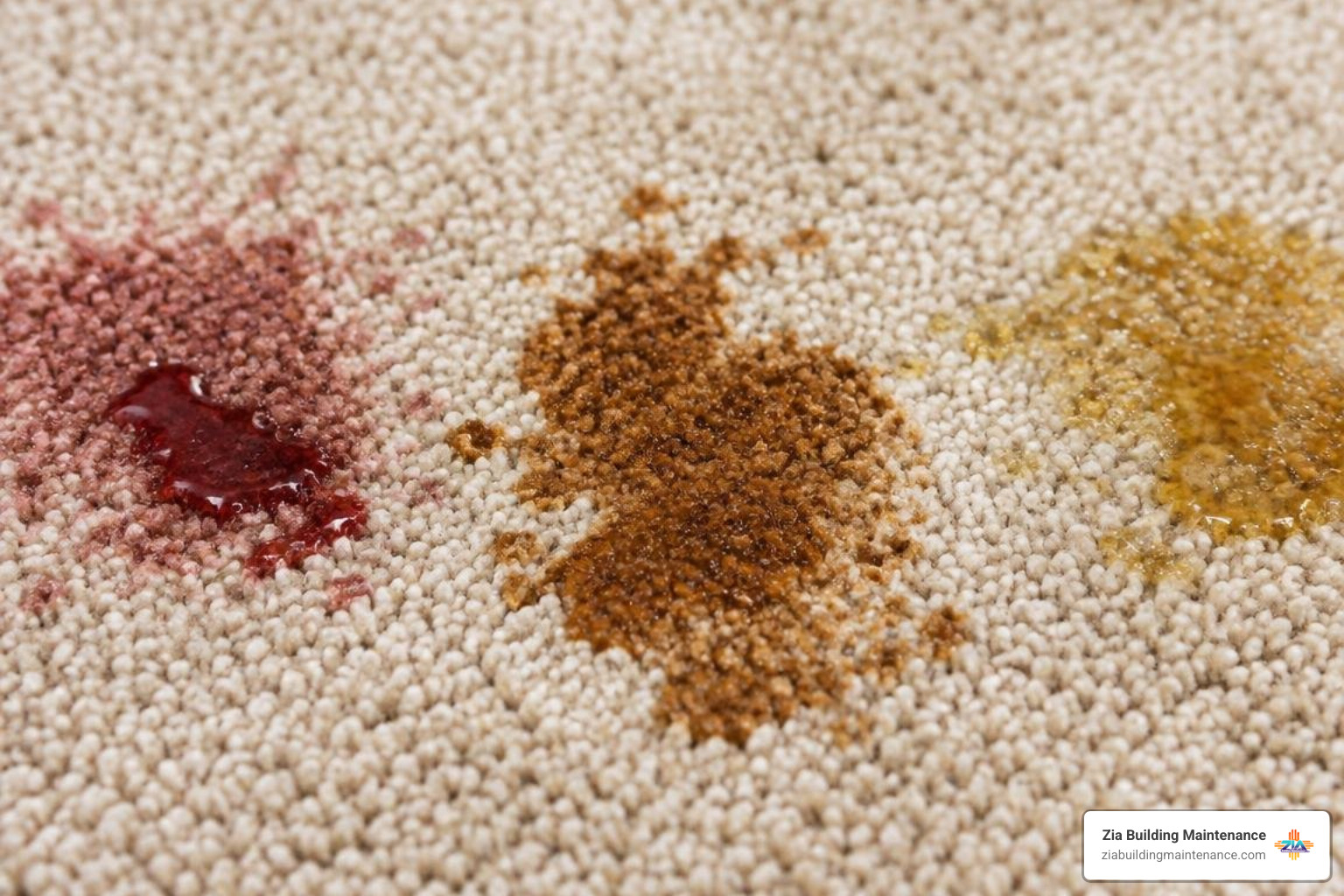
Understanding the pH scale and chemical bonding of spills prevents permanent carpet discoloration. In our commercial work across Bernalillo County, we frequently encounter common stains on your office carpet that require tailored chemical counter-measures:
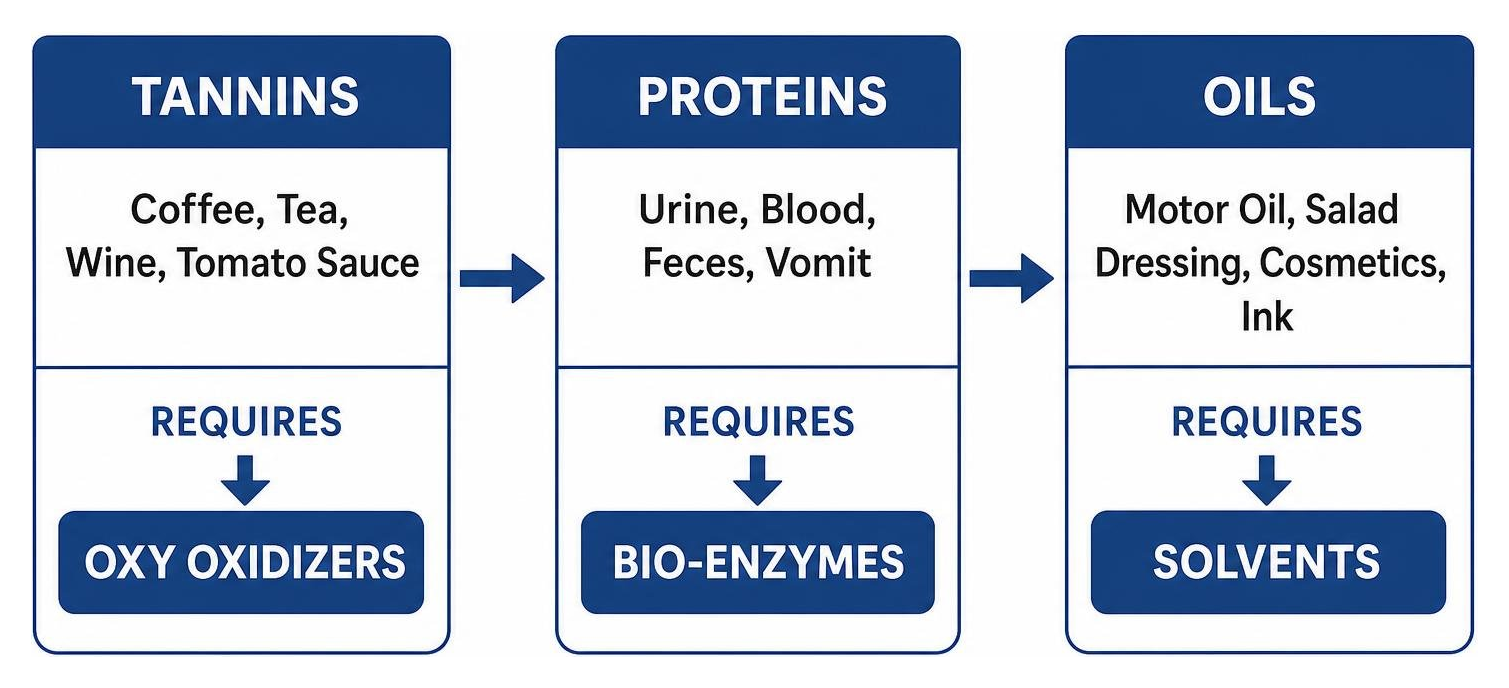
- Tannin & Colored Plant Liquids (Coffee, Tea, Wine, Tomato Sauce): Slightly acidic liquids with heavy natural pigments require mild oxygenating oxidizers to break pigment bonds without setting the stain.
- Protein & Bio-Messes (Urine, Blood, Feces, Vomit): Organic matter denatures and bonds with synthetic carpet fibers when exposed to high heat. They require cool water and neutral-pH enzymatic digesters.
- Petroleum & Synthetic Oils (Motor Oil, Salad Dressing, Cosmetics, Ink): Hydrophobic oils repel water-based cleaners. They demand specialized solvent-surfactant spotters to encapsulate grease.
Targeted Commercial Formulations vs. DIY Home Remedies
When a spill strikes, many turn to kitchen staples. However, DIY remedies carry operational trade-offs compared to lab-stabilized formulas:
- White Vinegar & Water (1:2 ratio): The mild acetic acid (pH ~2.5) neutralizes alkaline pet salts and brightens tannin stains. However, high acid can weaken delicate fibers and cannot break down heavy animal proteins.
- Baking Soda: A classic deodorizer that absorbs surface liquids. Unfortunately, baking soda particles are often smaller than 5 microns. Standard residential vacuums struggle to pull them out of dense carpet backings, leaving a dry mineral crust that abrades fibers over time.
- Diluted Dawn Dish Soap & Water: Effective at emulsifying grease, but nearly impossible to rinse fully by hand. The residual detergent acts like a magnet for fresh dirt.
- 3% Hydrogen Peroxide: Excellent for lifting blood and wine from light-colored carpet, but must be spot-tested to avoid accidental fiber bleaching on dark pile.
While you can review our guide to stop the stink with these diy pet stain removal secrets, commercial CRI-approved formulas minimize residue risk and offer balanced pH protection.
Fiber Safety and Residue Prevention
Different fiber materials react uniquely to cleaning chemistry:
- Nylon: Highly durable and resilient, but easily stained by acid dyes (like fruit punch). Nylon requires prompt treatment with neutral-to-mildly-acidic spotters.
- Polyester & Triexta: Naturally stain-resistant to water-borne pigments, but lipophilic (attracted to oily grease and cosmetic spills). These require solvent-based spotters.
- Olefin (Polypropylene) & Commercial Berber: Prone to soil wicking due to dense construction and low moisture absorption. For specialized techniques, read the ultimate guide to cleaning berber carpet in bernalillo.
- Wool & Natural Fibers: Sensitive to alkaline chemicals (pH > 8.0) and bleaches. Never use standard oxygen bleaches or harsh enzymes on wool carpets, as they digest natural keratin protein fibers.
Step-by-Step Restoration: Removing Fresh and Set-In Stains
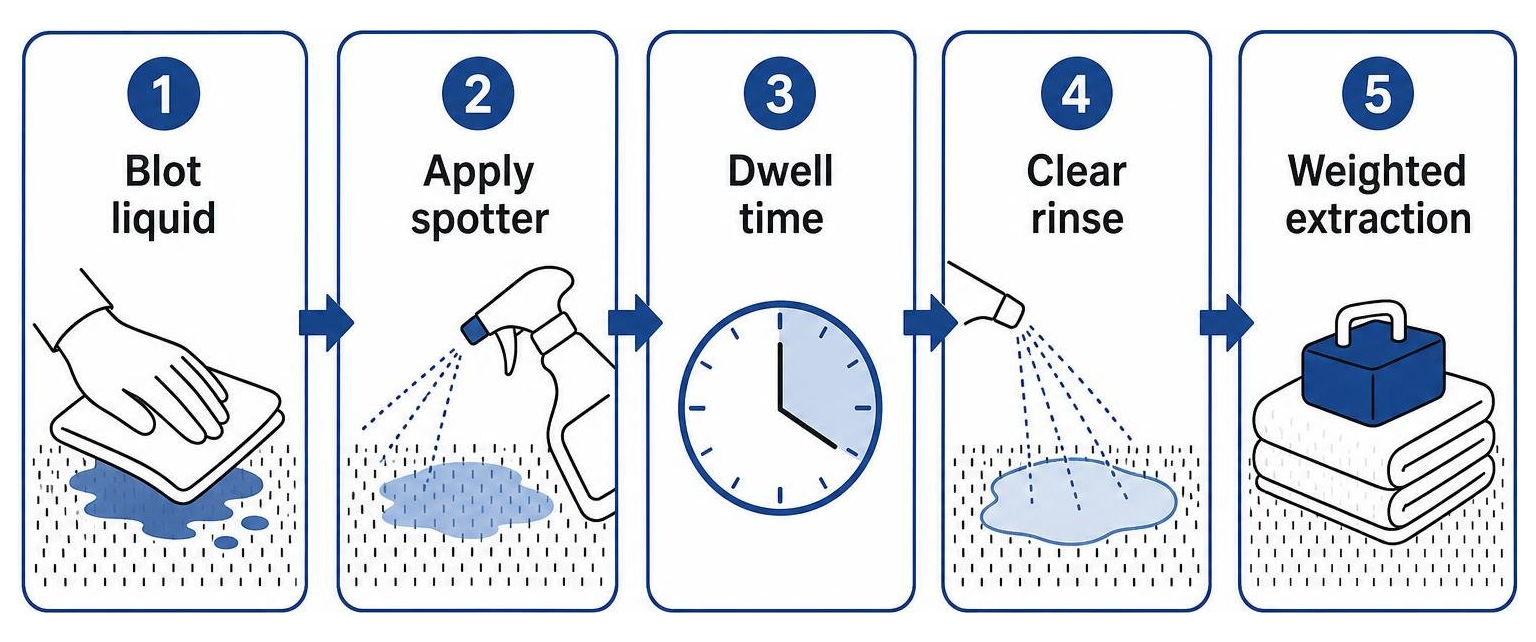
When an accident occurs, technique matters as much as the chemical you spray. Follow these professional steps to prevent spreading:
- Blot Immediately, Never Scrub: Rubbing pushes liquid deeper into the carpet pad and frays the yarn tips (known as carpet blooming). Always use clean white cotton or microfiber cloths.
- Work from the Outside In: Blot from the perimeter of the spot toward the center to avoid spreading the spill radius.
- Apply Chemistry Conservatively: Spray the cleaner onto your cloth or lightly mist the carpet. Never over-saturate the subfloor.
- Allow Proper Dwell Time: Let the chemical dissolve the stain bond (5 to 10 minutes for standard spotters; 30+ minutes for bio-enzymes).
- Rinse with Clear Water & Extract: Mist with clean water to lift residual soap, blot dry, and weight down a clean folded towel to pull remaining moisture up from the pile.
For an in-depth breakdown of these fundamental mechanics, see our 3 tips removing carpet stains.
How to Use the Best Carpet Stain Remover for Fresh vs. Set-In Stains
- Fresh Spills: Extract liquid immediately using a wet-dry vacuum or absorbent towels. Once dry solids and liquids are removed, mist an instant surfactant like FOLEX or an oxygen spray, dwell for 3 minutes, and blot clean.
- Set-In or Dried Stains: Old stains require rehydration. Lightly mist the area with warm water to loosen hardened soils. Apply an enzymatic digester or heavy-duty oxy cleaner, cover with a damp cloth or plastic wrap to prevent evaporation, and allow an extended dwell of 4 to 12 hours. Rinse thoroughly with cool water and extract.
Knowing When to Transition from Spot Cleaning to Commercial Extraction
Consumer spotters are engineered for localized surface spills. However, when spills soak through the primary backing into the secondary latex backing and polyurethane pad, surface blotting is no longer sufficient.
Deep moisture trapped in the pad triggers capillary action (wicking), drawing old stains back to the surface as the top fibers dry. In busy workplaces, deep soil buildup also hurts air quality. For broad commercial challenges, facilities benefit from professional commercial carpet cleaning methods like industrial hot water extraction (steam cleaning) and low-moisture polymer encapsulation.
Frequently Asked Questions About Carpet Stain Removal
wp:html
How long should an enzyme cleaner dwell on a carpet stain?
Enzyme cleaners require active moisture to break down organic proteins. For fresh biological accidents, maintain a dwell time of 15 to 30 minutes. For severe, set-in pet urine or dried vomit, saturate the spot thoroughly, cover with a damp towel or plastic sheet, and allow the solution to dwell for 8 to 12 hours before rinsing.
Why do some carpet stains reappear days after cleaning?
Stain reappearance happens due to two primary causes:
- Wicking: The spill penetrated the carpet backing or padding. As the surface dries, evaporation pulls moisture and dissolved pigment back up the yarn shaft.
- Residue Resoiling: High-foaming detergents were left unrinsed in the carpet pile. The sticky surfactant film captures everyday foot traffic and dust, creating a dark smudge in the exact shape of the old spot.
Can carpet stain removers damage carpet dye or backing?
Yes. Cleaners containing high concentrations of sodium hypochlorite (chlorine bleach) or aggressive oxidizers with high pH levels (above 10.0) can permanently strip carpet dyes. Additionally, soaking carpet backings with harsh solvents can dissolve the latex binding adhesives, causing carpet delamination (rippling and bubbling). Always test cleaning products on an out-of-sight closet corner before treating open areas.
Conclusion: Maintaining Flawless Flooring
Keeping carpets spotless requires matching the right spot-treatment chemistry to specific spills and acting before stains oxidize into carpet fibers. While high-performance retail spotters handle everyday spills, heavy facility traffic and deep-set stains demand systematic maintenance.
At Zia Building Maintenance, we have delivered dependable commercial janitorial and floor care services across Albuquerque, Rio Rancho, Corrales, and Los Ranchos since 1989. Our certified technicians pair targeted spot treatments with industrial hot water extraction to keep your flooring clean, fresh, and durable.
Need help restoring your facility’s high-traffic carpets? Explore our guide to say goodbye to pet messes with the best stain remover for carpet or contact Zia Building Maintenance today for a comprehensive commercial floor care evaluation!