

Why Pet Stain Carpet Removal Is Harder Than It Looks (And What Actually Works)
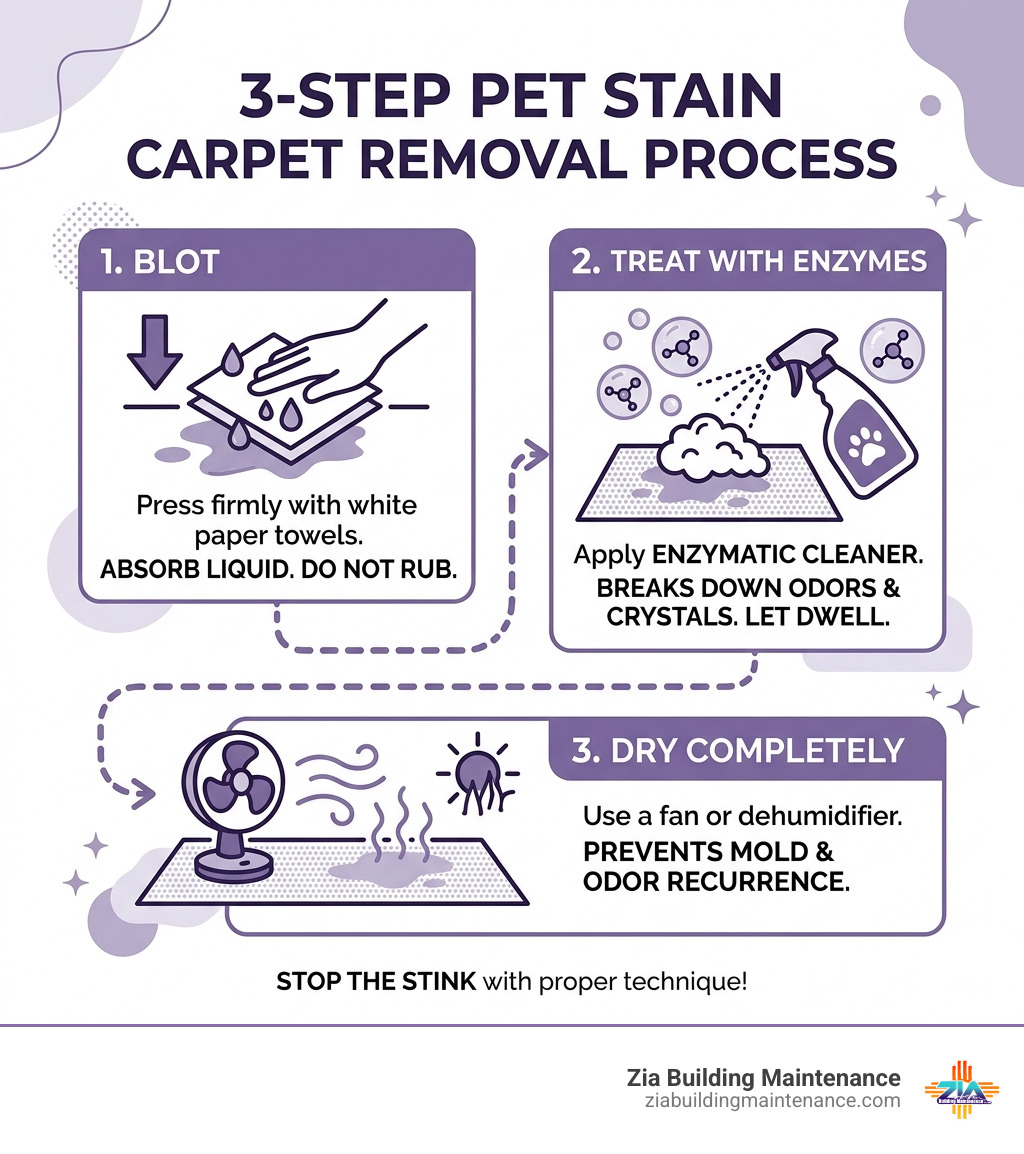
Pet stain carpet removal comes down to four steps done in the right order:
- Blot – Press firmly with white paper towels to pull liquid out. Never rub.
- Rinse – Apply cool water lightly, then blot again. Repeat 2-3 times.
- Treat – Apply an enzymatic cleaner. Let it dwell fully so it reaches the padding.
- Dry – Use a fan or dehumidifier. Complete drying is non-negotiable.
That sequence matters more than any product you use.
Here’s the frustrating truth: most people skip straight to scrubbing or spraying a cleaner. That pushes the urine deeper into the carpet fibers and padding. The stain looks gone — until humidity hits, and the smell comes roaring back.
Pet urine isn’t just a surface problem. It contains uric acid that forms crystals deep in carpet fibers. Standard cleaners can’t break those down. And if heat gets involved — say, from a steam cleaner — those proteins bond permanently to the fibers. The stain is set for good.
This guide walks you through every scenario: fresh accidents, dried stains, mystery odors, and the situations where you genuinely need a professional.
I’m Ashley Cordova, Vice President of Zia Building Maintenance, a family-owned janitorial company serving New Mexico since 1989 — and pet stain carpet removal is one of the most common challenges our commercial cleaning teams handle across Albuquerque facilities. That hands-on experience shapes everything in this guide.
Immediate Action: The Golden Rule of Pet Stain Carpet Removal
When you discover a fresh mess in April 2026, time is your greatest ally. The “Golden Rule” of pet stain carpet removal is to act before the liquid migrates from the surface fibers into the carpet backing and padding. Once it hits the subfloor, you’re no longer dealing with a simple stain; you’re dealing with a structural odor issue.

The most effective technique is blotting. We recommend using a thick stack of white paper towels or a clean white microfiber cloth. Avoid using colored towels, as the dyes can transfer to your carpet. Place the towels over the spot and apply significant pressure. A “pro tip” we use in the field is to stand on the towels for 30–60 seconds. Your body weight helps pull moisture from the base of the fibers.
According to WebMD, you should continue this process, replacing the towels with fresh ones, until no more moisture is being absorbed. After the initial extraction, rinse the area with a small amount of cool, plain water and blot again. This helps flush out the remaining organic material before it can dry. For more on the fundamentals of spot treatment, check out our 3 Tips Removing Carpet Stains.
Why Heat is Your Enemy in Pet Stain Carpet Removal
One of the most common mistakes we see in Downtown Albuquerque homes and offices is the use of steam cleaners on fresh urine. While steam is great for sanitizing some surfaces, it is disastrous for pet accidents.
Pet urine is protein-based. When you apply high heat, you trigger “protein denaturation.” Essentially, the heat “cooks” the proteins, causing them to bond permanently to the man-made fibers of your carpet. This is especially true for nylon and polyester carpets, which dominate over 70% of the U.S. market. Once these proteins are heat-set, the discoloration and odor become nearly impossible to remove with DIY methods. Always stick to lukewarm or cool water during the initial stages of pet stain carpet removal.
Essential Tools for Fresh Messes
To handle accidents like a pro, keep a “pet emergency kit” ready. Your kit should include:
- A Wet-Dry Vacuum: This is the single best tool for initial extraction. It pulls liquid out far more effectively than manual blotting.
- White Paper Towels: Lots of them.
- Microfiber Cloths: For the final rinse and dab.
- Distilled White Vinegar: A natural pH neutralizer.
If you’re in a high-traffic area like a storefront in the Nob Hill district, having these tools on hand can save you thousands in carpet replacement costs.
The Science of the Stink: Why Enzymatic Cleaners are Non-Negotiable
If you’ve ever cleaned a spot only to have the smell return a week later, you’ve met the “uric acid crystal.” When pet urine dries, it breaks down into urea and uric acid. While water and soap might wash away the urea, the uric acid crystals are insoluble and cling to carpet fibers.
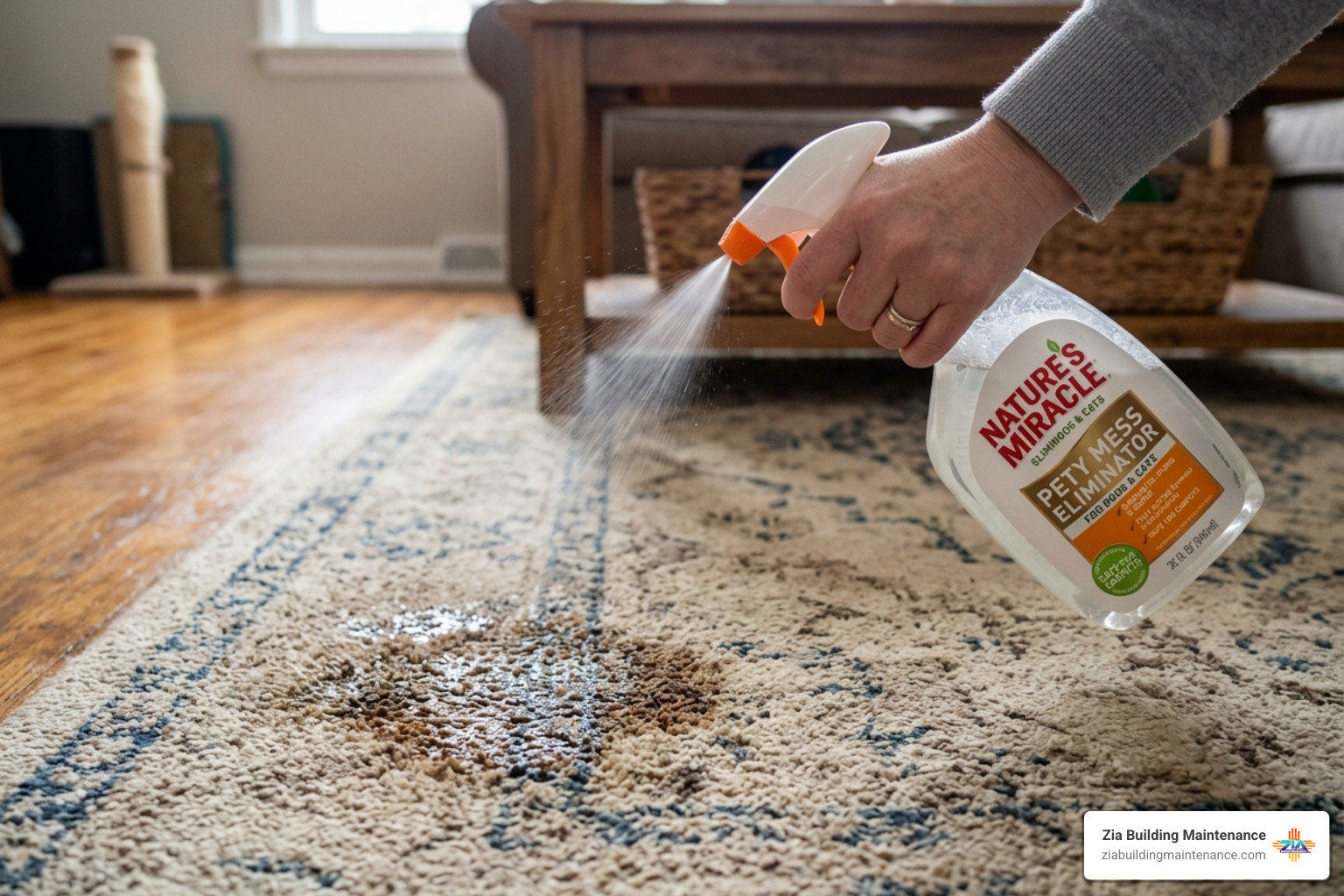
This is where enzymatic cleaners come in. Unlike standard detergents that just mask smells with heavy perfumes, enzymatic cleaners contain specific bacteria that produce enzymes to “eat” the organic matter. As The Humane Society points out, these bio-enzymatic formulas are the only way to truly neutralize the odor at its source.
How Enzymes Eliminate Pet Urine Odors
Enzymes work through a process called catalyzing hydrolysis. They break down complex molecules (like those found in urine, vomit, and feces) into smaller, water-soluble components that the bacteria can then digest.
For these cleaners to work, they must stay moist. We often suggest saturating the area and then covering it with a damp towel or plastic wrap for 12 to 24 hours. This “dwell time” allows the enzymes to penetrate deep into the padding where the odors hide. If the area dries too quickly, the enzymes stop working.
Avoiding the Ammonia Mistake in Pet Stain Carpet Removal
Never use cleaning products that contain ammonia. Why? Because urine itself breaks down into ammonia. If you clean with an ammonia-based product, your pet’s sensitive nose will interpret the scent as a signal that the spot is a “bathroom zone,” encouraging them to re-mark the same area.
When dealing with Common Stains On Your Office Carpet, sticking to pH-neutral or enzymatic solutions is the best way to maintain a professional environment without confusing your furry “office assistants.”
DIY Rescue: Effective Home Remedies for Pet Stain Carpet Removal
If you don’t have a commercial enzyme cleaner on hand, you can use common household items to manage the situation. However, always perform a colorfastness test on an inconspicuous area first to ensure you won’t bleach your carpet.
| Method | Best For | Key Ingredients |
|---|---|---|
| The Volcano | Fresh urine & surface odors | Vinegar & Baking Soda |
| The Oxygen Boost | Tough stains & organic matter | Hydrogen Peroxide & Dawn |
| The Simple Rinse | Tracked-in mud or fresh vomit | Lukewarm water & Microfiber |
For detailed step-by-step instructions on various surfaces, the Stain Removal Guides offer excellent technical breakdowns for different fiber types.
The “Volcano” Method for Surface Stains
This method uses the chemical reaction between acidic vinegar and alkaline baking soda to lift stains to the surface.
- Spray: Mix 1 part white vinegar with 1 part water. Spray the area liberally.
- Sprinkle: While the area is wet, sprinkle a generous amount of baking soda over it. You’ll hear it fizz—this is the “volcano” reaction breaking down the soil.
- Sit: Let it dry completely (this may take overnight).
- Vacuum: Once dry, vacuum up the powder. The baking soda absorbs the neutralized odors.
Tackling Vomit and Feces Accidents
Vomit is particularly dangerous for carpets because it contains stomach acid, which can act as a dye and permanently change the carpet color. The Spruce recommends removing solid matter immediately using a plastic bag or a dull scraper to avoid pushing it further into the weave.
Once solids are removed, use a cool water rinse. Do not use hot water, as the proteins in feces and vomit will set just like urine. Use a mixture of one teaspoon of mild dish soap and one cup of lukewarm water to dab the area from the outside in.
Tackling the Tough Stuff: Dried Stains and Deep Padding Issues
Sometimes accidents happen while we’re at work or asleep. Dried stains are a different beast because the uric acid has already bonded with the fibers.
To find these “invisible” messes, we recommend using a UV black light. In a dark room, pet urine will glow a dull yellow or neon green. Once you locate the spot, outline it with a piece of chalk so you don’t lose it when the lights go on.
To treat a dried stain, you must “rehydrate” it. Apply an enzymatic cleaner generously—enough to soak into the padding—and let it sit. This reactivates the uric acid crystals so the enzymes can break them down.
Identifying Subfloor Contamination
If you’ve cleaned the carpet three times and the smell still returns every time it rains or gets humid, the urine has likely reached the subfloor. Carpet padding acts like a sponge; once it is saturated, DIY surface cleaning will not suffice. In these cases, the smell “wicks” back up as the moisture evaporates. If you suspect subfloor damage, especially in older Albuquerque homes with wood floors, you may need to pull back the carpet to treat the floorboard or replace the padding entirely.
Video Guide: Deep Cleaning Techniques
For a visual walkthrough of these techniques, watch our recommended guide below:
When DIY Isn’t Enough: Professional Pet Stain Carpet Removal
While DIY methods are great for the occasional “oops,” there are times when industrial intervention is necessary. Professional pet stain carpet removal utilizes truck-mounted hot water extraction systems that can reach temperatures and pressures impossible for home rental units.
At Zia Building Maintenance, we utilize advanced extraction methods that pull contaminants from the very bottom of the carpet pile. Regular professional cleaning can actually extend the life of your carpet by up to 50% by removing the abrasive salts and crystals that wear down fibers. If you are managing a facility, our Commercial Carpet Cleaning Service is designed to handle large-scale issues efficiently.
Signs You Need a Professional Extraction
- Overlapping Accidents: If a pet has used the same spot repeatedly, the volume of liquid is likely too much for a spray bottle to handle.
- Yellow Discoloration: Old urine can bleach carpet dyes. Professionals can sometimes use specialty “oxidizers” to reduce the appearance of these rings.
- Persistent Smells: If the “doggy smell” lingers despite your best efforts, it’s time for a deep-tissue extraction.
Safety Precautions for Kids and Pets
When cleaning, always ensure the area is well-ventilated. Many commercial products, even those with the EPA Safer Choice label, can be irritating to respiratory systems while wet. Keep children and pets away from the area until it is 100% dry. As noted by TNT Carpet Cleaning, thorough drying prevents the growth of mold and mildew, which can cause secondary health issues.
Frequently Asked Questions about Pet Stains
How long does it take for a pet stain to dry completely?
In the Albuquerque climate, surface drying can happen in 2 hours, but the padding can stay damp for 24–48 hours. Use a fan or a dehumidifier to speed up the process. If the backing stays damp, you risk “wicking,” where the stain travels back up the fibers to the surface.
Can I use a steam cleaner on dog urine?
No! As mentioned earlier, heat sets the proteins and odors permanently. Use a carpet extractor that uses suction and cool/lukewarm water instead.
Why does the urine smell return when it’s humid?
Uric acid salts are hygroscopic, meaning they attract moisture from the air. When humidity levels rise (like during our New Mexico monsoon season), the salts absorb water and reactivate the bacterial decomposition process, releasing that familiar ammonia smell.
Conclusion
Pet stain carpet removal doesn’t have to be a nightmare. By following the “Blot, Treat, Dry” sequence and using enzymatic cleaners, you can keep your home or office smelling fresh. However, for those deep-set issues or large commercial spaces, nothing beats the power of professional extraction.
Since 1989, Zia Building Maintenance has been Albuquerque’s trusted partner for high-quality, dependable cleaning. We bring family-owned values and attention to detail to every job, ensuring your space isn’t just “surface clean,” but truly professional.
Schedule Your Commercial Carpet Cleaning Service today and let us handle the tough stuff!