

Most office managers focus on what they can see: clean desks, vacuumed floors, empty trash cans. But visible cleanliness and healthy air quality are not the same thing. Understanding why office air quality cleaning related practices matter goes far beyond surface appearances. The air your employees breathe every day is shaped directly by how your office is cleaned, how often, and with what products. This article breaks down the connection clearly, so you can make decisions that protect your team’s health and keep productivity where it needs to be.
Table of Contents
- Key Takeaways
- Why office air quality and cleaning are directly connected
- How cleaning practices directly affect office air quality
- Ventilation, filtration, and building features
- Practical steps to improve air quality through cleaning
- Common misconceptions that undermine air quality efforts
- My perspective on cleaning as an air quality strategy
- How Zia Building Maintenance supports healthier office air quality
- FAQ
Key Takeaways
| Point | Details |
|---|---|
| Cleaning affects air, not just surfaces | Dust removal, product choices, and vacuuming technique all directly influence what your employees breathe. |
| HEPA vacuuming reduces airborne particles | Using HEPA-filter vacuums prevents fine particles from being re-released into the air during cleaning. |
| Separate dust removal from disinfecting | Running these as distinct tasks prevents chemical vapors from compounding particle irritants in the air. |
| HVAC coordination is non-negotiable | Cleaning without maintaining filters and ventilation systems allows contaminants to recirculate constantly. |
| Professional cleaning supports measurable results | Structured cleaning programs tied to air quality monitoring lead to fewer sick days and better focus. |
Why office air quality and cleaning are directly connected
Indoor air quality, or IAQ, refers to the condition of the air inside a building as it relates to the health and comfort of occupants. In an office setting, that means tracking levels of dust, allergens, volatile organic compounds (VOCs), carbon dioxide, bacteria, and mold spores. These pollutants do not announce themselves. They accumulate quietly in carpets, on surfaces, in HVAC ducts, and in the air itself.
The EPA’s occupant guide makes clear that poor IAQ costs businesses billions annually through lost productivity and increased medical expenses. That is not a minor operational footnote. That is a direct line between how clean your office is and how much your business loses each year.
People spend about 90% of their time indoors, which means pollutant exposure inside your office is far more significant than anything your employees encounter outside. Common office pollutants include:
- Dust and fine particulate matter from foot traffic, paper, and furniture
- Allergens from carpets, upholstery, and HVAC systems
- VOCs released from cleaning products, adhesives, and office equipment
- Biological contaminants including bacteria, mold, and viruses
- Carbon dioxide buildup from occupancy without adequate ventilation
“Workplace air quality should be treated as a preventable occupational health risk, not just housekeeping.” — American Lung Association
The American Lung Association identifies tobacco smoke, allergens, bacteria, viruses, and chemicals as common workplace air hazards. The important word there is preventable. Cleaning is one of your primary tools for prevention.
How cleaning practices directly affect office air quality
Here is where most office managers are surprised. Cleaning does not automatically improve air quality. Done incorrectly, it can make things worse.
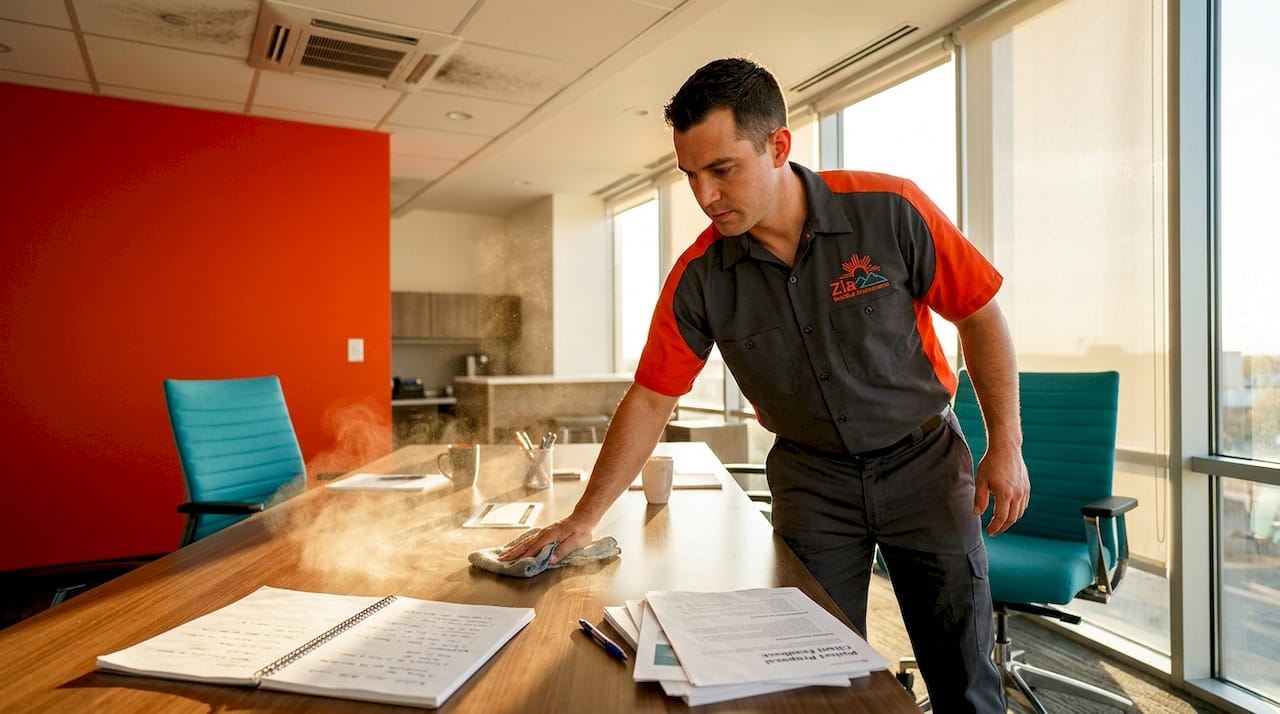
Dry dusting, for example, is one of the most common mistakes in office cleaning routines. When you wipe a surface with a dry cloth, you lift particles off the surface and send them airborne, where they stay suspended for hours. Your employees then breathe them in. HEPA-filter vacuuming traps fine particles rather than redistributing them, which is why equipment choice matters as much as cleaning frequency.
The same logic applies to disinfectants. Many commercial disinfectants release short-term irritant vapors that add chemical pollutants to the air. When you apply these products in a poorly ventilated space immediately after dusting, you are layering two types of irritants at once. Separating dust removal from disinfecting tasks is one of the most practical steps you can take to protect air quality during cleaning.
Pro Tip: Schedule dusting and vacuuming tasks at the end of the workday, then disinfecting surfaces during a separate session with windows open or HVAC running. This prevents particles and chemical vapors from peaking at the same time.
The interaction between cleaning and your HVAC system is also critical. HVAC maintenance lapses allow the system to redistribute contaminants throughout the building. Dirty filters, clogged ducts, and moisture buildup in HVAC components turn your ventilation system into a pollutant delivery mechanism. Cleaning the office without maintaining the HVAC is like mopping the floor with a dirty mop.
Ventilation, filtration, and building features
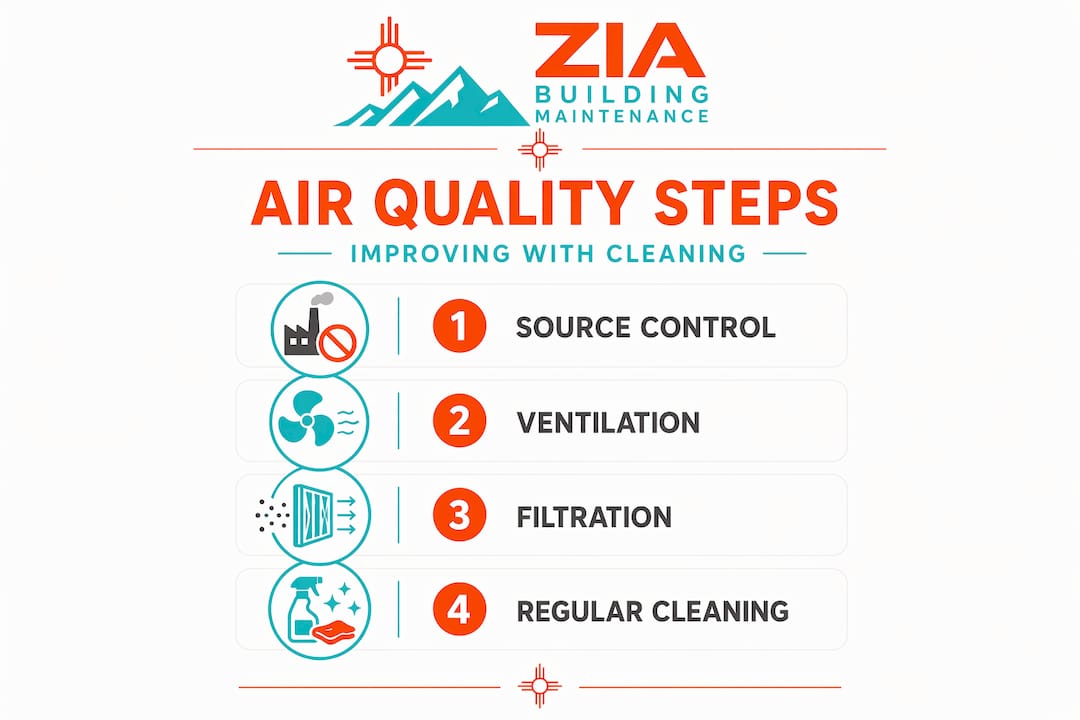
Cleaning is one part of the solution. The EPA describes a three-pronged IAQ management approach: source control, ventilation, and filtration. Cleaning addresses source control directly. But ventilation and filtration determine whether the pollutants you loosen during cleaning actually leave the building or just recirculate.
Carbon dioxide levels are a reliable indicator of ventilation effectiveness. Elevated CO2 between 800 and 1,000 ppm causes headaches, fatigue, and up to 30% reduced cognitive function in office workers. That is a measurable productivity loss tied directly to ventilation, not just to visible dirt.
Building design also plays a role. A study in Scientific Reports found that casement windows produce lower pollutant and humidity levels in naturally ventilated offices compared to projecting or louvered window types. While you may not be redesigning your office, this research confirms that building features influence how well cleaning efforts translate into actual air quality improvements.
The table below shows how source control, ventilation, and filtration work together:
| Strategy | What it does | Cleaning’s role |
|---|---|---|
| Source control | Removes or reduces pollutant origins | Dust removal, carpet cleaning, product selection |
| Ventilation | Dilutes and removes indoor pollutants | Coordinating cleaning with HVAC operation |
| Filtration | Captures airborne particles before recirculation | HEPA vacuuming, filter replacement schedules |
When your cleaning team and your HVAC maintenance team operate on separate schedules without coordination, you lose the benefit of all three strategies working together. Collaboration between those two functions is not optional if you want sustained air quality results.
Practical steps to improve air quality through cleaning
Improving the importance of office air quality starts with a structured approach. Here are the steps that make the most measurable difference:
- Schedule deep cleaning of carpets and upholstery regularly. These surfaces trap allergens, dust mites, and biological contaminants that standard vacuuming does not fully remove. For high-traffic offices, quarterly deep cleaning is a reasonable baseline.
- Switch to low-emission cleaning products. Look for products with low VOC content and avoid aerosol sprays in enclosed spaces. Many effective disinfectants are available in formulations that do not compromise air quality.
- Coordinate cleaning schedules with HVAC filter changes. Replace filters before a deep clean, not after. This prevents the HVAC system from pulling freshly disturbed particles back into circulation.
- Conduct moisture inspections during cleaning rounds. Mold grows fast in office environments with poor moisture control. Cleaning staff are often the first to notice early signs around windows, under sinks, and near HVAC vents.
- Install CO2 monitors in high-occupancy areas. Set a target threshold of 700 to 800 ppm and use readings to trigger ventilation adjustments. This gives you data to act on rather than guesswork.
- Educate employees about pollutant sources. Scented candles, personal air fresheners, and certain desk plants can contribute to VOC levels. A short communication to staff about these sources costs nothing and reduces the cleaning burden.
Pro Tip: For offices with more than 50 employees, consider cleaning frequency guidelines that separate high-touch surface disinfecting (daily) from deep dust and allergen removal (weekly or biweekly). Treating them as one task leads to both being done inadequately.
Common misconceptions that undermine air quality efforts
Several persistent misconceptions prevent office managers from getting real results, even when they invest in cleaning services.
The most common one is equating surface cleanliness with air quality. A desk can look spotless while the carpet beneath it holds months of accumulated allergens and the HVAC duct above it circulates mold spores. Surface appearance is not a reliable measure of what your employees are breathing.
A second misconception is that more disinfectant means cleaner air. Overuse of disinfectants introduces chemical irritants that worsen air quality, particularly in offices with limited ventilation. The goal is targeted application, not saturation.
Ignoring the HVAC system is another common oversight. Many managers invest in better cleaning products or more frequent cleaning visits, but never address the filters, coils, or drainage pans in their HVAC units. Contaminants redistributed by HVAC systems will undo cleaning efforts within hours of the cleaning crew leaving.
Finally, occupant involvement is often missing from air quality programs. Employees who notice musty smells, visible mold, or unusual odors are valuable early warning systems. Creating a simple reporting process and acting on feedback quickly prevents small problems from becoming major IAQ events. Collaborative action between building management and occupants is one of the most effective and least costly improvements you can make.
My perspective on cleaning as an air quality strategy
I’ve spent years working with office environments across different industries, and the pattern I see most often is this: managers treat cleaning as a cosmetic service and then wonder why employees keep getting sick or why focus seems low in the afternoons.
In my experience, the offices that see real improvements in wellness and productivity are the ones that treat cleaning as an operational health function. Not a luxury. Not a background task. A deliberate, scheduled, coordinated effort that accounts for what happens in the air, not just on the floor.
What I’ve learned from working alongside janitorial and HVAC teams is that the coordination gap between them is where most air quality problems live. The cleaning crew finishes at 10 PM. The HVAC filter hasn’t been changed in four months. By 9 AM, everything the crew cleaned the night before is partially redistributed. Closing that gap is where the real gains are.
I’ve also seen resistance from building owners who don’t want to invest in HEPA equipment or low-VOC products because the upfront cost is higher. But when you calculate reduced absenteeism and the productivity impact of reduced cognitive function from poor air quality, the math shifts quickly. Cleaning done right is not a cost center. It’s a health investment with a measurable return.
— Bernadette
How Zia Building Maintenance supports healthier office air quality
If you are ready to move beyond surface-level cleaning and address what your employees actually breathe, Zia Building Maintenance is built for exactly that. Since 1989, they have served offices across Albuquerque with tailored janitorial programs that account for dust control, low-emission product selection, and coordination with HVAC maintenance schedules.

Their team understands that shared office environments carry unique air quality risks, and their cleaning programs are designed to address those risks systematically. Whether your office needs routine upkeep or a thorough deep clean, Zia Building Maintenance customizes the approach to fit your space and occupancy. Rated the #1 office cleaning service in South Valley for 2025, they bring the consistency and attention to detail that air quality management requires. Contact Zia Building Maintenance today to request an estimate and build a cleaning plan that protects your team’s health from the ground up, and the air down.
FAQ
What makes office air quality a cleaning issue?
Cleaning directly controls the primary sources of indoor air pollutants, including dust, allergens, mold, and chemical residues. Without proper cleaning practices, these pollutants accumulate and circulate through the office air, affecting health and focus.
How does vacuuming technique affect air quality?
Using a vacuum with a HEPA filter traps fine particles instead of releasing them back into the air. Standard vacuums and dry dusting can re-aerosolize contaminants, temporarily worsening indoor air quality during the cleaning process.
Can cleaning products make office air quality worse?
Yes. Many disinfectants and aerosol cleaners release VOCs and short-term irritant vapors. Choosing low-emission products and separating disinfecting from dust removal tasks reduces the chemical load added to office air during cleaning.
How often should offices be cleaned to maintain good air quality?
High-touch surfaces benefit from daily disinfecting, while deep dust and allergen removal from carpets and upholstery should happen weekly or biweekly depending on occupancy. Larger offices should follow structured cleaning frequency guidelines tied to staff count and foot traffic.
Does HVAC maintenance count as part of office cleaning?
HVAC maintenance is a separate discipline, but it must be coordinated with cleaning schedules to be effective. Dirty filters and poorly maintained ducts redistribute contaminants that cleaning removes, making coordination between janitorial and HVAC teams critical for sustained air quality.