TL;DR:
- The commercial cleaning industry provides essential sanitation, maintenance, and specialized disinfection services for various facilities, regulated by OSHA, CDC, and ISSA standards. It is a highly fragmented, $112 billion U.S. market driven by outsourcing and hygiene awareness, with service quality hinging on workforce management and clear scope. Choosing a provider requires verifying certifications, understanding service scope, and emphasizing staff training for optimal health and operational compliance.
The commercial cleaning industry is defined as the professional sector providing cleaning, sanitation, and maintenance services to businesses, institutions, and commercial facilities. ISSA describes it as encompassing both routine janitorial tasks and specialized disinfection in higher-risk environments. Unlike residential cleaning, commercial work operates under stricter health and safety regulations, serves spaces with heavy foot traffic, and requires industrial-grade equipment and documented protocols. The U.S. market alone is projected to reach $112 billion in revenue in 2026, making it one of the most economically significant service sectors in the country.
What is the commercial cleaning industry and why does it matter?
The commercial cleaning industry covers professional cleaning services delivered to offices, medical facilities, schools, retail spaces, warehouses, and other non-residential properties. The sector goes well beyond appearance. ISSA emphasizes that commercial cleaning protects occupant health, supports regulatory compliance, and maintains operational excellence across facility types. A hospital that fails infection control standards faces liability. An office with inconsistent cleaning sees higher employee sick days. The stakes are real and measurable.
The industry operates under a recognized classification. IBISWorld categorizes it under NAICS code 56172 (Janitorial Services), which includes interior building cleaning, vehicle interior cleaning, and commercial window washing. This classification matters when you are writing contracts, sourcing vendors, or benchmarking costs against industry data. Knowing the correct terminology prevents procurement errors that cost facilities managers time and money.

Three organizations shape the standards and direction of this sector: ISSA (the worldwide cleaning industry association), OSHA (Occupational Safety and Health Administration), and the CDC (Centers for Disease Control and Prevention). Any provider worth hiring operates within frameworks set by all three. Zia Building Maintenance has built its service model around exactly these standards since 1989.
What services does the commercial cleaning industry provide?
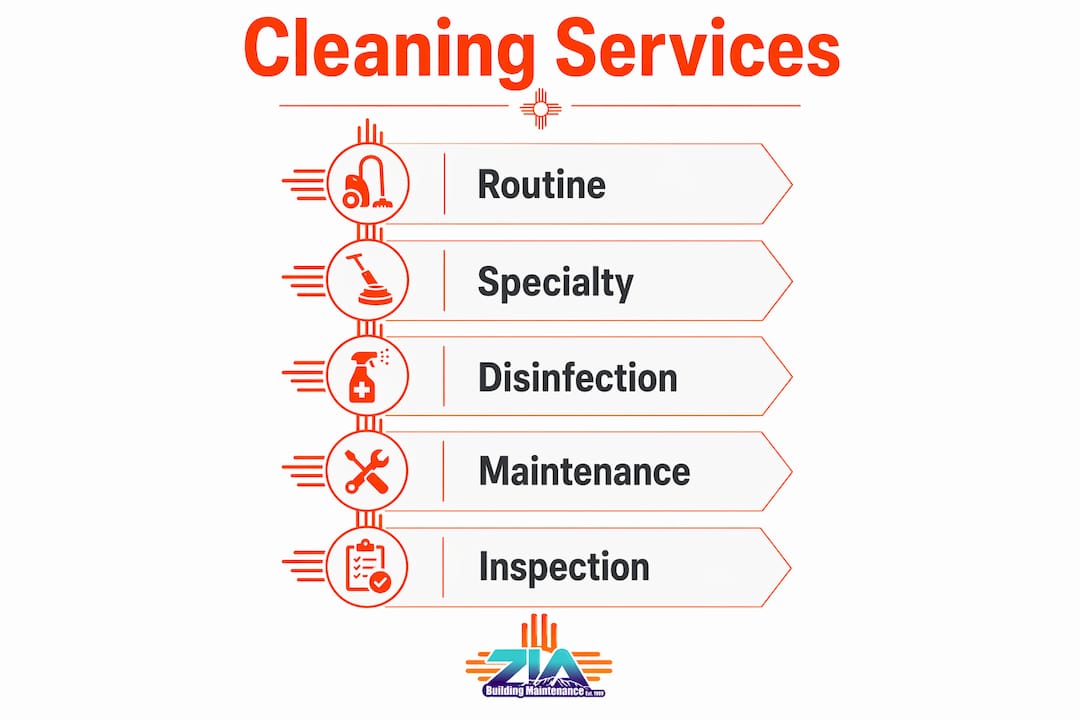
Commercial cleaning services span a wider range than most decision-makers initially expect. The core categories, as defined by ISSA, include:
- Routine janitorial services: Daily or weekly tasks such as dusting, vacuuming, trash removal, restroom sanitation, sweeping, and mopping. These form the backbone of any facility maintenance program.
- Floor care: Carpet extraction, hard floor stripping, buffing, waxing, and refinishing. High-traffic lobbies and corridors require scheduled floor care to prevent surface degradation.
- Specialty cleaning: Window washing, post-construction cleanup, pressure washing, and graffiti removal. These services require specialized equipment and trained technicians.
- Infection control and disinfection: Electrostatic spraying, ATP surface testing, and pathogen-specific protocols. Healthcare facilities, schools, and food-service environments rely on these services to meet regulatory requirements.
- Hazardous waste handling: Biohazard cleanup, chemical spill response, and sharps disposal. This category requires certified technicians and strict chain-of-custody documentation.
The right mix of services depends on building type, occupancy level, and industry-specific regulations. A medical clinic in Albuquerque has entirely different cleaning requirements than a law firm two blocks away. Providers like Zia Building Maintenance build customized cleaning plans that map service frequency and scope to each client’s actual operational needs.
Pro Tip: When evaluating a commercial cleaning proposal, ask the provider to separate routine janitorial tasks from specialty services in the pricing breakdown. Bundled quotes make it nearly impossible to compare providers or identify what you are actually paying for.
How does commercial cleaning differ from janitorial and residential cleaning?
Buyers consistently confuse these three categories, and the confusion leads to mismatched contracts. ISSA notes that many procurement teams conflate janitorial services with the full scope of commercial cleaning, resulting in RFPs that under-specify or over-specify service requirements. Understanding the distinctions protects your budget and your facility.
The table below outlines the key differences:
| Category | Scope | Scale and equipment | Regulatory requirements |
|---|---|---|---|
| Janitorial cleaning | Routine daily upkeep: trash, restrooms, floors | Standard commercial equipment | Basic OSHA compliance |
| Commercial cleaning | Full-spectrum: routine plus deep cleaning, specialty, and restoration | Industrial-grade and specialized equipment | OSHA, CDC, and facility-specific protocols |
| Residential cleaning | Home surfaces, general tidying | Consumer-grade tools | Minimal regulatory oversight |
Janitorial cleaning is a subset of commercial cleaning, not a synonym for it. A janitorial contract covers what happens every night after your staff goes home. Commercial cleaning covers what happens when the carpets need extraction, the windows need professional washing, or a biohazard event requires certified response. Zia Building Maintenance offers a detailed breakdown of janitorial versus commercial scope that helps facility managers write tighter contracts.
Residential cleaning differs from both in scale, liability, and equipment. A residential cleaner carries a mop bucket and a vacuum. A commercial provider operating in a 50,000-square-foot office building uses ride-on floor scrubbers, HEPA-filtered vacuums, and EPA-registered disinfectants. The workforce is also larger, more specialized, and subject to background screening and safety training requirements that residential services rarely match.
What industry standards and accreditations govern commercial cleaning?
Standards in commercial cleaning come from three primary sources: OSHA for worker safety, the CDC for public health and infection control guidance, and ISSA for industry-specific best practices and accreditation. Multi-layered standards integration across all three frameworks is what separates compliant, high-performance providers from budget operators cutting corners.
OSHA’s Hazard Communication Standard (HazCom) requires that cleaning staff receive training on every chemical they handle, with Safety Data Sheets (SDS) accessible on-site. Bloodborne pathogen standards apply directly to any provider working in healthcare or post-incident cleanup scenarios. Non-compliance exposes both the cleaning company and the facility owner to significant liability.
The CDC’s guidelines on environmental infection control are particularly relevant for healthcare facilities, schools, and food-service environments. These guidelines specify surface contact times for disinfectants, frequency of high-touch point cleaning, and protocols for outbreak response. Providers who follow CDC guidance reduce measurable infection risk for building occupants.
ISSA’s GBAC STAR accreditation is the most recognized infection prevention credential in the commercial cleaning sector. GBAC STAR requires providers to demonstrate documented cleaning procedures, trained staff, and verified infection control protocols. Facilities that require GBAC STAR from their cleaning vendors, including airports, convention centers, and hospitals, see measurable reductions in pathogen transmission risk.
Pro Tip: Before signing any commercial cleaning contract, ask the provider for proof of GBAC STAR accreditation or equivalent infection control certification. A provider who cannot produce documentation of their protocols is a liability risk, not just a service risk.
Quality inspections and workforce training round out the standards picture. The commercial cleaning methods a provider uses matter less than whether those methods are applied consistently by trained, supervised staff on every visit.
What is the market size and what challenges shape the industry?
The U.S. commercial cleaning market is large, growing, and structurally complex. IBISWorld projects $112 billion in industry revenue for 2026, supported by a 2.7% compound annual growth rate over the past five years. Two forces drive that growth: increased outsourcing of facility services by businesses seeking to reduce overhead, and heightened hygiene awareness following the COVID-19 pandemic.
“The commercial cleaning industry is contract-driven and highly fragmented, creating buyer challenges in choosing consistent quality providers.” — IBISWorld
The fragmented structure of the market creates real challenges for buyers. Thousands of small operators compete on price, which pushes down margins and creates pressure to cut labor costs. IBISWorld identifies workforce management as the single most important operational driver of service quality, more critical than the chemicals or equipment a provider uses. A cleaning company with strong hiring, training, and inspection systems will consistently outperform a larger competitor with poor workforce practices.
| Market indicator | 2026 figure |
|---|---|
| U.S. industry revenue | $112 billion |
| 5-year CAGR | 2.7% |
| Industry structure | Highly fragmented, contract-driven |
| Primary growth drivers | Outsourcing demand, hygiene awareness |
Technology adoption is reshaping how providers operate. AI-powered scheduling, quality inspection apps, and AI-enhanced client management tools are giving well-managed providers a competitive edge in responsiveness and accountability. Sustainability is also gaining traction, with clients increasingly specifying green-certified products and reduced-chemical protocols in their contracts.
Key takeaways
The commercial cleaning industry is a $112 billion sector where service quality depends on standards compliance, workforce management, and clearly defined contract scope.
| Point | Details |
|---|---|
| Industry definition | Commercial cleaning covers routine janitorial, specialty, and infection control services for business facilities. |
| Standards compliance | OSHA, CDC, and GBAC STAR accreditation define the minimum quality bar for credible providers. |
| Scope distinctions matter | Janitorial cleaning is a subset of commercial cleaning; conflating them leads to contract gaps. |
| Market scale | The U.S. market reaches $112 billion in 2026, driven by outsourcing and hygiene demand. |
| Workforce is the differentiator | Training and inspection practices determine service consistency more than equipment or chemicals. |
Why scope clarity is the most underrated decision in facility management
I have reviewed hundreds of commercial cleaning contracts over the years, and the single most common mistake I see is a facility manager signing a janitorial agreement when they actually need a full commercial cleaning program. The two are not interchangeable, and the gap between them shows up fast. You notice it when the carpets go six months without extraction, when the windows are never washed, or when a post-construction cleanup falls to your own staff because it was never in scope.
The second mistake is treating accreditation as a checkbox rather than a genuine quality signal. GBAC STAR is not marketing. It requires documented procedures, trained staff, and third-party verification. A provider who holds that credential has made a real operational commitment. One who cannot explain their infection control protocols has not.
What I find most interesting about this industry is how counterintuitive the quality drivers are. Buyers focus on price per square foot, product brands, and equipment lists. The research consistently shows that none of those factors predict service quality as reliably as how a company manages its workforce. Turnover, training hours, and inspection frequency are the numbers that actually matter. Ask for them before you sign.
The trend toward sustainability and technology is real, but do not let it distract from the fundamentals. Green-certified products and AI scheduling tools add value only when the underlying service model is sound. Start with standards, scope, and workforce. Everything else is secondary.
— Ashley
Find the right commercial cleaning partner for your facility
Choosing a commercial cleaning provider is a procurement decision with direct consequences for occupant health, regulatory compliance, and your facility’s professional image. Zia Building Maintenance has served offices, medical facilities, and schools across Albuquerque since 1989, building a reputation as the #1 office cleaning service in South Valley for 2025.
Whether you manage a single office or a multi-building campus, the right starting point is understanding what your facility actually needs. Zia Building Maintenance offers expert cleaning strategies tailored to your building type, occupancy level, and compliance requirements. You can also use the contract checklist for managers to define scope, frequency, and accountability standards before you sign anything. Contact Zia Building Maintenance to request an estimate and see what a properly scoped cleaning program looks like for your facility.
FAQ
What is the commercial cleaning industry?
The commercial cleaning industry is the professional sector that provides cleaning, sanitation, and maintenance services to businesses, institutions, and commercial properties. It includes routine janitorial work, specialty cleaning, and infection control services governed by OSHA, CDC, and ISSA standards.
How is commercial cleaning different from janitorial services?
Janitorial services cover routine daily upkeep such as trash removal, restroom cleaning, and floor mopping. Commercial cleaning is the broader category that also includes deep cleaning, floor restoration, window washing, post-construction cleanup, and hazardous waste handling.
What standards do commercial cleaning companies follow?
Credible commercial cleaning providers operate under OSHA’s Hazard Communication and bloodborne pathogen standards, CDC infection control guidelines, and ISSA’s GBAC STAR accreditation framework for infection prevention.
How large is the commercial cleaning market in the U.S.?
The U.S. janitorial and commercial cleaning market is projected to reach $112 billion in revenue in 2026, with a 2.7% compound annual growth rate driven by outsourcing demand and increased hygiene awareness.
What should I look for when choosing a commercial cleaning provider?
Verify GBAC STAR accreditation or equivalent infection control credentials, ask for a detailed scope breakdown separating routine from specialty services, and request information on workforce training and quality inspection practices before signing a contract.