

TL;DR:
- A bonded cleaning company holds a surety bond that protects clients against employee theft and dishonesty. This bond works alongside insurance but does not cover accidents or property damage, which are protected separately. Verifying the bond certificate before hiring ensures proper coverage and reduces financial risks.
A bonded cleaning company is defined as one that holds a janitorial surety bond, a financial guarantee that protects clients if an employee steals or acts dishonestly during a cleaning visit. This bond is not the same as insurance. It fills a specific gap that standard insurance policies leave open. Understanding what does bonded cleaning company mean gives you the knowledge to hire cleaning services with real confidence, not just hope.
What does a bonded cleaning company mean?
A bonded cleaning company holds a janitorial surety bond that typically covers client losses from employee theft or dishonesty, with coverage ranging from $5,000 to $25,000. That range reflects the variety of job sizes, from small residential visits to large commercial contracts. The bond costs the cleaning company roughly $100–$300 per year, which is a modest expense relative to the protection it provides clients.

The term “bonded” comes from the surety bond industry, where a third party (the bond company) guarantees payment if the cleaning company’s employee causes a covered loss. Clients benefit directly from this arrangement. If a cleaner steals a laptop or jewelry during a job, the bond company compensates the client up to the bond limit.
Pro Tip: Ask for the bond certificate on your first call, not after you sign a contract. A legitimate company will send it without hesitation.
How does a janitorial surety bond work?
The janitorial surety bond is not insurance for the business. It is a financial guarantee that runs in favor of the client. When a covered theft occurs, the bond company pays the client’s claim. The cleaning company then owes that money back to the bond company.
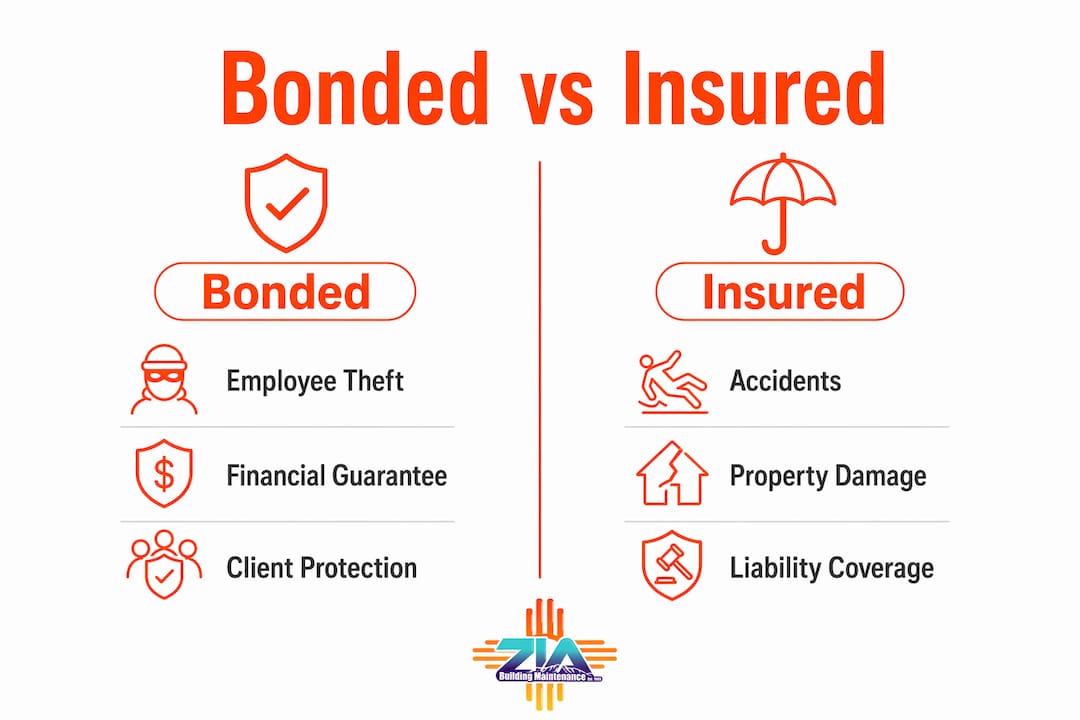
That reimbursement obligation is the key mechanic most clients miss. The cleaning business owner remains financially liable after the bond pays. This structure gives bond companies a strong incentive to vet the cleaning companies they bond, and it gives cleaning companies a strong incentive to vet their employees.
Common scenarios a janitorial bond covers include:
- An employee pockets cash left on a desk during a scheduled office clean.
- A cleaner removes a piece of jewelry from a residential bathroom.
- A worker takes small electronics from an unlocked drawer in a medical office.
- A team member removes tools from a storage room during a facility clean.
What a bond does not cover is equally important. Accidental property damage, slip-and-fall injuries, and chemical spills are not bond claims. Those fall under insurance, which is a separate product entirely.
Pro Tip: Bond coverage limits reset after a claim is paid, but the cleaning company’s premium often rises. Ask your provider whether a prior claim history exists before signing a long-term contract.
What is the difference between bonded and insured cleaning?
Bonding and insurance protect different parties against different risks. Clients often assume that “insured” covers everything, including theft. That assumption creates real financial exposure.
General Liability insurance covers accidents and property damage that happen during cleaning, such as a broken window or a slip on a wet floor. Workers’ Compensation covers the cleaning company’s employees if they are injured on the job. Neither of these policies covers client property theft by a cleaning employee. Most cleaning business insurance policies explicitly exclude employee theft, which is exactly why a separate bond is necessary.
The “Care, Custody, and Control” exclusion in standard General Liability policies removes coverage for damage or theft of client property while it is in the possession of cleaning staff. This exclusion creates a coverage gap that only a janitorial bond fills.
| Protection type | What it covers | What it excludes |
|---|---|---|
| Janitorial surety bond | Employee theft, dishonesty, client property loss | Accidents, injuries, property damage |
| General Liability insurance | Accidents, property damage during cleaning | Employee theft, Care, Custody, and Control losses |
| Workers’ Compensation | Employee injuries on the job | Client losses of any kind |
Pro Tip: Always request proof of both bonding and General Liability insurance before a cleaner enters your building. One without the other leaves a meaningful gap in your protection.
Carrying both bonding and insurance is the industry standard for professional cleaning companies. A company that carries only one is not fully covered from your perspective as a client. General Liability costs can range from $500 to $25,000 annually depending on company size, while bond premiums stay far lower at $100–$300 per year. The cost difference is not a reason to skip either product.
Why does hiring a bonded cleaning company matter?
Bonding builds trust in a practical, documented way. When a cleaning company carries a janitorial bond, it signals that a third party has reviewed the business and agreed to back it financially. That review process alone filters out the least credible operators.
Many commercial clients require proof of both a janitorial surety bond and insurance before signing a cleaning service contract. Offices, medical facilities, retail locations, and schools routinely ask for this documentation. If a cleaning company cannot produce it, the contract does not move forward.
The practical benefits of hiring a bonded company include:
- Financial reimbursement if an employee steals from your property.
- A documented accountability structure between the cleaning company and a bond issuer.
- Confidence that the company has passed at least a basic level of third-party review.
- A clear claims process if a theft incident occurs, rather than a dispute with no resolution path.
- Alignment with the requirements of most commercial lease agreements and facility management standards.
Bonding is a financial safety net, not a theft prevention tool. It does not stop a dishonest employee from stealing. It compensates you after the fact. This distinction matters because clients who rely solely on bonding as a security measure miss the more important step: choosing a company that screens its employees thoroughly. Background checks and employee vetting complement bonding by reducing the probability of theft in the first place. You can read more about what separates trustworthy providers in this guide to professional janitorial services.
How do you verify that a cleaning company is truly bonded?
Saying “we are bonded” costs a company nothing. Proving it requires documentation. Clients who skip the verification step take on risk they believe they have transferred.
Follow these steps to confirm a cleaning company’s bond before signing any agreement:
- Request the bond certificate. Ask for it in writing before the first cleaning visit. The certificate lists the bond company, coverage amount, and expiration date.
- Confirm the bond amount matches your job scope. Typical bond amounts for residential or small commercial jobs range from $10,000 to $25,000. Larger contracts may require higher limits.
- Check the bond issuer’s legitimacy. The bond company should be a recognized surety provider licensed in your state. A quick search of your state’s Department of Insurance database confirms this.
- Verify the expiration date. Bonds renew annually. An expired bond offers no protection. Ask for updated documentation at each contract renewal.
- Request proof of insurance alongside the bond. A legitimate cleaning company provides both documents without delay. Receiving only one is a warning sign.
- Ask whether the bond amount matches the contract value. Bond amounts vary, and clients should confirm the bond value covers the scope and risk of their specific contract.
A thorough commercial cleaning contract checklist includes bond verification as a standard step, not an optional one. Treat it the same way you treat verifying a contractor’s license.
Pro Tip: If a cleaning company hesitates or delays when you ask for bond documentation, that hesitation is your answer. Move on.
Key Takeaways
A bonded cleaning company holds a janitorial surety bond that financially protects clients against employee theft, and this bond works alongside, not instead of, General Liability insurance and Workers’ Compensation.
| Point | Details |
|---|---|
| Bond definition | A janitorial surety bond covers client losses from employee theft, ranging from $5,000 to $25,000. |
| Bond vs. insurance | Bonding covers theft; General Liability covers accidents. Both are needed for full client protection. |
| Verification matters | Always request the bond certificate, confirm the amount, and check the expiration date before signing. |
| Bond is not prevention | Bonding compensates after theft occurs; employee background checks reduce the risk before it happens. |
| Commercial standard | Most offices, medical facilities, and schools require proof of bonding before awarding cleaning contracts. |
Why bonding alone is not the whole story
Clients often ask me whether a bonded company is automatically a safe company. My honest answer is: not automatically, but it is a meaningful filter.
The bond tells you that a surety company reviewed the cleaning business and agreed to back it financially. That review is not exhaustive, but it is not nothing either. What the bond does not tell you is whether the company runs background checks on every hire, whether it has a low turnover rate, or whether its supervisors actually monitor job sites. Those factors matter more to day-to-day safety than the bond itself.
The misconception I see most often is clients treating “bonded and insured” as a single phrase that covers everything. It does not. Insurance and bonding are separate products covering separate risks. A company can carry a $1 million General Liability policy and still leave you completely exposed to employee theft if it has no bond. The reverse is also true.
My recommendation is to use bonding as a baseline requirement, not a final check. Combine it with a direct question about the company’s hiring and background screening process. Ask how long the average employee has been with the company. High turnover in cleaning is common, and it correlates with higher risk. A company like Zia Building Maintenance, which has operated in Albuquerque since 1989, carries the kind of institutional knowledge and staff stability that a bond certificate alone cannot capture.
— Ashley
Zia Building Maintenance: bonded, insured, and ready to serve
Zia Building Maintenance has provided bonded and insured commercial cleaning services in Albuquerque since 1989. Every client receives the documentation they need before a single cleaner walks through the door.
Offices, medical facilities, and schools across the South Valley trust Zia Building Maintenance because the company combines industry-standard bonding and insurance with thorough employee vetting. That combination is what turns a cleaning contract into a genuine partnership. If you want to understand how professional janitorial services save businesses money while keeping your property protected, Zia Building Maintenance is ready to walk you through the details. Contact the team today to request your certificate of bonding and insurance before your first service visit.
FAQ
What does bonded mean for a cleaning company?
A bonded cleaning company holds a janitorial surety bond that pays clients if an employee steals or acts dishonestly during a cleaning job. The bond company pays the client first, then seeks reimbursement from the cleaning business.
What is the difference between bonded and insured cleaning?
Bonding covers client losses from employee theft, while General Liability insurance covers accidents and property damage during cleaning. Most insurance policies exclude employee theft, making both products necessary for full protection.
How much does a janitorial bond typically cover?
Janitorial bonds typically cover between $5,000 and $25,000 per claim, with higher limits available for larger commercial contracts. Clients should confirm the bond amount matches the scope of their specific job before signing.
How do I verify a cleaning company is bonded?
Request the bond certificate directly and confirm the issuer, coverage amount, and expiration date. A legitimate company provides this documentation immediately and without hesitation.
Does bonding prevent employee theft?
Bonding does not prevent theft. It compensates clients after theft occurs. Employee background checks and active supervision are the tools that reduce the risk of theft before it happens.