TL;DR:
- Green cleaning in offices uses non-toxic, biodegradable products and health-focused practices to maintain sanitation safely. It requires certified products, trained staff, and documented management systems for effective implementation. Proper green cleaning improves indoor air quality, reduces sick days, and extends asset lifespan.
Green cleaning in an office setting is defined as the use of non-toxic, low-VOC, biodegradable products and health-focused practices that maintain effective sanitation without exposing employees to harmful chemicals. The industry standard term is “sustainable cleaning,” though “green cleaning” is the phrase most office managers search for and recognize. This guide covers what qualifies as a green cleaning product, how eco-friendly office cleaning affects employee health and productivity, which certification standards matter, and how to implement a green cleaning program that actually works. Whether you manage a single-floor office or a multi-building campus, the decisions you make about cleaning products and practices directly affect the air your team breathes every day.
What is green cleaning in an office environment?
Green office cleaning is a systematic approach that replaces conventional chemical-heavy janitorial products with certified safer alternatives while also improving cleaning processes, equipment, and staff training. The green office cleaning definition goes beyond swapping one bottle for another. It covers the entire cleaning operation, from the formulas used on floors to the filtration in vacuums to the training custodial staff receive.
The three most recognized frameworks for green cleaning in commercial spaces are Green Seal, the EPA Safer Choice program, and LEED (Leadership in Energy and Environmental Design). Green Seal certifies both products and cleaning service providers. The EPA Safer Choice label confirms that every ingredient in a product meets safety standards for human health and aquatic ecosystems. LEED credits reward buildings that use certified products and certified service providers as part of their overall sustainability score.
True green cleaning encompasses non-toxic chemicals, energy-efficient equipment, staff training, and indoor air quality tracking. That definition matters because it rules out the shortcut of simply buying a product labeled “natural” and calling it done.
What qualifies as green cleaning products for offices?
Green cleaning products for offices share three core characteristics: low or zero VOC content, biodegradable ingredients, and third-party certification from a recognized body. VOCs (volatile organic compounds) are the chemicals that off-gas from conventional cleaners and accumulate in indoor air. Reducing them is the fastest way to improve air quality in a closed office environment.
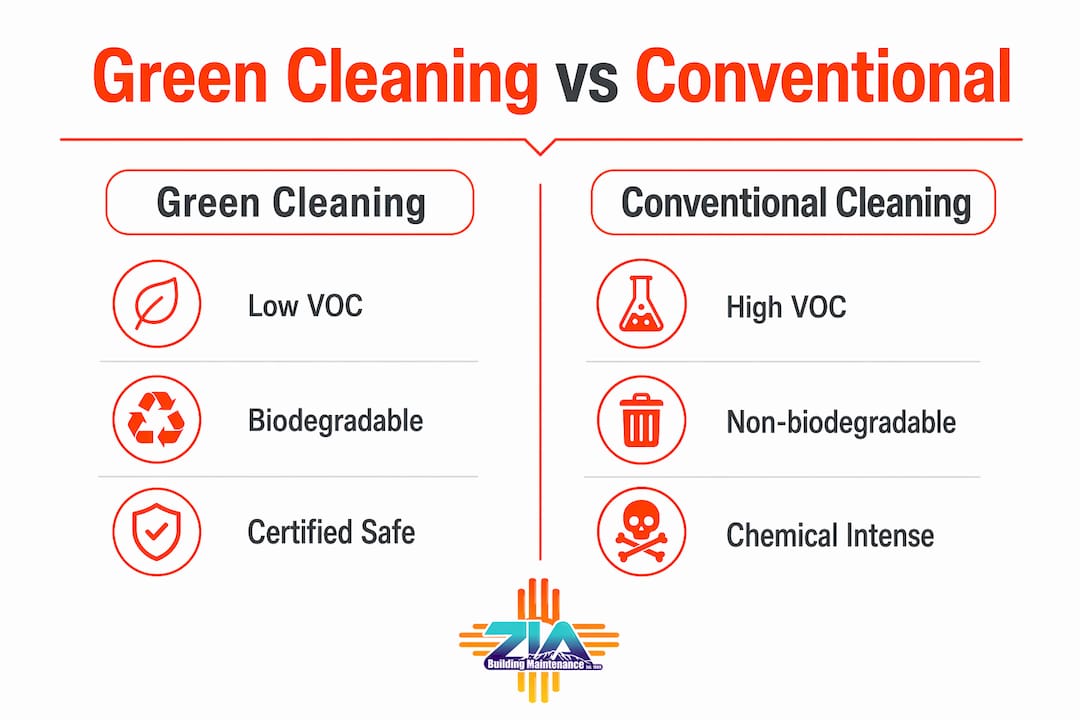
The two certifications that carry the most weight are Green Seal GS-37 (for cleaning and degreasing products) and the EPA Safer Choice label. Green Seal GS-37 sets limits on VOC content, prohibits specific toxic ingredients, and requires biodegradability testing. The EPA Safer Choice program warns against vague marketing terms like “eco-safe” or “natural,” which are unregulated and unreliable. Only third-party labels from recognized bodies provide meaningful assurance.
Disinfection is a specific challenge within green cleaning. Not every surface in an office needs to be disinfected daily. Restrooms, shared touchpoints like door handles and elevator buttons, and kitchen surfaces are the priority zones. General work surfaces typically need cleaning, not disinfection. Using EPA-registered disinfectants only where the risk justifies it reduces chemical load without sacrificing hygiene.
- Low or zero VOC formulas: Look for products with VOC content below 3% by weight for general cleaners.
- Biodegradable surfactants: Plant-derived surfactants break down in wastewater without harming aquatic life.
- Green Seal GS-37 or EPA Safer Choice certification: These labels confirm independent testing, not just manufacturer claims.
- Concentrated formats: Concentrated products reduce packaging waste and lower transportation emissions per use.
- pH-neutral floor cleaners: Neutral pH protects floor finishes and reduces the need for stripping and recoating.
Pro Tip: Before purchasing any product marketed as “green,” search its name in the EPA Safer Choice product database or the Green Seal certified products list. Both are publicly searchable and free to use.
How does green cleaning improve office health and employee productivity?
The health case for eco-friendly office cleaning is well documented. Workplaces with green cleaning report 23% fewer sick days and 40% reduced respiratory complaints. That reduction traces directly to lower chemical exposure and better indoor air quality. Fewer sick days means less disruption to projects, fewer coverage gaps, and lower costs from absenteeism.
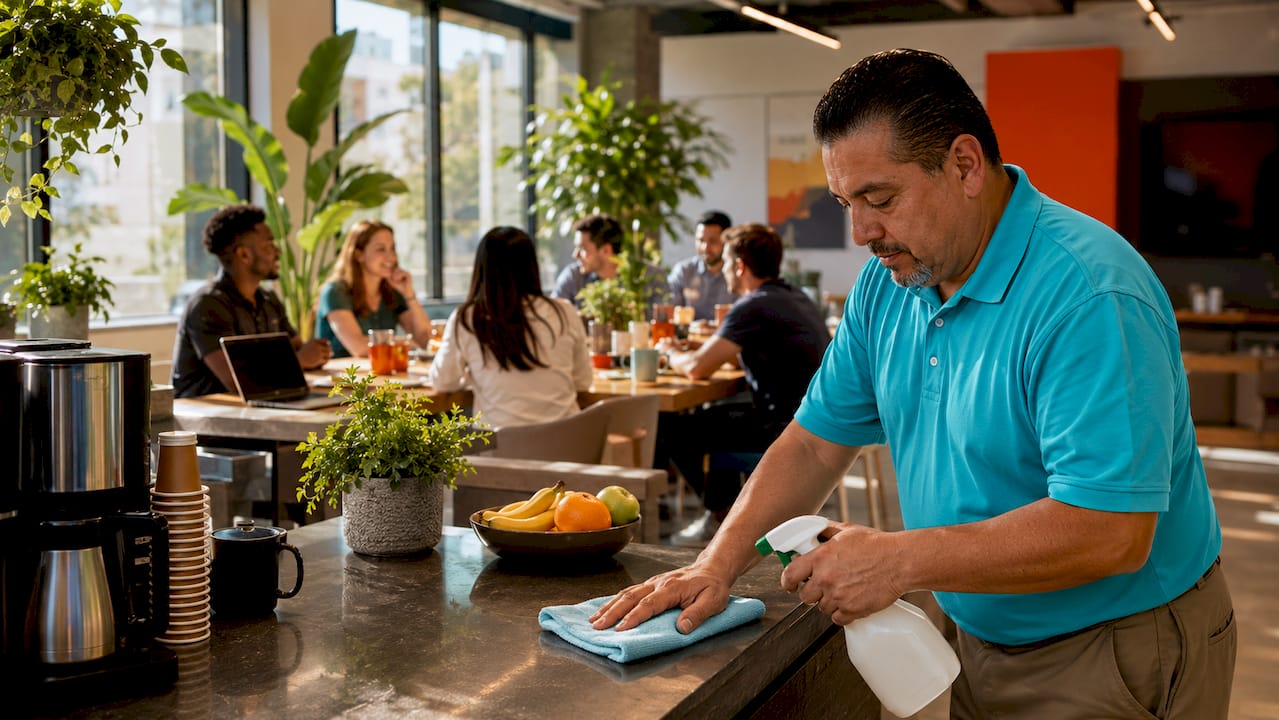
Indoor air quality improves up to 85% when VOCs and harsh chemicals are removed from the cleaning program. That figure reflects the cumulative effect of switching to low-VOC products, using HEPA-filtered vacuums, and reducing the frequency of chemical disinfection on low-risk surfaces. HEPA filters remove 99.97% of airborne allergens including pollen and dust mites. For offices with employees who have asthma or seasonal allergies, HEPA filtration alone produces a measurable difference in comfort and attendance.
The productivity connection is equally strong. Employees in green-certified offices scored up to 26% higher on cognitive function tests compared to those in conventionally cleaned buildings. Better air quality supports concentration, decision-making, and sustained focus throughout the workday.
The specific benefits that office managers see most consistently include:
- Fewer employee complaints about headaches, eye irritation, and respiratory discomfort
- Reduced allergen load from dust mites, mold spores, and pollen captured by HEPA vacuums
- Lower absenteeism tied to cleaning-related chemical sensitivities
- Improved air quality scores when offices track indoor environment metrics
- Stronger employee satisfaction scores related to workplace comfort and safety
The connection between office air quality and cleaning practices is direct. Every product applied to a surface either adds to or subtracts from the chemical burden in the air your team breathes.
What operational practices support effective green cleaning?
Switching products is the starting point, not the finish line. Effective green cleaning requires trained staff, the right equipment, and a documented process. Green cleaning as a comprehensive program includes management systems, not just product substitutions. The Green Seal GS-42 standard and the CIMS-GB (Cleaning Industry Management Standard Green Building) certification both address how cleaning operations are managed, documented, and audited.
Staff training is the variable that most office managers underestimate. Investing in trained custodial staff reduces turnover and can contribute to up to $200 billion in annual productivity gains across the commercial cleaning sector. Trained staff dilute products correctly, use equipment properly, and apply disinfectants only where needed. Undertrained staff often over-apply chemicals, which wastes product and increases chemical exposure.
The operational steps that define a mature green cleaning program follow a clear sequence:
- Audit current products and processes. Identify which products contain high-VOC or restricted ingredients and which cleaning tasks are over-chemicalized.
- Switch to certified products. Replace conventional cleaners with Green Seal GS-37 or EPA Safer Choice certified alternatives in each product category.
- Upgrade equipment. Introduce HEPA-filtered vacuums and microfiber cloths. Microfiber removes more soil with less chemical than conventional cotton mops and cloths.
- Train all custodial staff. Cover correct dilution ratios, surface-specific product selection, and targeted disinfection protocols.
- Document and track. Use a management system aligned with GS-42 or CIMS-GB to record product use, training completion, and air quality measurements.
- Review and adjust quarterly. Green cleaning programs improve over time when managers track outcomes and adjust protocols based on real data.
Pro Tip: Microfiber cloths and mop heads should be laundered at lower temperatures to preserve fiber integrity and reduce energy use. Optimized laundering temperatures are one of the process changes that reduce environmental footprint beyond product switching alone.
The role of staff training in commercial cleaning outcomes cannot be separated from product selection. Both elements must work together for the program to deliver consistent results.
How does green cleaning support sustainability goals and protect office assets?
Green cleaning contributes directly to LEED certification credits, which matter for office buildings pursuing or maintaining green building status. LEED v5 requires 75% use of Green Seal-certified products and GS-42 certified service providers for a 5% credit allocation. Seven product categories are specified, including general cleaners, floor care products, paints, and trash bags. For organizations with sustainability reporting requirements, those credits translate into measurable progress toward environmental goals.
Process redesign delivers sustainability gains that product switching alone cannot. Systemic changes like optimized chemical dosing and lower laundering temperatures can reduce global warming potential by up to 47.7%. That figure reflects lifecycle analysis across the full cleaning operation, not just the product formula. Concentrated products in refillable packaging further reduce plastic waste and transportation emissions per cleaning cycle.
The table below compares the environmental and asset-protection outcomes of conventional versus green cleaning approaches:
| Factor | Conventional cleaning | Green cleaning |
|---|---|---|
| VOC emissions | High; off-gassing from solvents and fragrances | Low to zero; certified formulas limit VOC content |
| Floor finish lifespan | Shortened by harsh alkaline strippers | Extended by pH-neutral cleaners that preserve coatings |
| Furniture and hardware | Accelerated wear from corrosive chemicals | Protected by gentler, biodegradable formulas |
| Wastewater impact | Chemical runoff harms aquatic ecosystems | Biodegradable ingredients break down safely |
| Packaging waste | Single-use containers per product | Concentrated refillable formats reduce plastic volume |
Asset preservation is an underappreciated benefit of green cleaning. pH-neutral floor cleaners extend the life of tile, hardwood, and vinyl coatings by avoiding the chemical degradation that alkaline strippers cause over time. Furniture finishes, metal hardware, and glass surfaces all last longer when cleaned with gentler certified formulas. For office managers tracking facility maintenance budgets, those savings accumulate across every cleaning cycle. Federal facility managers have recognized this connection, with GSA green building investments demonstrating that sustainable procurement extends asset life while reducing operating costs.
Key Takeaways
Green cleaning in offices is a documented, certified program that improves employee health, extends asset life, and supports sustainability goals through product selection, equipment upgrades, and trained staff working together.
| Point | Details |
|---|---|
| Green cleaning is a program, not a product swap | Effective implementation requires certified products, HEPA equipment, staff training, and documented processes. |
| Certifications that matter | Green Seal GS-37, EPA Safer Choice, GS-42, and CIMS-GB are the recognized standards for products and service providers. |
| Health outcomes are measurable | Green cleaning workplaces report 23% fewer sick days and up to 85% improvement in indoor air quality. |
| Sustainability gains require process changes | Optimized dosing and laundering practices reduce global warming potential by up to 47.7%, beyond product switching alone. |
| Asset protection adds financial value | pH-neutral and biodegradable formulas extend floor, furniture, and hardware lifespan, reducing maintenance costs over time. |
What I’ve learned after years of watching green cleaning programs succeed and fail
The most common mistake office managers make is treating green cleaning as a purchasing decision rather than an operational one. They approve a list of certified products, hand it to the cleaning crew, and assume the work is done. Six months later, the products are correct but the outcomes are not. Air quality has not improved. Employees still complain about headaches. The floors look dull.
The reason is almost always training. Products applied at the wrong dilution, with the wrong equipment, on the wrong surfaces, do not perform as designed. A certified product used incorrectly is no better than a conventional one. The GS-42 management standard exists precisely because the industry recognized that product certification alone does not guarantee results.
The second mistake is ignoring greenwashing. The EPA is direct on this point: vague terms like “eco-safe,” “plant-based,” and “biodegradable” on a label mean nothing without third-party verification. I have seen offices spend more money on unverified “green” products than they would have spent on properly certified ones, with no health or environmental benefit to show for it. Always verify against the EPA Safer Choice database or the Green Seal certified products list before approving a product.
The third mistake is skipping measurement. You cannot manage what you do not track. Indoor air quality monitors, employee absence records, and product usage logs are the tools that tell you whether your green cleaning program is working. The offices that see the strongest results treat green cleaning as a continuous improvement process, not a one-time initiative. That mindset is what separates programs that deliver real change from those that just look good on paper.
— Ashley
Zia Building Maintenance brings certified green cleaning to Albuquerque offices
Zia Building Maintenance has served commercial clients in Albuquerque since 1989, and green-certified cleaning is a core part of how the team operates. Every cleaning plan uses products that meet recognized certification standards, and custodial staff receive training on correct application, targeted disinfection, and equipment care.
Office managers who want a cleaner, healthier workspace without the guesswork of building a green program from scratch can rely on Zia Building Maintenance’s proven approach. The team’s professional office cleaning services cover everything from routine maintenance to deep cleaning, all aligned with the health and sustainability standards that matter most to your team and your building. Request an estimate today and see why Zia Building Maintenance earned the title of the #1 office cleaning service in South Valley for 2025.
FAQ
What is the green office cleaning definition?
Green office cleaning is the use of non-toxic, low-VOC, biodegradable products and health-focused cleaning practices that maintain effective sanitation without exposing employees to harmful chemicals. It also includes certified equipment, trained staff, and documented management systems.
What is green cleaning certification for offices?
Green cleaning certification refers to third-party standards like Green Seal GS-37 for products, GS-42 for cleaning service management, EPA Safer Choice for ingredient safety, and CIMS-GB for overall cleaning program quality. These certifications confirm independent testing and compliance, not just manufacturer claims.
How do I implement a green cleaning program in my office?
Start by auditing current products and identifying high-VOC or restricted-ingredient cleaners. Replace them with Green Seal GS-37 or EPA Safer Choice certified alternatives, upgrade to HEPA-filtered vacuums and microfiber tools, train all custodial staff, and track outcomes quarterly using air quality and absenteeism data.
Do green cleaning products work as well as conventional cleaners?
Certified green cleaning products meet the same soil-removal and disinfection performance standards as conventional products. The difference is that they achieve those results without the VOCs, harsh solvents, and synthetic fragrances that degrade indoor air quality and irritate employees.
How does green cleaning connect to LEED certification?
LEED v5 awards credit points when a building uses Green Seal-certified products for at least 75% of its cleaning purchases and employs a GS-42 certified service provider. Those credits contribute directly to a building’s overall LEED score and sustainability reporting metrics.